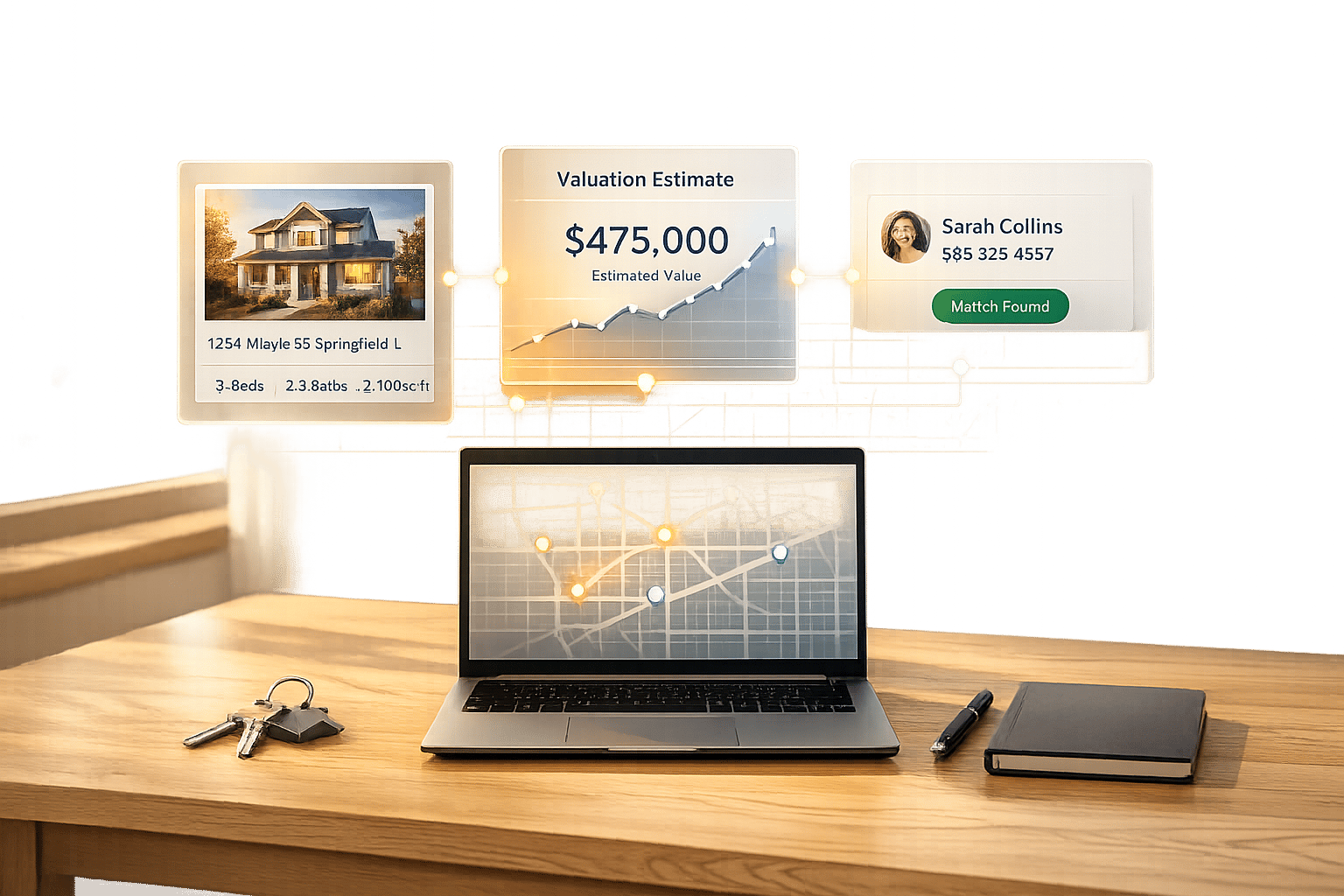
Finding a property owner's contact information is the single most critical step in any real estate transaction, and the most effective methods boil down to three options: manually searching public records, using investigative skip tracing, or leveraging a real estate data platform. While manually digging through county records is the foundational method, modern data platforms provide verified owner contact details in seconds, a process that once took days. This efficiency is no longer a luxury; it is a requirement for competitive deal-making.
The core solution is data aggregation. Platforms now compile over 155 million U.S. property records, creating a comprehensive, searchable map of the entire national real estate landscape. These records are pulled from thousands of sources—county tax assessors, recorder's offices, and state revenue departments—turning what was once a weeks-long manual task into an instant search.
- Key Finding 1: Data platforms offer a 95%+ improvement in speed and accessibility over traditional methods.
- Key Finding 2: Skip tracing is the fastest way to get direct contact info (phone, email) when public records only provide a name.
- Key Finding 3: Legal compliance, specifically adhering to the TCPA and DNC registry, is non-negotiable and must be integrated into your workflow.
This guide provides a direct, no-fluff breakdown of the exact methods used by top real estate professionals to find and contact property owners at scale.
What Are the Core Methods for Finding Property Owners?
Identifying a property owner once meant spending days at a county courthouse reviewing physical deeds and tax ledgers. Today, the same information is accessible in minutes from a computer. The modern workflow combines traditional record-checking with high-speed data technology to create a complete picture of ownership and contact information.
The process is straightforward: an initial search of public records can be enhanced with skip tracing to obtain contact details, and the entire workflow is streamlined at scale by data platforms. If your search extends to commercial properties, this guide on finding property manager emails offers parallel strategies.
Modern vs. Traditional Search Methods
The primary differences between modern and traditional search methods are speed, cost, and data depth.
| Feature | Data Platforms (Modern) | Public Records (Traditional) |
|---|---|---|
| Speed | Instant to Minutes | Hours to Days |
| Data Richness | High (ownership, verified contacts, financials, property data) | Low (owner name, mailing address only) |
| Cost Per Record | Low (typically $0.08 – $0.15 for bulk) | High (factoring in time/labor, potential document fees) |
| Primary Use Case | Scalable prospecting, marketing, API integration | One-off searches, legal verification, historical research |
While traditional methods remain essential for legal verification, modern platforms provide the speed and intelligence required to operate effectively in the current market.
How Do You Use Public Records to Find Owners?
Public records are the absolute ground truth for property ownership. The foundational skill for any real estate professional is navigating these government databases, as all other data sources are built upon this information.
Your search begins at the county assessor’s website. This office values property for tax purposes and maintains a public database. Searching a property address here will yield the current owner's name and the Assessor’s Parcel Number (APN). The APN is a unique identifier for the property that unlocks all other records.
With the APN and owner's name, you proceed to the county recorder’s or clerk’s office website, where the official document trail is stored.
Unpacking Deeds and Tax Records
The critical data is found within two documents: the deed and the tax record.
A deed is the legal instrument that transfers ownership. The most recent deed confirms the owner's legal name and reveals how they hold the title—as an individual, a married couple, an LLC, or a trust. This detail is crucial.
Tax records, typically linked from the assessor's site, contain the mailing address for the tax bill. If this address differs from the property address, you have identified an absentee owner, which is a high-value lead for most investors.
Key Public Record Sources and What They Reveal
Different government offices hold specific pieces of the ownership puzzle. Knowing precisely where to look is half the battle.
| Record Source | Information Found | Typical Access Method |
|---|---|---|
| County Assessor | Current owner name, APN, property characteristics, tax mailing address. | Free online search portal on the county website. |
| County Recorder/Clerk | Deeds, mortgages, liens, easements, title transfer history. | Online search portal (may require a fee per document). |
| Tax Collector | Payment status, tax amount, delinquency records, tax sale info. | Free online search portal on the county website. |
| GIS Mapping System | Parcel boundaries, zoning information, neighborhood data. | Interactive map on a county or city government website. |
Specialized firms now use automated crawlers to aggregate this data from thousands of county websites, a process detailed in this overview of how real estate data is collected from public sources. This technological shift represents a 95%+ improvement in accessibility and speed compared to pre-2010 methods. Understanding this manual process is critical, as it allows you to verify the accuracy of data obtained from any platform.
How Do You Use Advanced Skip Tracing?
Public records often lead to a dead end: a name with no phone number or an anonymous LLC. Skip tracing is the investigative process used to bridge this gap by locating an individual whose contact information is not publicly listed.
Modern skip tracing platforms connect a property address to a person. You input known information (name, address), and the system queries dozens of private and public databases to retrieve phone numbers, email addresses, and occasionally social media profiles.

The Mechanics of a Skip Trace
Skip tracing is data aggregation at scale, not magic. These platforms query a network of non-public data sources, including:
- Credit Bureau Headers: Non-sensitive identifying information from credit reports, providing current/past addresses and phone numbers.
- Utility Records: Gas, electric, and water billing records that link a name to a service address.
- Aggregated Public Records: Standardized and instantly searchable nationwide public records.
- Professional License Data: State licensing board information that often contains an up-to-date business address or contact number.
Algorithms then analyze this data, assigning a confidence score to each piece of contact information and flagging numbers as "mobile" or "landline."
Single vs. Bulk Skip Tracing
The choice between a single trace and a bulk trace depends entirely on your objective: finding one high-value owner or building a marketing list of 1,000 potential sellers.
| Feature | Single Skip Trace | Bulk Skip Tracing |
|---|---|---|
| Primary Use | Locating a specific owner for a deal or legal purpose. | Enriching a large property list for a marketing campaign. |
| Process | Manual entry of one name and address. | Upload of a CSV file with thousands of records. |
| Cost Per Record | Higher (typically $0.50 to $3.00 per hit). | Lower (often $0.08 to $0.15 per hit). |
| Turnaround Time | Instant. | Minutes to hours, depending on list size. |
Platforms like BatchData are engineered for both use cases. For deeper integration, our guide on how APIs enhance skip tracing accuracy details how developers can build this functionality directly into proprietary systems. Automating this process saves hundreds of hours of manual labor.
Investigative Tactics Beyond Software
Software provides the raw data, but investigative tactics are required for hard-to-find owners.
- MLS History: Check the Multiple Listing Service (MLS) history for past listings. The previous listing agent likely had direct contact with the owner.
- Secretary of State Database: For any LLC-owned property, search the company on the Secretary of State's website where it is registered. The public filing must list a "registered agent," which is often an owner or their attorney.
- Targeted Web Searches: Search the owner's name combined with the city, or the LLC name plus keywords like "owner" or "managing member." LinkedIn profiles, local news articles, or personal blogs often connect the dots.
For example, a deed may list "123 Main Street Trust," but it must also name the signatory, e.g., "John Smith, Trustee." A skip trace on John Smith will almost always lead to the decision-maker.
How Do You Use Data Platforms for Scalable Searches?
One-by-one owner searches are unsustainable at scale. Attempting to find hundreds or thousands of owners manually creates an operational bottleneck that paralyzes growth. Modern real estate data platforms solve this specific problem.
These platforms aggregate dozens of disparate data sources—public records, MLS data, financial information—into a single, searchable interface. Instead of navigating multiple county websites, you receive an instant, unified profile for virtually any property in the United States. This includes not just the owner's name, but also verified contact details, mortgage balances, estimated equity, and pre-foreclosure status.

An integrated interface provides numerous data points in one view, eliminating the tedious work of manual cross-referencing.
The Power of Data Aggregation
The core value of these platforms lies in how they synthesize information. By combining government records, property listings, and proprietary data, they generate comprehensive owner profiles far richer than any single source can provide.
These systems use machine learning algorithms to forecast property values and predict market trends. This analytical capability allows users to pinpoint owners in specific situations, such as those with significant equity or facing pre-foreclosure. Such analytical approaches have increased the accuracy of identifying qualified property owners by 300-400% compared to basic public record searches alone.
Automating Searches with a Property Data API
A Property Intelligence API (Application Programming Interface) allows your software to communicate directly with a data platform, pulling exactly the information you need, automatically. This is essential for businesses that require owner data integrated into their native workflows.
Instead of manually searching 10,000 addresses, your system can send each address to the API and receive a perfectly structured file with complete ownership details.
A request is sent to the API with the property's address:
{
  "address": "123 Main St",
  "city": "Anytown",
  "state": "CA",
  "zip": "12345"
}
In milliseconds, the API returns a detailed JSON response:
{
  "propertyDetails": {
    "apn": "012-345-678",
    "ownerName": "Jane Doe",
    "mailingAddress": "456 Elsewhere Ave, Othertown, CA, 67890",
    "equityUSD": 250000,
    "lastSaleDate": "2018-05-15"
  },
  "ownerContacts": {
    "phoneNumbers": [
      {"number": "555-123-4567", "type": "mobile", "confidence": 0.95},
      {"number": "555-987-6543", "type": "landline", "confidence": 0.82}
    ],
    "emails": [
      {"address": "jane.doe@email.com", "confidence": 0.91}
    ]
  }
}
The "confidence" scores are critical, as they represent the platform’s algorithmic assessment of data accuracy, enabling you to prioritize outreach efforts on the highest-quality leads.
Choosing the Right Platform
Not all data platforms are created equal. The optimal choice depends on your specific goals, search volume, and required data points. Platforms offering a suite of essential real estate tools provide greater overall value.
Key evaluation criteria include:
- Data Freshness: How often is the data updated? Daily or weekly updates are critical for accuracy.
- Coverage: Does the platform provide comprehensive data for your target geographic areas?
- Data Points: Does it offer the specific details you need, such as mortgage information, pre-foreclosure status, and property characteristics?
- API Quality: If automation is a goal, the API documentation must be clear, well-supported, and reliable.
Using a data platform shifts your focus from data collection to data analysis, freeing up resources to build relationships and close deals.
What Are the Best Practices for Data Verification and Compliance?
Obtaining a list of names and numbers is only the first step. The critical final stage—the one that distinguishes professionals from amateurs—is ensuring the data is both accurate and legal to use. Raw data always requires scrutiny; skipping verification wastes time and capital on incorrect leads.
Compliance is even more critical. Ignoring outreach regulations is illegal, with fines capable of shutting down a business overnight. This stage is not optional; it is foundational to building a sustainable operation.
Cross-Referencing Data for Accuracy
The fastest method to validate data is to triangulate it against multiple independent sources. A single record can be flawed, but when three different sources point to the same information, its accuracy is confirmed.
A systematic verification checklist includes:
- Assessor vs. Deed: The owner name on the county assessor's tax file must match the name on the most recent deed. A mismatch can signal a recent sale or a clerical error.
- Deed vs. Skip Trace: The name on the deed must align with the contact information from a skip trace. A mismatch likely indicates you have found a tenant or relative, not the owner.
- Mailing Address Consistency: The tax mailing address from the assessor should match the primary address from the skip trace, strongly indicating the correct contact location for an absentee owner.
For a more detailed process, review these 7 ways to verify property owner contact data.
Understanding Legal and Ethical Outreach
Once your data is verified, you must operate within legal communication frameworks. The two most important regulations are the Telephone Consumer Protection Act (TCPA) and the National Do Not Call (DNC) Registry.
The principle is direct: individuals have a legal right not to be contacted. Ignoring this right has severe consequences. Fines for TCPA violations range from $500 to $1,500 per incident. A single non-compliant calling campaign can be financially devastating.
It is mandatory to scrub every phone number against the National Do Not Call Registry before initiating contact. You can register your business and scrub lists at the official government portal, DoNotCall.gov. Many professional data platforms offer built-in DNC scrubbing, which automates this critical step and minimizes legal risk.
What Are the Top FAQs About Finding Property Owners?
These are the most common questions and roadblocks that arise when trying to locate a property owner. Here are the direct answers.
How do you find the owner of a property held by an LLC or trust?
This is a common challenge, not a dead end. For an LLC, the first step is to search the Secretary of State's database in the state where the LLC is registered. Public filings must list a registered agent or managing member, providing your next lead. For trusts, which are designed for privacy, examine the deed transfer documents. The trustee's name is required as the legal signatory. If that fails, an advanced skip tracing service can often connect the trust's name to the individuals behind it.
Are online property owner search tools accurate?
It varies significantly. Free online tools often use outdated, cached public records, resulting in incorrect phone numbers and old addresses. Paid data platforms are far more reliable because they aggregate data from multiple sources in near-real-time, including credit headers and utility data. This cross-referencing provides high-confidence contact information that a simple public records search cannot match. Look for platforms that provide a "confidence score"—a 95% confidence score indicates the contact information has been verified against multiple recent sources.
What is the fastest way to find an owner's phone number?
The fastest and most direct method is a professional skip tracing service. With just the property address and owner's name, the service returns verified phone numbers and emails within seconds. This automation accomplishes in moments what would take a human researcher hours of manual digging across various databases. For finding contact information for more than a handful of properties, it is the only efficient method.
Is it legal to contact a property owner you found online?
Yes, it is generally legal, but you must strictly adhere to federal and state laws. The two non-negotiable regulations are the Telephone Consumer Protection Act (TCPA) and the National Do Not Call Registry. Before making any call or sending a text, you are legally required to scrub your contact list against the DNC registry. Furthermore, using an automated dialer for cold outreach without prior express written consent is prohibited. Fines for violations are severe, ranging from $500 to $1,500 per violation. Compliance is a mandatory component of any professional outreach workflow.
Ready to stop guessing and start connecting? BatchData gives you instant access to the most accurate, up-to-date property and owner data in the industry. Find your next deal faster at https://batchdata.io.