


































The official real estate tax rate for Fairfax County in Fiscal Year (FY) 2026 is $1.1225 per $100 of assessed value—a figure that directly funds county services but often misleads property owners about their true tax liability. The real financial impact is driven not by this rate, but by the county's exceptionally high property values, which have pushed the median annual tax bill to $7,669. This guide dissects the exact calculation, explains hidden "add-on" taxes, and provides actionable strategies for reducing your bill.
Core Takeaways:
- The Official Rate: $1.1225 per $100 of assessed value.
- The Real Cost: High property values mean the median tax bill is $7,669, more than double the Virginia average.
- Hidden Taxes: Your final bill includes extra charges for services like stormwater management and community centers, raising your effective rate.
- How to Lower Your Bill: You can appeal your assessment by the April 1 deadline or apply for tax relief programs if you qualify.
This analysis provides a complete breakdown of how the Fairfax County property tax system operates, ensuring you are equipped to manage and potentially lower your tax obligations.
What is the 2026 Fairfax County Property Tax Rate?
The adopted FY 2026 real estate tax rate is $1.1225 per $100 of assessed value, but this rate's impact is magnified by the county's extremely high home values. This dynamic means that even with an effective tax rate of 1.01%—only slightly above the 0.89% national average—the actual dollar amount paid by homeowners is substantial.
The median home value in Fairfax County is $760,400, dwarfing both the Virginia median ($403,500) and the U.S. median. This valuation disparity results in a median annual property tax bill of $7,669, which is over 2.5 times the Virginia median of $2,872. This illustrates why focusing solely on the tax rate is a critical mistake for homeowners and investors.
Fairfax County VA Property Tax at a Glance (FY 2026)
This table provides a direct comparison of key property tax metrics, highlighting the financial reality in Fairfax County.
| Metric | Fairfax County | Virginia (Statewide) | U.S. National Average |
|---|---|---|---|
| Median Home Value | $760,400 | $403,500 | $358,734 |
| Median Annual Tax Bill | $7,669 | $2,872 | $3,211 |
| Effective Tax Rate | 1.01% | 0.71% | 0.89% |
The data confirms that the primary driver of high tax bills in Fairfax County is not an exorbitant rate, but the high property values it is applied against. This relationship between tax rates and local market values is a fundamental factor in any regional real estate analysis. To see how these dynamics compare in other Virginia markets, you can review our guide on the Sussex, VA market.
How Does Fairfax County Calculate Your Property Tax Bill?
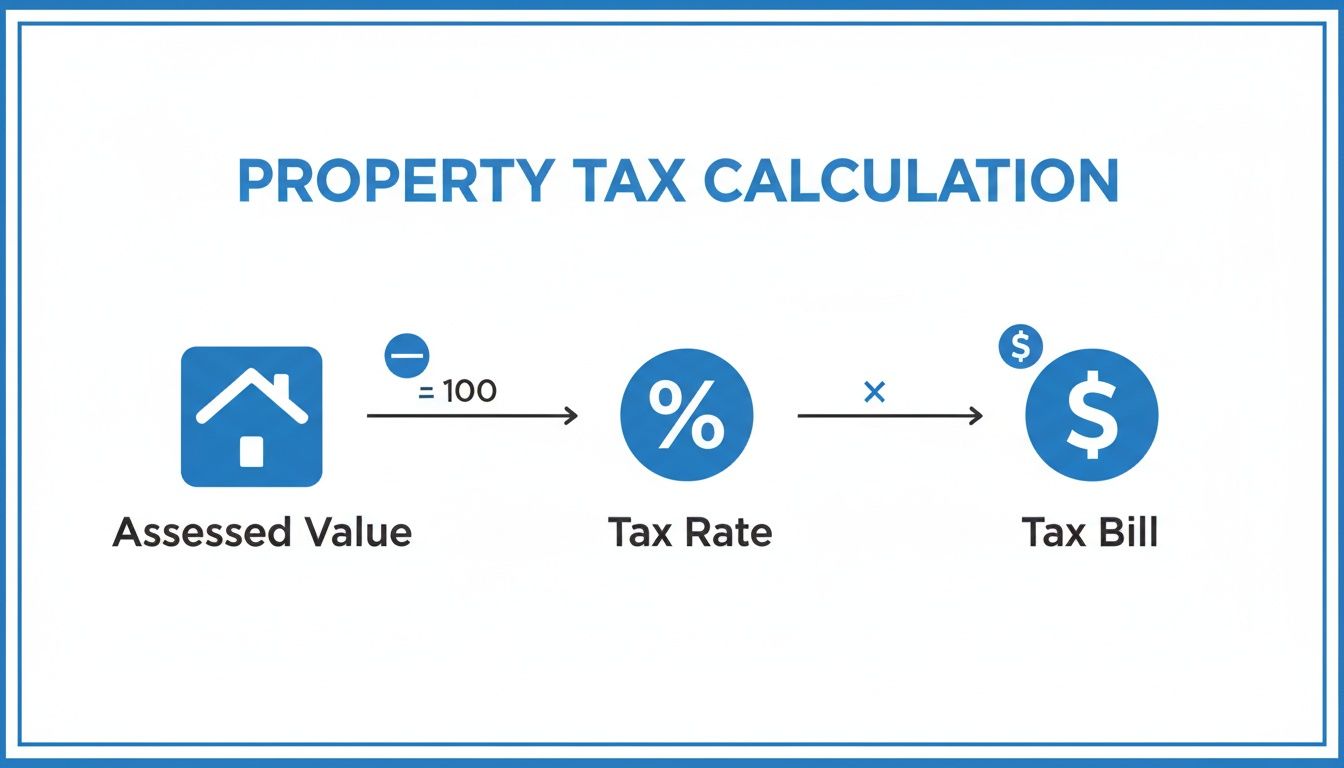
The calculation is a simple formula: (Assessed Property Value / 100) x Tax Rate = Your Tax Bill. However, the two inputs—assessed value and the tax rate—are determined by two separate government bodies in a system of checks and balances.
The Fairfax County Department of Tax Administration (DTA) first determines your property's fair market value as of January 1st each year. For the county's nearly 360,000 properties, the DTA uses a mass appraisal system that analyzes recent sales, property characteristics (e.g., square footage, age), and market trends to generate an assessed value. You receive this new assessment notice every February.
The Two Sides of the Tax Coin
The process involves two distinct, independent functions:
- Assessment (Valuation): The DTA appraises property value annually to reflect current market conditions. The DTA has no authority over the tax rate.
- Rate-Setting (Taxation): The Fairfax County Board of Supervisors sets the tax rate based on the county's budgetary needs. The Board has no control over individual property assessments.
A Real-World Calculation Example
Using Fairfax County's median home value of $760,400 and the FY 2026 tax rate of $1.1225 per $100 of assessed value, the calculation is as follows:
Step 1: Divide the assessed value by 100 to determine the number of taxable units.
$760,400 / 100 = 7,604
Step 2: Multiply that result by the tax rate to find the base tax amount.
7,604 x $1.1225 = $8,535.51
For a median-priced home, the base annual property tax bill is $8,535.51. This figure does not include special district taxes, which can add several hundred dollars to the final bill.
How Do Tax Rate Trends Affect Property Owners?
The primary trend affecting Fairfax County property owners is the county's fiscal strategy: holding the tax rate steady while property assessments rise. This approach increases total revenue without the political blowback of a direct rate hike, but it guarantees that as your property's value increases, your tax bill will rise in lockstep.
County Executive Bryan Hill’s proposed $5.7 billion budget for FY2027 exemplifies this strategy by keeping the real estate tax rate flat at $1.1225 per $100 of assessed value. This decision coincides with a projected 3.6% increase in overall property assessments, primarily driven by the residential market. This maneuver is expected to boost real estate tax revenue to $3.856 billion, accounting for the majority of the county's 3.7% total revenue growth. Full details are available in the county's proposed budget from FFXnow.
This flowchart shows how rising property values directly inflate tax bills even with a constant rate.
What This Means for Property Owners
The direct consequence for property owners is the necessity of budgeting for consistently higher tax payments. The stable tax rate creates a facade of predictability, but the reality is that rising assessments are the true engine of tax increases. The responsibility falls on homeowners and investors to anticipate these growing costs. This pattern of escalating values impacting affordability is a national issue, explored further in our latest Investor Pulse Report, which offers context for navigating expensive markets like Northern Virginia.
What Are the Additional Taxes Beyond the Base Rate?
Your total tax liability is almost always higher than the base rate calculation because Fairfax County levies several "add-on" taxes and fees for specific service districts. These ad valorem taxes, which are based on property value, are stacked on top of the general real estate tax and are critical for accurately calculating the true cost of ownership.
The base rate for FY2026 is $1.1225 per $100 of assessed value, but your property's location determines which additional rates apply. For example, commercial properties are subject to an extra $0.125 for the countywide transportation district. Properties in development zones like the Tysons Service District face another $0.050, while Dulles Rail phases can add $0.090 or $0.140. The full breakdown is available in the county's FY 2026 tax facts summary.
Key Special Taxing Districts
Below are the most common special taxes that increase a property's effective rate.
| Special Taxing District | Additional Rate (per $100 Value) | Applicable To | Purpose |
|---|---|---|---|
| Countywide Stormwater District | $0.0325 | All Properties | Funds stormwater management and infrastructure maintenance. |
| Reston Community Center | $0.047 | Properties in Small Tax District 5 | Supports the Reston Community Center's operations and programs. |
| McLean Community Center | $0.023 | Properties in Small Tax District 1 | Funds the McLean Community Center and its local programming. |
| Commercial Transportation | $0.125 | Commercial/Industrial Properties | Finances major transportation projects in key corridors. |
A home assessed at $800,000 within the Reston Community Center district has an effective tax rate of $1.202 ($1.1225 base + $0.0325 stormwater + $0.047 community center), adding over $600 to its annual tax bill.
Non-Ad Valorem Charges
Your bill may also include flat-rate fees, known as non-ad valorem charges, that are unrelated to your property's value. These are direct charges for services delivered to your address, such as refuse fees for trash collection or leaf collection fees. Ignoring these charges leads to inaccurate holding cost calculations and flawed net operating income models.
How Can You Reduce Your Fairfax County Property Tax Bill?
Fairfax County provides two primary avenues for homeowners to lower their property tax burden: qualifying for a tax relief program or successfully appealing the property's assessed value. Each path has strict eligibility requirements and deadlines that must be met.
The decision tree is simple: either you are eligible for a specific tax relief program, or you must challenge your property's valuation through the formal appeals process.

Major Tax Relief and Exemption Programs
These programs can dramatically reduce or eliminate your tax bill if you meet the criteria.
- Seniors (Age 65+) & Individuals with Disabilities: This is an income- and asset-based program. A household income between $0 and $60,000 can qualify for a 100% exemption. The maximum household income is $90,000, and total assets (excluding the primary home) cannot exceed $400,000.
- Disabled Veterans: Veterans with a 100% service-connected, permanent, and total disability rating from the VA are eligible for a full tax exemption on their primary residence.
- Surviving Spouses: Spouses of military members and first responders killed in the line of duty may also qualify for exemptions.
The Official Property Tax Appeals Process
If you believe your property's assessed value is higher than its fair market value, you have the right to appeal. A successful appeal lowers the taxable value of your home, directly reducing your tax bill. The process is time-sensitive and requires concrete evidence.
The appeals sequence is:
- Administrative Appeal: File with the Department of Tax Administration by the April 1 deadline. You must provide evidence, such as recent comparable sales (comps), to prove overvaluation.
- Board of Equalization (BOE) Appeal: If the first appeal is denied, file with the independent BOE by the June 1 deadline. The BOE will hear your case and make a final determination.
- Circuit Court Appeal: This is the final option, typically reserved for high-value disputes and requiring legal counsel.
To win an appeal, you need hard data. Comps are your strongest evidence. Documenting specific property defects or a disadvantageous location can also significantly strengthen your case.
How Does Proptech Use Fairfax County Tax Data?
Proptech platforms like BatchData transform Fairfax County's complex tax data from a liability into a strategic asset, providing a competitive edge for real estate investors, lenders, and insurers. This goes far beyond simply looking up the base property tax rate in Fairfax County VA.
Mortgage lenders and insurance carriers use this granular data to refine underwriting models, instantly verify ownership, identify liens, and accurately assess risk. For investors, this data unlocks hidden market opportunities by filtering properties based on financial triggers that signal a motivated seller.
Unlocking Investor Opportunities
Proptech enables investors to identify unique opportunities through data-driven strategies:
- Finding Pre-Foreclosures: Monitoring tax delinquency records allows investors to identify distressed owners long before a property enters the formal foreclosure process.
- Predictive Modeling: Algorithms analyze tax history, assessment trends, and owner data to forecast which properties are most likely to be listed for sale.
- Portfolio Health Checks: Investors can automatically track assessment changes and tax liabilities across their entire portfolio, flagging properties ripe for a tax appeal. Reviewing general strategies to reduce property taxes can provide a useful framework, even if specific tactics vary by locality.
Advanced Data Integration
The true power of proptech lies in integrating tax data with other datasets. Layering tax records with geospatial data creates highly accurate automated valuation models (AVMs), as detailed in our guide on how geospatial analysis enhances AVMs. This allows for a deeper understanding of value by factoring in location-specific attributes like proximity to transit or inclusion in a special tax district.
This integrated approach empowers real estate professionals to:
- Validate Data Instantly: Cross-reference county tax records with other public and private data sources to ensure accuracy.
- Build Rich Property Profiles: Combine tax data with owner contact information, mortgage history, and building permits for a 360-degree property view.
- Automate Due Diligence: Generate comprehensive reports that include a property's full tax and assessment history, eliminating hours of manual research.
Proptech translates the dense world of Fairfax County property taxes into actionable intelligence, equipping professionals to make faster, data-driven decisions.
What Are Common Questions on Fairfax County Property Taxes?
Here are direct answers to the most frequent questions about Fairfax County property taxes.
When are my property taxes due?
Your tax bill is divided into two equal payments, due on July 28th and December 5th. Missing these deadlines results in immediate late payment penalties and interest.
How can I look up my property's assessed value?
You can find current and historical assessed values on the official Fairfax County Real Estate Assessment Information site. This public portal is searchable by address, owner name, or tax map number and is the definitive source for assessment data. Always verify the property details listed, as errors in the public record (e.g., incorrect square footage) are a common and valid basis for a tax appeal.
What is the difference between real and personal property tax?
The distinction is critical for understanding tax liability.
Real Property Tax: This is the tax on land and attached structures (e.g., your house). It is the primary tax for homeowners and real estate investors, calculated using the $1.1225 per $100 assessed value rate.
Personal Property Tax: This tax applies to movable assets. For residents, this typically means vehicles. For businesses, it covers all furniture, fixtures, and equipment (FF&E). This tax is a major revenue source for the county and is the reason neighboring Loudoun County can maintain a lower real estate tax rate, thanks to the immense value of its data center server farms.
Navigating Fairfax County's property data is a complex job, but BatchData makes it simple. Our platform brings together tax records, owner details, and key market signals, giving investors and lenders the tools they need to spot opportunities, manage portfolios, and perform due diligence with speed and precision. See how our developer-friendly APIs and smart search can power your real estate strategy.