





































SEO Title: Hire Private Investigators Online Guide for Due Diligence
Meta Description: Learn when to hire private investigators online, how to verify them, what they do, and when a data platform is the faster option.
Meta Keywords: private investigators online, online private investigator, due diligence, skip tracing, asset search, real estate data platform, property intelligence, PI services
You're usually looking at private investigators online when Google has already failed you. You have a name, maybe an old address, maybe a company, maybe a property. What you don't have is confidence that the information is current, complete, or usable.
That's the real divide. Consumer search tools surface fragments. Professional investigation work connects records, verifies identity, cross-checks ownership, and turns scattered data into something you can act on. For real estate teams, lenders, insurers, and investors, that difference matters because a bad assumption about ownership, occupancy, liens, or reachability slows everything down.
Quick takeaways
- Google is not an investigation system. It's a discovery layer.
- Modern PIs are data users first. Many rely heavily on online databases, not just fieldwork.
- Hiring a PI makes sense for judgment-heavy work. Interviews, surveillance, complex fraud review, and evidence handling still require a person.
- A platform makes sense for repeatable data tasks. Owner lookups, property history, skip tracing, and portfolio-wide due diligence are often better handled directly in software.
Why You Might Need More Than Google
You can search a name all afternoon and still miss the one record that matters. That's common in ownership disputes, pre-close due diligence, insurance review, borrower verification, and outreach to hard-to-reach owners.
The reason is simple. Search engines index public web pages. They do not reconcile fragmented identity data, merge address history, normalize property records, or tell you whether two similar names are the same person. That's where the professional side of this market starts.
The private investigation business is also much larger and more digital than often assumed. The global private investigation services market is projected to reach USD 32.8 billion by 2035, and the U.S. had approximately 43,600 private investigators in 2024, with the Bureau of Labor Statistics projecting 6% job growth from 2024 to 2034. Many of those investigators now work through extensive online databases rather than purely field methods, according to private investigator market projections and workforce data.
What Google misses
A normal search often breaks down in four places:
- Identity resolution: Common names, aliases, and stale addresses create false matches.
- Property context: A search result may mention an address, but not mortgage status, lien context, or ownership chain.
- Contactability: Finding a person online isn't the same as finding a reachable phone or email.
- Evidence quality: Screenshots and casual searches rarely hold up when decisions need documentation.
Practical rule: If the task requires validation across records, not just discovery of a webpage, you're already outside basic search.
What modern online investigation really means
When people search for private investigators online, they often picture remote convenience. The more useful definition is different. It means an investigator or a data workflow built on structured record access, OSINT, validation steps, and documented outputs.
That distinction matters because many jobs that sound investigative turn out to be data acquisition problems. Others are still human problems. The best decision comes from knowing which is which.
How to Find and Verify Legitimate Private Investigators Online
The fastest way to hire the wrong PI is to trust the website. Nice branding doesn't prove licensing, insurance, lawful methods, or actual investigative depth.
Start with verification, not marketing.
Check primary records first
Use this order:
Confirm the license with the relevant state regulator
- Search the investigator or agency name in the state licensing database.
- Confirm the license is active.
- Check whether the individual, company, or both must be licensed in that state.
Ask for proof of insurance
- Errors and Omissions coverage matters.
- General liability matters too, especially if field activity is involved.
Request a methods overview
- You don't need trade secrets.
- You do need to hear how they handle database work, OSINT, verification, and reporting.
Look for disciplinary history
- Don't stop at testimonials.
- Search for complaints, enforcement actions, and court disputes involving the firm.
What a credible PI should answer clearly
A legitimate investigator should be able to tell you:
- What they can legally do in your jurisdiction
- What they will not do
- What records they'll rely on
- How they validate identity and ownership
- How they document findings
- What the final deliverable looks like
If they dance around any of those, move on.
Good signs and bad signs
| Signal | Good sign | Bad sign |
|---|---|---|
| Licensing | Gives you license details upfront | Avoids specifics |
| Scope | Defines task boundaries clearly | Promises “anything you need” |
| Methods | Explains lawful research process | Hints at secret or questionable access |
| Reporting | Offers documented findings | Relies on verbal updates only |
A real investigator usually sounds more cautious than a fake one. Careful language is a sign they understand legal exposure.
Ask what databases they actually use
This is one of the best filters because it reveals whether you're hiring a marketer or a practitioner. Strong investigators typically work from specialized databases, public records, social platforms, and direct verification workflows.
If your use case is heavily data-driven, it also helps to understand the alternative. A good primer on this distinction is this overview of a private investigator database, which shows the type of consolidated records many investigators depend on behind the scenes.
Review the intake process
A serious PI won't jump straight to “we found something.” They'll ask for identifiers, timeline, purpose, known addresses, related entities, and what decision you need to make from the result.
That's not bureaucracy. That's how you avoid paying for a search that answers the wrong question.
What Services PIs Offer and What They Really Cost
Private investigators don't sell one thing. They sell different mixes of data access, judgment, fieldwork, and evidence handling. If you don't separate those components, you'll overpay for simple work and under-scope the hard work.

The core service categories
Some assignments are mostly digital. Others aren't.
Skip tracing and locate work
- Finding a current address, phone, email, associates, or prior locations.
- Usually database-heavy.
Background investigations
- Can range from basic public-record checks to deeper relationship, litigation, or asset reviews.
- Scope changes everything.
Asset and property research
- Useful in litigation support, collections, underwriting, and transaction diligence.
- Often requires cross-checking ownership, liens, mortgage signals, and entity relationships.
Social media and OSINT review
- Helpful for fraud indicators, behavioral verification, and identity analysis.
- Dangerous when handled casually.
Surveillance and interviews
- This is the classic human side of the profession.
- Software doesn't replace it.
Why online-heavy work changes the economics
According to a UNC study, private investigators may spend 40% to 60% of case time on online searches, and qualitative findings in that study indicate database-driven cases can resolve two to three times faster than cases relying only on field interviews, as noted in the UNC research on PI workflows.
That has one practical implication. If your assignment is mostly searchable data, you should be skeptical of a scope that defaults to heavy manual effort.
If an investigator reaches for surveillance before exhausting structured records, you may be paying for motion instead of progress.
What “cost” actually means
There's no honest universal price sheet because surveillance, fraud review, and a basic locate are not the same job. What you should compare is pricing model against task type.
| Service type | Best pricing model | Watch out for |
|---|---|---|
| Simple locate or record pull | Flat fee | Vague “research package” language |
| Open-ended fraud or witness work | Hourly with cap | No budget ceiling |
| Ongoing monitoring | Retainer with reporting schedule | Undefined deliverables |
For real estate teams, this distinction matters a lot. Paying a human to manually reconstruct property context that could be pulled from a structured dataset is usually a weak trade.
A practical example is tag and vehicle-related tracing, where workflows often start with data enrichment before any human escalation. This is why many teams study adjacent lookup processes such as how to run a tag number before they decide whether a PI is even necessary.
When paying a PI is worth it
Use a person when you need:
- Field verification
- Witness interviews
- Fraud pattern interpretation
- Chain-of-custody discipline
- Court-ready reporting tied to a specific matter
This video gives a useful view into how clients often think about investigative cost and scope before hiring:
When it's probably not worth it
Don't hire a PI first for tasks like:
- Pulling broad property records at scale
- Finding owner contact data across many addresses
- Screening portfolios for liens, permits, or pre-foreclosure signals
- Routine reachability enrichment for marketing or servicing
Those are software problems first.
Navigating the Legal and Ethical Tightrope
A PI who “gets results” by cutting corners can create a mess that lands on your desk, not just theirs. That matters more in online investigations because the line between aggressive research and unlawful access isn't always obvious to clients.
The risk isn't theoretical. An Emerald study highlighted that 30% of PIs admitted to using deceptive online tactics, and those methods can expose clients to legal risk under privacy regimes such as GDPR and CCPA, according to this analysis of social media investigation risks and deceptive tactics.
The first legal question to ask
Ask this before you discuss tactics:
What is the permissible purpose for collecting and using this information?
That question changes everything. Public availability does not automatically mean unrestricted use. Real estate, lending, insurance, and tenant-related workflows often intersect with regulated decisions, which means the downstream use of data matters as much as the collection step.
What usually goes wrong
The common failures aren't dramatic. They're procedural.
Pretexting and deception
- If a PI implies they can impersonate, trick, or socially engineer access, that's a problem.
- A result gathered improperly can become unusable or dangerous.
Bad consent assumptions
- Recording, tracking, and communications monitoring laws vary.
- “We do this all the time” is not legal analysis.
Misuse of regulated data
- Background-style information used in a regulated decision can trigger compliance obligations.
- Many clients realize that too late.
Weak evidence handling
- Digital evidence can be altered, deleted, or challenged.
- Casual screenshots are not the same as preserved evidence.
The cheapest investigator can become the most expensive part of the case if their methods don't survive scrutiny.
A practical client standard
Use this standard in every engagement:
| Question | Acceptable answer | Bad answer |
|---|---|---|
| How will you obtain the information? | Lawful sources and documented methods | “We have ways” |
| Can you explain the legal boundary? | Gives a clear, limited answer | Shrugs it off |
| Will this be usable for my purpose? | Explains limits and caveats | Guarantees admissibility |
| How do you verify online findings? | Cross-checks across records and sources | Trusts social media alone |
The real trade-off
An aggressive PI might produce more noise faster. A disciplined PI produces findings you can use.
For due diligence, underwriting, and fraud review, that distinction is everything. You're not buying drama. You're buying defensible information.
The DIY Alternative PI-Grade Data for Real Estate Pros
For many real estate tasks, the actual product behind private investigators online is not the investigator. It's the database stack.
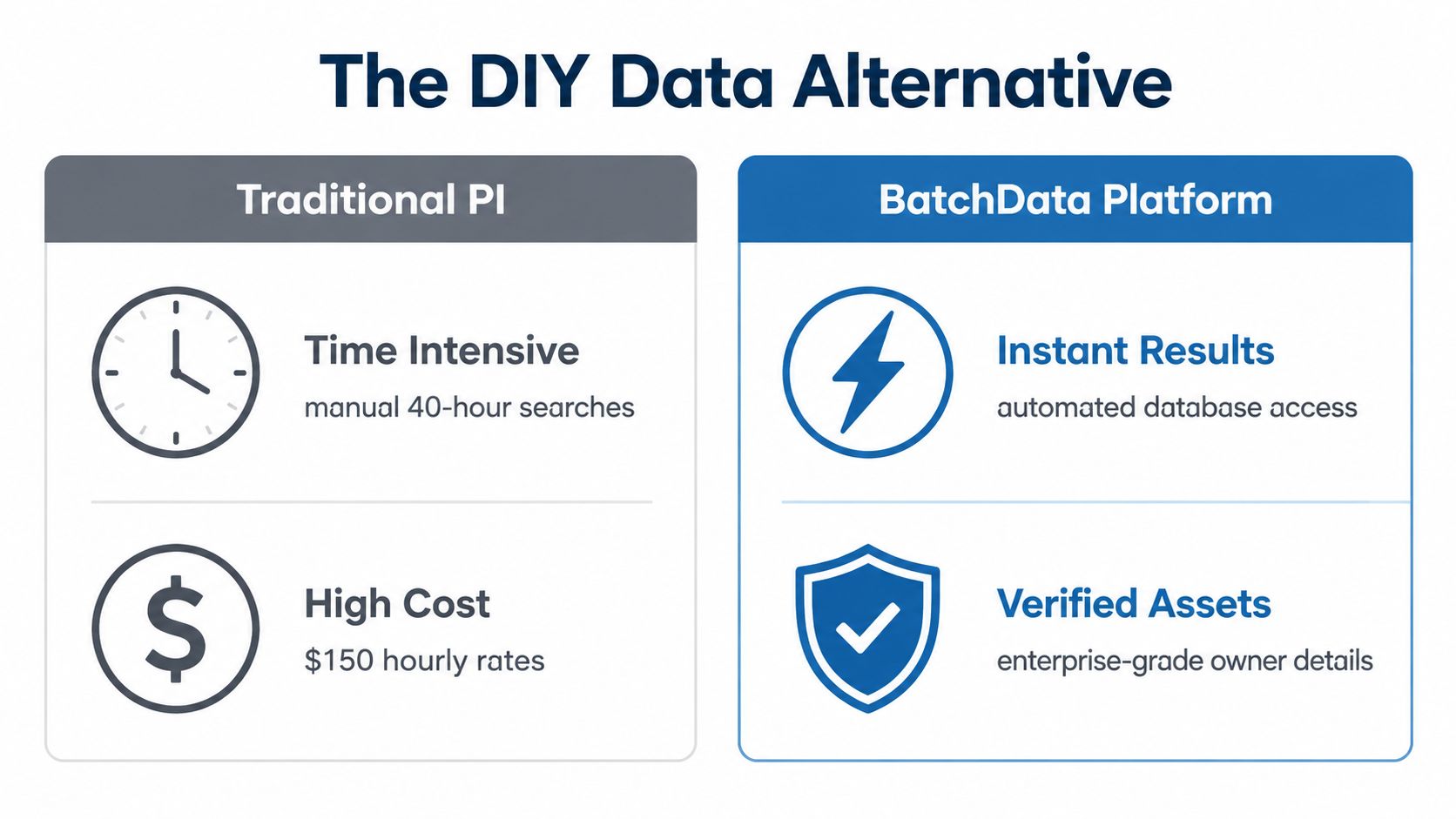
That's not a knock on investigators. It's just the workflow reality. Top investigators rely heavily on specialized online databases, subscribe to 2.5 databases on average, and in one surveyed group 87.2% selected Tracers as a top choice, according to survey findings on PI database usage. In other words, a large part of modern investigation work starts with access to extensive data.
Where platforms beat people
If your workflow is repeatable, high-volume, and property-centric, a data platform usually wins on speed, consistency, and operational control.
Typical examples:
- Owner identification across a portfolio
- Property history review before outreach or acquisition
- Lien and mortgage context for underwriting
- Skip tracing for contact enrichment
- Daily monitoring of property-level changes
- Bulk screening across many addresses or borrowers
A structured property intelligence platform can replace a large share of manual PI work. One example is previous address search workflows, which are often needed in tracing, verification, and borrower or owner resolution.
PI vs. data platform for real estate work
| Task | Hiring a Private Investigator | Using a Real Estate Data Platform | Winner for Speed & Cost |
|---|---|---|---|
| Find current owner contact info | Manual research and validation | Immediate structured lookup across records | Data platform |
| Review property history | Case-by-case pull and interpretation | Standardized record access across properties | Data platform |
| Check broad portfolio risk signals | Slow if done one asset at a time | Built for bulk and recurring monitoring | Data platform |
| Interview a witness or neighbor | Can do it | Cannot do it | Private investigator |
| Conduct physical surveillance | Can do it | Cannot do it | Private investigator |
| Build a custom field investigation | Can do it | Cannot do it | Private investigator |
The smart operating model
The strongest teams don't treat this as an either-or decision. They use a tiered workflow.
Run platform-based screening first
- Confirm ownership
- Pull core property context
- Enrich contact details
- Flag exceptions
Escalate only the exceptions
- Identity conflicts
- Fraud indicators
- Hidden relationship questions
- Situations requiring field verification
Reserve PI time for tasks software can't do
- Human interviews
- Surveillance
- nuanced investigative interpretation
Operational view: If you can standardize the first pass, you reduce PI spend and improve consistency.
One option in that stack
For real estate due diligence specifically, BatchData is one example of a platform approach. The publisher states that it delivers 155M+ U.S. property records, 1,000+ attributes, ownership history, AVMs, mortgage and lien detail, permits, listings, pre-foreclosure activity, and contact enrichment through APIs or bulk delivery. That makes it relevant for underwriting, portfolio monitoring, outreach, and owner verification where the work is data retrieval and normalization rather than field investigation.
What doesn't work in practice
Two mistakes show up repeatedly:
Using a PI for commodity record retrieval
- This burns time and budget.
Using a platform for human investigation
- A database can surface patterns, but it can't interview a source, watch a subject, or make judgment calls in the field.
The right model depends on the task. The bad model is paying a specialist to do what software already handles well.
Making the Hire Final Questions and Contract Checklist
Once you've decided a PI is needed, the last step is tightening the engagement. Most hiring mistakes happen here, not in the initial search.
A good contract doesn't just protect you from billing surprises. It forces clarity on methods, deliverables, and legal boundaries before the work starts.
Questions to ask before you sign
Ask these directly and listen for precision:
- What specific databases and record sources do you use for this kind of case?
- What part of this assignment requires a human investigator rather than a data pull?
- How will you verify identity, ownership, or subject matching?
- What legal limits apply to this engagement?
- What deliverable will I receive at the end?
- How often will you report progress?
- What events would cause the budget or scope to expand?
- Have you handled similar assignments involving property, owners, liens, or fraud indicators?
If the investigator can't distinguish searchable data from field investigation, they probably haven't scoped the work correctly.

Contract terms that should be non-negotiable
| Clause | Why it matters | What to avoid |
|---|---|---|
| Scope of work | Defines exactly what is being investigated | Broad, open-ended language |
| Fee structure | Sets hourly, flat-fee, or retainer terms | No ceiling or change-order rules |
| Reporting schedule | Keeps the case from going dark | “Updates as needed” |
| Legal compliance statement | Confirms lawful methods | Silence on methods |
| Termination rights | Lets you stop bad work quickly | One-sided lock-in terms |
| Deliverables | Clarifies what you receive | Vague promise of “results” |
Final screening checklist
Use this before payment:
- License confirmed
- Insurance confirmed
- Written scope reviewed
- Budget cap approved
- Reporting schedule agreed
- Method boundaries discussed
- End deliverable defined
- Termination language reviewed
The best hiring outcome is boring. Clear scope. Clear method. Clear reporting. No theatrics.
If your team's real need is owner resolution, property context, skip tracing, or portfolio-scale due diligence, start with structured data before you hire a person. BatchData helps real estate, lending, insurance, and proptech teams work from unified property records, ownership history, valuations, liens, and verified owner contacts so you can reserve private investigators for the work only humans can do.