





































SEO Title: Private Investigator Database Guide for Real Estate Teams
Meta Description: Learn how a private investigator database works, what data it includes, and why general PI tools create accuracy and compliance risks in real estate.
Meta Keywords: private investigator database, PI database, skip tracing, property data, real estate due diligence, compliance risk, proptech data, underwriting data
The modern private investigator is less trench coat, more data operator. The sector reflects that shift. The global private investigation services market is projected to grow from USD 21.1 billion in 2025 to USD 32.8 billion by 2035, according to Fact.MR’s private investigation services market report.
For real estate and proptech teams, that matters because PI databases solve a familiar problem. They collapse fragmented records into something searchable, linkable, and operational. They also introduce a second problem that property operators cannot ignore: broad investigative tools are not automatically accurate, current, or compliant for underwriting, marketing, or portfolio decisions.
Key takeaways:
- A private investigator database is an aggregation system, not just a people search tool.
- The value comes from cross-referencing records such as addresses, phones, relatives, assets, and ownership clues.
- Professionals use these systems for skip tracing, background research, asset searches, and fraud work.
- Legal use depends on permissible purpose, especially when data touches consumer privacy or regulated decisions.
- Real estate teams need to treat PI databases carefully, because investigative breadth is not the same thing as property-grade accuracy.
- If you work in business intelligence or fraud review, the workflow has clear overlap with the work done by financial detectives who connect records, entities, and behavioral signals across messy datasets.
Introduction The Modern Investigator’s Secret Weapon
A private investigator database is the primary engine behind much of modern investigative work.
Many people still picture surveillance vans and stakeouts. In practice, a large share of the job starts with data aggregation, identity matching, record linking, and source validation. The field keeps expanding because clients want faster answers and more defensible evidence trails, not just intuition.
For an informed real estate audience, the interesting part is not the romance of investigations. It is the operating model. PI platforms collect scattered public and commercial data, normalize it, and surface likely connections. That is the same basic problem proptech platforms solve with parcels, ownership, liens, valuations, and contactability.
What matters most
- Data density: PI platforms consolidate records that would otherwise require manual searching across many systems.
- Connection logic: The useful output is not a raw record dump. It is the inferred relationship between people, addresses, phones, and assets.
- Speed: Investigators use these tools to triage cases, prioritize leads, and decide what deserves manual work.
- Compliance: Access does not equal permission. Legal use depends on context.
- Fit: A strong PI tool can still be the wrong tool for property underwriting or consumer-facing workflows.
Key takeaway: The power of a private investigator database is not that it finds everything. It is that it narrows uncertainty fast enough for a professional to make the next decision.
The rest of the discussion comes down to four questions: what these systems are, what data they expose, how professionals use them in real workflows, and where they break down for property intelligence teams that need cleaner, fresher, and more compliance-aware data.
What Exactly Is a Private Investigator Database
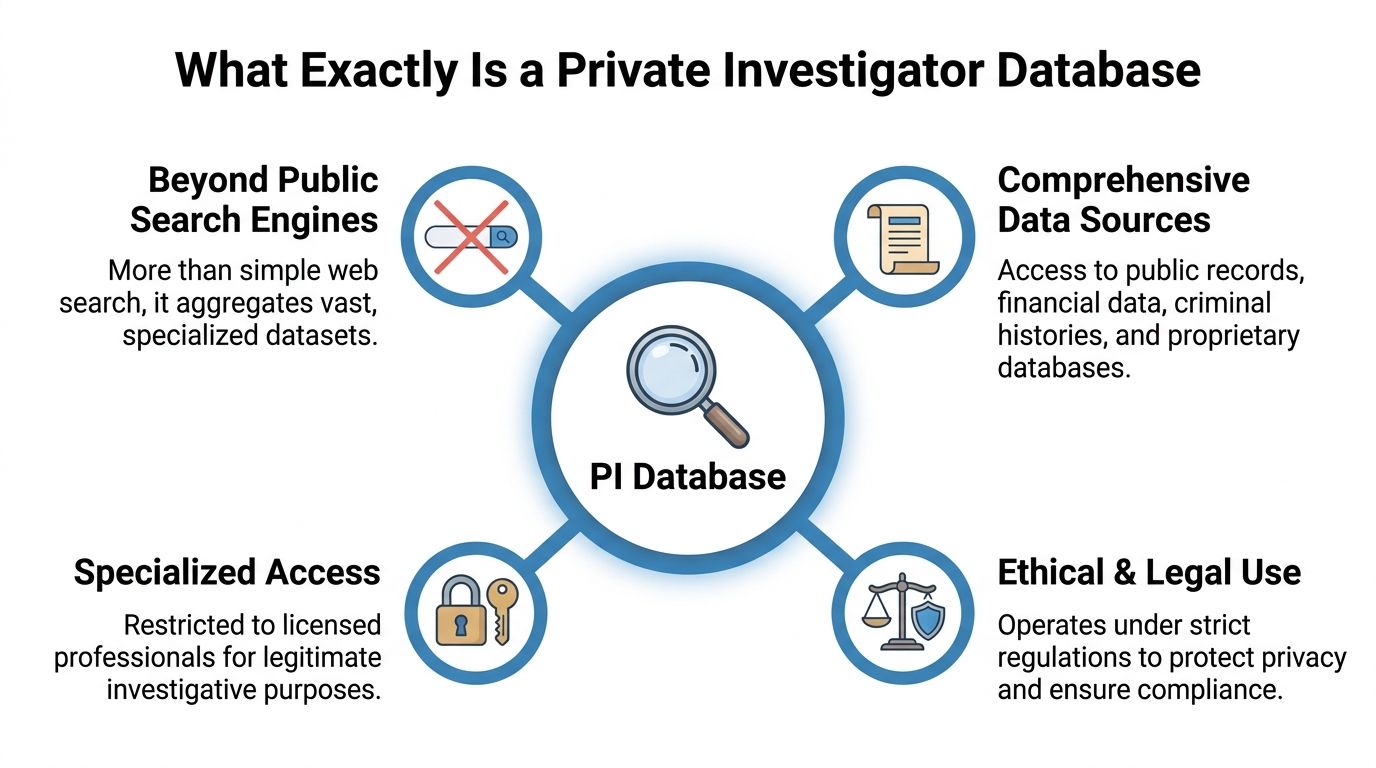
A private investigator database is a specialized search and analysis platform that aggregates records from multiple sources and links them into a usable profile of a person, business, address, phone, or asset.
That definition matters because many buyers expect a PI database to behave like a public search engine. It does not. A public search engine indexes webpages. A PI database tries to perform data aggregation, identity resolution, and cross-referencing across records that were never designed to live together.
Think of it as a private record graph
The better analogy is a curated record graph.
You search a name, number, email, or address. The platform then tries to answer several linked questions at once:
- Is this the right identity?
- What other records point to the same person or entity?
- Which addresses, associates, businesses, or assets connect to that identity?
- Which records conflict, and which appear most current?
A good system reduces manual stitching. It does not eliminate judgment.
Why these platforms are useful
The core value is operational. Investigators need to move from fragment to profile.
If all you have is a mobile number, the platform may surface address history, likely relatives, associated properties, business links, or deceased-record flags. If all you have is an LLC or parcel address, the platform may help reveal the human actors around it. That jump from a single clue to a structured lead is what makes the tool professionally useful.
Where people misunderstand the product
Three mistakes show up repeatedly:
- Mistaking aggregation for ground truth: Linked records are leads, not self-authenticating facts.
- Assuming completeness: Even very large systems have blind spots, lag, and mismatch risk.
- Ignoring context: The same search result can be useful for fraud review and unusable for a regulated lending decision.
Practical rule: Use the database to generate and rank hypotheses. Use direct-source verification to support any high-stakes action.
This is also why private investigator databases have durable demand. They sit between open-web OSINT and full manual courthouse research. They turn scattered signals into a shortlist of likely truths. For investigators, that provides an advantage. For real estate operators, it is a useful reference point, but not always the final system of record.
What Types of Data Do Investigators Access
Investigators access a mix of public records, commercially available identity signals, and provider-specific linked data.
That mix is why these tools are effective. A PI platform is rarely valuable because of one record type alone. It becomes useful when a phone number, address history, associate graph, and property clue line up strongly enough to justify further work.
Tracers is a good example of how broad these platforms can get. It aggregates datasets that include relatives, associates, contact details, address histories, asset records, deceased records, phone numbers, and address validations, and in a survey of over 400 private investigators, 87.2% selected Tracers as the top PI database, according to Tracers’ survey summary.
Core Data Types in Private Investigator Databases
| Data Category | Source Examples | Primary Use Case |
|---|---|---|
| Identity data | Names, aliases, DOB-linked records, address history, deceased records | Confirm whether the subject is the right person |
| Contact data | Phone numbers, emails, address validations, possible current addresses | Skip tracing and outreach preparation |
| Relationship data | Relatives, associates, co-residents, linked businesses | Build a connection map around the subject |
| Property and asset data | Property records, asset clues, ownership-linked records | Asset searches and financial context |
| Court and legal signals | Court filings, judgments, liens, bankruptcy-related indicators | Litigation support and risk review |
| Vehicle and identifier data | License plate-linked or registration-linked clues where permitted | Locate movement or confirm identity patterns |
| Business data | Corporate registrations, business associations, entity links | Tie individuals to companies and holdings |
Not all data classes behave the same
A property record and a phone number do not carry the same evidentiary weight.
Property ownership tends to be easier to anchor because it often traces back to a filing system. Contact data is more volatile. Associate data is often inferential. Deceased flags can be highly useful, but they still need confirmation before anyone acts on them.
That matters for real estate teams because a broad investigative platform can appear thorough while mixing hard records with softer inferences in the same result set.
Why source discipline matters
Investigators who know what they are doing do not treat every field equally. They sort by reliability:
- Direct record first: filed ownership, court records, official registrations
- Corroborating identity second: address history, linked household data
- Volatile enrichment last: phones, emails, marketing-style contact append data
Teams handling damaged drives or legacy files run into the same issue with evidence quality. If records are incomplete or corrupted, specialist help matters. In those situations, professional data recovery services can be relevant before anyone tries to interpret the data trail.
The takeaway is simple. A private investigator database offers breadth. Professionals still have to decide which fields are factual anchors and which are only directional leads.
How Do Professionals Use These Databases
Professionals use a private investigator database to move from a weak starting clue to an actionable next step.
That workflow usually starts with one fragment. A name. A disconnected phone. An LLC. An old address. The database helps the investigator test whether that fragment belongs to the right subject, then surfaces nearby records worth checking.

Skip tracing and subject location
Skip tracing is the most obvious use case.
An investigator may begin with an outdated address and a phone number that no longer answers. The platform can expose linked addresses, likely relatives, alternate numbers, and historical records that suggest where the subject went next. None of that guarantees a current location. It does cut down blind searching.
What works:
- Starting from stable identifiers such as a long-held address or legal name
- Comparing multiple linked records before assuming recency
- Using relatives and associates as context, not proof
What fails:
- Treating the newest-looking phone as current without validation
- Assuming every same-name match is the same person
- Ignoring jurisdiction-specific record gaps
Background research and fraud review
Background work is less about sensational findings and more about contradiction detection.
Investigators compare what a subject claims against what the records imply. That can include address continuity, business ties, property links, or signs that an identity narrative does not hold together.
Modern platforms increasingly add analytical layers. According to CROSStrax’s PI database overview, machine learning on aggregated data streams has produced a 40-60% reduction in false positives over manual methods in some investigative contexts, and PI benchmarks cited there point to 25% faster case resolutions.
Those gains make sense in a triage environment. If software suppresses weak matches and highlights stronger relationship patterns, investigators waste less time on dead ends.
Real estate and asset investigation
Here, the overlap with proptech becomes obvious.
A real estate investor, servicer, or analyst often asks the same practical questions an investigator asks:
- Who controls this property?
- Is the mailing address still valid?
- Are there linked entities or associates worth reviewing?
- Do the ownership story and the contact story match?
- Are there legal or financial signals that change risk?
A PI workflow can help when the goal is locating a person tied to an asset or mapping connections around ownership. It is less reliable when the goal is property-level decisioning that demands valuation context, lien depth, structured parcel attributes, or highly current portfolio monitoring.
The reporting mindset matters too. Good teams do not just collect records. They turn them into a sequence:
- Establish identity.
- Confirm currentness.
- Map linked people and entities.
- Validate asset ties.
- Escalate only the strongest leads.
For teams monitoring investor activity and market behavior at scale, structured market intelligence is a different layer entirely. This is the gap between investigative lookup and portfolio analysis, which is why tools built for market monitoring, such as national investor activity reporting, serve a different job.
A quick visual overview helps if you want to see how the profession frames these workflows:
Operational truth: The database saves time at the start of the case. It does not replace judgment at the end of the case.
What Are the Legal and Privacy Constraints
The legal answer is simple. You can only use sensitive investigative data for a lawful purpose, and that purpose changes what data you can access, how you can use it, and what you can do with the result.
That is where many non-investigative teams get into trouble. They see a private investigator database as a faster record source, then try to use it for tenant screening, underwriting, marketing, or employment-related decisions. That is exactly where regulatory boundaries matter.

Permissible purpose is the gate
The key concept is permissible purpose.
A licensed investigator may have access to records or workflows that are not broadly available to commercial users. Even then, access is conditioned on the reason for the search. The user is not buying unrestricted freedom. The user is operating inside a regulated use case.
In practice, that means:
- Investigation context matters: litigation support, fraud review, and lawful asset investigation are not the same as prospect marketing.
- Decision context matters: using data in credit, housing, or employment-related decisions can trigger a much stricter compliance framework.
- Downstream use matters: even accurate data can become noncompliant if used for the wrong purpose.
The main laws teams need to understand
Several frameworks routinely come up.
| Legal framework | What it generally governs | Why it matters here |
|---|---|---|
| FCRA | Consumer report use in credit, housing, employment, and related decisions | A PI database result cannot be repurposed for regulated decisioning |
| GLBA | Protection and handling of certain financial information | Financially linked records require careful use and access controls |
| DPPA | Privacy restrictions tied to motor vehicle records | Vehicle-related lookups are not open-ended and require lawful basis |
These laws are not optional fine print. They determine whether a search is legitimate in the first place.
The practical compliance problem for real estate teams
Real estate operators often sit in a gray zone if they are not careful.
A marketing team may want owner contact data. A lender may want background context on a borrower or guarantor. A proptech company may want to enrich a user-facing workflow with identity-linked signals. Those are all different use cases, and they do not carry the same permissions.
Practical rule: If the outcome affects housing, credit, insurance, employment, or another regulated decision, do not assume a PI-style data source is appropriate just because it is accessible.
What disciplined teams do instead
Teams with mature compliance habits usually follow a stricter process:
- Define the exact use case before any data pull.
- Classify whether the workflow is investigative, marketing, operational, or regulated decisioning.
- Separate lead-generation data from decision-grade data.
- Validate key records at the source.
- Keep audit trails around who searched what and why.
A private investigator database is powerful. It is not a compliance shield.
How Are Modern PI Databases Built and Maintained
Modern PI databases are built through a data engineering pipeline that collects records, standardizes them, tries to match them to the right identity, and continuously updates or suppresses stale links.
That sounds straightforward until you look at the underlying problem. The source systems were not designed to agree with each other. Names vary. Addresses change format. Entities split and merge. Some feeds are structured, others messy. The product only works if the provider can reduce that mess without creating too many false joins.
The pipeline behind the product
Most platforms follow the same broad lifecycle.
| Stage | What happens | Main risk |
|---|---|---|
| Collection | Data comes in from public records, licensed sources, commercial feeds, and direct integrations | Source inconsistency |
| Normalization | Fields are standardized so records can be compared across systems | Data loss during cleanup |
| Identity resolution | Records are matched to a probable person, entity, phone, or address | False matches and duplicate profiles |
| Enrichment and refresh | Additional signals are appended and stale links are revised or removed | Latency and outdated associations |
The hard part is identity resolution. That is the layer where a provider decides whether two records refer to the same person, two different people with the same name, or a family cluster that should stay separate.
What separates strong systems from weak ones
The best providers do not just ingest more data. They control linkage quality better.
Signals that usually matter:
- Record hierarchy: Some sources carry more trust than others.
- Conflict handling: The system needs logic for contradictory addresses, duplicate names, and recycled phone numbers.
- Freshness policy: High-volatility fields need more aggressive refresh logic than static filings.
- Suppression discipline: Bad links must be removed, not just buried.
For a technical audience, the comparison to property intelligence is obvious. Parcel data platforms face the same challenge with owner names, mailing addresses, legal descriptions, and market signals. The difference is that property-centric systems optimize around real estate entities first. If you want a useful reference for how geospatial context changes data quality in valuation workflows, this overview of geospatial analysis and AVMs captures the engineering mindset well.
Why maintenance is never finished
There is no final clean state.
A private investigator database is always decaying and being repaired at the same time. New filings appear. Consumers move. Businesses dissolve. Phones get reassigned. A platform that looked strong last quarter can drift quickly if refresh logic weakens or matching logic gets too aggressive.
That is why experienced users treat the product as a dynamic intelligence layer, not a permanent source of truth.
Why General PI Databases Fall Short for Real Estate
General PI databases fall short for real estate because property decisions require cleaner ownership resolution, fresher parcel-level updates, and clearer compliance boundaries than broad investigative tools usually provide.
The issue is not that PI platforms are useless. They are often very good at finding people, surfacing associates, and uncovering asset clues. The issue is fit. Real estate teams do not just need a broad clue engine. They need property-grade data infrastructure.

Accuracy problems become business problems
Broad aggregation creates noise.
According to Legal Eye Investigations’ industry summary, public record aggregation can carry error rates of up to 30%, and a 2023 FTC report cited there found 15% of skip tracing data inaccuracies led to compliance fines.
Those are not abstract issues for a real estate operator. They translate into:
- Mail sent to the wrong owner
- Calls placed to recycled or unrelated numbers
- Bad diligence on ownership chains
- False confidence in asset linkage
- Compliance exposure when outreach or decisions rely on weak data
Property workflows need different outputs
Investigative breadth is not the same as property intelligence depth.
A PI user may be satisfied with a likely match and a shortlist of connected records. A lender, insurer, investor, or proptech platform usually needs a more structured answer:
- parcel-level ownership history
- mortgage and lien context
- valuation and equity framing
- listing and permit signals
- scalable refresh patterns across portfolios
General PI databases are rarely designed around those outputs. They are designed around cases.
Compliance risk gets sharper in real estate
Real estate use cases also sit closer to regulated decisions and consumer outreach.
That is why a general investigative tool can become risky when a team stretches it into underwriting, tenant-related screening, or high-volume marketing. The earlier sections covered the legal logic. In practice, real estate operators need sources and workflows designed for their own decision boundaries.
For firms tracking acquisition and servicing opportunities at scale, market-wide property analytics such as investor trend reporting are far more aligned than a general PI lookup product.
Bottom line: A PI database is good at locating and connecting. Real estate teams need systems built to model, monitor, and validate property risk.
Frequently Asked Questions About Investigator Databases
Can anyone buy access to a private investigator database
Usually, no.
Many platforms limit access based on licensing, business type, permissible purpose, or vendor review. Even when a non-PI business can access a dataset, the provider may restrict certain data classes or use cases. Access control is part legal screening, part risk management.
How is a private investigator database different from a consumer background check tool
A private investigator database is broader and more workflow-driven.
Consumer tools usually return a simplified report. PI systems are designed for iterative searching, record linking, and follow-up analysis. They are built for professionals who need to pivot from a phone to an address, from an address to an associate, or from an entity to a related asset trail.
Are these databases accurate enough for underwriting or tenant decisions
Not on their own.
They can be useful for investigative leads. They are a poor substitute for decision-grade, use-case-specific data and compliant verification workflows. If the decision touches credit, housing, or another regulated area, teams should assume much stricter sourcing and validation standards apply.
Which PI databases do professionals talk about most
Several names come up repeatedly, including Tracers, IRBsearch, TLOxp, idiCORE, and SkipSmasher.
Each has a different reputation. Some are known for broad public-record style search, some for hard-to-find identity clues, some for speed in people-location work. The right question is not “which one is best.” It is “best for what exact workflow.”
What should a real estate team evaluate before using one
Use a short decision framework.
| Question | Why it matters | Good sign |
|---|---|---|
| What is the exact use case | Prevents compliance drift | The vendor can state allowed uses clearly |
| How fresh is the data | Contact and ownership data can age fast | Refresh policy is explicit |
| What is inferred versus direct-source | Prevents over-trust in linked records | Record provenance is visible |
| Can the data support property workflows | Real estate needs parcel logic, not just people search | Property context is first-class, not bolted on |
Are they worth using at all for real estate teams
Sometimes, yes.
They are useful when the problem is investigative. Locating an owner, mapping human connections around an LLC, or checking whether scattered identity clues point to the same person are valid reasons to use a private investigator database.
They are not the right foundation for every property workflow. If your main job is underwriting, outreach at scale, market monitoring, or portfolio intelligence, use tools designed for property data first and investigative tools second.
If your team needs property intelligence built for underwriting, due diligence, contact enrichment, and portfolio-scale workflows, BatchData is the better fit. It gives real estate operators a property-first data platform with nationwide records, valuations, ownership context, and verified contact workflows designed for modern proptech, lending, insurance, and investment use cases.