



Implementation documentation is a controlled engineering artifact, not a post-launch writing task. Standards work dating from the early 1990s treated software documentation as reproducible material covering development, operation, use, and maintenance, and DoD MIL-STD-498 required documentation to correspond with software units in the configuration design (DoD MIL-STD-498).
The practical consequence is straightforward. Documentation must be reviewed alongside implementation, versioned with source, and tested for the same operational paths engineers depend on during integration, deployment, onboarding, and incidents. More pages won't solve the problem. Current, task-first documentation with explicit failure behavior will.
- Scope: APIs, schemas, authentication, deployment configuration, runbooks, onboarding, and handoff records.
- Quality bar: Reproducible steps, traceable requirements, runnable examples, controlled ownership, and release alignment.
- Production test: A successful quickstart isn't enough. The docs must answer what happens with expired credentials, throttling, schema drift, partial failure, and version changes.
- AI readiness: Predictable structure, precise terminology, and synchronized examples help both engineers and retrieval systems find the right answer.
What Implementation Documentation Covers
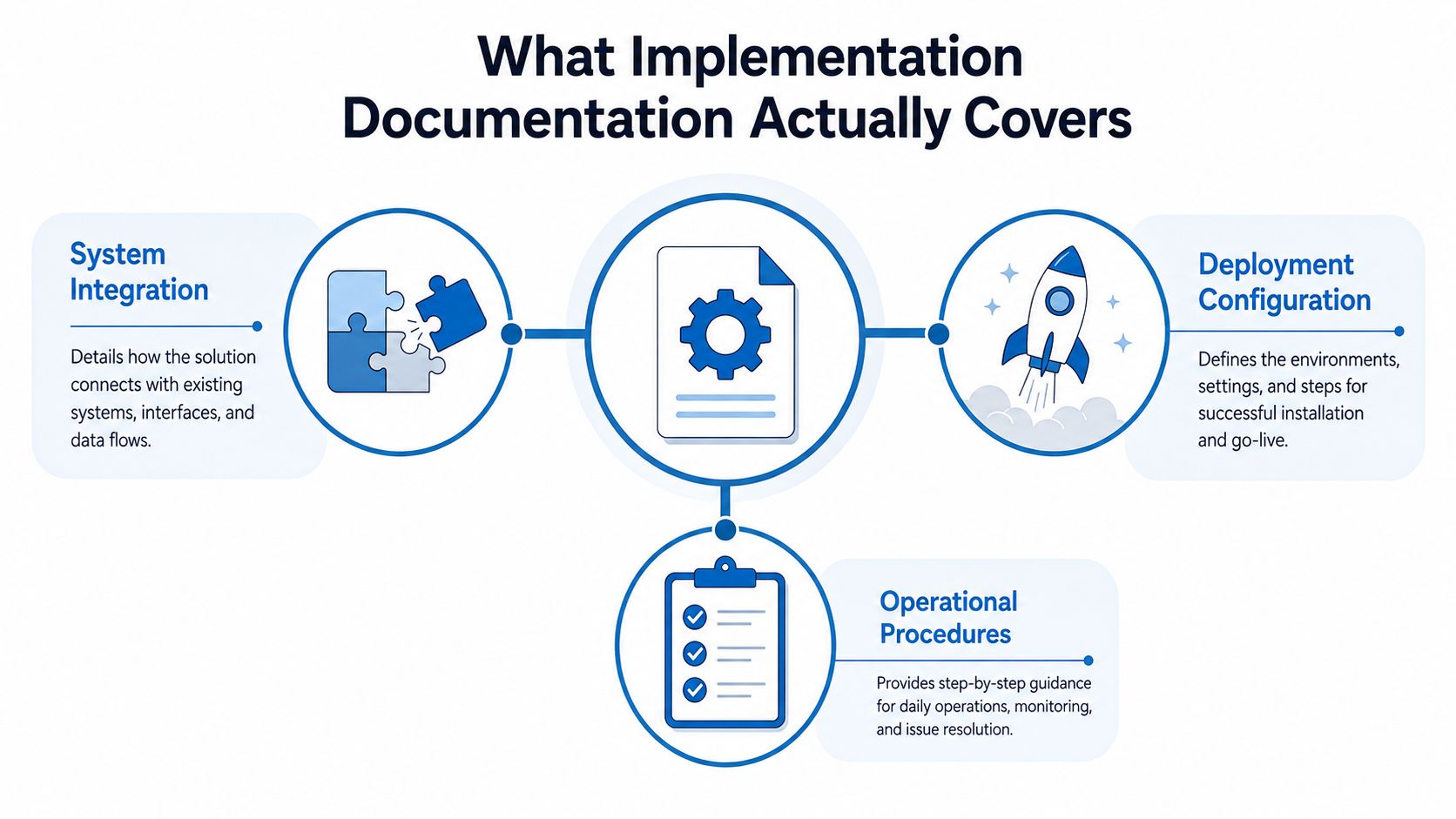
Implementation documentation is a controlled engineering artifact that gives another engineer a repeatable path to integrate with, deploy, or operate a system. It starts with an empty environment and ends with a working integration that can be supported in production. Its contents include endpoints, payloads, schemas, credentials, error behavior, configuration, and onboarding gates.
The document belongs beside the implementation, not in a separate post-launch writing queue. Review it with the code change that alters an authentication rule, response field, deployment setting, or operational procedure. That review catches stale examples and undocumented edge cases before they reach the team integrating the system.
Implementation documentation differs from general product documentation. Product documentation explains features to end users. Evaluation documentation supports purchase decisions, audits, or compliance reviews. Implementation documentation serves engineers in the IDE, terminal, deployment pipeline, and incident channel, where success means a verified request, a controlled release, and a supportable handoff.
Its practical scope includes:
- API references: Methods, paths, parameters, headers, content types, status codes, authentication requirements, and credential failure behavior.
- Integration walkthroughs: Ordered tasks from prerequisites through a verified request, including expected responses and common failure states.
- Deployment runbooks: Environment variables, secrets, release sequencing, rollback actions, health checks, and ownership.
- Onboarding checklists: Accounts, permissions, credentials, smoke tests, and acceptance gates.
- SDK and payload schemas: Typed inputs and outputs, validation rules, enums, compatibility notes, and examples that match the current release.
- Handoff records: Owners, dashboards, escalation paths, known limitations, and links to operational procedures.
Where the boundary sits
Market-facing pages, end-user manuals, and design rationale may link to implementation documentation, but they cannot substitute for it. A developer integrating a property-data API needs exact authentication behavior and response schemas, not product positioning. Teams evaluating ways to access automated property data need a developer-facing resource that exposes those integration details.
Use one test: could an engineer follow the document without asking the system's original author a question? If not, it describes intent rather than implementation.
How Standards Shaped Modern Implementation Documentation
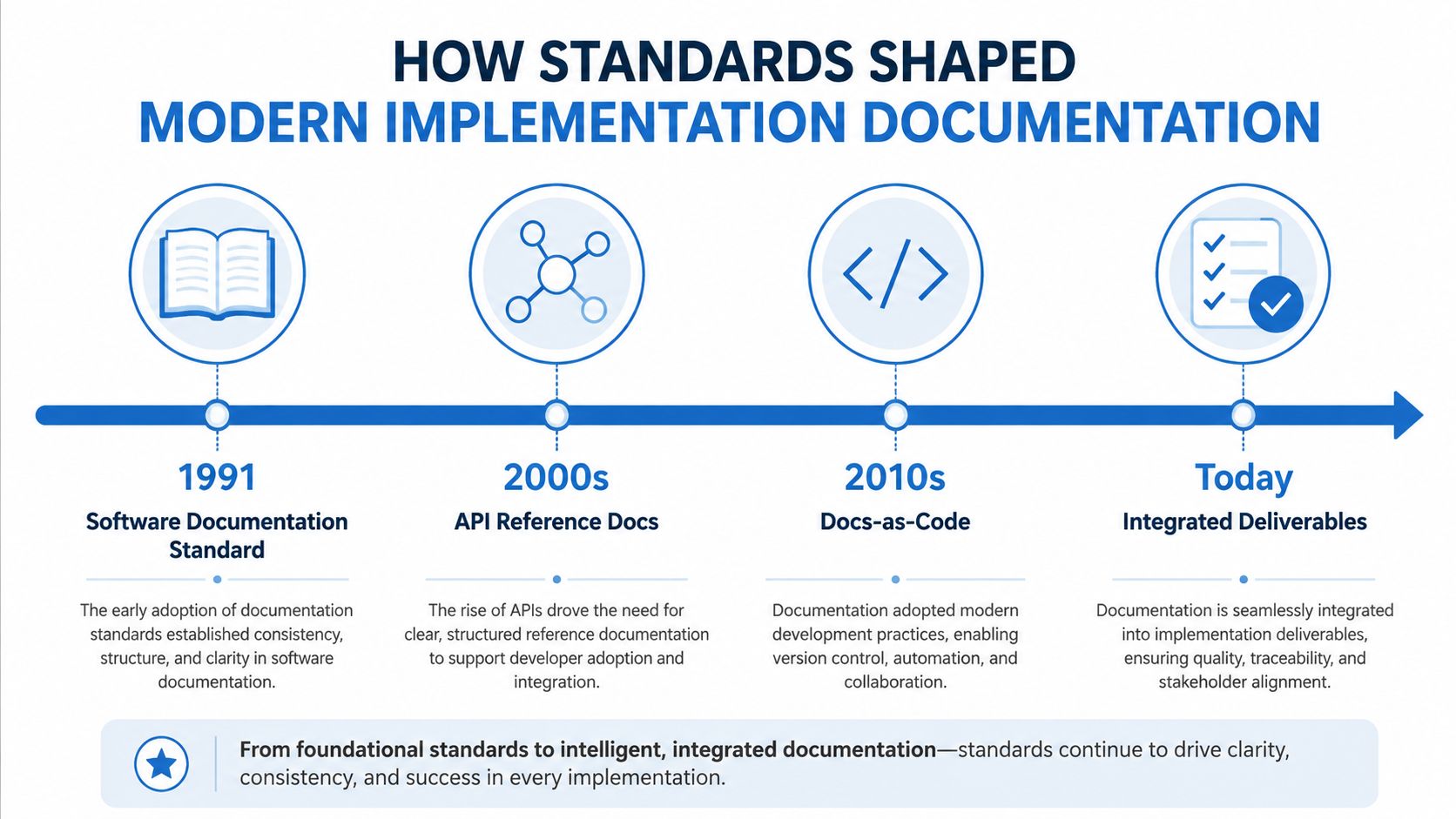
Standards made documentation a controlled engineering artifact, not project notes written after delivery. NASA approved its Software Documentation Standard on July 29, 1991. NIST guidance from the 1990s defined software documentation as reproducible, human-usable material covering development, operation, use, and maintenance (NIST software documentation guidance).
DoD MIL-STD-498 connected software development with documentation and required developers to record the software corresponding to each software unit in the configuration design (DoD MIL-STD-498). Statistics Canada later distinguished implementation records from general and evaluation documentation. Those records covered operations, inputs, outputs, schedules, resources, expenditures, and timing.
The common thread
Later frameworks, including IEEE Std 1016, IEEE Std 1063, ISO/IEC guidance, and ISO/IEC/IEEE 26514:2022, formalized information content, structure, audience, and format. ISO/IEC/IEEE 26514:2022 places user documentation within the software life cycle and defines requirements for its structure and content (ISO/IEC/IEEE 26514:2022).
The details changed, while the engineering discipline remained:
- Plan documentation with the system.
- Track it as a controlled artifact.
- Review it against implementation.
- Maintain traceability through changes and handoff.
Modern OpenAPI and AsyncAPI workflows apply the same logic. Keep documentation in the same change set as the code or contract it describes, then review authentication edge cases, rate-limit behavior, stale examples, and machine-readable structure alongside implementation changes. A post-launch writing project creates a second system that can drift from the first. The expensive mistake is allowing the contract engineers read to diverge from the contract software enforces.
Essential Components Every Implementation Doc Must Include
Every implementation document needs enough detail to make integration reproducible, diagnosable, and supportable. The following components are essential because each one closes a predictable failure path.
| Component | Must Contain | Failure When Missing |
|---|---|---|
| API surface | Base URLs, environment separation, authentication headers, OAuth scopes, token refresh, and revocation behavior | Engineers send valid requests to the wrong environment or use credentials with insufficient scope |
| Endpoint contract | HTTP method, path, parameters, content types, status codes, and idempotency keys | Clients duplicate writes, misread success, or construct requests incorrectly |
| Payload and schema | Typed bodies, required and optional fields, enums, examples, and validation rules | Integrations fail because clients guess field names, types, or allowed values |
| Error contract | Stable codes, readable messages, retry guidance, and correlation IDs | Support teams can't distinguish client errors, transient failures, and server defects |
| Environment configuration | Secrets, feature flags, region mapping, timeout budgets, and deployment dependencies | A working integration behaves differently after promotion |
| Onboarding checklist | Prerequisite accounts, sandbox and production credentials, smoke tests, and acceptance gates | Teams declare success before permissions, monitoring, or production behavior is verified |
The contract starts before implementation
Requirements should be verified before code is implemented. The OpenRegulatory software-requirements review checklist requires requirements to be traceable to design inputs or risk controls, complete, understandable, uniquely identifiable, non-contradictory, and testable with acceptance criteria (software requirements review checklist).
That traceability matters when an endpoint changes. A required field shouldn't appear in documentation because one engineer remembered it late in the release. It should connect to a requirement, an acceptance test, and a rendered reference that reviewers can inspect.
Authentication is commonly underdocumented because teams describe the happy path and omit the token lifecycle. State which credential obtains access, where the token goes, which scopes apply, how expiration is handled, and what revocation means. For errors, document the response shape, not only the status code. A correlation ID is useful only if the document tells engineers where that identifier can be used during support escalation.
A Reusable Template Structure With Example
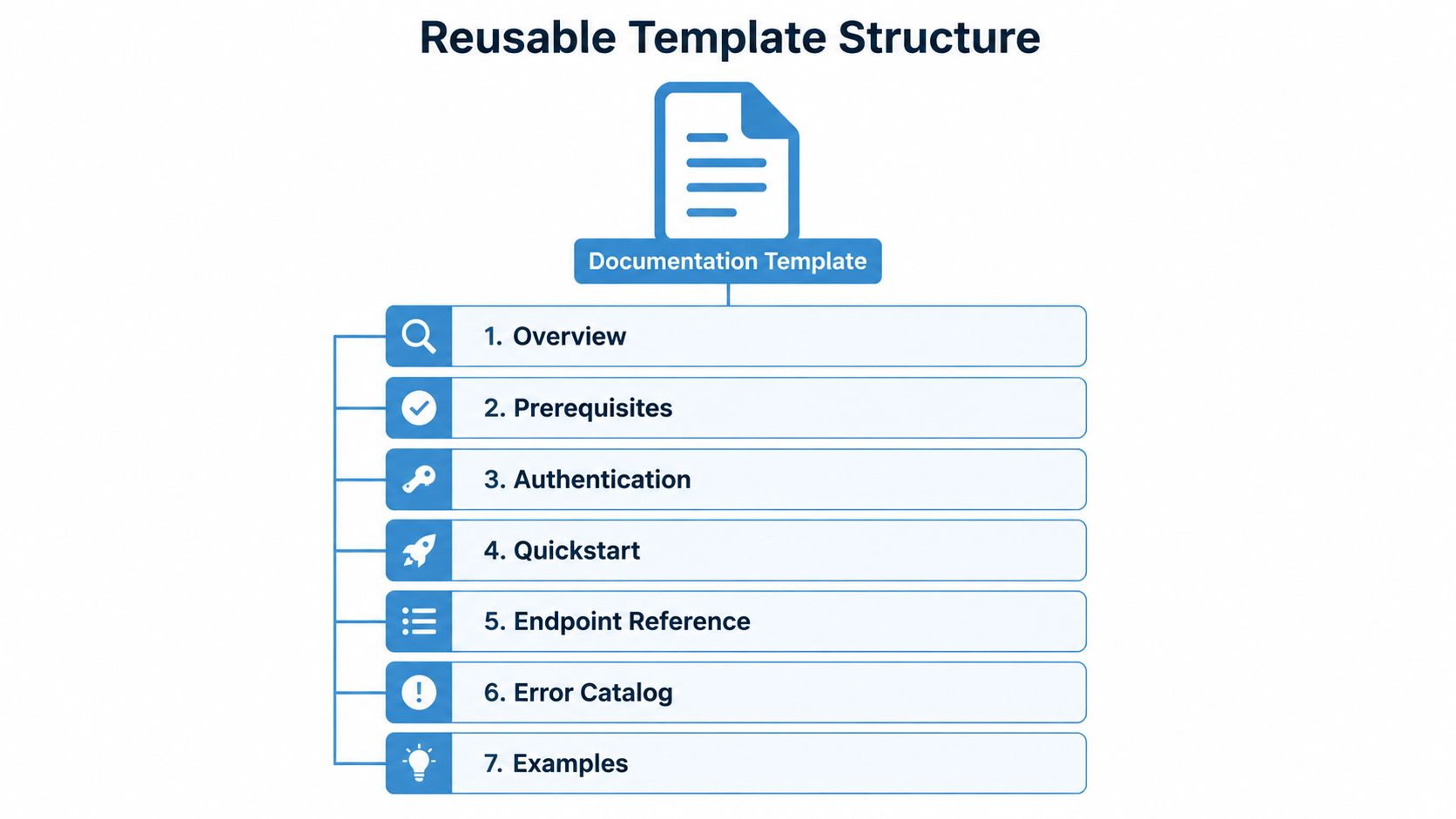
A reusable implementation-documentation template should follow the engineer's work sequence, from prerequisites through support. Use this canonical order in the repository:
- Overview
- Prerequisites
- Authentication
- Quickstart
- Endpoint Reference
- Error Catalog
- Rate Limits
- Webhooks
- Versioning
- Support
Keep one endpoint per page. Show the request and response near each other, provide copy-pasteable cURL plus an equivalent supported language, and include a status-code table whenever an endpoint is documented. Teams working with property data can also compare conventions in these real estate API documentation examples.
A rendered endpoint example
For a fictional POST /v1/transfers endpoint, the page should map every field to an action:
- Purpose: Creates a transfer from an authorized source account.
- Prerequisites: An active account, production or sandbox credentials, and permission to create transfers.
- Authentication: Bearer token with the required transfer scope.
- Request:
amount,currency,destination, and an idempotency key, with requiredness and validation stated. - Success response: Transfer identifier, status, and creation timestamp.
- Errors: Authentication failure, validation failure, duplicate idempotency key, and unavailable service.
- Status table: Each response status paired with client action.
- Support data: Correlation ID and request timestamp.
The stable reference should contain contract details that change rarely, such as field definitions and authentication mechanics. The changelog-driven lane should carry release-specific changes, deprecations, renamed parameters, and migration instructions. That separation prevents the reference from becoming a diary while preserving a clear record of what changed and when.
Runnable Code Snippets and Payload Examples
A runnable snippet must contain the authentication header, a complete request body, the expected success response, and at least one documented error state. An example that only shows the shortest successful request teaches the least useful part of the integration.
A canonical cURL example should make the variables visible without exposing credentials:
POST
Authorization: Bearer $ACCESS_TOKEN
Content-Type: application/json
Idempotency-Key: $IDEMPOTENCY_KEY

{"amount":"100.00","currency":"USD","destination":"acct_example"}
The documentation should then show a success response and explain how the client handles a 401. If the error body includes a request identifier, the example should print or preserve it for support lookup. A Python or Node example can make the same behavior easier to adopt in a README, while Java or Go belongs in the language set only when the SDK supports it.
| Quality | Good Snippet | Bad Snippet |
|---|---|---|
| Credentials | Uses placeholder variables such as $ACCESS_TOKEN |
Hardcodes a token that may be copied into source control |
| Request | Includes headers, a complete body, and required idempotency behavior | Omits headers or leaves required fields unexplained |
| Response | Shows success and a structured 401 error with request ID handling |
Returns only a successful body |
| Maintenance | Generated from the served contract and checked in CI | Handwritten separately from the API schema |
| Readability | Uses http or json syntax hints for highlighting |
Uses unmarked blocks that are harder to scan |
Practical rule: If an example can't be run, copied, and diagnosed, label it as pseudocode or remove it.
The strongest workflow generates snippets from the same OpenAPI specification the API serves. A schema change should break the documentation build or example tests rather than shipping stale copy. That is the difference between an example that demonstrates an interface and one that merely resembles it.
Versioning, Change Logs, and Docs-as-Code Workflows
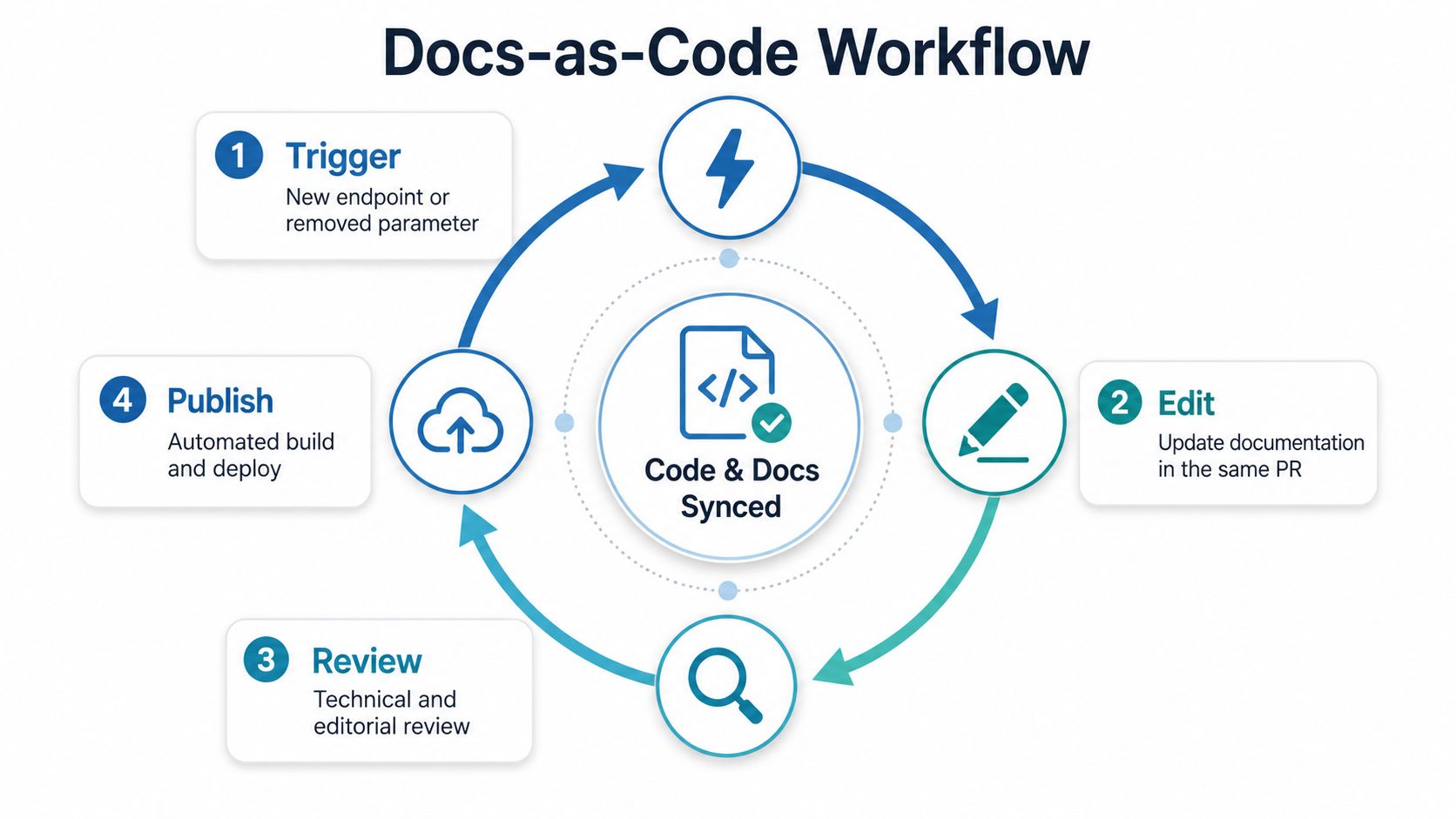
Documentation must change in the same pull request as the implementation that changes the contract. Google's documentation guidance recommends storing documentation with source, versioning it with code, reviewing it in the same change set, and checking for stale links or broken examples (Google documentation guidance).
A documentation edit is mandatory when a release introduces an endpoint, removes a parameter, changes a default, alters authentication, or opens a deprecation window. Use a changelog entry with these fields:
- Date
- Version
- Category, Added, Changed, Deprecated, Removed, or Fixed
- One-line summary
- Diff link
A workable pipeline
Keep the OpenAPI specification beside the service that owns it. Configure CI to fail when an endpoint lacks a description, required schema metadata is absent, examples no longer validate, or internal links break. A scheduled publishing job can render the approved documentation site, but publication shouldn't bypass review.
The review path should identify the people who can catch different defects:
- Technical review: The service owner verifies behavior and examples.
- Documentation review: A documentation reviewer checks structure, terminology, and task order.
- Product approval: The product owner signs off before a major compatibility change.
- Support notification: Support receives notice before a breaking change reaches customers.
Controlled management also needs named ownership. A document-management SOP recommends designating a document controller with exclusive edit access and requiring review, approval, and sign-off by relevant department heads or delegates (document management and version-control SOP). Ownership isn't bureaucracy when a stale authentication page can block every new integration.
The same release discipline applies to data integrations. Teams can review why version control matters for data rules when deciding how contract changes should move through source control and approval.
When the Quickstart Works but Production Still Fails
A quickstart proves that one narrow path works. It doesn't prove that the integration survives production conditions. The missing layer usually contains the operational details that tutorials avoid, including throttling, credential edge cases, retry semantics, pagination, and partial success.
Rate-limit documentation often becomes inaccurate after deployment. A published quota may not match a production throttle, a response may expose retry metadata that the page ignores, or separate environments may enforce different policies. The fix isn't another paragraph in the quickstart. Maintain a rate-limit policy table with the enforced behavior, response indicators, retry guidance, and owner.
Authentication failures also hide outside the happy path. Token clock skew, expanded scopes, and audience mismatches between identity providers can produce a credential that looks valid while the receiving service rejects it. The authentication page should describe those failure modes and show the diagnostic fields an engineer must inspect.
Pages that need release review
Some pages are coupled directly to production behavior and deserve review for every relevant release:
- Authentication flows: Token acquisition, scopes, audiences, expiration, refresh, and revocation.
- Error catalogs: Codes, retry advisability, response shapes, and correlation identifiers.
- Webhook instructions: Signature verification, delivery behavior, replay handling, and failure response.
- Rate-limit tables: Quotas, headers, backoff rules, and environment differences.
Sandbox environments commonly hide retry behavior, pagination differences, and partial-success responses. The operational layer should therefore be owned by the engineer responsible for the runbook, not by a separate writer working only from a changelog. That owner can compare the document against dashboards, alerts, deployment configuration, and observed incidents.
The most dangerous documentation is not missing documentation. It's a confident example that no longer matches production.
Developer and Operations Handoff Responsibilities
A handoff works when developers and operations sign off on the same behavioral contract. Developers know the API surface and SDK setup. Operations knows whether the documented behavior can be monitored, supported, and recovered under real conditions.
| Doc Section | Developer Owner | Operations Owner | Acceptance Criteria |
|---|---|---|---|
| Endpoint references | Methods, paths, parameters, schemas, and examples | Consumes contract for service monitoring | Requests and responses validate against the approved specification |
| Authentication | Headers, scopes, token lifecycle, and client setup | Secret handling, access escalation, and incident support | Valid and invalid credential paths are documented and tested |
| Error catalog | Error shape, codes, and client interpretation | Correlation lookup, alert routing, and escalation | Each operationally relevant error has an owner and response action |
| Rate limits | Client behavior and retry guidance | Enforced policy, dashboards, and alerts | Documented limits match deployed behavior |
| Webhooks | Event payloads and signature verification | Delivery monitoring, replay process, and failure handling | Operators can identify, investigate, and recover delivery failures |
| Runbook references | Links from implementation tasks | Recovery commands, dashboards, and on-call ownership | Links resolve and the documented procedure matches the live service |
| Changelog | Contract changes and migration notes | Customer impact and release communication | Change category, version context, and support action are explicit |
The acceptance boundary
Handoff should happen through a pre-release review meeting and a docs-as-code pull request that links the documentation to dashboards and runbooks. The go-live checklist must verify that monitoring, alerting, and on-call rotations match the behavior described in the document.
Shared ownership is especially important for authentication, error catalogs, and changelogs. Neither team can approve those sections alone because each combines implementation truth with operational consequence. A structured developer onboarding process can help make the same contract visible to new engineers before they inherit support responsibility.
Troubleshooting Common Implementation Failures
Troubleshooting should start with the symptom and the first observable artifact, not with a general reread of the guide. The following playbook helps separate a client mistake from a server-side contract change.
| Symptom | First Check | Common Root Cause | Fix and Verification |
|---|---|---|---|
| Authentication failure | Inspect token claims, scope, audience, and expiry | Wrong environment, missing scope, expired token, or identity-provider mismatch | Obtain the correct credential, retry the documented request, and retain the correlation ID |
| Schema mismatch | Diff the request and response against the OpenAPI schema | Incorrect field type, missing required field, renamed property, or stale generated client | Update the payload or client, rerun contract validation, and verify both success and error responses |
| Rate-limit exhaustion | Check the response status and retry-related headers | Client burst behavior, undocumented throttling, or missing backoff | Apply the documented retry policy, reduce concurrency, and confirm recovery without duplicate writes |
| Configuration drift | Compare the deployed service version with the documentation version | Feature flag, region, secret, timeout, or release mismatch | Align configuration and docs, redeploy if necessary, and run the environment smoke test |
The triage path
- Capture the structured error. Preserve the status, stable error code, message, timestamp, and correlation ID.
- Compare contracts. Check the deployed version, schema, authentication rules, and environment configuration.
- Classify ownership. A malformed client payload is integration debt. A changed server response without a documented contract update is documentation or release debt.
- Verify the fix. Reproduce the original symptom, test the corrected path, and add the missing case to the relevant example or runbook.
A support ticket that says “the API failed” is not actionable. A ticket containing the request shape, response code, correlation ID, environment, and documentation version gives the service owner a diagnosable starting point.
Writing Docs That Work for AI-Assisted Discovery
AI-assisted discovery works best when implementation documentation is explicit, consistent, and machine-readable. An internal copilot or language model can retrieve an answer reliably only when the document states the constraints instead of relying on implied context.
Use the same field names across endpoint pages, schemas, examples, changelogs, and support responses. Declare types, requiredness, defaults, allowed values, and error conditions directly. Similar concepts need distinct names, especially when “account,” “customer,” “owner,” and “destination” refer to different objects.
Structure for retrieval
- Stable terminology: Use one canonical term for each resource and don't alternate between synonyms.
- Explicit defaults: State what happens when a client omits a field.
- Anchored examples: Give canonical code samples stable headings or anchors that other pages can reference.
- Structured metadata: Pair narrative explanation with OpenAPI, frontmatter, and typed schemas.
- Complete error states: Document invalid credentials, validation failures, throttling, and partial outcomes.
The emerging guidance on AI documentation also emphasizes runnable examples, explicit errors, predictable structure, OpenAPI-generated references, and synchronized changelogs (AI documentation trends). The important shift isn't adding a chatbot to a documentation site. It's making the underlying content precise enough that retrieval doesn't need to guess.
Run a review question before release: could an internal copilot answer a developer's implementation question correctly using only this document? If the answer depends on an undocumented default, a page hidden behind a different term, or an example that diverges from the schema, the documentation isn't ready for human or machine consumption.
Quick Reference, Glossary, and Cross-Reference Index
A good quick reference lets an engineer find the relevant contract or recovery action without rereading the entire guide. Pin the checklist beside the onboarding workflow, handoff record, or on-call rotation.
Components checklist
Every implementation document should confirm:
- Scope: Integration, deployment, operations, and explicit exclusions.
- Requirements: Traceable, testable prerequisites and acceptance criteria.
- API contract: URLs, methods, parameters, headers, schemas, statuses, and idempotency.
- Security: Credential flow, scopes, token lifecycle, secrets, and revocation.
- Failure behavior: Error shapes, retry guidance, correlation IDs, and escalation.
- Environment behavior: Sandbox and production differences, flags, regions, and timeouts.
- Maintenance: Owner, version, changelog, review status, and source-control location.
Working glossary
- Endpoint: A callable API operation identified by a method and path.
- Payload: The data sent in a request or returned in a response.
- Schema: The typed contract describing payload structure and validation.
- Idempotency key: A client-supplied value used to prevent repeated processing of the same write.
- Rate-limit budget: The permitted request capacity and the policy for handling exhaustion.
- Correlation ID: An identifier used to connect a client request with server logs and support investigation.
- Runbook: An operational procedure for deployment, diagnosis, recovery, or rollback.
| Term or Task | Go To | Why It Matters |
|---|---|---|
| Start a new integration | Template structure and quickstart | Establishes prerequisites and the shortest verified path |
| Validate an endpoint | Essential components and runnable snippets | Confirms the contract, examples, and error behavior agree |
| Investigate a failed request | Troubleshooting playbook | Routes the symptom to the correct diagnostic and owner |
| Review a release | Versioning and changelog workflow | Ensures code, docs, support, and approvals move together |
| Prepare production handoff | Developer and operations matrix | Verifies monitoring, alerts, runbooks, and ownership |
| Improve AI retrieval | AI-assisted discovery guidance | Removes ambiguity, hidden defaults, and inconsistent terminology |
Use the template as a review checklist, the troubleshooting table during incidents, and the versioning workflow during every contract change. That turns implementation documentation from passive reference material into an operating control.
BatchData provides developer documentation for real estate APIs, including authentication guidance, endpoint exploration, and sample requests and responses that teams can use before deployment. Visit BatchData to evaluate a documented property-data integration for applications that need structured records, ownership information, valuations, and related real estate signals.