
Managing transformation rules without version control is a recipe for chaos. In real estate data pipelines, these rules standardize, map, and enrich property data. But when changes to these rules go untracked, the consequences – like broken dashboards, corrupted datasets, and financial losses – can ripple across the system.
Here’s why version control is indispensable:
- Traceability: Tracks every change, who made it, and why.
- Consistency: Prevents mismatched data outputs over time.
- Error Prevention: Catches issues before they disrupt pipelines.
- Rollback Capability: Quickly reverts to prior stable versions during incidents.
- Collaboration: Ensures team-wide visibility and approval of changes.
Master Data Pipeline Version Control
The Risks of Not Versioning Transformation Rules
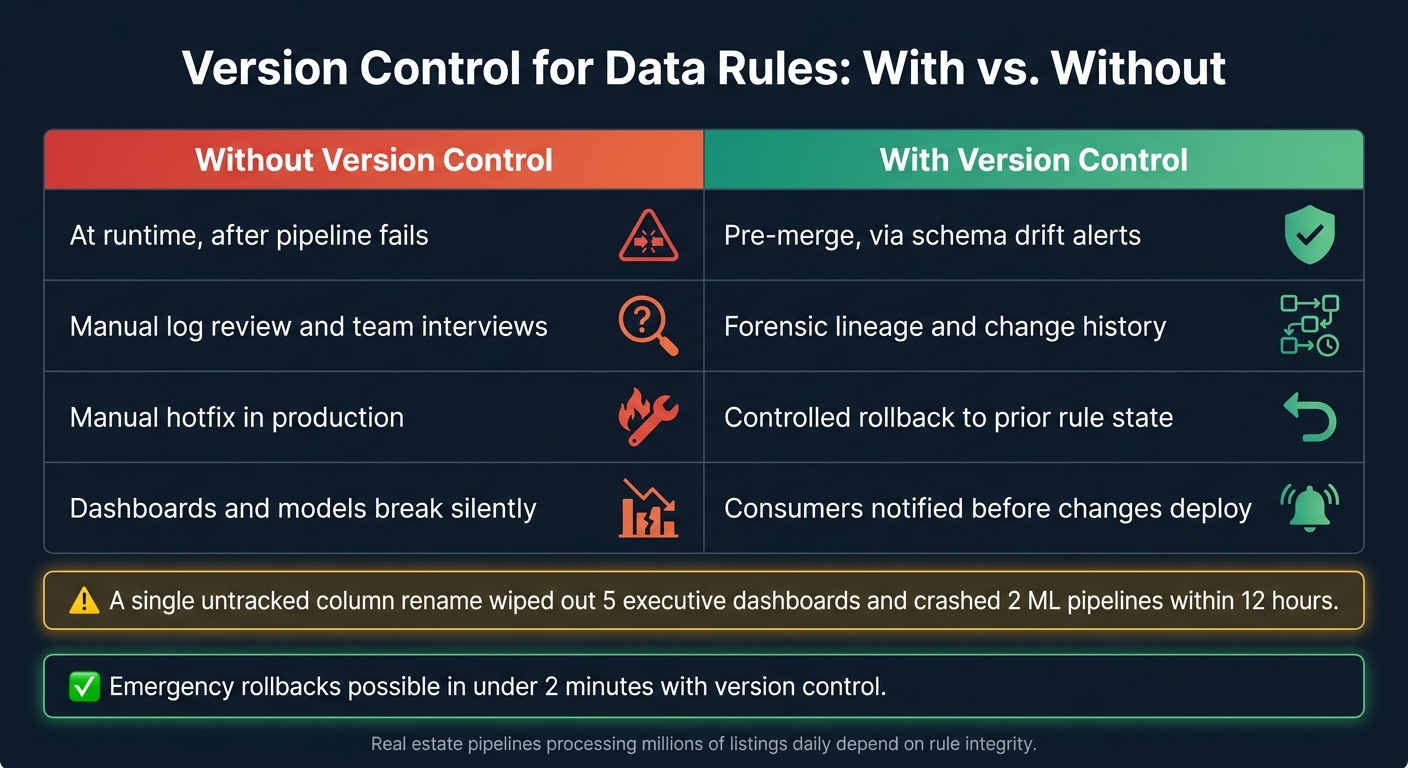
Version Control for Data Rules: With vs. Without
The dangers of skipping version control for transformation rules don’t usually show up with flashing lights. Instead, they creep in over time, revealing themselves as inconsistent data, broken dashboards, or even financial reporting errors. Here’s a closer look at the specific issues this can cause:
No Traceability or Accountability
When transformation rules are updated without a recorded history, tracking down the source of a data issue turns into a tedious guessing game. Teams have to manually reconstruct what changed, wasting hours and increasing the chance of errors. Without a clear change log, there’s no record of who made the change, why it was made, or which datasets were impacted. For industries like real estate, where audits and regulatory reviews are common, this lack of traceability can become a serious liability.
Inconsistent Data Outputs
Untracked rule changes can lead to data outputs that don’t align over time. For example, if you’re analyzing trends – like median home prices across a metro area over 18 months – you can’t trust the results if older data reflects one logic and newer data follows updated rules. This inconsistency undermines the reliability of trend analysis and decision-making.
Higher Risk of Data Quality Problems
Silent changes to transformation rules can introduce errors into datasets without causing an immediate system crash. For instance, a vendor might switch date formats, apply the wrong unit conversion, or misclassify property types. These unnoticed errors can corrupt thousands of records before anyone realizes something is wrong.
"An engineering team renames a database column from user_id to customer_id for better clarity. Twelve hours later, five executive dashboards show blank values, two ML pipelines have crashed, and your data engineering team is deep in a preventable incident." – Tenets of Data, March 2026
The financial implications can be huge. Take the case of a county tax assessor’s office that failed to normalize data properly. They overlooked 25,000 acres of oil fields, resulting in a $12 million annual revenue shortfall.
Team Conflicts When Editing Rules
Without version control, simultaneous edits to transformation rules can cause confusion and miscommunication. Teams working downstream – like those monitoring dashboards or machine learning models – often have no visibility into upstream changes. This lack of coordination leads to a “hotfix culture,” where teams rush to patch issues in production, making systems more fragile over time. These conflicts not only slow down resolution but also increase the risk of major pipeline failures.
Pipeline Downtime and Financial Loss
Untracked rule changes can degrade data quality and lead to operational downtime. If a breaking change is only discovered during runtime, pipelines may need to be shut down immediately. In high-volume industries like real estate, where millions of listings are processed daily, even a few hours of downtime can delay updates, disrupt platforms, and hurt client trust. The financial fallout grows when teams have to spend days backfilling and correcting records for the affected period.
These challenges emphasize why version-controlling transformation rules is so critical.
| Scenario | Without Versioning | With Versioning |
|---|---|---|
| Breaking change detected | At runtime, after pipeline fails | Pre-merge, via schema drift alerts |
| Root cause investigation | Manual log review and team interviews | Forensic lineage and change history |
| Recovery method | Manual hotfix in production | Controlled rollback to prior rule state |
| Downstream impact | Dashboards and models break silently | Consumers notified before changes deploy |
How Version Control Addresses These Problems
Version control fundamentally changes how rule management is handled, addressing the risks and inefficiencies of traditional methods. By logging every change – along with the author, timestamp, and reasoning – it transforms fragile scripts into well-managed assets. This approach eliminates gaps in traceability and accountability.
A Single, Shared History of Rule Changes
Without version control, critical business logic often resides in the minds of individual team members or gets buried in scattered email threads. Version control consolidates this knowledge into a shared, searchable codebase. This shared history is invaluable for performing precise historical analyses, like tracking median sale prices over long periods. With this foundation, teams can safely test changes, collaborate effectively, and maintain consistent data quality.
Safe Testing and Easy Rollback
Branching allows analysts to test rule changes in isolation using staging data. If a problem arises after deployment, a single command can roll back to the previous stable version. As dbt Labs explains:
"If a deployment introduces errors, the main branch can be reverted to its previous state. The deployment automation then runs again, restoring production to the last known good state. This safety net makes teams more confident in deploying changes frequently."
This process enables emergency rollbacks in under two minutes, compared to the hours of manual debugging that would otherwise be required.
Controlled Collaboration Across Teams
Pull requests bring structure to the review process. Every rule change must go through an approval process before it reaches production. This ensures that another team member reviews the logic, evaluates downstream impacts, and confirms compliance with data contracts. By catching potential issues early, teams can avoid last-minute fixes that disrupt dashboards and models. Additionally, enforcement gates – at pre-commit, pull request, and post-merge stages – help catch problems before they reach the data warehouse.
Better Data Quality and Consistency
Version control supports gradual, tested rollouts instead of sudden, unannounced changes. Automated tests run with every commit to validate schema integrity, check null rates, and monitor distribution shifts. Teams often aim for a maximum validation failure rate of 0.5% for new commits, ensuring most issues are caught before they can affect production. For real estate pipelines processing millions of property records daily, this level of automated quality control can prevent silent data corruption and maintain trustworthy outputs. Semantic versioning further clarifies the impact of changes, providing a structured way to communicate updates.
Using Semantic Versioning to Communicate Change Impact
Semantic versioning – structured as MAJOR.MINOR.PATCH – offers a clear way to describe the scope of a rule change.
- A major version signals a breaking change, like altering how square footage is normalized, which could disrupt existing comparisons and require updates from downstream teams.
- A minor version adds backward-compatible changes, such as introducing a new optional zoning classification field, allowing teams to adopt the update at their own pace.
- A patch addresses non-breaking fixes, like correcting a typo in a field description, which can be deployed immediately without affecting functionality.
| Version Type | Example in Real Estate Data | Downstream Impact |
|---|---|---|
| MAJOR | Changing how square footage is normalized | Breaks existing comparisons; requires consumer updates |
| MINOR | Adding an optional zoning classification field | Backward-compatible; consumers can adopt at their own pace |
| PATCH | Fixing a typo in a field description | No functional change; safe to deploy immediately |
This system ensures downstream teams – like those managing dashboards, machine learning models, and reporting tools – are informed well in advance, avoiding unexpected issues after deployment.
How to Set Up Version Control for Real Estate Data Rules
Deciding What to Version
Start by pinpointing all the elements that influence your data outputs. In real estate pipelines, some of the most vital components include address standardization rules (such as USPS formatting logic), normalization scripts that standardize variations like "St" and "Street", unification algorithms that resolve discrepancies between public records and MLS data, and enrichment models like automated valuation models (AVMs) or propensity scores. Schema definitions and automated test cases are also essential to track – any change to these files could impact downstream dashboards or models. Once identified, make sure to consistently integrate version control metadata throughout your pipeline.
Embedding Version Control Into Your Pipelines
Every output – whether delivered via REST API or in bulk – should be tagged with the corresponding rule version at each stage: ingestion, enrichment, and delivery. This ensures traceability, aligning with the broader goals of accountability and consistency. BatchData describes this process as:
"A property data solution’s core function is to execute a three-step process: ingest raw data, enrich it with computed intelligence, and deliver it through a flexible, usable format."
By embedding version tags at each step, analysts can easily trace which rule set was used to generate a specific property record, whether it was retrieved in real time via an API or loaded in bulk through systems like Ando Snowflake or S3.
Setting Up Governance and Change Management
Establish a clear workflow to ensure no rule changes reach production without proper oversight. This should include pull requests, peer reviews, and documented justifications. Adopt a MAJOR.MINOR.PATCH versioning system to clearly communicate the scope of changes. Maintain public, interactive documentation with practical code examples to help engineering teams implement updates efficiently. For larger pipelines, providing onboarding resources and direct communication channels can ease transitions when rule sets are updated. With governance in place, continuous monitoring will help ensure that rule changes do not disrupt downstream processes.
Monitoring and Validating Rule Changes
Validation processes should be automated and ongoing. Document baseline source schemas (including column names, data types, and constraints) in your repository. Then, integrate schema checks into your ingestion pipeline to catch deviations before they impact downstream systems. For minor, non-breaking changes, an alert may suffice while processing continues. Use time-travel queries (e.g., with Delta Lake or Apache Iceberg) to perform "as of" comparisons between rule versions, ensuring changes behave as expected before they are fully deployed to production.
Using Professional Services and Automation
Managing pipelines for millions of U.S. property records is a complex task. Companies like BatchData simplify this process by handling large-scale data aggregation, unification, and enrichment. Their services include daily nationwide database updates, ensuring that versioned rules are applied to the most current data. BatchData’s Portfolio Monitoring service offers automated alerts for critical events like new liens, ownership changes, and foreclosure activity. This acts as an additional validation layer, verifying that transformation rules effectively capture real-world changes. For teams seeking to cut down on manual efforts, automating data verification through property data APIs can reduce underwriting labor costs by more than 50%.
Conclusion: The Case for Version Control in Real Estate Data
Untracked transformation rules can cause chaos. Imagine this: a single column rename, done without notice, wipes out five executive dashboards and disrupts multiple pipelines – all within 12 hours. The fallout isn’t just about fixing the tech; it hits finances and operations hard.
This is where version control becomes indispensable. It doesn’t just track changes – it makes them auditable. By turning rule updates into traceable events, version control ensures time-series analyses are accurate, showing exactly when and how business logic shifted. As Vexdata explains:
"Data version control addresses [business rule changes] by recording transformation rule changes as versioned events – so that any historical analysis can be qualified against which version of the business rule was active for a given time period."
The perks don’t stop there. Version control catches schema drift early, stopping bad data before it wreaks havoc downstream. Semantic versioning lets users know if an update is breaking or backward-compatible right away. And if something does go wrong? Rollback features can restore operations in under 30 minutes. Automated audit trails add another layer of security, replacing error-prone manual tracking with a compliance record – critical when penalties like GDPR fines can climb to €20 million or 4% of global annual revenue.
In short, version control is the backbone of reliable data pipelines. Whether you’re running automated valuation models, skip tracing, or bulk property data enrichment with tools like BatchData, the quality of your outputs depends on the integrity of the rules shaping them. Version control ensures that integrity stays intact at every stage.
FAQs
What exactly should be versioned in data transformation rules?
To ensure your data processes are reliable and consistent, it’s essential to version key components of your transformation logic. Here’s what to focus on:
- Transformation logic: This includes elements like SQL models, pipeline DAGs, and business rules. Versioning these ensures that any updates or changes are tracked and reproducible.
- Schemas: Every time there’s a structural change to files, tables, or APIs, create a new schema version. This helps manage compatibility and ensures clarity in data structure over time.
- Reference tables: Versioning these is crucial for maintaining consistent results, even as underlying data or business rules evolve.
For each version, include detailed metadata such as the reasons for changes, approval logs, and effective dates. This extra layer of documentation makes it easier to trace changes and maintain accountability.
How do you tie a rule version to each dataset or API response?
To ensure traceability and maintain a clear record of applied logic, it’s important to associate a rule version with each dataset or API response. Treat the version ID as key metadata and attach it directly to the output.
When applying a rule to a business object, store a rule_version_id on the object itself. This makes it easier to track changes during audits or when re-checking data.
For APIs, make sure the version ID is included in either the metadata header or the response body. This provides a clear and consistent way to trace the logic that was applied.
When is a change MAJOR vs. MINOR vs. PATCH for data rules?
Versioning for data rules follows a Major.Minor.Patch format to maintain clarity and control over updates. Here’s how it works:
- Major changes: These are big updates, such as introducing new business rules. They often require comprehensive testing to ensure everything functions correctly.
- Minor updates: These cover improvements that are backward-compatible, like refining existing logic. They enhance functionality without breaking previous setups.
- Patch updates: These focus on fixing bugs or making optimizations. They’re designed to be non-disruptive, ensuring workflows and historical data remain unaffected during deployment.