






































You've probably seen this failure: an address looks perfectly reasonable in a CRM, passes a basic geocoder, and still produces returned mail, a misplaced property point, or a bad downstream match. How to validate addresses correctly requires two separate answers: can mail reach the location, and where exactly is it?
A reliable workflow parses and standardizes raw input, verifies postal deliverability with authoritative data, evaluates geospatial precision separately, and preserves every uncertain result for review. It also treats freshness, exception handling, and auditability as production requirements, not cleanup tasks.
- Postal correctness: Normalize the record and compare it with postal standards.
- Deliverability: Use CASS, DPV, and related USPS signals to determine whether mail can reach a delivery point.
- Spatial precision: Classify geocoding as rooftop, interpolated, or centroid.
- Operational resilience: Handle retries, fallbacks, duplicates, and human review without collapsing everything into a Boolean.
- Governance: Track freshness windows, source versions, confidence, and compliance requirements.
The practical difference between a trustworthy address pipeline and a fragile one is the separation of these layers.
Why Address Validation Is an Ongoing Infrastructure Problem
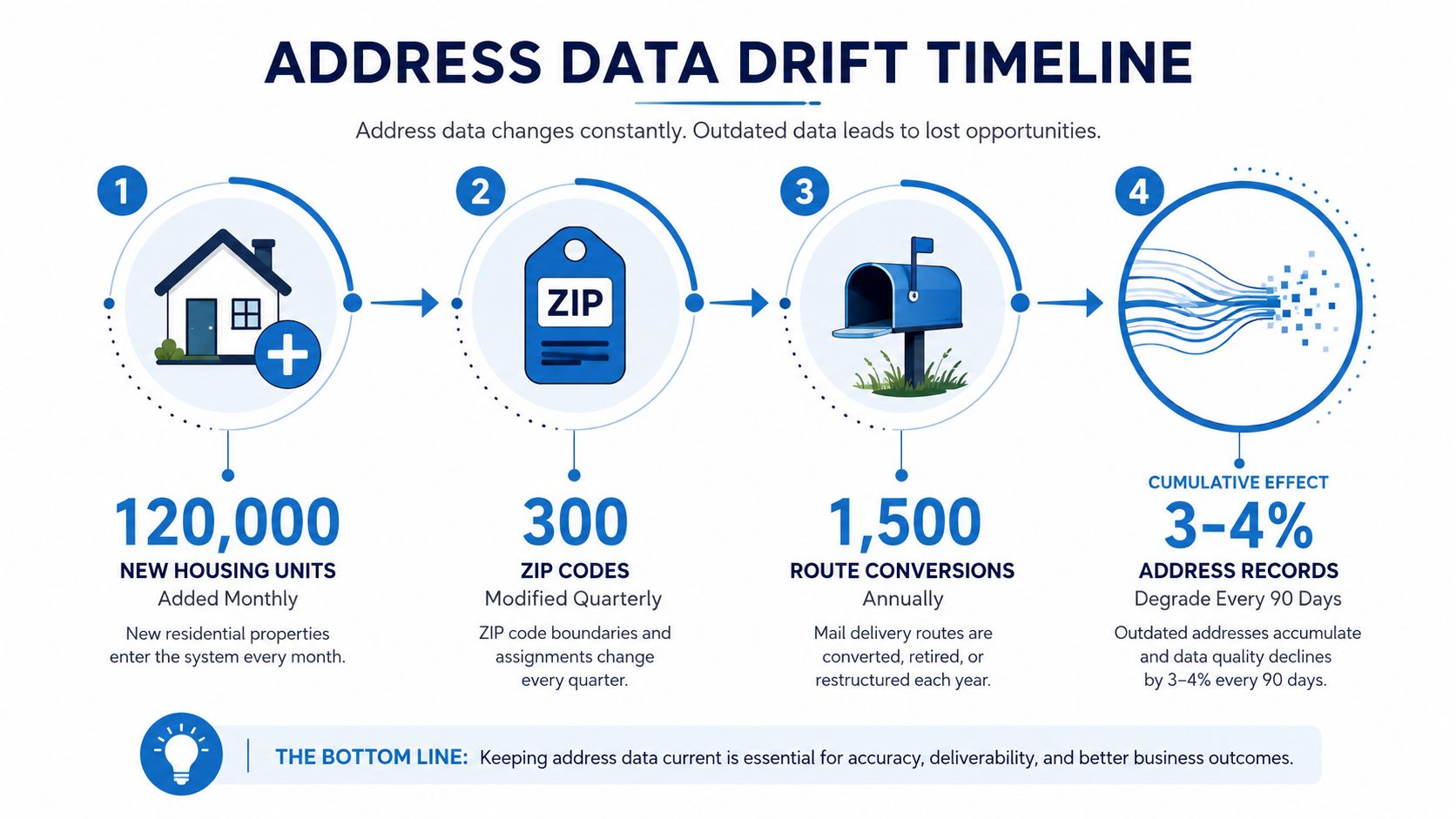
Address validation is recurring data infrastructure, not a one-time cleanup task. According to USPS Publication 28, approximately 17% of Americans change addresses annually, which translates to roughly 45 million moves each year. The same source also describes annual relocation as affecting about one in six families. For lenders, insurers, property platforms, marketers, and delivery teams, stale records are therefore an operational certainty. USPS Publication 28 explains address completeness, standardization, validation, and mailing-list timing requirements.
A corrected address can become incorrect later. A new tenant, changed unit assignment, rural-route conversion, annexation, or postal database update may alter the record's meaning without materially changing its visible text. Validating only at initial capture eventually pushes outdated data into shipping calculations, tax logic, fraud controls, property matching, and customer communications.
Two questions, two layers
A dependable design separates two outcomes:
- Deliverability: Does an authoritative postal reference recognize the record as a mailable delivery point?
- Spatial precision: Does the location resolve to a rooftop, parcel, interpolated street position, or broader centroid?
A ZIP code match answers neither question completely. A geocoder may return coordinates for an address USPS cannot deliver to. A valid postal address may receive a low-precision spatial result because the mapping source lacks a parcel or unit feature. Combining these results into one Boolean hides the trade-off and can contaminate downstream property or risk workflows.
Postal-system history reinforces the distinction. The UK postcode rollout began in 1965 after a 1959 Norwich pilot, the national system was completed in 1974, and the Postcode Address File was formally created in 1985. These milestones trace the shift from routing labels toward structured address datasets. The Software Bureau's timeline covers the development of the UK Postcode Address File and modern addressing infrastructure.
The pipeline that holds up
A production sequence should include:
- Parse: Split free text into street, locality, region, postal code, country, and secondary information.
- Standardize: Apply postal abbreviations, casing, punctuation, and field rules.
- Verify: Run authoritative postal matching, including USPS CASS and DPV.
- Geocode: Assess the spatial result independently from postal acceptance.
- Deduplicate: Match records using validated components or stable identifiers.
- Monitor: Track pass rates, fallback rates, freshness, and exception buckets.
Do not overwrite the submitted value with a provider's “clean” result and discard the trail. Retain the original input, corrected value, provider response, validation timestamp, and confidence signals. That record history lets engineers explain why a mortgage file, property parcel, or mailing list changed, and it gives downstream systems enough context to reject low-confidence fallbacks instead of treating them as verified facts.
How Should You Parse and Standardize Raw Address Input?
Parsing converts unstructured text into address components, while standardization makes those components consistent with postal rules. Neither step proves that the location exists. They prepare the record for authoritative matching.
Start by retaining the original input exactly as submitted. Then tokenize the value into likely components, identify unit designators, and normalize directional and street-suffix terms. USPS Publication 28 defines standardized address elements and requires Postal Service abbreviations for standardized addresses. These address normalization techniques provide useful implementation context for turning inconsistent input into structured fields.
A practical normalization sequence
- Separate major fields. Identify address lines, city, state or province, postal code, and country before attempting corrections.
- Extract secondary information. Detect
APT,STE,UNIT, and#, but don't discard an unrecognized unit token. - Normalize directionals. Convert directional forms such as
Ninto the selected canonical representation, such asNORTH, when the target standard requires it. - Map suffixes. Apply USPS suffix mappings, including
STtoSTREET,AVEtoAVENUE, andBLVDtoBOULEVARD. - Normalize typography. Use consistent casing, remove unnecessary punctuation, and trim duplicated whitespace.
- Keep uncertainty visible. A parser should emit a confidence or exception state when a token could represent a unit, street name, or locality.
For example, a raw input such as 123 1/2 N. Maple Ave., Apt 3b can become 123 1/2 NORTH MAPLE AVENUE, APT 3B. That transformation improves matching because equivalent strings now share predictable components. It still doesn't establish that apartment 3B exists or that the address receives mail.
| Raw Input | Standardized Output | Rule Applied |
|---|---|---|
123 1/2 N. Maple Ave., Apt 3b |
123 1/2 NORTH MAPLE AVENUE, APT 3B |
Expand directional and suffix, normalize casing and punctuation |
45 W Oak St #7 |
45 WEST OAK STREET APT 7 |
Normalize directional, expand suffix, map secondary designator |
800 S. River Blvd., Ste. 210 |
800 SOUTH RIVER BOULEVARD STE 210 |
Expand directional and suffix, standardize suite notation |
Edge cases require rules, not guesswork
Dual-address ranges can contain both a physical location and a mailing destination. Half addresses can include fractional house numbers that a simplistic numeric parser wrongly rounds or drops. Puerto Rico urbanizations add another common failure point because the urbanization name can be essential to identifying the location and doesn't always fit a conventional U.S. street-line pattern.
Don't “correct” these records by choosing the most familiar format. Store the unresolved structure, send it through a provider that supports the relevant addressing convention, and route ambiguous results to review. A parser's job is to expose structure and uncertainty, not manufacture certainty.
What Do CASS and DPV Prove?
A formatted address can look perfect and still fail at the mailbox. CASS standardizes and evaluates address-matching software, while DPV supplies delivery-point evidence. Together, they support postal decisions, but neither label alone proves that a property record is complete, occupied, or suitable for a downstream spatial workflow.
USPS defines CASS as a quality framework for address-matching software. Its supported capabilities include 5-digit coding, ZIP+4 and delivery-point coding, carrier-route coding, DPV and DSF2, LACSLink, SuiteLink, eLOT, and RDI. The USPS CASS certification documentation defines the certification framework and supported address-matching capabilities.
CASS is the software and process gate. DPV is the delivery-point signal. A DPV Y generally supports a confirmed delivery point. N means the submitted address has no confirming match. S commonly indicates that the primary address is recognized, while secondary information is missing or unresolved. A blank or unavailable response is an exception, not a successful match.
Read the signals independently
| Signal | Code or Value | What It Means | Action Required |
|---|---|---|---|
| DPV confirmation | Y |
Delivery point is confirmed by the postal reference | Accept for the postal layer, subject to business rules |
| DPV failure | N |
No confirming delivery point was found | Correct, research, or reject |
| Secondary issue | S |
Primary location may match, but required unit information is missing or unresolved | Request the unit or route to review |
| No usable result | Blank or unavailable | Provider couldn't return a definitive signal | Preserve as an exception and investigate |
LACSLink can identify converted rural or box-style addresses. SuiteLink can append or improve suite information for commercial buildings. Each addresses a different failure mode. Neither one proves that an incomplete unit record is safe for property-level matching.
For U.S. mailings, CASS certification is required when software applies ZIP+4 codes for automation pricing. USPS states that CASS-certified delivery-point-code software must append the additional delivery-point digits and check digit with 100% accuracy. The USPS Domestic Mail Manual sets the CASS certification requirement for address-matching software used in automation mail.
Operational rule: Never use a formatted address as proof of deliverability. Require the postal response code, preserve the provider response, and record the reason for every non-confirming result.
Reference data also has a service life. USPS requires address-matching and coding updates within 90 days before carrier-route mailings and within 180 days for non-carrier-route mailings. The USPS Postal Bulletin describes these coding-data update windows. Monitor certification status and reference-data age in production. A fresh DPV result is stronger evidence than a result produced from stale files, even when both records have identical formatting.
How Can You Geocode Without Confusing Precision With Deliverability?
A geocoder can place an address on a map even when the postal record cannot confirm delivery. Run geocoding after postal normalization and deliverability checks, and store its output as a separate evidence trail. The USPS CASS overview describes the postal layer, while batch geocoding workflows show why matching and spatial enrichment require explicit process controls.
A rooftop match places the point near a building footprint, parcel, or unit-level feature. A range-interpolated match estimates a position along a street segment from address ranges. A centroid match represents a broader geography, such as a ZIP code, city boundary, or polygon. Each result can be useful, but each supports a different decision.
Do not combine geocoding success with delivery confirmation. A record may receive coordinates while still lacking a verified delivery point. Conversely, a postal check may confirm deliverability without providing the spatial precision needed for parcel analysis.
| Result Type | What It Indicates | Safe Operational Use |
|---|---|---|
| Rooftop | Point tied closely to a building, parcel, or unit feature | Parcel analysis, property review, high-value location workflows |
| Range-interpolated | Estimated position along a street segment | Routing, service-area analysis, provisional mapping |
| Centroid | Approximate center of a ZIP, city, or other geographic area | Broad segmentation and regional analysis |
Store the evidence beside the coordinates
Your geospatial record should include:
- Match method: Rooftop, interpolated, centroid, or another provider-defined class.
- Confidence: The provider score and how your pipeline interprets it.
- Source: The geocoder or parcel dataset that returned the result.
- Effective date: When the coordinate and source reference were current.
- Matched components: The street, locality, postal code, and secondary elements used.
A high score can still conceal a newly constructed unit, renamed road, or point on the wrong side of a street. A low spatial score does not prove that postal validation failed. For title decisions, insurance underwriting, and property-tax appeals, review the returned point and matched feature on a map before accepting the result.
Join spatial data with standardized components and stable address IDs. Do not join only on raw street text, and keep legal, mailing, and location addresses distinct. Monitor ambiguous matches by region, address type, and provider. Reprocess areas affected by development, annexation, or road changes, and preserve the prior result so downstream users can see what changed. Batch geocoding workflows for large property datasets illustrate why matching and spatial enrichment need explicit process controls.
How Should APIs, Batch Jobs, and Exceptions Work Together?
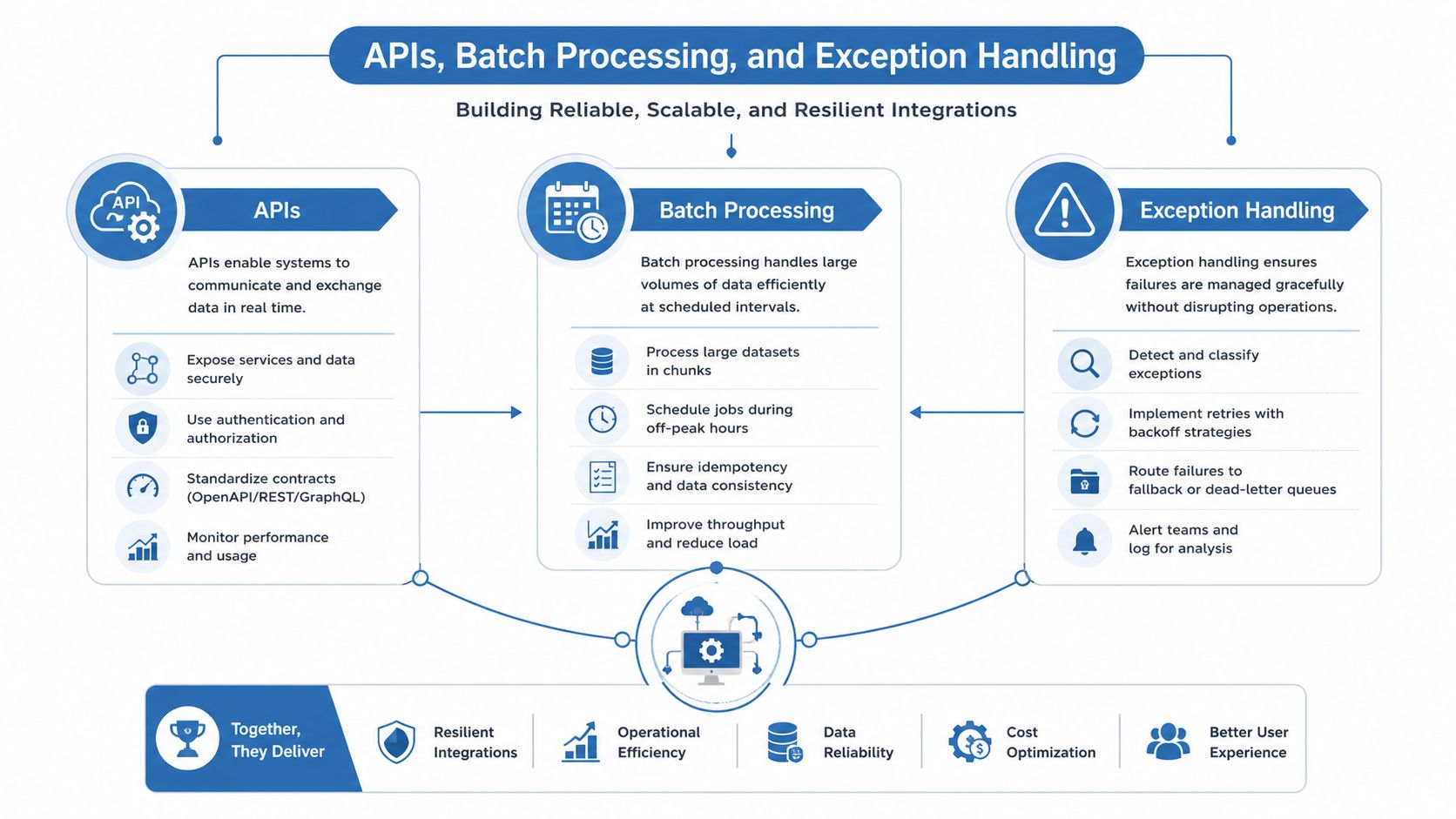
Use synchronous validation for immediate feedback and asynchronous processing for expensive or slow enrichment. A form can receive a compact preliminary response while CASS, DPV, geocoding, or additional matching runs in a controlled background job.
A dependable API contract should return a request ID, normalized fields, stage statuses, and any correction candidates without pretending that every stage has completed. Webhooks can report later results, but the same request ID must remain stable across callbacks, retries, and support investigations.
Design the batch path for auditability
For bulk files, process bounded chunks and attach a stable record ID before calling any provider. Write every result to an auditable table rather than updating the source file in place. Preserve:
- Submitted address and corrected address
- Provider response and raw status
- Validation and geocoding timestamps
- Schema or reference-data version
- Reviewer decision
- Retry and failure history
Don't collapse outcomes into true or false. Useful states include:
- Validated: Structure and postal checks passed.
- Deliverable: Postal reference confirmed the delivery point.
- Missing secondary: A unit or suite remains unresolved.
- Ambiguous: Multiple plausible candidates remain.
- Unmatched: No acceptable candidate was found.
- Rate-limited: The provider requested delayed processing.
- Provider error: The service failed without proving anything about the address.
Retry failures without creating new data defects
Retry only transient errors. Use exponential backoff with jitter, honor Retry-After, cap attempts, and apply idempotency keys so a retry can't create duplicate corrections. Circuit breakers should stop a failing provider from overwhelming your queue or delaying unrelated workflows.
Deduplicate before validation when the same batch contains repeated records, but don't deduplicate solely by street text. Residents, apartments, and suites can share a building. Use a validated fingerprint or stable address identifier for confirmed duplicates, and reserve fuzzy matching for candidate discovery.
Permanent defects belong in explicit exception buckets, including incomplete units, conflicting localities, unverifiable rural addresses, newly constructed properties, and suspected duplicates. Queue uncertain records for human review instead of forcing a choice between plausible candidates. That decision preserves the distinction between a system that found a candidate and a system that proved an address.
Where Does AI Fit and Where Doesn't It?
An LLM shouldn't decide whether an address exists. A language model generates plausible text from learned patterns. It isn't an authoritative delivery database, a current postal reference, or a parcel registry. Recent analysis specifically warns that LLMs can produce plausible but incorrect address-validation results, while postal authorities update reference data more frequently than model training data. The GeoPostcodes analysis examines why LLM-based address validation cannot replace authoritative reference data.
A model may invent a ZIP code, alter a legitimate rural route, remove a suite number, or choose the wrong locality when several places share a name. Repeated prompts can also produce different outputs. That nondeterminism is unacceptable for pricing eligibility, insurance risk, payment acceptance, or any workflow requiring an audit trail.
Use models as candidate generators
AI can still help around deterministic validation:
- Extract noisy text: Identify address-like spans in documents or messages.
- Classify ambiguity: Separate a unit, building name, locality, or delivery instruction.
- Translate descriptions: Convert a caller's informal wording into a candidate record for review.
- Summarize exceptions: Explain why a provider returned an unresolved or conflicting result.
- Suggest corrections: Produce candidates that still must pass postal and spatial gates.
Every suggestion should be labeled machine-generated, retain its source context, and pass through the same parser, postal verification, and geocoding workflow as user-entered data. Require structured JSON, validate fields against allowlists and enums, and reject unexpected output rather than mapping it into your database. Teams reviewing machine learning algorithm labels should apply the same discipline here. Model terminology doesn't change the need for authoritative validation.
| Use AI For | Use Deterministic Services For |
|---|---|
| Extracting address-like text from noisy documents | Confirming a delivery point with CASS and DPV |
| Classifying ambiguous components | Applying USPS standardization rules |
| Summarizing provider exceptions | Determining ZIP+4, delivery-point, and route coding |
| Generating correction candidates | Producing accepted coordinates and match types |
Payment workflows make this boundary more urgent. SWIFT CBPR+ rules require town and country fields in designated places for relevant messages from 15 November 2026, and unstructured postal addresses are being removed from those flows. Industry coverage reports that April 2026 SWIFT data still showed unstructured postal information in 61.2% of debtor addresses and 62.9% of creditor addresses. The Global Banking & Finance coverage describes the structured-address cutover and reported readiness gap.
Flexible AI input can create a candidate. Deterministic constraints must decide whether the candidate is accepted.
What Should You Measure for Freshness and Production Quality?
A mortgage portfolio can show a high overall validation rate while still containing unusable property coordinates and stale mailing records. A good validation dashboard separates stage performance instead of reporting one overall accuracy number. Track parsing confidence, postal match outcomes, geocoding precision, exception ratios, fallback usage, provider failures, and the business cost of false positives.
Postal freshness needs explicit policy checks. Presorted mail must verify five-digit ZIP Codes within 12 months of mailing, automation mail must verify complete addresses within 95 days, and carrier-route mail must verify carrier-route data within 90 days. USPS documents these mailing-list hygiene intervals. Those windows belong in job eligibility rules and monitoring, not only in operational documentation.
Build the dashboard by stage
| Dashboard Area | What to Track | Why It Matters |
|---|---|---|
| Parsing | Parse confidence, missing fields, unresolved tokens | Detects input and parser drift |
| Postal matching | CASS and DPV outcomes, secondary failures | Separates deliverability from formatting |
| Geocoding | Rooftop, interpolated, centroid, and unmatched results | Shows spatial precision rather than mere match volume |
| Exceptions | Counts by rural, unit, new construction, locality conflict, and duplicate | Prevents weak cases from disappearing inside an average |
| Operations | Retry volume, rate limits, provider errors, processing age | Reveals pipeline instability |
| Governance | Source version, effective date, reviewer decision, schema version | Supports audits and reproducibility |
Operational guidance reports that lists processed through CASS, NCOA, and DPV can reach about 98.5% deliverability after hygiene, while unverified 12-month-old data may be only 85% to 90% deliverable. It also recommends treating geocoding scores below 0.8 cautiously and describes one sample with roughly 80% rooftop, 15% range-interpolated or nearest-point, and 5% other result types. The MailPro NCOA processing guidance provides these benchmark and QA considerations. Use these figures as operational reference points, not guarantees. Geography, address type, source quality, and provider mix will change the distribution.
Production checklist
Before shipping the workflow, confirm that you can:
- Isolate fallbacks: A centroid fallback must not appear as a rooftop confirmation.
- Retain audit evidence: Store source, correction, response, timestamps, and reviewer action.
- Version schemas: Track changes to normalized fields, status enums, and provider mappings.
- Monitor freshness: Reprocess records according to postal and business-risk windows.
- Review exceptions: Give high-value ambiguous records to a human rather than forcing a match.
- Separate address purposes: Keep legal, mailing, location, and property addresses distinct.
- Prepare structured payments data: Capture town, country, and other required components before the November 2026 cutover.
The international baseline is equally practical. The Universal Postal Union defines an address as information that allows the unambiguous determination of a physical recipient location. The UPU addressing and postcode manual explains this global baseline for structured delivery information. Preserve enough structure to identify the delivery point, rather than enough text to look familiar.
BatchData compares submitted input with trusted databases, returns standardized output alongside the original value, and supports USPS-based verification through its platform and APIs. Mortgage, proptech, insurance, and property teams needing auditable address matching with batch and API delivery can visit BatchData to evaluate its validation options.