






































SEO Title: How to Find Tax Liens With Public Records and APIs
Meta Description: Learn how to find tax liens through county records, federal databases, and API workflows, plus the due diligence steps that prevent bad buys.
Meta Keywords: how to find tax liens, tax lien search, county tax lien records, IRS Automated Lien System, tax lien API, property lien search, lien priority, delinquent property search
Tax liens aren't a niche side market anymore. U.S. tax lien sales grew from $3.8 billion in 2021 to $5.02 billion in 2024, a $1.22 billion increase and 32% year-over-year growth in market value (verified market data).
That scale changes the core question. The issue isn't whether lien opportunities exist. It's whether you can find them reliably, validate them correctly, and process enough of them fast enough to matter.
Most guides on how to find tax liens stop at “check the county website.” That's incomplete. The county site is where many searches start, but serious work requires moving across treasurer portals, recorder indexes, GIS maps, federal lien data, and eventually a structured workflow that doesn't collapse when you move from one property to a thousand.
Core takeaways:
- Start local: County assessor or treasurer records usually surface delinquent parcels first.
- Validate separately: Recorder or clerk systems reveal mortgages, judgments, HOA liens, and prior encumbrances.
- Check outside county records: Federal and state liens can change priority and collectability.
- Manual search works for one-off deals: It's slow, fragmented, and error-prone for volume work.
- Programmatic search works for portfolios: APIs turn scattered filings into structured datasets you can sort, score, and monitor.
Introduction
Finding one tax lien is easy. Building a repeatable pipeline of valid lien opportunities is the hard part.
That distinction matters more than the headline growth in the tax lien market, which was already established earlier. The actual problem is operational. County records can surface opportunity, but they also create drag. Portals break, parcel formats change by jurisdiction, recorder indexes return inconsistent name matches, and a single missed filing can change the risk profile of the deal.
A tax lien search process usually starts with county data and ends with a decision about scale. For a one-off property, manual public-record work is still useful because it shows how the county records delinquencies, sale status, and redemption timelines. For acquisition teams, list builders, and anyone tracking more than a small handful of properties, that same process becomes slow, repetitive, and hard to audit.
The split is straightforward. You can work county sites one parcel at a time, or you can use a structured data source and API to pull lien, parcel, and ownership records into one workflow. If you need background on what a tax lien actually is, start there. If your goal is sourcing at volume, the method matters as much as the lien itself.
A practical workflow usually includes:
- Initial discovery: Identify delinquent parcels through county tax collector, treasurer, or assessor records.
- Record validation: Confirm the parcel, owner, tax years, and status against recorder or clerk filings.
- Risk review: Check for other claims that can affect collectability, foreclosure strategy, or resale.
- Property screening: Eliminate parcels with access issues, unusable land, or obvious physical problems.
- Process choice: Decide whether the job calls for manual research or a system that can handle hundreds or thousands of records.
One rule holds up in practice. If the process depends on opening county websites one by one, copying parcel numbers into spreadsheets, and rechecking the same records by hand, it does not scale.
That is where many investors and data teams lose time. They find a recorded delinquency and treat it like a finished lead, even though the actual work starts after the first match.
Where Are Tax Lien Records Actually Kept?
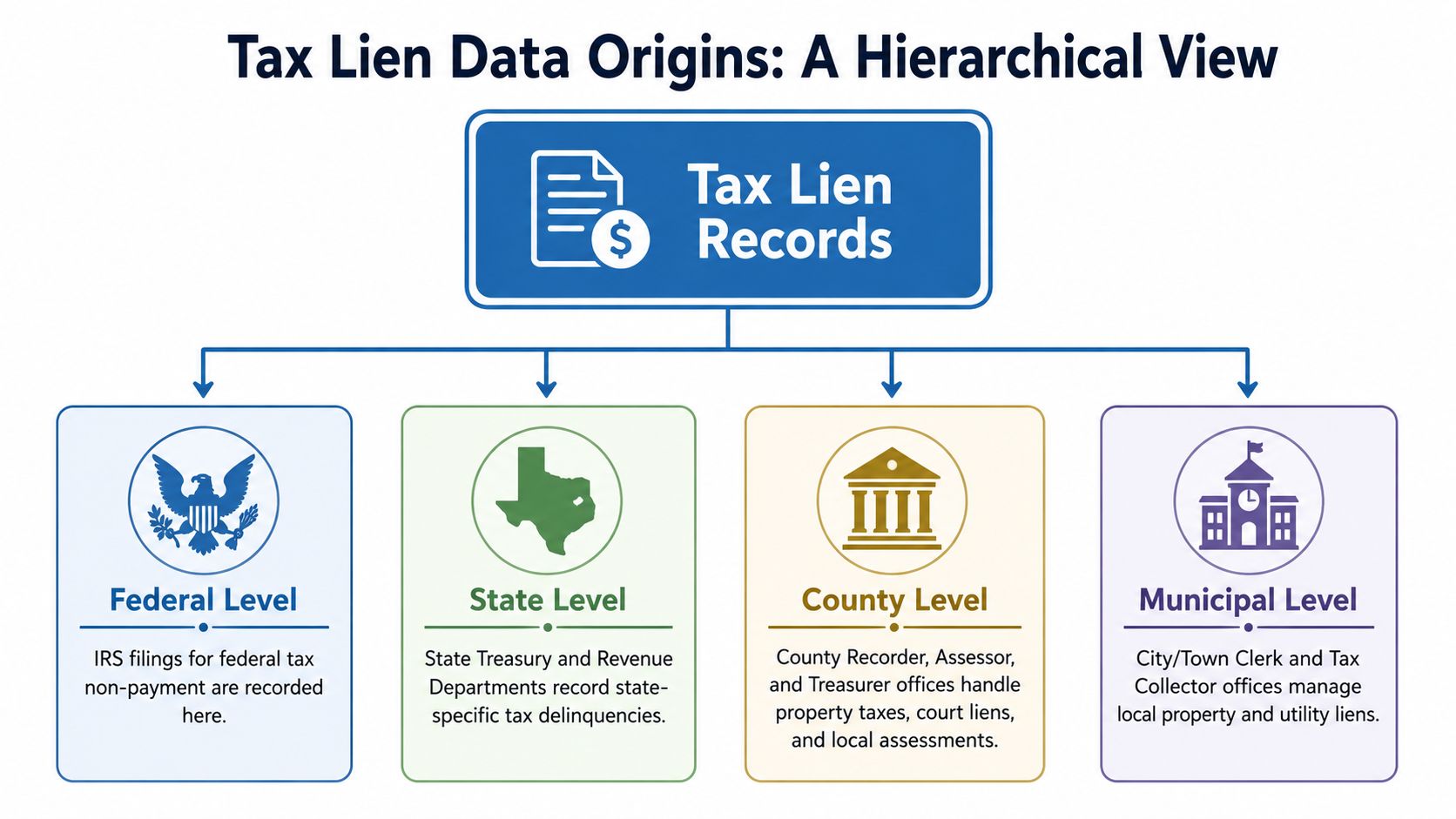
Tax lien records are kept across multiple layers of government, and searching only one layer is a common mistake. Property tax delinquencies usually surface at the county or municipal level, but federal and state filings can affect enforceability and priority.
County records hold the operational starting point
If you're looking for unpaid property taxes, the county is usually where the trail begins. The tax assessor, tax collector, or treasurer portal often publishes delinquent parcel lists, auction schedules, or redemption information.
Those systems answer basic questions:
- Which parcel is delinquent
- Who the assessed owner is
- Whether the parcel is heading to sale
- What tax years are involved
That's useful, but incomplete. The treasurer's site tells you there's a tax problem. It usually doesn't tell you everything else attached to the property.
Recorder and clerk systems show the other claims
The recorder, register of deeds, or clerk index is where you look for the rest of the stack. In this index, mortgages, judgments, HOA liens, releases, assignments, and other encumbrances tend to appear.
That split matters because new investors often search only the delinquent tax list and assume they've found a clean, senior claim. They haven't. They've found a lead that still needs legal and financial context.
A fast mental model helps:
| Office | What it usually shows | What it usually misses |
|---|---|---|
| County treasurer or tax collector | Delinquent taxes, sale status, parcel details | Full encumbrance picture |
| Recorder or clerk | Recorded liens, deeds, judgments, releases | Current tax balance context |
| Assessor | Parcel characteristics, situs, assessed owner | Priority and enforceability |
| GIS portal | Map location, lot shape, quick screening | Recorded legal risk |
Search the tax office to identify the problem. Search the recorder to understand the risk.
Federal and state data can outrank your assumptions
A lien search that stops at county records is unfinished. Federal and state tax claims can materially change the investment profile, especially when you're trying to confirm position.
One important access change is easy to miss. On January 1, 2023, the IRS eliminated all charges for FOIA requests seeking Automated Lien System database listings, which opened access to the federal repository used for tax lien data (verified ALS access fact). The IRS Automated Lien System, or ALS, is updated quarterly and serves as the federal record set for business and individual tax liens.
That matters for due diligence. Federal data isn't just a legal curiosity. It's part of the file review.
Municipal records still matter in edge cases
City and town records can hold special assessments, utility-related claims, or local code-related obligations. These aren't always surfaced cleanly in the same place as county tax data.
Unsecured tax situations are even messier. In those cases, the lien may be indexed against the assessee's name rather than a parcel number. If you search only by APN, you can miss the filing entirely.
How Do You Find Liens Manually Through Public Records?
The manual process starts with the county tax portal, then moves to the recorder or clerk index for parcel-by-parcel validation. It works. It's also tedious.

A practical workflow for how to find tax liens begins at the county level: use the tax assessor or treasurer portal to identify delinquent parcels, then cross-check the parcel number in the recorder or clerk system for mortgages, prior tax liens, HOA liens, judgments, and other encumbrances before bidding, as outlined in this county-first tax lien workflow.
Step one, pull the delinquent list
Start with the county where you want to buy. Then locate one or more of these:
- Tax assessor portal
- Treasurer or tax collector portal
- Auction page
- Downloadable delinquent list
The best counties make this easy. They offer CSV, Excel, or at least PDF exports. The worst counties bury delinquency data inside a search interface that forces one parcel lookup at a time.
Your goal at this stage isn't deep analysis. It's extraction. You want a usable set of candidate parcels with identifiers such as:
- Parcel number or APN
- Owner name
- Situs address
- Sale status
- Tax years due
Step two, move the parcel into the recorder index
This is the step most lightweight tutorials skip. Take the parcel number and owner name from the delinquent list and search the recorder, clerk, or register of deeds database.
Look for recorded items that can change your decision:
- Mortgages and assignments
- Prior tax liens
- HOA liens
- Judgments
- Releases and satisfactions
- Deeds that suggest recent transfer activity
If the county recorder search is weak, search by both parcel ID and owner name. Indexing errors happen. Name formatting varies. A clean APN search can still miss relevant filings.
For a deeper parcel timeline, this guide on how to research property history is useful because it frames the chain of title and filing sequence, not just the current owner snapshot.
Field note: A lien record without chain-of-title context is just a headline. The recorder index is where you find out whether the headline matters.
Step three, screen the property visually
A parcel can be legally viable and still make no economic sense. That's why experienced buyers add a quick physical screen before they spend more time.
Use:
- County GIS maps to confirm parcel shape, access, and neighboring use
- Street View when available for basic condition review
- Aerial imagery for landlocked lots, odd topography, or unusable improvements
This doesn't replace inspection. It filters obvious dead ends early.
A visual walkthrough helps if you've never watched someone work through public records in real time.
Step four, check sale mechanics before you waste effort
Every jurisdiction has its own rules. Don't assume two neighboring counties handle sales the same way.
Review:
- Registration requirements
- Accepted payment methods
- Redemption rules
- Bid format
- Document deadlines
Some investors spend hours validating parcels they were never eligible to bid on because they ignored the auction procedures until the end.
What manual search does well
Manual search has one real advantage. It forces direct contact with source records.
That helps when:
- You're underwriting a single target asset
- You need to verify a strange filing manually
- The county data isn't syndicated well
- You want to understand local recording quirks before automating anything
What it doesn't do well is throughput. Once you move beyond a handful of parcels, the workflow becomes repetitive, slow, and vulnerable to missed filings.
Why Does the Manual Search Process Break Down at Scale?
Manual tax lien search breaks down because county systems aren't standardized, the work is repetitive, and priority validation is easy to miss when volume increases.
The first problem is structural. County websites were built for public access, not portfolio sourcing. Different counties use different vendors, different field names, different search logic, and different export formats. Some have decent data portals. Some have PDFs. Some still require click-by-click searching.
The second problem is operational. A manual process creates hidden failure points:
- You miss owner-name variants
- You skip stale or hard-to-read filings
- You lose time reformatting exports
- You can't monitor changes without rerunning everything
- You treat “found in records” as “safe to buy”
Priority is where manual workflows get expensive
This is the gap that hurts people. Over 40% of tax lien certificates sold at auction are later challenged or found to be subordinate to federal tax liens or previously recorded judgments. That's the clearest warning in this space, and it's why lien priority work can't be treated as optional.
Most public-records tutorials teach search mechanics. They don't teach enforceability. They tell you how to locate a filing by parcel or owner, but not how to decide whether that filing is still legally useful, superseded, or junior to something more dangerous.
If your workflow ends when you “find a lien,” you haven't done due diligence. You've done lead collection.
The trade-off is speed versus control
Manual searching gives you direct visibility into source documents. That's real value. But the minute you need consistency across markets, that same manual control turns into drag.
| Attribute | Manual Public Records Search | API-Based Data Platform (e.g., BatchData) |
|---|---|---|
| Speed | Slow, county-by-county research | Fast querying across many properties |
| Coverage | Depends on each local site | Broader, normalized multi-market access |
| Data structure | PDFs, CSVs, images, inconsistent fields | Structured records suitable for workflows |
| Freshness management | You must recheck each source manually | Easier recurring pulls and monitoring |
| Validation workflow | High human effort | Easier to automate filters and reviews |
| Cost per researched lead | Labor-heavy | Better fit for repeated searches at volume |
Manual search is still the baseline, not the destination
Every serious operator should know how to work the public record trail manually. It teaches the anatomy of the data. But running that same process across many counties is not a professional operating model. It's a backlog.
The more properties you review, the more you need a system that can ingest, normalize, and monitor lien-related records without relying on browser tabs and spreadsheets.
How Can You Find Tax Liens Programmatically with an API?
You find tax liens programmatically by querying structured property and lien data through an API, then filtering, sorting, and monitoring records in code instead of searching county sites one by one.
That changes the unit of work. With public records, the unit is usually one parcel at a time. With an API, the unit becomes a list, geography, segment, or rule set.
What a programmatic workflow looks like
A usable API workflow usually does four things well:
- Searches by geography such as county, city, or ZIP set
- Returns normalized records instead of mixed county export formats
- Includes related property context such as ownership, characteristics, and encumbrance signals
- Supports repeatable pulls so you can monitor changes instead of starting over
That's the practical advantage. You stop behaving like a researcher hunting records manually and start behaving like an analyst defining rules.
A typical search might ask for:
- Properties with tax lien indicators
- Specific recording date windows
- Selected ZIP codes or counties
- Additional property filters such as occupancy or property type
- Owner and mailing details for contact or risk review
Why structured output matters
County data is often fragmented because each office records for its own administrative purpose. An API is valuable when it converts those signals into fields your systems can use.
That usually means getting data as structured JSON or bulk delivery instead of manually cleaning:
- Parcel identifiers
- Owner details
- Lien-related attributes
- Recording references
- Property characteristics
- Related risk signals
For proptech teams and investor operators, that format changes what's possible. You can score opportunities, suppress bad fits, create review queues, and monitor the same properties over time.
For teams comparing supporting services around contactability and lead quality, this buyer's guide for lead verification APIs is worth reviewing because lien sourcing often turns into an outreach workflow after the legal review is complete.
One data call can replace a lot of browser work
An API doesn't eliminate due diligence. It eliminates repetitive collection work.
One option in this category is BatchData, which provides property search and lien-related data through APIs and bulk delivery. That's useful when you need one environment for search, enrichment, and recurring monitoring rather than separate county workflows. If you're evaluating the economics of integrating tax-related data into production systems, this breakdown of API integration for tax data cost benefits is the relevant reference.
Workflow shift: Manual search asks, “What can I find on this parcel?” API search asks, “Which parcels match my criteria right now?”
What APIs don't solve on their own
An API won't make legal judgment calls for you. It won't tell you whether a local rule creates an unusual redemption issue, and it won't replace counsel or a formal title review.
What it does solve is the part that usually consumes the most hours:
- Finding records across many properties
- Normalizing data
- Running repeatable filters
- Keeping watchlists current
- Feeding internal tools and models
That's how you move from finding one lien to sourcing a pipeline.
What Are the Critical Next Steps After Finding a Lien?
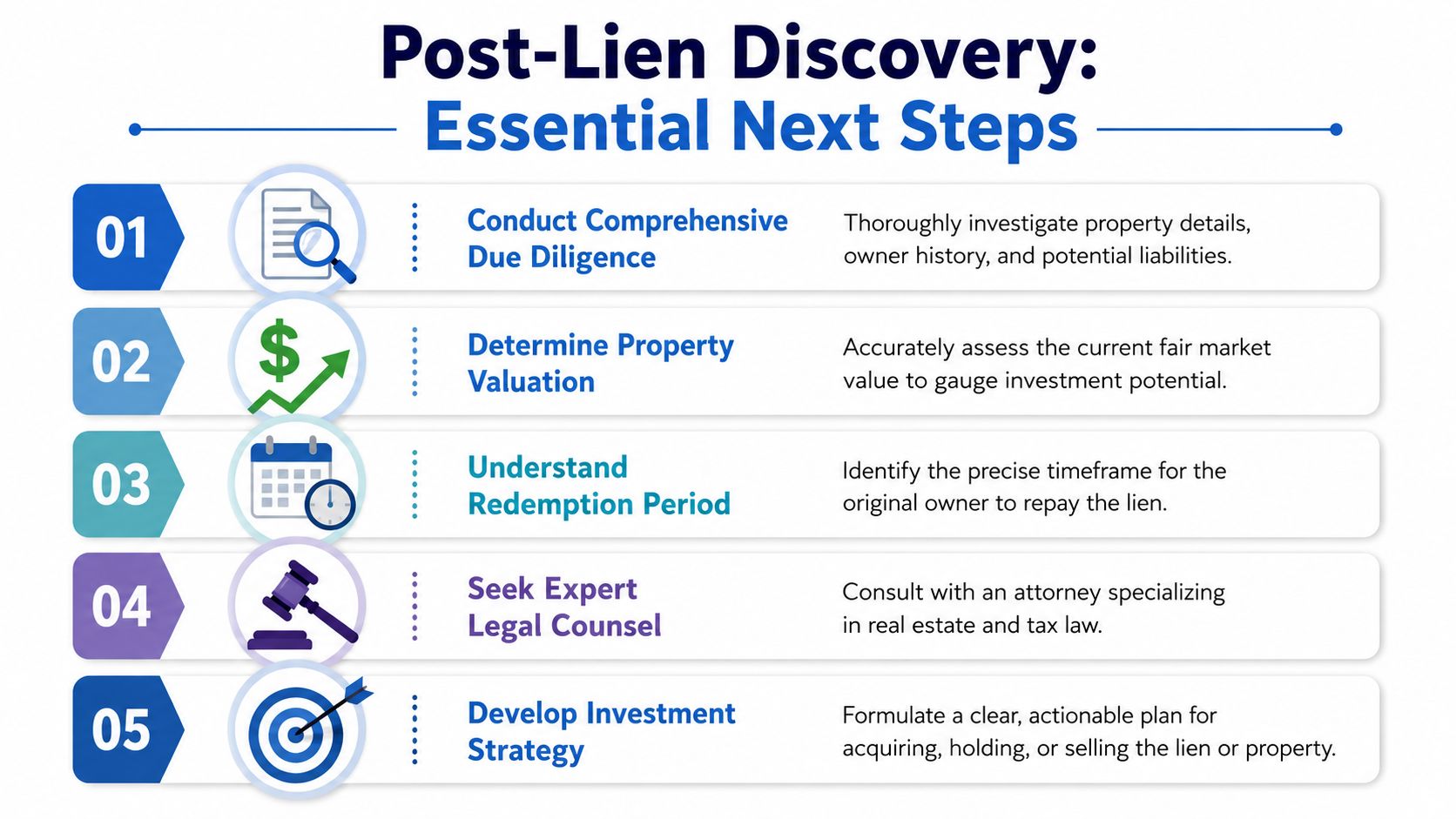
After finding a lien, the next steps are priority review, legal validation, property valuation, redemption analysis, and decision discipline. Discovery is the start of the file, not the end.
Confirm priority before you underwrite anything
A key technical pitfall is lien priority. If a parcel already has an outstanding or prior tax lien, you may not be in first-lien position, which changes recovery risk and expected return. Due diligence typically includes a four-part lien search covering UCC, federal tax, state tax, and judgment liens, as explained in this state tax lien search guidance.
That check needs to be deliberate, not casual. Investors get into trouble when they assume the label “tax lien” automatically means a protected position.
Build a post-discovery checklist
Use a fixed checklist so every file gets reviewed the same way.
| Next step | Why it matters | What to verify |
|---|---|---|
| Priority review | Determines claim position | Federal, state, judgment, UCC, HOA, prior tax filings |
| Property value review | Tests economic upside | Marketability, condition, land use, access |
| Redemption review | Defines timing and exit path | Local deadlines, notices, cure requirements |
| Document review | Confirms legal status | Recording data, releases, assignments, satisfactions |
| Counsel escalation | Handles ambiguity | Conflicts, irregular filings, enforceability concerns |
Understand the redemption path
A lien can look attractive on paper and still tie up capital under rules that don't fit your strategy. Redemption windows, notices, and cure mechanics vary widely by jurisdiction.
That means you need answers to practical questions:
- When does the owner's redemption period expire
- What notices must be served
- What actions preserve your rights
- What events can interrupt or complicate the timeline
If your workflow includes borrower or owner outreach, it also helps to understand the resolution side. This explainer on steps for lien withdrawal and release is useful context because investors often encounter properties where payoff, release, or negotiated resolution becomes the more realistic outcome than acquisition.
A recorded lien creates an opportunity only if the legal path, asset quality, and economics still line up after review.
Keep the decision standard stricter than the search standard
Your search criteria can be broad. Your investment criteria can't.
That usually means rejecting files for reasons that don't show up in the original lien record:
- Bad location
- Unclear title
- Subordinate position
- Weak collateral
- Procedural complexity you don't want to carry
The cleanest operators treat tax lien sourcing as a funnel. Many records enter. Few survive underwriting. That's normal.
If you need to move from manual county searches to a repeatable sourcing workflow, BatchData gives teams API and bulk access to property, ownership, and lien-related records so they can search, enrich, and monitor opportunities in one data pipeline.