






































SEO Title: How to Find Real Estate Investment Opportunities
Meta Description: Learn how to find investment opportunities with a repeatable, data-driven real estate workflow built on APIs, screening, risk checks, and outreach.
Meta Keywords: how to find investment opportunities, real estate deal sourcing, property data API, off market property search, real estate underwriting, property lead enrichment, investment thesis
Manual deal hunting is too slow. A McKinsey analysis of global real assets found that firms using advanced, frequently updated datasets achieved deal sourcing pipelines that were 30 to 50% larger and acquisition cycles that were 20 to 40% faster than peers relying on legacy data.
That gap changes how to find investment opportunities in real estate. The job is no longer “find a property.” The job is to build a system that turns market noise into a ranked pipeline, then pushes the right records into underwriting and outreach before everyone else sees them.
| Stage | What happens | Output |
|---|---|---|
| Define thesis | Convert strategy into machine-readable criteria | Clear buy box |
| Source data | Pull property, ownership, lien, and valuation signals | Searchable universe |
| Screen opportunities | Filter and rank records | Shortlist worth review |
| Run risk checks | Validate value, title friction, and legal standing | Go or no-go decision |
| Execute outreach | Enrich contacts and launch tailored sequences | Owner conversations |
Generic advice fails because it stops at “know your market” or “network more.” That isn't a workflow. A real acquisition engine starts with structured data, uses hard filters, and keeps humans focused on judgment instead of list building.
Introduction
The old playbook still exists. Drive neighborhoods. Pull broad lists. Scrape MLS. Send generic mail. Wait. That method can still surface deals, but it doesn't scale cleanly across markets or teams.
A modern shop works differently. It defines a buy box first, maps that buy box to available data fields, and then monitors change events instead of restarting the search from scratch every week. That's the practical difference between activity and coverage.
Why the generic approach breaks
Traditional sourcing has two core problems:
- Low signal density: Most records on a broad list will never fit your strategy.
- High manual load: Analysts spend time gathering facts that should already be structured.
- Slow reaction time: By the time a lead is manually reviewed, the useful signal may already be stale.
Practical rule: If your sourcing process depends on someone opening county pages one by one, you don't have a sourcing system. You have a research bottleneck.
The better model is simple. Define the exact kind of opportunity you want. Pull the right records from a property data platform or API. Rank them. Run quick valuation and title checks. Push only the survivors into contact workflows.
That's how teams turn data into deals without drowning in records.
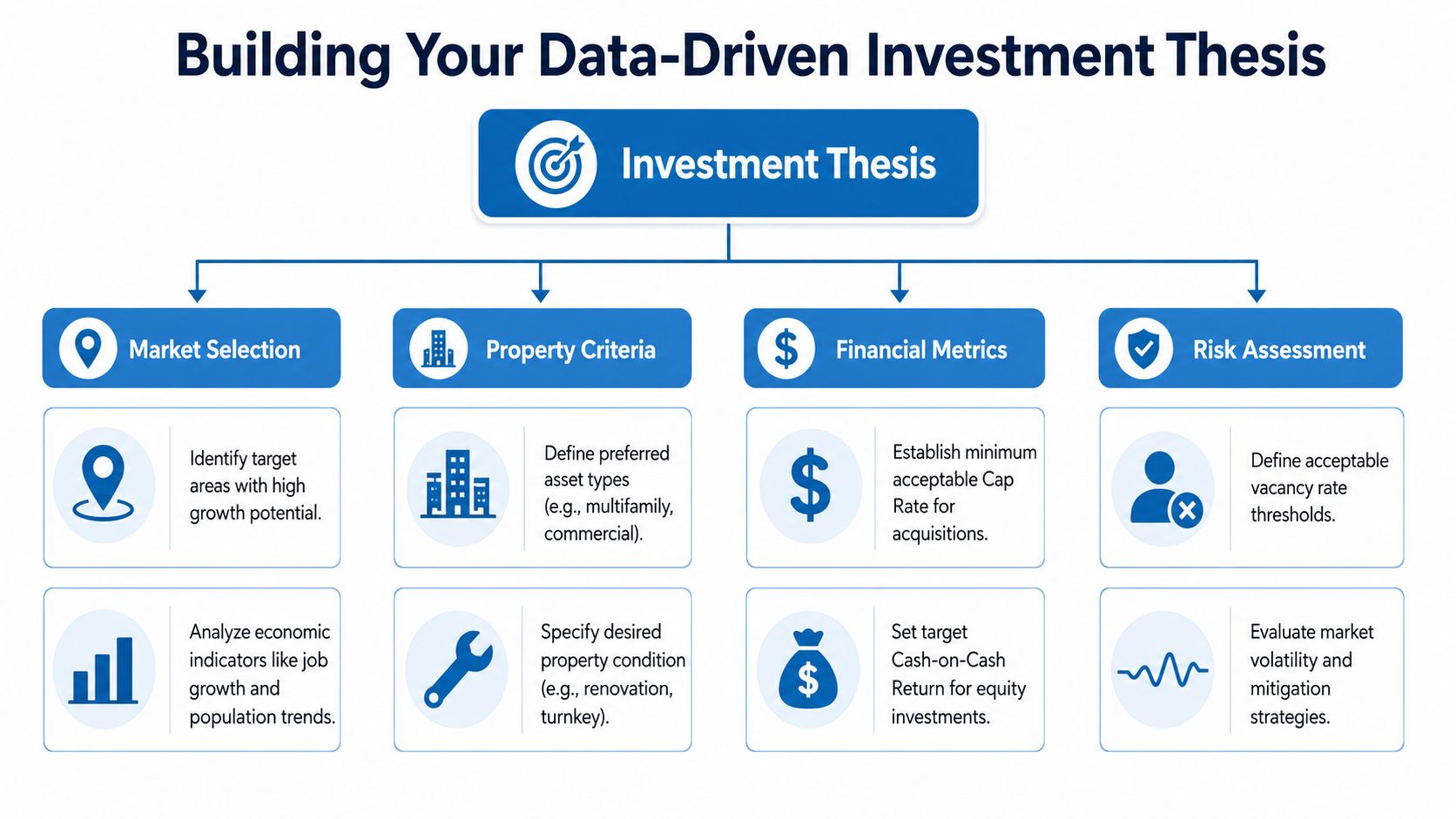
How to Define Your Investment Thesis with Data
An investment thesis isn't a slide. It's a query.
If your strategy is “buy distressed single-family homes,” that statement is too vague to run against a database. You need a machine-readable version that an analyst, API, or data vendor can evaluate consistently across a large property universe.
Start with market selection
Pick the market before you pick the property. Top-down idea generation starts by identifying structural trends and drilling down, and industry analysts find that only about 5 to 15% of publicly traded companies derive more than half of revenue from high-growth themes, which makes thematic shortlisting a strong filter in broader investing, as noted in Morningstar's practical guide.
In real estate, the same logic applies. Start with a structural driver such as:
- Housing shortage
- Aging housing stock
- Owner distress
- Inherited property turnover
- Neighborhood price dislocation
Then define geography in operational terms, not vague preference. ZIPs, counties, census tracts, servicing territories, or custom polygons all work better than “good suburbs” or “up-and-coming areas.”
Translate strategy into fields
Investment groups often get sloppy. They describe the deal they want, but they never define the data rules that identify it.
A workable buy box usually includes four layers:
Location rules
County, ZIP, subdivision, flood exposure, school district, or investor-defined territory.Property rules
Asset type, year built, square footage band, lot size, bedroom and bathroom count, owner occupancy, and condition proxy.Capital structure rules
Estimated equity, loan position, refi history, mortgage age, lien presence, and listing status.Distress or intent signals
Pre-foreclosure activity, tax delinquency, code issues, recent vacancy signals, inherited ownership, or title transfers.
Here's the practical distinction:
| Vague thesis | Usable query logic | Why it matters |
|---|---|---|
| Distressed homes | Single-family, absentee owner, open lien signal, estimated equity band | Search becomes executable |
| Value-add rentals | Small multifamily, older vintage, non-owner occupied, permit or condition friction | Narrows to operational fit |
| Fast resale candidates | Recent ownership change, valuation gap, listing change signal | Aligns with shorter timelines |
A good filter doesn't just reduce volume. It preserves team attention for records that can transact.
Compare old sourcing with API-led sourcing
| Method | Strength | Limitation |
|---|---|---|
| Driving for dollars | Good for visual condition cues | Slow, local, hard to standardize |
| Generic direct-mail lists | Easy to buy | Weak fit to strategy |
| MLS-first search | Useful for active inventory | Misses much of the off-market and distress layer |
| API and bulk data workflows | Structured, repeatable, monitorable | Requires upfront data design discipline |
The edge comes from consistency. If your criteria live in a shared query, your team can rerun them daily, compare output over time, and adjust without rebuilding the process from scratch. For a deeper take on why that matters, see this discussion of how data-driven investors find better property deals.
Tight criteria don't reduce opportunity. They remove records you were never going to buy anyway.
What Are the Modern Channels for Sourcing Deals
Modern sourcing starts with choosing the right channel for the question you're asking.
If you need a point lookup on one address, a search API works. If you want to sweep a region for ownership, lien, and valuation patterns, bulk delivery is more practical. If you already have a watchlist or servicing book, change monitoring matters more than fresh searching.

Use the right pipe for the job
I'd break sourcing channels into three buckets.
- Search APIs: Best for interactive querying, one-off lookups, and application workflows where users need near-immediate property facts.
- Bulk datasets: Best for market scans, model training, backtesting, and large territory builds.
- Portfolio monitoring feeds: Best for existing books of business where the question is “what changed?”
That last one is where many teams miss easy wins. A new lien, listing event, deed transfer, or valuation move on a tracked property can matter more than another broad county export.
Build a sourcing stack that narrows, not floods
A practical sourcing stack looks like this:
- First pass: Pull the broad market universe for your target geography.
- Second pass: Apply the buy box fields that should never be violated.
- Third pass: Append event-based signals that indicate timing.
- Fourth pass: Route survivors into a scoring queue for analyst review.
This is also where channel selection affects cost and speed. If your team keeps scraping semi-structured pages to recreate records available in normalized data feeds, you're paying for complexity with analyst time. For teams comparing data collection methods, these insights on how to find qualified real estate leads are useful because they separate raw lead volume from lead usability.
Search, bulk, and monitoring are not substitutes
| Channel | Best use case | Common mistake |
|---|---|---|
| Search API | On-demand address or owner lookup | Using it as a full market export tool |
| Bulk feed | Large-scale screening and analytics | Treating snapshots as live monitoring |
| Monitoring API | Alerting on change events | Loading unqualified watchlists |
One useful pattern is to use a search layer for ad hoc review, bulk data for territory models, and a monitoring layer for properties already under observation. That's a durable architecture.
A concrete example of this workflow appears in this guide to finding off-market properties, which shows how targeted data access changes sourcing behavior.
A short walkthrough helps if you're operationalizing this with a team:
Many teams don't have a data shortage. They have a routing problem.
How Do You Screen Thousands of Properties Efficiently
Screening works when it becomes mechanical first and judgment-based second.
That distinction matters. In public equities, a 60-year analysis summarized by Investopedia showed that mechanically applying rigorously defined criteria significantly improved the hit rate for finding mispriced securities, with value strategies outperforming the broad market by about 4 percentage points annually. Real estate isn't identical, but the operating lesson is the same. Rules first. Opinions later.

Use a staged filter
A large property set needs progressive elimination.
Stage one removes obvious non-fits.
Exclude the wrong asset types, out-of-bounds geography, ownership structures you don't buy, and records with missing critical fields.
Stage two evaluates strategy fit. You score for equity position, lien status, ownership tenure, absentee patterns, valuation spread, and timing signals.
Stage three sends only the top slice to manual review.
Analysts should be reading exceptions, not sorting spreadsheets.
The fastest analysts aren't the ones who review more records. They're the ones who never see bad records in the first place.
Filter first, then rank
Filtering answers, “Should this property stay in the pile?” Ranking answers, “Which surviving property gets attention first?”
That sounds obvious, but many teams mix the two and end up overfitting weak leads. Keep the sequence clean:
- Hard filters for your absolute requirements
- Score inputs for probability or attractiveness
- Review queue ordered by expected actionability
Propensity models can help. A model such as BatchRank can prioritize records based on likely seller intent or strategic fit, but the model only adds value if the input universe is already clean. If the data is noisy, the score just helps you sort noise faster.
For teams building this process end to end, the operational piece is less glamorous than the model. Data normalization, field mapping, deduplication, and refresh logic usually matter more than clever scoring. This overview of building scalable real estate data pipelines gets into the mechanics.
Read the signals the right way
| Signal | What it usually tells you | Screening implication |
|---|---|---|
| Estimated equity | Potential room for negotiation or refinance constraints | Higher equity often moves up the queue |
| Open lien data | Friction, pressure, or title complexity | Review for urgency and cleanup effort |
| Ownership duration | Possible fatigue, legacy ownership, or embedded gains | Longer holds can be worth special attention |
| Listing and status changes | Active intent or failed sale friction | Good timing signal |
| Mortgage history | Payment structure and leverage context | Helps frame likely decision path |
Some teams still brute-force web extraction to collect these fields. That can work, but the quality of your parser becomes part of your investment process. If you're evaluating collection infrastructure, these insights on web scraping API performance are useful because they highlight the trade-off between raw access and normalized usability.
The point isn't to automate judgment. It's to reserve judgment for the records that earned it.
What Are the Essential Valuation and Risk Checks
A property can look attractive in screening and still fail in five minutes.
Fast underwriting starts with two questions. Is the value plausible? Is the title or counterparty risk manageable? You don't need a full appraisal or legal memo to answer either one at the first pass.
Start with a fast value view
For valuation, use an AVM and recent comparable context to establish a rough band. You're not trying to be perfect. You're trying to decide whether the record deserves more time.
Then compare that value view against the likely encumbrance picture:
- Mortgage stack: How burdened is the property?
- Estimated equity: Is there enough room for a deal structure you can execute?
- Listing history: Has the market already rejected the owner's price?
- Property condition clues: Do permits, deferred maintenance signals, or ownership patterns imply rehab cost?
If the deal requires rehab, don't leave renovation assumptions as a gut check. Use a consistent scope template, and if your team needs a structured estimating workflow, Exayard construction estimating software is one practical tool for turning rough condition assumptions into a repeatable cost view.
Check risk in a fixed order
Risk checks should be sequenced. Don't let analysts freestyle the order.
| Risk Signal | What It Means | Investor Action |
|---|---|---|
| Open tax lien | Potential delinquency and closing friction | Confirm amount, priority, and cure path |
| HOA or mechanic's lien | Added title complexity | Review payoff and closing implications |
| Pre-foreclosure status | Timing pressure may be real, but not always actionable | Validate status before outreach |
| Recent deed change | Ownership may be in transition | Confirm current decision maker |
| Inconsistent owner data | Contact or title mismatch risk | Resolve identity before marketing spend |
Field note: A good five-minute underwrite doesn't prove a deal works. It proves the deal is worth the next hour.
Verify legal standing before committing capital
This step gets skipped when teams move too fast. It shouldn't.
Regulators recommend verifying the legal standing of an investment opportunity and the professionals involved. The SEC provides a free search tool on Investor.gov that lets investors check whether an investment professional or firm is licensed and registered, including disciplinary history, as outlined on Investor.gov's guidance on what to verify before you invest.
If you're buying through intermediaries, syndicators, fund managers, or specialist operators, this isn't optional. A property can be fine while the sponsor is not.
Connect due diligence to outreach
Valuation and risk checks shouldn't end with a yes or no. They should shape the message.
If lien pressure is visible, the outreach angle is problem-solving. If the owner has high equity and no distress, the outreach angle is flexibility and convenience. If the property has failed to sell, the outreach angle is certainty and speed. Data enrichment matters because the best outreach is specific to the situation, not generic to the market.
How to Build a Scalable Outreach Workflow
A sourced lead has no value until someone can reach the owner and say something relevant.
Many acquisition teams break their own pipeline. They spend heavily on discovery, then push records into generic SMS blasts or broad email drips that ignore the property context. That wastes data.
The gap is well recognized. Existing guidance often misses how to systematically score and prioritize inbound deal flow using third-party data, and in real estate there's limited practical guidance on combining tax, lien, and valuation signals into a repeatable workflow, as discussed by the British Business Bank in its overview of how opportunities are surfaced and prioritized.
Build the outreach sequence around the record
Start with contact enrichment. You need current phone numbers, emails, mailing addresses, and confidence checks before launch. Then tie the message to the signal that triggered review.
Use a simple sequence structure:
Initial text or email
Reference the property directly and keep the ask small.Follow-up call
Confirm ownership, interest, and timing.Second written touch
Add context that proves relevance, such as awareness of listing history or property type.Final check-in
Keep it respectful and easy to decline.
Keep scripts plain
Examples work best when they're boring and direct.
- Text opener: “Hi, I'm reaching out about your property on [Street Name]. Are you open to a conversation about selling it?”
- Email opener: “I'm looking at properties in your area and wanted to ask whether you'd consider discussing options for [Street Name].”
- Call frame: “I'm calling about a property you own. I'd like to confirm whether you'd consider a sale or another solution.”
Don't force fake familiarity. Don't mention every data point you have. Use the record to sharpen relevance, not to sound invasive.
Operational rules that keep outreach scalable
| Workflow area | What works | What fails |
|---|---|---|
| Lead routing | Assign by geography, asset type, or signal | Round-robin without context |
| Messaging | Property-specific, short, direct | Generic investor templates |
| Follow-up timing | Consistent cadence with status tracking | Random retries based on memory |
| Feedback loop | Push response outcomes back into scoring | Treat outreach and screening as separate worlds |
Good outreach sounds like a person who understands the property, not a bot with a list.
The final piece is closed-loop learning. Every response, wrong number, uninterested owner, stale title record, and positive conversation should feed back into the sourcing model. That's how the engine improves. Teams that separate data acquisition from outreach performance never really learn which signals produce actual conversations.
If you want to operationalize this workflow with one system, BatchData is one option for combining property records, valuations, lien and ownership data, portfolio monitoring, and verified owner contact enrichment into a single real estate sourcing stack.