


































SEO Title: How to Find Off Market Properties With Data
Meta Description: Learn how to find off market properties with a scalable, data-driven system for sourcing, enrichment, outreach, and API automation.
Meta Keywords: how to find off market properties, off market real estate, property data API, skip tracing, motivated sellers, real estate lead generation, BatchData, property records
Roughly 1.2 million single-family and multifamily home sales in the United States occurred off the MLS in a single recent year, with Texas and Florida accounting for nearly 300,000 of those transactions alone, according to ResiClub Analytics.
That changes the way serious operators should think about acquisitions. Off-market inventory isn't a side channel. It's a large part of the market, and the firms that consistently find it don't rely on luck, handwritten driving lists, or a broker texting them a pocket listing once in a while.
The practical system is straightforward:
| Step | What you do | What matters |
|---|---|---|
| Targeting | Define a narrow buy box | Broad lists kill response quality |
| Sourcing | Pull property and ownership data | Raw records alone aren't enough |
| Enrichment | Verify owner contacts before outreach | Bad contact data burns budget |
| Activation | Use mail, phone, and email in sequence | One channel rarely carries the whole campaign |
| Automation | Monitor new signals continuously | The edge comes from speed and repeatability |
If you want a broad market view before building your own workflow, PropLab's guide on how to find off-market properties in 2026 is a useful reference point. The scalable version, though, looks less like prospecting and more like an acquisition pipeline.
The Playbook for Unlocking Hidden Real Estate Inventory
Off-market sourcing works when you stop treating it like treasure hunting and start treating it like data infrastructure.
Most investors begin with the visible tactics. They drive neighborhoods. They ask agents for pocket listings. They send mail to crude lists pulled from county records. Those methods can still surface deals, but they don't scale cleanly, and they break down fast when the market gets competitive.
A repeatable off-market program has four parts.
- Define the asset and seller profile. Know the geography, property type, equity position, ownership pattern, and distress signals you're willing to pursue.
- Source records with enough depth to filter aggressively. Basic ownership data isn't enough if you need absentee flags, lien context, transfer history, or valuation gaps.
- Enrich records before outreach. The owner name on file isn't the same thing as a reachable person.
- Automate alerts and refreshes. The value isn't just the list. It's catching change fast.
Practical rule: If your process depends on someone manually pulling lists every few weeks, you're already behind operators who monitor the same market continuously.
The old advice on how to find off market properties usually assumes human labor is the main input. That's outdated. The scarce resource now is verified signal quality. Whoever identifies the right properties earlier, reaches the right contact faster, and filters out noise more effectively gets the first serious conversation.
Why Is Off-Market Sourcing a Quantifiable Advantage
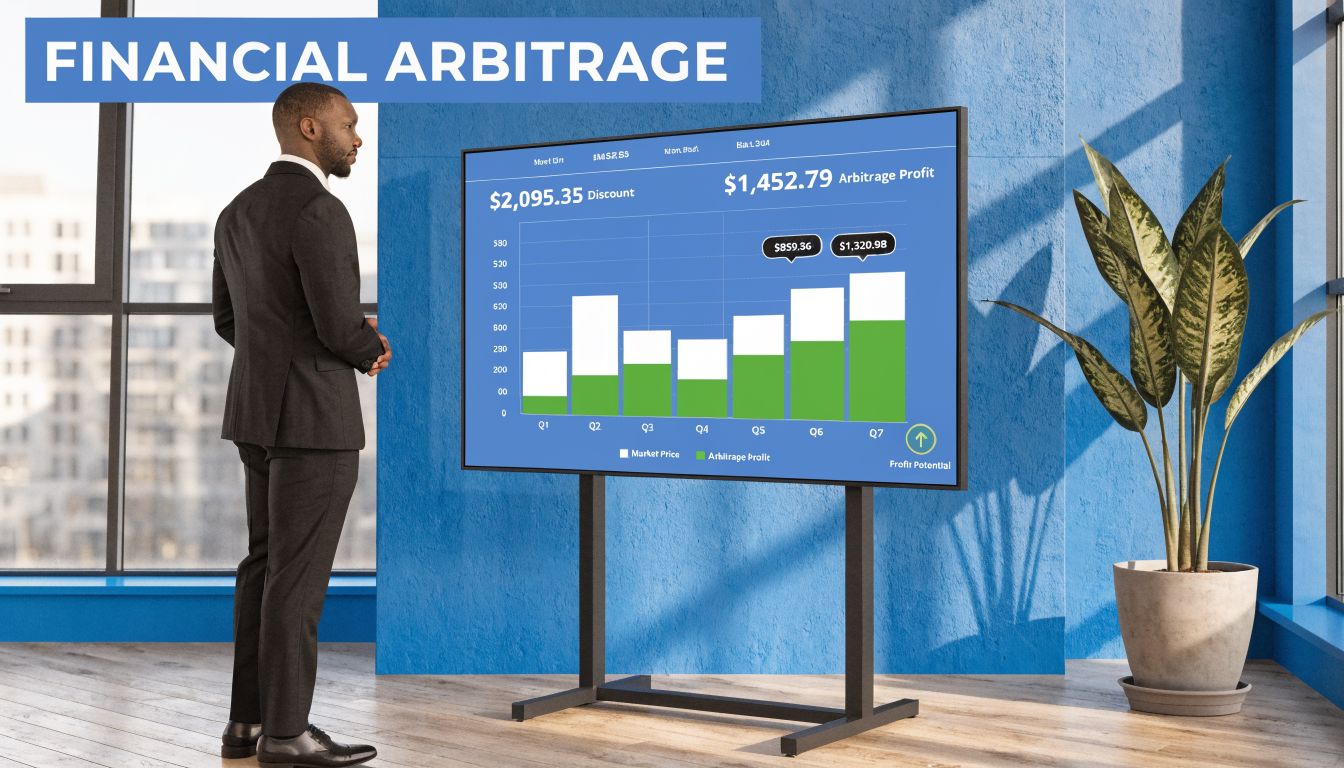
The financial case is simple. Off-market properties often trade below comparable on-market sales, and that discount is large enough to justify building a dedicated sourcing system.
A 2026 Zillow study found that homes sold off-MLS traded for a median 1.5% less nationwide, with the discount widening to $30,075 in California. Separate research across major East Coast metros found a 16.98% median discount for off-market sales. If you're buying, lending against, or underwriting these assets, that's not a curiosity. It's a pricing gap.
What creates the discount
Most off-market discounts come from seller circumstances, not from magic sourcing tactics.
Common drivers include:
- Urgency: The owner wants speed and certainty more than full market exposure.
- Complexity: Probate, inherited homes, lien issues, deferred maintenance, or title friction make a standard listing less attractive.
- Privacy: Some sellers don't want open houses, days on market, or public negotiation.
- Investor churn: Some transfers happen between investors or through nontraditional channels where pricing is less optimized.
That matters because it changes how you underwrite. A discount tied to cosmetic neglect is different from a discount tied to title defects or tax distress. The acquisition process has to distinguish between "underpriced" and "problematic."
Why this is an operational edge
The mistake is assuming off-market is only about less competition. That's true sometimes, but it's not the main edge. Its primary advantage is that off-market sourcing lets you identify pricing dislocation before it becomes broadly visible.
For teams tracking market behavior, the Investor Pulse national market report is useful context because it frames acquisition decisions against broader housing and investor activity. But the portfolio-level takeaway is more important. If off-market transactions systematically clear below public-market comps, then data-driven sourcing isn't optional for serious acquisitions teams.
Buy boxes get more resilient when you're sourcing from mispriced inventory, not just from whatever happened to hit the MLS this morning.
How to Define Your High-Intent Property Profile
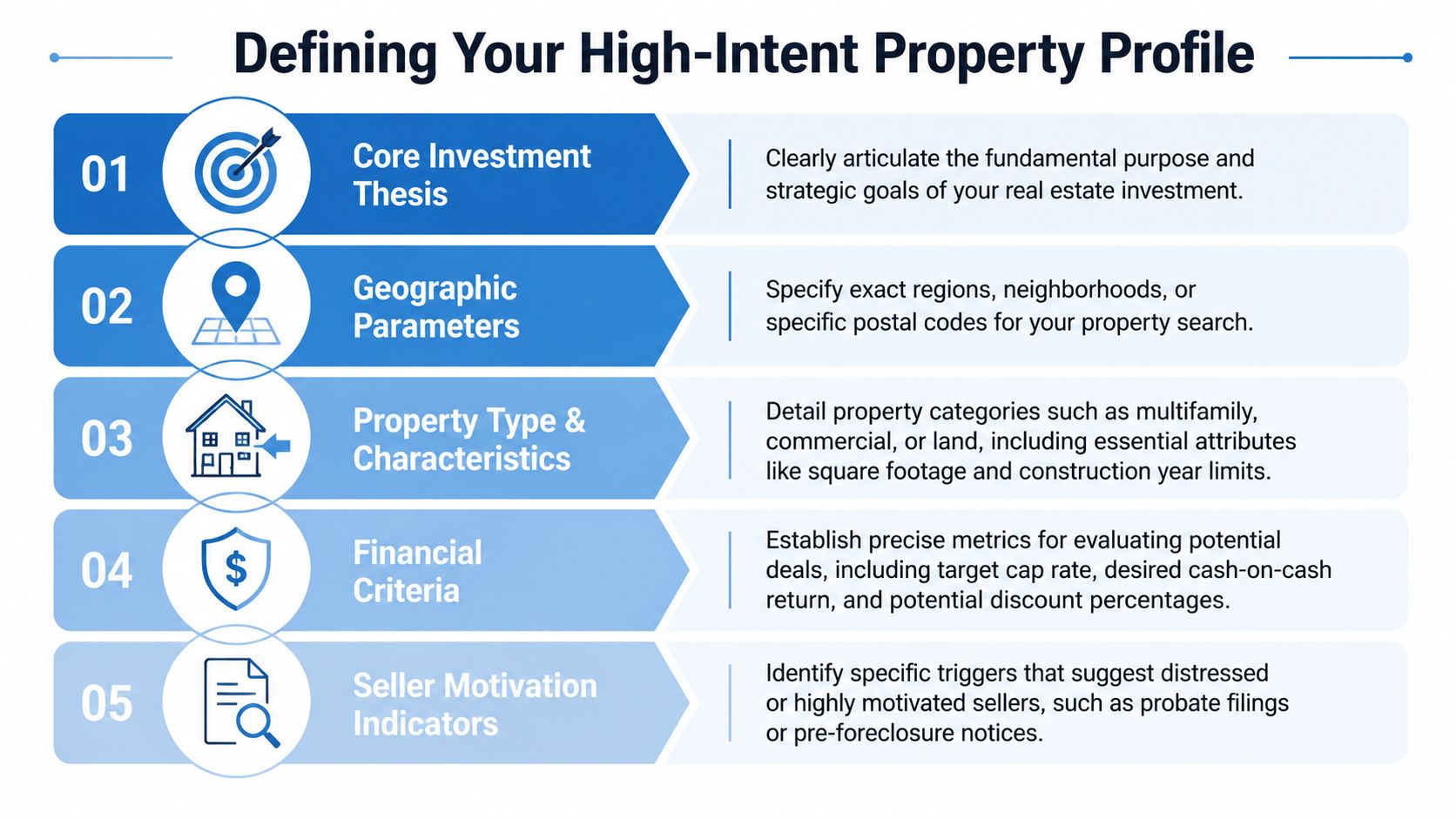
You don't find good off-market deals by searching for "motivated sellers." You find them by building a profile that combines property economics with owner behavior.
PropertyRadar's research found that professionals who use stacked criteria such as value, tax delinquency, and non-market transfers achieve 40-60% higher response rates than single-variable targeting, as noted in PropertyRadar's off-market methodology overview. That's the difference between list building and signal design.
Start with the asset, not the seller
A lot of campaigns fail because the criteria begin with distress and end with a pile of unusable addresses.
Start with your actual acquisition thesis:
- Geography: specific zip codes, census tracts, or submarkets
- Property type: single-family, small multifamily, larger multifamily, mixed-use
- Economic fit: yield, renovation range, hold period, refinance path
- Operational fit: occupancy assumptions, title complexity tolerance, repair bandwidth
That prevents wasted motion. If your team only buys small multifamily in a narrow rent band, broad absentee-owner lists are noise.
Then stack seller signals
Once the property thesis is tight, layer owner-level indicators that point to intent or pressure.
A practical stack often includes:
- Equity position: owners with enough equity to transact without dead-end negotiations
- Tax delinquency status: especially when delinquency suggests pressure but not yet full public collapse
- Non-market transfer history: related-party transfers, trustee activity, inherited ownership, or unusual deed patterns
- Absentee ownership: useful when paired with tenure, equity, or deferred maintenance signals
- Historical listing behavior: prior failed listings or stale market attempts can indicate openness to direct offers
For multifamily acquisitions, one of the cleaner economic screens is rents that sit 15% or more below market average in a defined geography, a threshold discussed in the verified PropertyRadar material. That can signal management inefficiency, under-market operations, or an owner who's not maximizing the asset.
Use thresholds that force discipline
The best target profile is restrictive. It should eliminate most properties.
A disciplined profile asks questions like these:
| Filter category | Tight screen | Why it matters |
|---|---|---|
| Location | Defined submarket only | Keeps comp logic consistent |
| Ownership | Absentee or inherited ownership | Narrows to owners with possible liquidity events |
| Financial stress | Tax delinquency or pricing mismatch | Adds urgency or inefficiency |
| Market signal | Prior listing fatigue or non-market transfer | Surfaces owners outside normal brokerage flow |
The sharper the profile, the cheaper your outreach becomes. Broad targeting feels safer, but it usually buys you more bad records, more bad calls, and more false positives.
Where Can You Source Actionable Property Data
The source determines the ceiling of your strategy. If the data is fragmented, stale, or shallow, every downstream step gets weaker.
There are three practical ways to source off-market property data: raw public records, list brokers, and modern data platforms. They are not interchangeable.
Property Data Source Comparison
| Source | Accuracy | Data Depth | Refresh Rate | Scalability & API Access |
|---|---|---|---|---|
| County and assessor records | Can be authoritative but fragmented and uneven by county | Usually limited unless you merge multiple offices and normalize fields yourself | Often inconsistent by jurisdiction | Poor for multi-market scale, usually no developer-friendly API workflow |
| Traditional list brokers | Better packaged than raw county pulling, but quality varies by vendor | Often enough for simple mail campaigns, rarely enough for deep modeling | Depends on vendor update cycle | Moderate for list buying, weak for technical automation |
| Modern data platforms | Built for normalized, multi-source querying and enrichment | Suitable for ownership, valuation, distress, and contact workflows | Designed for ongoing refreshes | Strong fit for repeatable operations and system integration |
What breaks with public-record-only workflows
Public records are useful, but they are not a complete acquisition system.
The usual failure points are familiar:
- Fragmentation: assessor, recorder, tax, and court data often live in separate systems.
- Normalization pain: owner names, parcel identifiers, and transfer formats rarely line up cleanly across counties.
- Slow execution: by the time a team exports, cleans, dedupes, and enriches a county pull, the lead window may have shifted.
- Limited contact utility: ownership records tell you who owns the property, not whether you can reach them.
That last point is decisive. Plenty of investors can pull a tax-delinquent file. Fewer can turn it into a reachable, prioritized seller list in time to matter.
What to look for in a modern stack
When evaluating vendors, don't just ask whether they "have off-market data." Ask whether they can support the full acquisition loop.
Look for:
- Entity resolution: property, owner, and mailing data connected reliably
- Deep attributes: ownership history, liens, mortgage context, valuations, listing behavior
- Bulk and API delivery: essential if your team runs recurring jobs or internal scoring
- Contact enrichment options: skip tracing, verification, and suppression workflows
If you're comparing vendors beyond the property-data layer, this roundup of ReachInbox's real estate lead company list is a practical way to see how the broader lead-gen ecosystem is structured. For ongoing market tracking and acquisition context, the Investor Pulse archive is also useful because it highlights where investor attention and property signals are shifting.
How to Turn Raw Data Into Actionable Leads
A property record is not a lead. It's a starting point.
The gap between the two is contact verification. That's where most off-market campaigns underperform. According to OfferMarket's discussion of prospecting waste, outdated or incorrect owner information can waste 30-50% of marketing budgets in real estate prospecting. That's why broad direct mail campaigns often feel expensive and random. The targeting may be decent, but the reachability is bad.

Verification changes the economics
If you're still mailing or calling off basic public-record ownership data, you're paying to discover that the owner moved, the number is dead, or the contact belongs to a relative with no authority to sell.
A functional workflow should enrich and qualify each record before activation:
- Confirm ownership match. Make sure the contact maps to the legal owner or decision-maker.
- Check phone confidence. Not every appended number deserves a dial.
- Validate email quality where available. Email won't carry the whole campaign, but it's useful for sequence support.
- Scrub suppression lists. Compliance isn't optional.
- Rank contactability with property intent. A reachable owner with weak motivation is often less valuable than a moderately reachable owner with strong distress signals.
BatchData fits this layer as one option because it combines property records, skip tracing, phone verification, and related enrichment inside a single workflow. That's the part many teams miss. They buy data from one vendor, skip trace somewhere else, scrub elsewhere, then wonder why reporting and conversion analysis are messy.
Use a sequence, not a single touch
Good off-market outreach is coordinated. One touch rarely does the job.
A practical sequence looks like this:
- Start with mail: Use a simple, specific message tied to the property and the owner's likely situation.
- Follow with verified calling: Phone works better when the number has already been evaluated for confidence.
- Add email where relevant: Short, low-pressure follow-up can help when owners don't answer unknown calls.
- Track outcomes by signal cluster: Tax-delinquent absentee owners may respond differently than inherited free-and-clear owners.
For teams building scoring and price context into outreach, this article on how geospatial analysis enhances automated valuation models is a useful technical companion because it ties location intelligence back to underwriting quality.
Outreach should sound like problem-solving, not pressure. Owners with complicated properties don't need a pitch. They need a credible path to a clean transaction.
If you're also tightening front-end form capture and inbound workflows, Orbit AI's guide to lead generation for real estate is worth reviewing. The main lesson applies here too. Better acquisition comes from qualifying intent earlier, not just generating more names.
How to Automate Your Sourcing Funnel with an API
Manual list pulling can produce deals. It can't produce a durable acquisition machine.
Automation matters because market signals change continuously. Ownership updates, lien filings, listing withdrawals, valuation gaps, and distress indicators don't arrive on a neat monthly schedule. If your analysts refresh targets manually, they're spending time on mechanics instead of decisions.

What an automated funnel actually does
At a minimum, the system should do three things:
| Function | Automated action | Result |
|---|---|---|
| Search | Query for properties that match your buy box | New candidates surface without manual pulls |
| Monitor | Watch known assets or owner cohorts for change | You catch new signals faster |
| Activate | Push qualified leads into outreach workflows | Sales and acquisitions teams move immediately |
API-driven workflows prove more effective than spreadsheets and static exports. The verified Redfin-based research notes that cloud-based tools for remote property analysis can increase scouting efficiency by 300-400%, while verified phone and email data with confidence scoring can lift initial contact rates from 4-8% to 15-25%, as summarized in Redfin's guide to finding off-market properties. The operational lesson is clear. Faster discovery only matters if verified outreach follows.
How to structure the API workflow
The cleanest pattern is event-driven.
A practical architecture looks like this:
- Run recurring search queries against your target geographies and property criteria.
- Store matched properties in an internal acquisition table with owner and asset identifiers.
- Trigger enrichment only when a record crosses your threshold for likely intent.
- Subscribe to change events for watched properties or owner portfolios.
- Route alerts into CRM, dialer, direct-mail, or analyst review queues.
Fields worth prioritizing in the logic layer include property value, equity context, absentee indicators, owner occupancy, lien details, transfer history, and pre-foreclosure-related attributes where available.
Example request shape
The exact schema depends on the provider, but the logic is usually some version of this:
{
  "state": "TX",
  "propertyType": ["SFR", "2-4_UNIT"],
  "absentee": true,
  "minimumEquity": "high",
  "taxDelinquency": true,
  "nonMarketTransfer": true
}
That gets you closer to a machine-readable buy box. Then the monitoring layer can watch the same records for new filings, ownership changes, or status updates.
A monitoring payload often looks more like this:
{
  "portfolioId": "target-submarket-owners",
  "watchFor": ["lien", "preforeclosure", "ownershipChange"],
  "notify": ["crm", "analystQueue"]
}
Later in the workflow, this walkthrough is a useful visual reference:
The point of automation isn't to remove human judgment. It's to reserve human judgment for underwriting, negotiation, and exception handling instead of list maintenance.
What Legal and Compliance Guardrails Must You Follow
Compliance sits inside the acquisition system. It doesn't sit outside it.
If you're calling or texting owners, you need to operate with clear rules around consent, contact method, and suppression management. That includes TCPA awareness, internal dialing policies, and scrubbing against national and state Do Not Call lists before outreach. If your process scales but your compliance discipline doesn't, the exposure scales too.
Non-negotiable operating rules
- Scrub before outreach: Don't treat suppression checks as an afterthought.
- Document consent and contact history: Teams need a reliable record of who was contacted, how, and when.
- Review local rules: State and local requirements can add restrictions beyond federal baseline expectations.
- Use transparent messaging: Identify yourself clearly and don't imply urgency or authority you don't have.
Ethics matter here too. Off-market sellers are often dealing with inherited property, financial strain, or logistical headaches. Professional outreach is specific, respectful, and easy to opt out of. That's not just cleaner legally. It also improves the quality of conversations your team gets.
If you're building a real acquisition engine instead of another manual prospecting process, BatchData is worth evaluating for property data, contact enrichment, and API-based monitoring in one workflow. The practical advantage is operational: fewer disconnected vendors, cleaner targeting, and a sourcing funnel that can run continuously instead of waiting for the next list pull.