


































Calculating an insurer's loss ratio reveals a critical truth: for every dollar an insurer collects in premiums, it exposes exactly how many cents are paid out for claims.
The formula is (Incurred Losses / Earned Premiums) × 100, and this single percentage is the most vital sign of an insurer's underwriting health and financial stability. Understanding it means you can predict market shifts before they happen.
- Loss Ratio: The percentage of an insurer's premium income used to cover claims and related expenses.
- Incurred Losses: The total estimated cost of all claims for a period, including paid, reserved, and unreported claims (IBNR).
- Earned Premiums: The portion of premium that applies to coverage already provided.
- Combined Ratio: Loss Ratio + Expense Ratio, offering a complete view of operational profitability.
This guide breaks down exactly how to calculate the loss ratio, interpret it, and use it as a predictive tool for the real estate and mortgage industries.
What is the loss ratio and why should you care?
The insurance loss ratio is the definitive metric for gauging an insurer's risk management performance and underwriting profitability.
A high loss ratio is a red flag, signaling that an insurer has priced policies too low, covered overly risky assets, or is failing to manage claims efficiently. Conversely, an unusually low ratio suggests premiums are too high, attracting regulatory scrutiny and pushing customers to competitors. For most property and casualty (P&C) lines, a loss ratio between 40% and 60% is considered healthy for sustained profitability.
Loss Ratio at a Glance
| Component | Definition | Example |
|---|---|---|
| Incurred Losses | The total estimated cost of all claims for a period, including paid claims, reserves for reported claims, and estimates for claims that have happened but not yet been reported (IBNR). | A hailstorm causes $5M in damage. $2M is paid out, $2.5M is reserved for known claims, and $500k is estimated for unreported claims. The total incurred loss is $5M. |
| Earned Premiums | The portion of premium payments that applies to the coverage period that has already passed. | A customer pays a $1,200 annual premium. After six months, the insurer has "earned" $600 of that premium. |
| Loss Ratio | The percentage of earned premiums used to cover incurred losses. | An insurer has $75M in incurred losses against $100M in earned premiums, resulting in a 75% loss ratio. |
The inputs are more nuanced than just "money in" versus "money out." Let's break down the components.
Core Components
Getting the loss ratio right requires matching the losses from a specific period to the revenue generated during that same timeframe.
Incurred Losses: This is a comprehensive estimate of all claims occurring during a period, not just paid checks. It includes paid claims, reserves for reported but unsettled claims, and an estimate for claims Incurred But Not Reported (IBNR). It also folds in the costs of investigating and settling these claims, known as Loss Adjustment Expenses (LAE).
Earned Premiums: This is the portion of the premium corresponding to the coverage period that has already passed. An insurer "earns" a $1,200 annual premium at a rate of $100 per month as it provides coverage.
For example, an insurer with $80,000 in incurred losses against $150,000 in earned premiums has a healthy 53.3% loss ratio. You can experiment with these numbers using a loss ratio calculation guide on swoopfunding.com.
A loss ratio is a direct measure of underwriting profitability. While benchmarks vary by insurance line, a ratio consistently above 70-80% often signals an underwriting loss before accounting for other operational expenses.
For mortgage and real estate professionals, this metric is a powerful forward-looking indicator. Spikes in loss ratios in a specific geography—often driven by climate events—are a direct precursor to changes in insurance availability, soaring premium costs, and stricter underwriting standards. Professionals can get ahead of these shifts by leveraging property and risk data, as detailed in our guide on insurance solutions for real estate.
How do you break down the loss ratio calculation?
The calculation's accuracy hinges on defining the numerator (losses) and the denominator (premiums) with absolute precision.
The core relationship is a direct comparison between the total cost of claims and the revenue recognized for providing coverage during the same period.
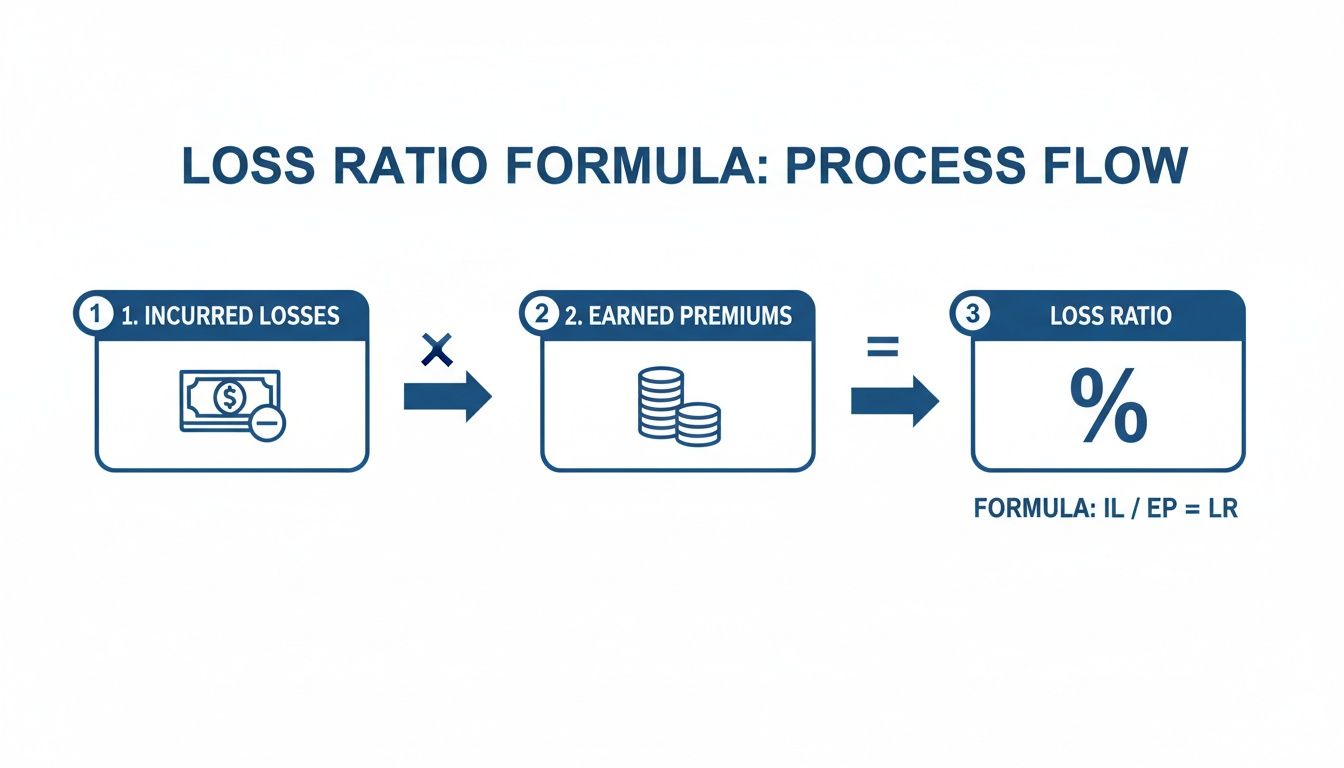
This visualizes how money paid for claims relates to the revenue recognized for providing coverage. Now, let's dissect the components that truly matter.
Numerator: Incurred Losses
The most common error is using paid losses instead of incurred losses. They are not the same.
Incurred losses represent the total estimated cost of all claims that happened during a period, paid or not. It's an accrual-based figure capturing the full financial obligation.
It is composed of three critical parts:
- Paid Claims: The cash already paid to settle claims.
- Case Reserves: Funds earmarked for specific, reported claims that are not yet fully resolved.
- IBNR (Incurred But Not Reported) Reserves: An actuarial estimate for claims that occurred but have not been reported yet. This is essential for "long-tail" lines like liability, where claims may surface months or years later.
Forgetting IBNR will produce a dangerously low loss ratio, understating true liabilities.
Loss Adjustment Expenses
The numerator is incomplete without Loss Adjustment Expenses (LAE). These are all costs tied to investigating, managing, and settling claims.
LAE is split into two categories:
- Defense and Cost Containment (DCC): External costs like fees for lawyers, expert witnesses, and court proceedings.
- Adjusting and Other (A&O): Internal costs, such as claims adjuster salaries and claims department overhead.
The complete numerator formula is: Incurred Losses = Paid Claims + Case Reserves + IBNR Reserves + LAE. This ensures every cost related to a claim is accounted for. The "Losses" component must include all payout drivers, including unexpected events like spikes in UK weather car insurance claims.
A "pure loss ratio" omits LAE, but the industry-standard calculation includes it to reflect the true cost of claims activity. Always confirm if LAE is included in any loss ratio you analyze.
Denominator: Earned Premium
The denominator must be earned premium, not written premium.
- Written Premium is the total premium from all policies sold in a period. It's a measure of sales, not revenue earned.
- Earned Premium is the portion of written premium corresponding to the part of the policy period that has passed. It is the revenue truly earned for the risk covered so far.
If a client pays a $12,000 annual premium on January 1, the books show $12,000 in written premium. By March 31, only three months of coverage have been provided, so the insurer has only "earned" $3,000 ($1,000 per month). Using earned premium correctly aligns revenue with the losses from that same time frame.
Practical Calculation Example
Let's calculate the 2023 loss ratio for a regional property insurer.
Data:
- Total Paid Claims: $8,250,000
- Case Reserves: $2,100,000
- IBNR Reserves: $975,000
- Loss Adjustment Expenses (LAE): $1,687,500
- Total Earned Premium: $15,750,000
Step 1: Calculate Total Incurred Losses
Total Incurred Losses = $8,250,000 (Paid) + $2,100,000 (Case) + $975,000 (IBNR) + $1,687,500 (LAE)Total Incurred Losses = $13,012,500
Step 2: Calculate the Loss Ratio
Loss Ratio = $13,012,500 (Incurred Losses) / $15,750,000 (Earned Premium)Loss Ratio = 0.8262
The loss ratio for the period is 82.6%. This means for every dollar of premium earned, the insurer spent nearly 83 cents on claims and their associated management costs, leaving a thin margin for other business expenses and profit.
What is a good insurance loss ratio?
There is no single "good" loss ratio; it's a moving target that shifts with the insurance line, market conditions, and an insurer's strategy.
An acceptable loss ratio for most property and casualty (P&C) lines falls between 40% and 60%. P&C carriers often target a ratio in the 55-65% range for sustained profitability. In contrast, health insurers operate with much higher ratios, typically between 75% and 85%. This is partly driven by regulations like the U.S. Affordable Care Act's 80/20 rule, which mandated that a large portion of premiums be spent on medical care, resulting in $2.7 billion in consumer rebates in 2022. For a deeper dive into these benchmarks, see this comprehensive loss ratio overview from the Corporate Finance Institute.
High Loss Ratios
A consistently high loss ratio—anything above 70%—is a major red flag indicating that for every premium dollar coming in, an unsustainable amount is flowing out to cover claims.
This almost always points to one or more fundamental problems:
- Poor Underwriting: Taking on too much risk for the price, such as writing policies in high-risk flood zones without adjusting premiums.
- Inadequate Pricing: Premiums are too low to cover expected claims and operational costs, often due to fierce market competition.
- Inefficient Claims Handling: Bloated Loss Adjustment Expenses (LAE) that erode each premium dollar.
- Catastrophic Events: A single event like a hurricane or wildfire can cause a massive, sudden spike in loss ratios for a specific region.
A high loss ratio is a direct threat to an insurer's solvency. It forces decisions like raising premiums, pulling out of markets, or implementing stricter underwriting rules.
Low Loss Ratios
An extremely low loss ratio (e.g., below 40%) is not always a sign of success.
A consistently low ratio might actually mean:
- Overpriced Policies: The company charges customers far more than needed to cover claims, making it uncompetitive over time.
- Regulatory Scrutiny: State regulators can view extremely low loss ratios as a sign that an insurer isn't providing fair value to policyholders, triggering investigations or forced rate reductions.
- Restrictive Claim Practices: Suggests the insurer may be aggressively denying legitimate claims, a practice that destroys brand reputation and invites litigation.
The goal is a "Goldilocks zone"—a ratio low enough for solid profitability but high enough to prove competitive pricing and fair claims payment.
The Combined Ratio
The loss ratio ignores all other expenses required to run an insurance business. For a complete view of an insurer's financial health, you must use the combined ratio.
The combined ratio adds the expense ratio (non-claim costs like commissions, marketing, and salaries) to the loss ratio.
Combined Ratio = Loss Ratio + Expense Ratio
This single number reveals the total profitability of an insurer's core operations before investment income.
Loss Ratio vs. Combined Ratio
| Metric | What It Measures | Formula | Indication of Profitability |
|---|---|---|---|
| Loss Ratio | Measures pure underwriting efficiency—how much of each premium dollar is spent on claims and related expenses. | (Incurred Losses + LAE) / Earned Premiums | Shows if pricing is adequate for claims but ignores other business costs. |
| Combined Ratio | Measures overall operational profitability—how much of each premium dollar is spent on all claims and expenses. | Loss Ratio + (Underwriting Expenses / Earned Premiums) | A ratio below 100% indicates an underwriting profit; a ratio over 100% indicates an underwriting loss. |
The combined ratio is the truest measure of core business health. A company with a healthy 65% loss ratio but a bloated 40% expense ratio has a combined ratio of 105%. It is losing five cents on every dollar of premium collected, forcing it to rely on investment income to stay afloat.
How do you calculate loss ratios with real-world data?
Calculating the loss ratio with real-world data requires wrangling claims and premium data from different systems. Here's a practical guide using Excel and SQL.
The goal is to build a repeatable process that plugs directly into your workflow.
Data Preparation
First, organize your data. For a period like the 2023 calendar year, you need two core datasets: one for premiums and one for losses.
Sample Property Insurance Premium Data (Earned Premium):
| Policy ID | State | Earned Premium |
|---|---|---|
| PROP-001 | CA | $2,500 |
| PROP-002 | FL | $4,200 |
| PROP-003 | CA | $1,800 |
| PROP-004 | TX | $2,100 |
Sample Property Insurance Loss Data (Incurred Losses):
| Claim ID | Policy ID | State | Incurred Loss |
|---|---|---|---|
| CL-101 | PROP-001 | CA | $1,200 |
| CL-102 | PROP-002 | FL | $3,500 |
| CL-103 | PROP-002 | FL | $5,000 |
| CL-104 | PROP-004 | TX | $800 |
With these tables, you can calculate a total loss ratio or slice it by state. This granular view is fundamental to effective real-estate data analytics, pinpointing exactly where your book of business is winning or losing.
Excel Calculation
For smaller datasets, Excel's Pivot Tables are the most efficient tool.
Here is the process:
- Load Data: Place your premium and loss data into two separate sheets in an Excel workbook.
- Create a Data Model: Use Excel's Power Pivot to create a relationship between the two tables using the 'State' column.
- Build a Pivot Table:
- Drag 'State' to the Rows area.
- Drag 'Earned Premium' and 'Incurred Loss' to the Values area.
- Create a Calculated Field to divide the sum of Incurred Loss by the sum of Earned Premium.
This method is dynamic, less prone to errors than manual formulas like
SUMIF, and easier to update with new data.
SQL Calculation
For large, structured datasets in a database, SQL is the standard. This single query joins, aggregates, and calculates everything required.
Assuming your data is in two tables, premiums and losses, this SQL query will calculate the 2023 loss ratio by state:
WITH
  AggregatedPremiums AS (
    -- Calculate total earned premium per state
    SELECT
      state,
      SUM(earned_premium) AS total_earned_premium
    FROM
      premiums
    WHERE
      policy_year = 2023
    GROUP BY
      state
  ),
  AggregatedLosses AS (
    -- Calculate total incurred loss per state
    SELECT
      state,
      SUM(incurred_loss) AS total_incurred_loss
    FROM
      losses
    WHERE
      loss_year = 2023
    GROUP BY
      state
  )
-- Join aggregated tables and calculate the ratio
SELECT
  p.state,
  p.total_earned_premium,
  COALESCE(l.total_incurred_loss, 0) AS total_incurred_loss,
  -- Multiply by 100 for a percentage and handle division-by-zero issues
  (COALESCE(l.total_incurred_loss, 0) / p.total_earned_premium) * 100 AS loss_ratio_percentage
FROM
  AggregatedPremiums p
LEFT JOIN
  AggregatedLosses l
  ON p.state = l.state
ORDER BY
  p.state;
This query uses Common Table Expressions (CTEs) to aggregate premiums and losses first. The LEFT JOIN is crucial, as it includes all states with premiums, even those with zero losses. COALESCE converts any null loss values into zero, preventing errors in the final calculation. This robust query is the backbone of any automated reporting dashboard.
Why are loss ratios a crystal ball for real estate and mortgage pros?
The insurance loss ratio is a powerful market signal for lenders, servicers, investors, and proptech firms—a crystal ball providing a forward-looking glimpse into portfolio risk and regional market health.
When loss ratios in a specific area begin to rise, it's the first domino in a predictable chain reaction that every real estate professional must monitor.

Insurer Reaction
A spike in regional loss ratios from events like wildfires or floods forces insurers to protect themselves. Their first move is to tighten underwriting standards.
Properties that were once easily insured are now scrutinized. Insurers may require expensive mitigation features, like hurricane-rated windows, to even offer a policy. Simultaneously, premiums will skyrocket as insurers re-price the risk. In extreme cases, carriers pull out of a market entirely, creating an "insurance desert" where coverage is either unavailable or financially crippling.
Ripple Effect on Valuations and Lending
These insurance market shifts directly impact property valuations. A home in a high-risk zone with astronomical insurance costs is fundamentally less valuable than a similar home in a low-risk area.
This reality creates shockwaves:
- Mortgage Lenders: Hazard insurance is a key part of PITI (Principal, Interest, Taxes, and Insurance). When the "I" jumps, a borrower's debt-to-income (DTI) ratio can be pushed over the edge, killing a deal.
- Property Investors: Higher insurance costs directly hit net operating income (NOI) and cash flow, making a previously hot investment look unattractive.
- Homeowners: Rising insurance costs can make a home unaffordable, increasing default risk. For sellers, high insurance costs are a major red flag for potential buyers.
Landlords and investors managing these variables find that using the best property management apps becomes essential for tracking expenses and protecting their bottom line.
A rising loss ratio in a zip code is a leading indicator of declining property affordability and increasing lender risk. It signals that the cost of ownership is about to climb, potentially impacting loan performance and property values.
Predictive Modeling
The real power is turning this backward-looking metric into a forward-looking advantage. By blending granular property data with historical loss ratio information, risk managers can build powerful predictive models.
After the 2022 California wildfires, some insurers saw loss ratios hit 78%, pushing their combined ratios to 110% according to PCIAA stats—a significant underwriting loss. Seeing this, savvy risk teams began modeling their exposure by layering AVMs and lien data over high-risk zones. You can find more detail in this resource on loss and combined ratios on insurancetrainingcenter.com.
Imagine you're a mortgage servicer and a hurricane is brewing. Instead of waiting, you get proactive. By analyzing property-level data—like Automated Valuation Models (AVMs), permit activity, and outstanding liens—you can model the fallout. This allows you to identify properties in the storm's path, cross-reference their characteristics (age, construction, elevation), and compare that against historical loss ratios from similar storms to estimate potential portfolio-wide losses.
This is the difference between reacting to a crisis and preparing for one. Our guide on real estate data licensing for mortgage analytics details how to implement these strategies at scale.
What are the most common questions about loss ratios?
The insurance industry is full of nuances that a simple equation can't capture. Here are the answers to the most common questions.
How does reinsurance impact loss ratio calculations?
Reinsurance directly alters both the numerator and denominator of the loss ratio calculation. As "insurance for insurance companies," it allows a primary insurer to offload a portion of its risk.
This has two immediate effects:
- It lowers incurred losses: When a large claim occurs, the amount covered by the reinsurance treaty is paid back to the primary insurer. This recovery is subtracted from gross incurred losses, shrinking the numerator.
- It lowers earned premiums: The cost of buying the reinsurance policy, called ceded premium, is subtracted from the gross earned premium, shrinking the denominator.
The result is the net loss ratio. For example, an insurer with $80M in gross incurred losses against $100M in gross earned premiums has a gross loss ratio of 80%. If they cede $20M of those losses and $25M of premium to a reinsurer, their net incurred losses drop to $60M, and their net earned premiums fall to $75M. The new net loss ratio is ($60M / $75M) * 100 = 80%. Analysts must be crystal clear whether they are looking at a gross or net loss ratio, as they tell different stories about risk appetite and true profitability.
Why can't I calculate a loss ratio for a single property?
A loss ratio for a single property is statistically useless because the metric is designed to measure the performance of a large pool of similar risks.
For one property, the outcome is binary: a claim happens, or it doesn't.
- No Claim: On a $1,500 annual premium, the incurred loss is $0. The loss ratio would be 0%, falsely implying risk-free profitability.
- A Claim: A $50,000 fire claim results in a loss ratio of
($50,000 / $1,500) * 100 = 3,333%. This number provides zero actionable insight.
The law of large numbers is the bedrock of insurance. Loss ratios only become stable and predictable when applied to a large portfolio where individual claim outcomes are smoothed out across the group. The metric measures the book's health, not an individual policyholder's luck.
How often should I calculate the loss ratio?
The calculation frequency depends entirely on its purpose, as different teams have different needs.
A standard cadence within an insurance carrier looks like this:
- Monthly: Operational teams (underwriters, claims managers) use monthly reports to spot emerging trends and react quickly. These calculations are often based on preliminary data.
- Quarterly: Finance and senior leadership review loss ratios quarterly for formal financial reporting to investors, regulators, and the board.
- Annually: Actuarial and statutory reporting teams perform a comprehensive annual calculation. This deep-dive analysis is used to set rates for the following year, true-up loss reserves, and file official statements with regulators.
For external professionals like mortgage lenders or real estate investors, a quarterly or semi-annual review of regional loss ratios is sufficient to monitor market trends and inform risk models.
Ready to turn raw property data into actionable risk insights? With BatchData, you can access over 155 million property records, complete with AVMs, lien data, and pre-foreclosure activity. Stop reacting and start predicting—build more accurate risk models with BatchData today.