


































Most market participants underprice new construction risk because they overvalue recency. A recently completed home can carry lower wear risk and higher documentation risk at the same time. For lenders, insurers, and acquisition teams, the real question is not whether a warranty exists. The question is which obligations survive closing, which are backed by the builder rather than a third-party administrator, and how long each exposure remains actionable under the governing contract and state law.
That distinction matters financially. A mislabeled warranty can distort loss forecasting, shift a defect claim to the wrong counterparty, and reduce recovery odds if notice deadlines expire while the file is being sorted. New construction also creates a timing problem that older housing stock does not. Early cosmetic issues are usually visible at turnover, systems defects often appear only after ordinary occupancy, and structural defects may stay latent until the asset has already changed hands.
The standard consumer shorthand is the 1-2-10 model. It is useful as a rough screening tool and weak as a risk model. Coverage terms are not standardized across jurisdictions, builders, or warranty administrators. Texas is the clearest example. Market participants who assume a universal 10-year structural term can miss the practical significance of state-level variation, including Texas's six-year structural framework in many contexts. That changes reserve logic, diligence priorities, and the expected tail of claim exposure.
A second blind spot is product confusion. Builder warranties attached to new homes are not the same as service contracts marketed as home warranties, and the legal distinction affects who pays, who investigates, and which exclusions apply. The Federal Trade Commission notes that newly built homes commonly include builder warranty protection and distinguishes that protection from separate home warranty service contracts, while also warning that exclusions often limit coverage for appliances and living expenses during repairs in its guidance on warranties for new homes.
Professionals also miss the market gap after the initial sale. Much of the public discussion stops at the builder's original package, yet a thinner and less understood market exists for post-sale structural protection. That matters for investors buying recently built homes in bulk, servicers handling early-life defect claims, and brokers advising on resale liquidity. Consumer guides on buying a house with a home warranty often flatten these distinctions, which is acceptable for household budgeting and inadequate for portfolio risk.
The practical framework is simpler than the marketing language suggests:
| Issue | Why it matters | Portfolio implication |
|---|---|---|
| Builder warranty vs home warranty | They are different legal and financial products | Repair liability can be assigned to the wrong party |
| Layered coverage terms | Workmanship, systems, and structure expire on different schedules | Exposure changes materially over the asset's early years |
| State-level variation | Structural terms and remedies differ by jurisdiction | National assumptions can misprice tail risk |
| Exclusions and notice rules | Many losses fall outside headline coverage or fail on procedure | Recovery rates depend on administration, not just defect severity |
| Post-sale structural products | Secondary protection markets remain underdeveloped | Creates room for new risk-transfer and advisory offerings |
For capital providers and operating teams, the first year after closing is less a courtesy period than a defect-capture window. The value of a new construction warranty depends on claim routing discipline, document retention, builder solvency, transferability on resale, and the legal structure behind the promise. Those variables, not the marketing label, determine whether the warranty reduces loss severity or instead delays its recognition.
Introduction
A new home is not a low-risk asset just because construction is recent. In practice, new construction shifts risk from age-related failure to defect timing, contract interpretation, and evidence quality.
The market shorthand is the familiar tiered warranty model. That shorthand is useful, but only as a starting point. Serious analysis begins where the shorthand stops. You need to know whether the builder stands behind workmanship directly, whether structural coverage is statutory or contractual, whether systems are carved out, and whether transferability survives resale, foreclosure, or builder distress.
Why professionals get this wrong
The most common mistake is treating warranty coverage as a uniform blanket over the property. It isn't. Different subsystems fail on different timelines, and warranty language reflects that reality. Cosmetic and installation defects tend to surface early. Systems defects can emerge after ordinary use. Structural problems can remain latent for years.
A second mistake is treating all "warranty" references as interchangeable. They aren't. The wrong classification can send a claim to the wrong counterparty and burn through notice periods while the file sits unresolved.
Analyst view: The first year after closing isn't just a customer service period. It's a defect capture window that can materially affect recoveries, reserves, and future disputes.
What matters most in practice
- Coverage architecture: Most new construction protection is layered, not singular.
- Evidence timing: Early defect reporting often determines whether a claim survives.
- Jurisdictional drift: State law can alter the structural risk window in ways national guides ignore.
- Counterparty mapping: Builder, manufacturer, insurer, and homeowner may each own a different slice of the same loss.
How Does a New Construction Warranty Actually Work
A new construction warranty functions less like a single promise and more like a liability schedule attached to the house after closing. For lenders, investors, and operators, the practical question is not whether the home "has a warranty." It is which defects are assigned to which counterparty, for how long, and under what notice and remedy conditions.
The market shorthand is the 1-2-10 model, but that shorthand can distort risk. Many programs do use a tiered structure with one period for workmanship, another for major systems, and a longer tail for structural exposure, as described in Treeline's overview of new construction home warranty coverage. The underwriting mistake is assuming those labels carry the same meaning across states, builders, and third-party administrators.
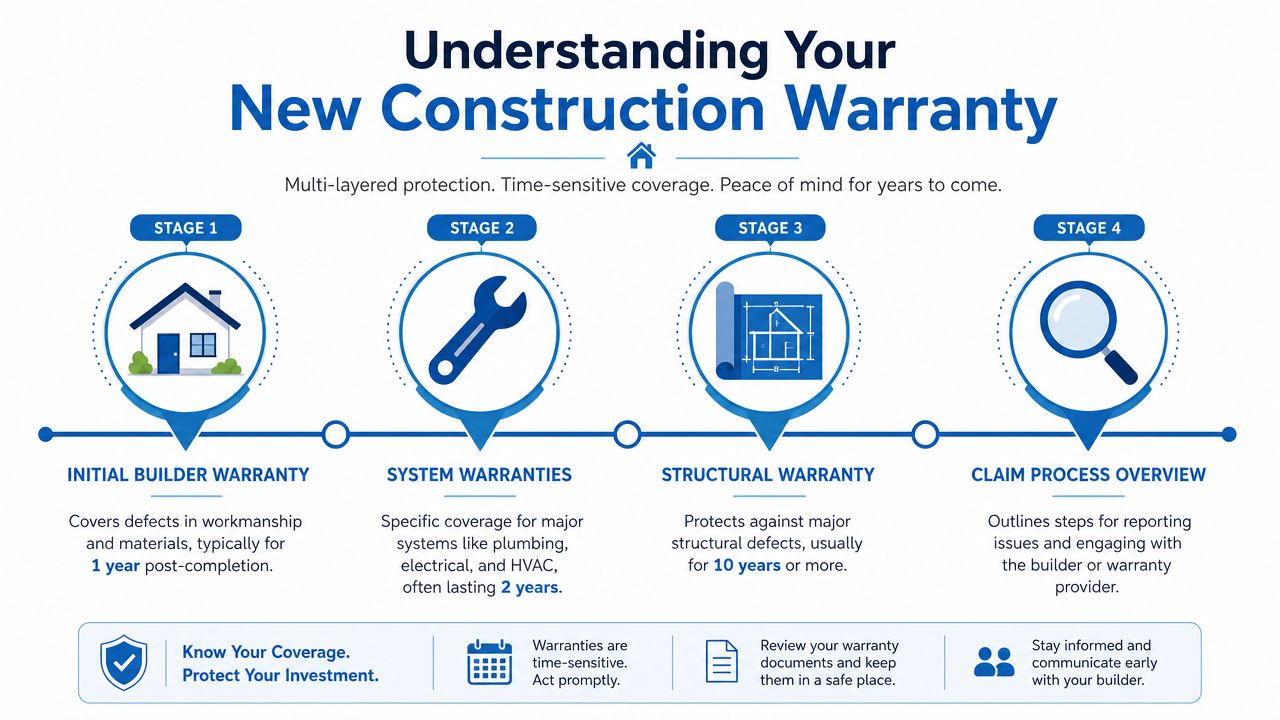
Coverage is tiered because defect emergence is tiered. Finish defects usually present quickly. Mechanical and plumbing issues often appear only after regular occupancy. Structural defects can stay latent until soil movement, water intrusion, or seasonal loading exposes them. That timing mismatch creates a risk management problem. A home may be fully occupied, cash flowing, and still carrying unresolved latent-defect exposure long after short-term warranty buckets have expired.
How the warranty clock is usually organized
| Coverage layer | Typical term | What it usually targets |
|---|---|---|
| Workmanship and materials | 1 year | Finish quality, installation defects, visible construction issues |
| Major systems | 2 years | Plumbing, electrical, heating, cooling, ventilating systems |
| Structural components | Longer-tail coverage, often around 10 years but not uniform | Foundation and other major load-bearing elements |
That table describes the common architecture, not a universal rule.
State law can materially reset the structural tail. Texas is a useful example because market participants often cite a generic ten-year structural term when the legal exposure can differ. Under Texas law, a suit for a construction defect generally must be brought within a four-year limitations period, but a latent structural defect may extend that window, subject to the state's statute of repose. In practice, that can create a six-year structural risk horizon in some defect scenarios, which matters more to reserve modeling than the marketing label attached to the warranty booklet.
Louisiana shows the same point from a different angle. Its statutory framework segments protection into shorter periods for workmanship and systems, with a separate term for major structural defects, as summarized in this discussion of Louisiana home warranty myths. For underwriting, the lesson is straightforward. Structural exposure is jurisdiction-specific, and a national template can misprice tail risk.
What happens after a defect is discovered
The claim process usually follows a sequence. The owner identifies a condition, documents it, and submits notice through the builder or program administrator. The builder then gets an opportunity to inspect and, if the issue falls within covered categories and timing requirements, repair the defect or direct the claim to the responsible party.
That sequence sounds simple. It rarely is.
Coverage often depends on procedure as much as condition. Late notice, undocumented repairs, owner alterations, or failure to give the builder a chance to cure can weaken recovery even when the underlying defect is real. For asset managers, the first post-close year is therefore a defect capture and evidence preservation period, not just a routine service interval.
A second operational issue is counterparty continuity. Some obligations sit directly with the builder. Others are administered by a third-party warranty company or backed by insurance for structural claims only. If the builder dissolves, restructures, or sells assets, the practical value of the warranty can diverge sharply from the language in the purchase documents. That gap helps explain an underserved niche in the market: post-sale structural warranty products that protect owners and portfolios after the original builder relationship becomes less reliable.
The non-obvious conclusion is that warranty review should look less like customer-service screening and more like contingent liability analysis. The term sheet matters. So do statutory overlays, claim mechanics, transfer rules, and counterparty durability. Those variables determine whether a "covered defect" becomes a reimbursed loss, a delayed repair, or an owner-borne capital event.
What Are the Differences Between Warranty Types
Confusion here does not create a minor servicing problem. It changes who bears the loss, how quickly capital must be deployed, and whether a defect is treated as a construction liability, a product claim, or an uncovered operating expense.
For lenders, investors, and portfolio operators, "home warranty new construction" is often an imprecise label for three different risk-transfer mechanisms. They overlap at the property level, but they attach to different failure modes and rely on different counterparties.
Warranty type comparison
| Warranty Type | Provided By | Typical Coverage | Primary Purpose |
|---|---|---|---|
| Builder Warranty | Builder or builder-backed program | Construction defects tied to workmanship, systems, or structure | Allocate post-close defect responsibility in new construction |
| Third-Party Home Warranty | Separate warranty company | Service-contract style coverage for appliances and home systems | Budget protection for breakdowns, often in resale housing |
| Manufacturer Warranty | Component manufacturer | Specific product defects for covered items | Product-level remedy for individual installed components |
As noted earlier, a builder warranty and a home warranty contract are not the same product. That distinction matters more in new construction than many acquisition models assume, because the wrong classification can send a claim to the wrong counterparty while notice periods continue to run.
The larger analytical mistake is treating the familiar "1-2-10" framework as if it resolves the issue. It does not. First, those timelines are not nationally uniform. Texas is a visible example because the structural term is shorter than the headline ten-year model many market participants still reference. Second, even where the structure appears familiar, the legal and financial function of each warranty type remains different. A builder warranty addresses construction responsibility. A third-party home warranty addresses specified breakdown events under a service contract. A manufacturer warranty addresses defects in a named product.
That difference affects underwriting at the component level.
If a window assembly leaks, the source of loss may be installation error, flashing design, frame failure, seal failure, weather intrusion, or owner modification after closing. Only one of those may fit the manufacturer warranty. Several may implicate the builder. Some may fall outside both. The answer turns on causation, contract language, and state-law overlay, not on the owner's shorthand description of the problem.
A practical screening sequence helps separate the products before claim costs expand:
- Identify the failed component or condition
- Determine whether the issue is a defect, a breakdown, or collateral damage
- Confirm who supplied and installed the item
- Match the failure mode to the governing warranty document
- Check whether state-specific warranty rules alter the expected term or remedy
This is also where a market gap becomes visible. Original builder warranties are strongest near closing and often weaken in practical value over time because the responsible builder, administrator, or insurer may change, dissolve, or limit recovery to a narrow structural definition. That leaves a thinly served segment between original construction coverage and ordinary maintenance risk: post-sale structural protection for owners, SFR operators, and lenders with longer hold periods.
For teams evaluating overlap with casualty recovery, understanding home insurance policies helps separate insured loss from warranty liability. Insurance may respond to sudden resulting damage. A warranty may respond to the defective work or product itself. In many files, those are related but legally distinct payment paths.
The working question is precise. Which contract, if any, assigns financial responsibility for this specific failure mode under this state's rules?
What Are the Critical Risks and Exclusions
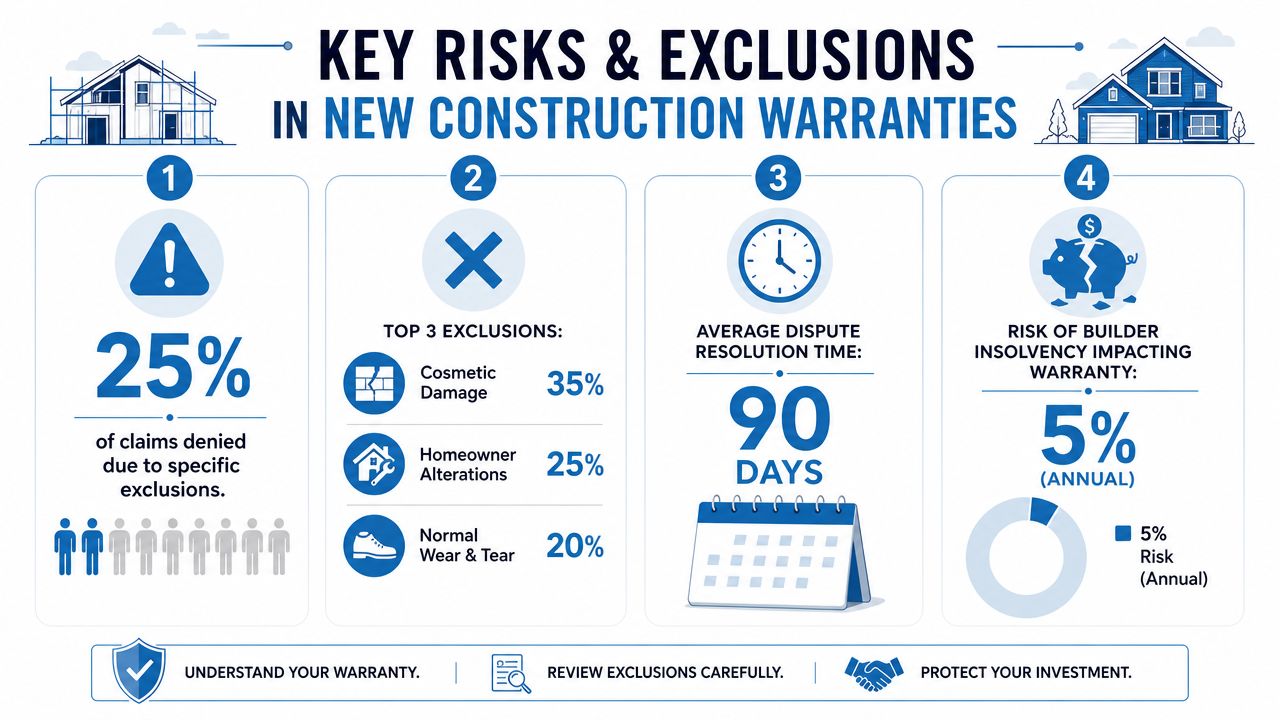
The national "standard" for new construction warranties is less stable than most market participants assume. The headline structure may look familiar, but legal duration, enforceability, and exclusions can vary enough to alter asset-level risk.
The Texas problem
A critical state-level shift has changed the structural risk window in a major new-build market. In Texas, statutory structural warranty periods were reduced from 10 years to 6 years, a change highlighted in this discussion of the Texas legislative shift.
For lenders and investors, the implication is direct. If a model still assumes a 10-year structural recourse window for affected Texas new builds, it overstates available protection. That can distort:
- Underwriting assumptions
- Reserve planning
- Hold-period risk analysis
- Repurchase and servicing workflows
- Vendor and insurer expectations
A 4-year shorter structural recourse window is not a cosmetic change. It compresses the time available to discover, document, and pursue latent structural claims in one of the country's most important new-construction markets.
The exclusions that matter most
Builder warranties for new construction typically exclude or sharply limit items outside the builder's control, including normal wear and tear, accidental damage, weather events, and many appliances or manufacturer-covered components, according to Select Home Warranty's overview of common new-construction exclusions.
Those exclusions matter because many expensive disputes involve mixed facts.
Consider the common categories:
| Exclusion area | Why claims get messy | Likely alternate payer |
|---|---|---|
| Weather events | Damage may appear in the same location as a construction defect | Homeowners insurer |
| Wear and tear | Gradual deterioration can be mistaken for defective work | Homeowner |
| Appliances | Owners assume "new home" means appliance coverage is automatic | Manufacturer or separate contract |
| Owner modifications | Later work can break causation and void builder responsibility | Homeowner or later contractor |
Read for causation, not marketing language
The key legal distinction is defect causation versus damage causation. If the issue stems from construction quality, builder coverage may apply. If the issue stems from misuse, external events, or later alteration, it often won't.
That is why file quality matters so much. Dated installation records, defect photos, inspection notes, and component-level documentation help establish causation before the builder or provider narrows responsibility.
A related due diligence issue appears in title and construction-risk review. Teams that underwrite newly built homes should pair warranty analysis with title insurance on new construction, because defect disputes and title issues can surface on very different timelines but affect the same asset-level risk profile.
If your review process captures what a warranty promises but not what it excludes, you're not analyzing coverage. You're reading marketing copy.
How Should Professionals Manage Claims and Disputes
Successful warranty recovery depends less on the defect itself than on proof, timing, and procedural discipline. In new construction, many valid complaints fail because the owner or servicer can't show when the issue appeared, how it was reported, or why the builder remains responsible.
Build the claim file before you argue the claim
A disciplined process usually outperforms an emotional one. That matters for servicers, investor asset managers, and property operations teams who may inherit the file after closing.
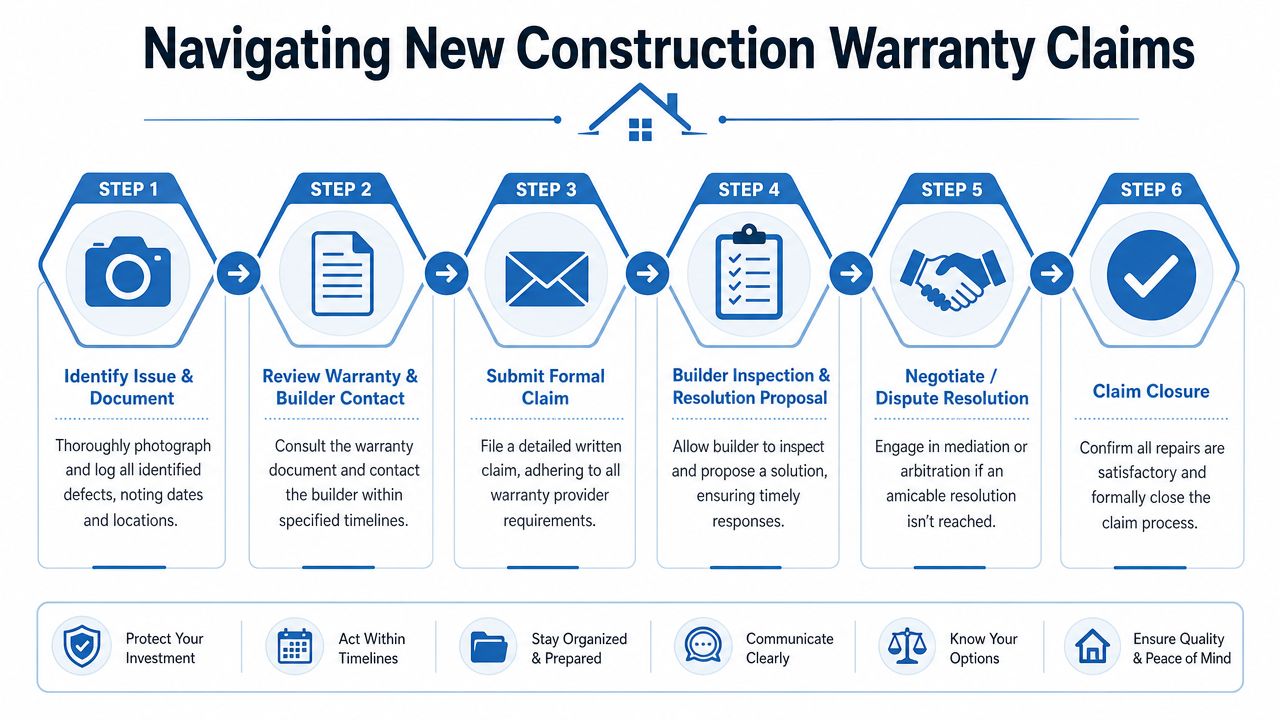
Use this sequence:
Document the defect immediately
Capture dated photos, video, exact location, affected component, and observed impact. If the issue changes over time, update the file rather than replacing the original evidence.Map the issue to the contract
Check whether the relevant coverage period is still open and whether the component belongs under builder, manufacturer, insurer, or service-contract responsibility.Submit formal written notice
Builders often require a specific intake channel. Use it. Include the defect description, timeline, supporting evidence, and a request for inspection.Preserve the chronology
Save every acknowledgment, call note, portal update, and repair proposal. Chronology gaps weaken later escalation.
What to include in the first notice
The first notice should be factual, not argumentative.
Include:
- Property identification: Address, closing date, and any internal asset ID
- Defect description: What failed, where, and when it was first observed
- Operational impact: Safety, livability, or systems implications
- Evidence package: Photos, video, invoices, or technician observations
- Requested action: Inspection, repair, or written coverage determination
Claims rule: Builders and warranty providers respond better to organized defect evidence than to general statements that "the house was built poorly."
How to handle builder inspections
Treat the inspection as a record-building event, not just a repair appointment.
Have a representative present. Confirm what was observed. Ask for a written summary of findings and next steps. If the builder attributes the issue to maintenance, weather, or owner action, document that position immediately because it frames the dispute.
Escalation when the builder pushes back
Not every dispute requires litigation. Many require a better file.
Use an escalation ladder:
| Stage | Objective | Best use case |
|---|---|---|
| Internal escalation | Move the issue beyond frontline service | Delays, inconsistent responses, weak repair proposals |
| Independent inspection | Create a neutral technical record | Causation disputes and recurring failures |
| Contractual dispute process | Trigger mediation or arbitration if required | Coverage denials or deadlocked repair responsibility |
If the warranty contract contains mediation or arbitration language, follow it carefully. Skipping required procedure can weaken bargaining power later.
When independent reports matter
A third-party inspector becomes most valuable when the dispute turns on root cause. Water intrusion, HVAC performance, and movement-related cracking often involve multiple plausible explanations. An independent technical report can separate installation defect from product defect or external damage.
That doesn't guarantee recovery. It does improve the quality of the decision tree.
What Are the Strategic Opportunities for Real Estate Professionals
Most market commentary stops at claim avoidance. That's too narrow. Warranty data can also create underwriting advantage, better acquisition decisions, and targeted revenue opportunities.

Use warranty data as a risk variable
Lenders and insurers should stop treating warranty status as a binary field. "Warranty present" doesn't say enough. The relevant variables are term, scope, transferability, state-specific override, and exclusion density.
That information can sharpen:
- Origination review
- Construction-to-perm transitions
- Portfolio monitoring
- Loss forecasting on early-life housing stock
- Vendor routing for defect complaints
A newly built home with short remaining workmanship coverage, uncertain structural transferability, and appliance carve-outs is not equivalent to a similarly aged home with clearer surviving protection.
Reprice assumptions around transferability and expiry
Investors buying new or nearly new homes should pay close attention to whether any structural coverage transfers after resale, foreclosure, or REO disposition. That affects not just repair risk but also exit story quality.
If protection survives transfer, the asset may carry a stronger risk narrative at sale. If it doesn't, the buyer inherits a narrower recovery path and should underwrite accordingly.
This is especially relevant for rental portfolios. Teams evaluating turnover, maintenance exposure, and acquisition timing should also think about how home warranty for rental property decisions intersect with builder and manufacturer coverage already attached to the asset.
The overlooked market in post-sale structural warranties
One of the more interesting gaps in the market is the emerging niche for legacy or post-sale structural warranty products. Current data suggests there is a growing but poorly documented market for products that allow owners to secure 10-year structural coverage independently after the original sale, as noted in ConsumerAffairs' discussion of home warranties for new construction.
For operators, that creates several opportunities:
| Opportunity | Why it matters | Who should care |
|---|---|---|
| Lead generation | Owners of homes 2-5 years post-sale may be approaching protection gaps | Home services marketers, insurers, warranty providers |
| Portfolio segmentation | You can flag homes with likely expiring original protection | Investors, servicers, risk teams |
| Distressed asset strategy | Foreclosed or builder-disrupted homes may lack intact original coverage | REO buyers, special servicers, private equity buyers |
The market is still thin on pricing, eligibility, and underwriting transparency. That lack of documentation is itself useful intelligence. It means many owners and many institutions are operating with incomplete assumptions about structural protection after the initial builder-backed period changes, expires, or becomes unusable.
The best opportunity isn't selling a generic warranty message. It's identifying exactly which owners are moving into a protection gap and why that gap matters now.
Where this becomes actionable
Professionals who can pair property-level construction age, jurisdiction, ownership timeline, and likely warranty status have an edge. They can identify:
- recently built assets nearing key coverage milestones
- properties in states where legal defaults differ from national assumptions
- homes acquired through distress channels where original warranty rights may be compromised
- owners likely to respond to post-sale structural protection offers
That is much more valuable than broad consumer messaging about "peace of mind."
If you're building underwriting models, monitoring new-build portfolios, or targeting owners near warranty expiration, BatchData gives you the property intelligence needed to work at scale. Its nationwide property records, ownership data, and portfolio monitoring capabilities help teams identify new-construction exposure, segment assets by risk profile, and turn scattered housing signals into actionable decisions.