



SEO Title: Title Insurance on New Construction Guide for Risk Teams
Meta Description: Learn how title insurance on new construction works, what it covers, what it costs, and how lenders, developers, and investors reduce risk.
Meta Keywords: title insurance on new construction, new build title insurance, mechanic's liens, enhanced owner's policy, lender's title policy, construction title risk, title insurance cost, real estate underwriting
A brand-new house can still carry an old title problem, and the fraud backdrop alone makes that obvious: real estate fraud losses reached $350 million across 11,727 victims in 2022 according to the FBI, as summarized by Urban Institute.
That is the core mistake even discerning buyers still make with title insurance on new construction. They focus on the structure because it's new. The legal risk sits under it. The dirt has a history, the subdivision paperwork can be messy, the contractor stack can break, and a post-closing lien can hit after everyone thinks the deal is done.
For lenders, developers, investors, and underwriters, the right question isn't whether new construction needs title coverage. It does. The key question is where the exposure sits, which policy form handles it, and how to catch preventable problems before they become insured losses or delayed closings.
Key takeaways
- New doesn't mean clean title: The land, easements, prior transfers, and subdivision filings can all create defects.
- Lender's and owner's policies do different jobs: A lender's policy protects the loan. It does not protect the buyer's equity.
- Mechanic's liens are the signature new-build risk: They can appear after closing and cloud title.
- Enhanced coverage matters: Standard forms often leave post-policy construction-related gaps.
- Data changes the workflow: Teams that monitor permit, ownership, and lien signals earlier make better underwriting decisions.
- Market conditions matter: Housing and title activity move together, which is one reason many operators track broader state and national property trends through resources like our Investor Pulse reports.
Introduction
Only a small share of title premium dollars are paid out as claims, according to Urban Institute's analysis cited elsewhere in this article. That statistic drives policy debate. It does not reduce the loss severity of a bad file on a new build.
Title insurance on new construction exists because the legal risk attaches to the land, the paper, and the construction draw process. A new house can sit on an old easement problem, a broken legal description, an unreleased deed of trust, or a contractor payment dispute that matures into a lien after closing. The structure is new. The title problem often is not.
That is why experienced buyers and lenders underwrite new construction differently from resale. The financial exposure is not limited to a one-time premium. A title defect can delay lot takedowns, block loan sales, impair lien priority, hold up certificates needed for exit, and force curative work across an entire phase of a subdivision. On larger projects, one bad exception can affect multiple closings.
The practical issue is timing. New construction title risk changes while the asset is being built. Ownership transfers, plat approvals, utility easements, permit activity, contractor stacks, and recordings create a moving risk profile that static file reviews often miss. Teams that monitor those signals earlier tend to catch trouble before it reaches the closing table. Broader housing and property activity also shape underwriting volume and risk concentration, which is one reason many operators watch national property market data, such as our Investor Pulse reports, alongside their title pipeline.
From an underwriting seat, the expensive mistakes are predictable. The file looks clean because the improvements are new, but the land history is incomplete, the subdivision documents were recorded out of sequence, or the indemnity package for contractor payments is thin. Data platforms such as BatchData help address that problem by giving lenders, developers, and title teams a way to screen parcels, ownership changes, permit signals, and lien exposure before the commitment is issued, not after a claim lands.
Underwriting view: Clean finishes do not cure defective title. Early data, tighter curative work, and the right policy structure do.
Why Is Title Insurance on New Construction Even Necessary?
A single unpaid contractor, recording error, or unreleased prior lien can cloud title on a brand-new home and stall a closing, refinance, or portfolio sale.
Title insurance on new construction exists because the risk sits in the land, the filings, and the construction payment chain. The house may be new. The title is not. By the time a retail buyer or takeout lender enters the file, the property may already carry a long chain of deeds, development transfers, plat recordings, easements, loan documents, releases, and contractor exposure.

That is why the common retail assumption fails. A new structure does not mean a clean title file. I see claims and curative work tied to old mortgages that were never released, legal descriptions that changed during subdivision, access or utility easements that were recorded late, and mechanic's lien exposure created during vertical construction.
Fraud is part of the risk as well. The FBI's Internet Crime Complaint Center reported more than $350 million in losses from real estate and rental fraud in 2022, which is one reason title review still matters even on new inventory. On the industry side, the American Land Title Association reported title insurance premium volume of $17.1 billion in 2023, a useful reminder that this is a large risk-transfer market built around defects that continue to produce real losses.
The other mistake is treating title insurance as a lender box-check. A lender's policy protects the lender's lien position. It does not protect the owner's equity, deposit, carry costs, or litigation bill. If a title defect reduces value, delays disposition, or forces curative work after closing, the owner's exposure is separate.
Which policy protects whom
| Policy Type | Who It Protects | Key Coverage | Is It Optional? |
|---|---|---|---|
| Owner's policy | Buyer or end owner | Protects the owner's equity and ownership rights against covered title defects | Usually optional in the legal sense, but often financially prudent |
| Lender's policy | Mortgage lender | Protects the lender's lien priority and loan balance | Effectively required if there is financing |
| Builder or lot policy | Developer or builder before retail sale | Protects the builder's interest in the lot during acquisition, development, or interim ownership | Depends on project structure and financing |
For builders, developers, and credit teams, the practical question is not whether title risk exists. It is when the defect becomes visible and who absorbs the delay. Static title review at the end of the process often catches the problem late, after schedules, rate locks, and exit assumptions are already set. Teams that use property and recording data earlier, including parcel history, ownership changes, permit activity, and lien signals surfaced through platforms such as BatchData, can screen for risk before the commitment becomes a closing problem.
The trade-off that matters
The premium is a one-time cost. The loss profile is not. A title defect can interrupt loan sale, subordinate lien priority, delay certificates and closings, block refinance proceeds, or force a reserve hit across multiple units in the same phase.
From an underwriting seat, owner coverage on a new build is a risk allocation decision. Skip it, and the buyer keeps the downside if the land history, subdivision record, or construction payment chain turns out to be wrong.
How Do Title Policies for New Builds Differ?
They differ by beneficiary, timing, and whether they cover issues that arise after construction activity continues.
The biggest operational mistake in new construction is assuming all title policies work the same way. They don't. The distinctions affect who gets paid, when coverage applies, and whether a post-closing lien becomes the owner's problem.
New Construction Title Insurance Policy Comparison
| Policy Type | Who It Protects | Key Coverage | Is It Optional? |
|---|---|---|---|
| Owner's Policy | The buyer | Covered title defects affecting ownership and equity | Optional at closing in many transactions, but financially important |
| Lender's Policy | The mortgage lender | Covered defects that impair the mortgage lien or its priority | Required by most lenders |
| Builder or Lot Policy | The builder or developer | Covered defects during pre-sale ownership of the land or project | Depends on project and lender requirements |
That table is the basic frame. The harder distinction is standard versus enhanced coverage.
Standard versus enhanced coverage
A standard owner's policy addresses traditional defects that existed before policy issuance, subject to listed exceptions. On a resale, that may be enough. On a new build, it often isn't, because some of the most painful claims emerge from the construction timeline itself.
An enhanced owner's policy is where new construction buyers, lenders, and counsel should focus. Enhanced forms can address issues that standard coverage doesn't adequately handle, especially where the risk surfaces after closing but traces back to work, filings, or conditions tied to the construction phase.
The three exposures that change the analysis
Mechanic's liens
This is the classic new-build problem. A subcontractor or supplier isn't paid, then files against the property after closing. If the policy structure doesn't pick that up, the owner can face settlement costs and legal expense.Permit and completion issues
Open permits, incomplete municipal sign-offs, or unresolved project documentation don't always create an insurable title claim by themselves, but they often correlate with sloppier project administration. In underwriting, they should trigger harder review of exceptions and endorsement needs.Vesting and transfer defects
A new subdivision can still have flawed deed execution, recording mistakes, unresolved entity authority issues, or subdivision-related errors. The house can be perfect and the transfer can still be defective.
Practical rule: In a financed new build, treat the lender's policy as transaction plumbing. Treat the owner's enhanced policy as balance-sheet protection.
What Are the Most Common Title Risks for New Construction?
Mechanic's liens, plat and access defects, and vesting errors drive a large share of preventable losses on new construction files.
Those problems do not arise from one bad closing. They accumulate across land acquisition, entity transfers, permitting, contractor payment, and final recording. By the time a retail buyer or takeout lender sees the file, the underlying defect may be weeks or months old.

Mechanic's liens create the most immediate post-closing risk
On a new build, unpaid subcontractors and suppliers can still assert lien rights after the buyer closes. State deadlines vary, but the underwriting problem is consistent. The title commitment reflects the record on its effective date, while construction payment disputes often mature later.
That gap is expensive.
A buyer may have paid the builder in full and still inherit a title problem that blocks resale or refinance. A lender may have funded against an apparently clean file and then face priority questions, curative cost, and delay. For investors and asset managers, this is one reason it helps to review external guidance on how to Find liens on properties before acquisitions, refinances, or disposition.
The practical underwriting issue is not just whether lien waivers exist. It is whether they are complete, current, and tied to actual draw activity. Partial waivers, stale affidavits, and poor draw controls are common precursors to claims.
Subdivision, survey, and access defects are quieter and often more expensive to cure
New subdivisions produce a steady stream of title defects that do not look dramatic until someone tries to build, finance, or sell. Common examples include legal descriptions that do not match the recorded plat, unrecorded easements, utility corridor conflicts, drainage encroachments, and lots that technically lack legal access.
These defects hit value directly. A boundary issue can reduce usable square footage. An access defect can impair lender marketability. A utility easement conflict can force redesign, relocation, or a negotiated release. None of that is cheap, and none of it improves because the house is new.
Modern underwriting teams are addressing this earlier by using parcel, ownership, and recording datasets to compare lot status against plats, assessor records, deed chains, and nearby encumbrance patterns before closing pressure builds. That is where data platforms such as BatchData add real value. They help teams spot lot-level anomalies across an entire pipeline instead of discovering them one file at a time in the final week.
This explainer gives a useful baseline on the issue:
Vesting defects still appear on polished builder files
A new home can sit on a broken chain of title. I see this most often in entity authority problems, missed conveyances between affiliated development entities, incorrect vesting on subdivision takedowns, and recording errors that leave a prior interest unresolved.
Fraud is less common than administrative error, but both matter. If the wrong entity signed, if a manager lacked authority, or if an intermediary deed never recorded correctly, the closing package can look complete while title remains defective.
The operational lesson is straightforward. New construction risk should be underwritten as a moving pipeline, not as a one-day closing event. Teams that use current title updates, draw-level payment controls, and property data monitoring catch more defects before they turn into claims.
What Is the Process and Timeline for Securing Coverage?
Coverage for a new build is set in stages, and each stage can change the risk the underwriter is being asked to insure.
A clean lot search at the start of construction does not mean the file is clean at closing. New construction title work begins before the first retail contract is signed, then has to be updated as permits are pulled, funds are disbursed, improvements are made, and parties with lien rights come into the project. If the file is not refreshed at the right moments, the policy can be issued against stale information.
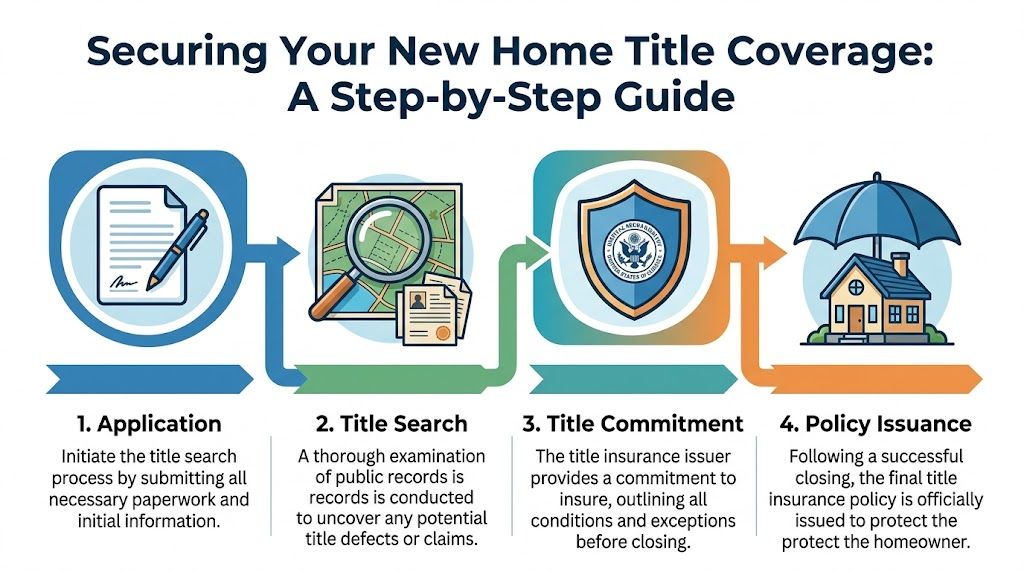
The basic timeline
Order intake and file setup
The title team opens the file, confirms the legal description, identifies the current vested owner, and reviews the contract, loan structure, and subdivision status. On builder inventory and multi-lot projects, this step should also confirm that the lot being sold matches the recorded plat and municipal addressing.Initial search and examination
The examiner reviews deed history, taxes, easements, restrictions, unreleased security instruments, judgments, and other recorded matters affecting the lot. For new construction, this review often reaches beyond the final lot to prior parent parcels, development conveyances, and recorded documents tied to common areas or phase maps.Commitment issuance
The commitment states what the insurer will cover, what must be cleared before closing, and what exceptions will remain in the policy. Prudent buyers and lenders should read Schedule B with the same care they give loan covenants. Exceptions tied to access, utility easements, shared improvements, pending plats, or lien risk can change project economics.Construction-phase updates
This is the part consumer guides usually skip. If the project is still active, the file needs date-down searches, indemnity review where appropriate, payoff verification, and updated lien handling before draws or before the retail sale closes. On higher-volume builder pipelines, data tools such as BatchData help teams monitor lot status, ownership changes, and recording activity across many parcels instead of waiting for a surprise in the last few days.Closing, recording, and final policy issuance
Once requirements are satisfied and closing documents record in the correct order, the insurer issues the lender's policy and, if elected, the owner's policy. The policy insures the state of title as of the effective date. It does not cure a problem that should have been caught and cleared before issuance.
What changes on construction files
Construction files keep moving. People get paid at different times. Deeds record on different dates. Municipal approvals can lag the sales schedule. A title commitment issued early in the build is only a point-in-time underwriting decision.
That is why disciplined updates matter. Before each major funding event and before final closing, the title company should confirm whether new liens, taxes, assessments, notices of commencement, or recording defects have appeared since the last search. On a subdivision pipeline, that work is easier when the team is using parcel and recording data to monitor exceptions in bulk. BatchData-style workflows are useful here because they let lenders, developers, and title operations teams identify changes across an entire inventory of lots rather than react file by file.
Where timing usually fails
Three failure points drive a large share of avoidable loss.
Before a construction draw
Funds go out based on an old search. An intervening lien, judgment, or notice is missed, and the lender advances money into a risk position it did not intend to take.After substantial completion but before the retail closing
This is a dangerous interval. The house looks finished, but downstream contractors or suppliers may still have payment disputes, unresolved lien waivers, or open claim periods.At simultaneous issue
Issuing the lender's and owner's policies together is efficient, but efficiency is not the same as good underwriting. If construction-period updates were weak, both policies can inherit the same avoidable exception or exposure.
On an active build, treat the commitment as a working document. Update it until the file records.
Who pays during the process
Payment responsibility depends on deal structure and local custom, but the operational point is simpler. The party writing the premium check is often not the party carrying the largest risk if title work is rushed or exceptions are misunderstood.
| Project setup | Common premium pattern | Operational reality |
|---|---|---|
| Builder-financed sale | Builder may cover some owner-related title charges as a sales incentive | The builder still needs clean lot-level underwriting because unresolved issues can delay closings across multiple homes |
| Buyer-financed purchase | Buyer commonly pays lender-related policy costs tied to the mortgage | The lender will require current title work before funding, especially if construction recently finished |
| Custom build on owned lot | Costs may be split across construction-loan and final-closing stages | The file usually needs coordination between the construction lender, title company, and final takeout financing |
How Much Does Title Insurance for New Construction Cost and Who Pays?
A title premium is a small line item compared with the loss exposure on a failed new-construction file, but it still affects deal economics and should be allocated deliberately.
For new construction, the premium is usually charged once at closing and priced from the insured amount under state rate rules or filed schedules. In practice, the owner's policy is commonly tied to the purchase price, and the lender's policy tracks the loan amount. On a tract project, that cost can look routine on a settlement statement. Across dozens or hundreds of closings, it becomes a budget item that developers and lenders need to model early.

It is also a one-time premium. The policy remains in force under its terms after closing, which is why the underwriting quality behind that premium matters more than shaving a marginal amount off the charge.
Who usually pays
Payment allocation is driven by local custom, bargaining power, and the purchase contract.
- Production builder sale: the builder may absorb part of the owner's policy as a sales concession, especially in a slower market or when using an affiliated title operation.
- Financed retail closing: the borrower often bears the lender's policy cost directly or indirectly through closing charges.
- Custom build or investor exit: costs are often negotiated across the construction loan, resale closing, and any endorsement package the lender requires.
- Institutional bulk or BTR transactions: title expense is typically folded into a broader closing-cost model, with more attention paid to endorsements, survey coordination, and curative timelines than to the base premium alone.
Who writes the check is only part of the analysis. The larger issue is which party absorbs the delay, reserve pressure, or impaired collateral value if title defects surface late.
Where cost control actually happens
Premium shopping has limits, particularly in states with regulated rates. The better savings come from reducing curative work, delayed closings, endorsement surprises, and post-policy claim friction. A file with clean entity vesting, current releases, and documented construction disbursements costs less to process than a file that reaches closing with unresolved exceptions and missing payoff support.
That is where modern property data becomes operationally useful. Teams that monitor parcel transfers, loan activity, permit history, and builder concentration before the final commitment arrives can flag bad lots earlier and keep marginal files out of the closing queue. For California operators trying to budget title and closing risk against broader market conditions, the California data in our Investor Pulse reports gives useful context on volume, competition, and project timing.
The core financial trade-off
The premium discussion gets distorted when it is framed only as a closing cost. Underwriting sees it differently. One missed mechanic's lien issue, one bad legal description carried through a subdivision split, or one unresolved construction deed of trust can turn a modest premium decision into a six-figure cleanup.
For lenders, that can mean delayed loan sale, repurchase pressure, or collateral that cannot be liquidated cleanly. For developers and investors, it can mean stalled unit closings, trapped proceeds, added legal fees, and a slower exit. The cost question is not just what the policy charges. It is what the project stands to lose if title review is treated as a commodity instead of a control function.
How Data Platforms Streamline New Construction Underwriting
They turn title risk from a closing-table discovery problem into a pipeline-monitoring problem.
Traditional title work is still essential. It is not enough by itself for modern new-construction underwriting. By the time a title commitment is on someone's desk, many upstream decisions have already been made about the lot, the builder, the draw structure, and the expected exit.
The better operating model uses property data throughout the project lifecycle. That means monitoring ownership history, mortgage and lien activity, permit status, and geographic context before the retail file reaches closing.
What underwriters should monitor continuously
A practical workflow should track:
Ownership chain signals
Confirm that the lot moved through the expected entities and that transfers align with the development timeline.Lien activity
Watch for newly recorded liens, releases, and related filings during the construction period.Permit records
Compare permit issuance and status with construction progress. Open or inconsistent permits don't automatically create title defects, but they often identify files that need deeper review.Property configuration
Boundary, parcel, and location context can expose subdivision oddities that look harmless in a sales brochure.
For teams building this into automated underwriting, geospatial context matters too. A practical primer on that side of the workflow is how geospatial analysis enhances automated valuation models.
What works and what doesn't
| Approach | What works | What fails |
|---|---|---|
| One-time review at closing | Catches obvious recorded defects | Misses evolving construction-phase risk |
| Manual document chase | Useful on individual exceptions | Slow, inconsistent, hard to scale |
| Integrated data monitoring | Surfaces changes earlier and supports faster escalation | Still requires policy judgment and title expertise |
Four practical uses
Builder selection
Lenders and insurers can screen counterparties more intelligently when public-record patterns suggest recurring payment or permit discipline issues.Construction draw oversight
Risk teams can compare draw cadence with new lien recordings and permit progression.Pre-acquisition diligence for investors
Buyers of scattered new-build portfolios can identify the outlier assets before purchase agreement deadlines expire.Exception management for underwriters
A stronger data picture helps determine when standard exceptions should remain and when enhanced coverage can be offered with confidence.
The fastest underwriters aren't the ones who skip review. They're the ones who already know where the file is likely to break.
Practical Checklists for Key Stakeholders
Use different questions for different roles. The buyer, builder, lender, and underwriter are not solving the same problem.
For homebuyers
- Ask who the lender's policy protects: If the answer is "you," the explanation is wrong. It protects the lender.
- Request the exact owner's policy form: Don't accept vague language like "full coverage."
- Ask whether post-closing mechanic's lien risk is covered: This is a core new-construction issue.
- Review exceptions carefully: Easements, restrictions, and survey matters can materially affect use and resale.
- Confirm subdivision documents are recorded: Especially if roads, utilities, or common areas are part of the development.
For developers
- Collect final lien waivers: Partial waivers are not enough if payment chains remain unresolved.
- Keep entity authority clean: Signatures, resolutions, and conveyance authority must match the seller of record.
- Close permit loops: Sloppy municipal closeout often signals sloppier project administration elsewhere.
- Coordinate title updates with project milestones: Don't wait for retail closing to revisit the file.
For lenders
- Verify lien-priority protection at every stage: Construction lending creates more moving parts than permanent lending.
- Check endorsement strategy early: If a file needs phased coverage, build that into closing instructions and draw procedures.
- Match disbursement controls to title controls: The draw process and title process should not operate in separate silos.
- Read exceptions, don't just price them: A broad exception can wipe out the practical value of the policy.
For underwriters
- Cross-check ownership history against development chronology: Unexpected transfers deserve explanation.
- Compare permit status with claimed completion: Mismatches are often where deeper file defects hide.
- Look harder at subdivision-related access and easement matters: These are common friction points on new builds.
- Escalate any sign of downstream payment instability: Lien exposure is often a process problem before it becomes a recorded claim.
Frequently Asked Questions about New Build Title Insurance
A finished house can still carry unfinished title risk. By the time that risk shows up at closing, refinance, or resale, the fix is usually slower and more expensive than it would have been during lot development or vertical construction.
Do HOA restrictions and unrecorded easements affect title risk?
Yes. Recorded CC&Rs, use restrictions, drainage easements, utility easements, reciprocal access agreements, and plat-based limitations can all affect value, financing, and exit options. Unrecorded matters are harder. If a road, drain line, shared drive, or access path exists on the ground but is missing, misstated, or inconsistently reflected in the title package, the issue can turn into a coverage exception, a closing delay, or a post-policy claim.
The financial problem is not abstract. A buyer may lose intended use. A lender may refuse to fund until access is confirmed. An investor may inherit a property that is technically improved but operationally constrained.
This is one of the clearest places where BatchData adds real underwriting value. Teams can use BatchData to compare ownership history, recorded liens, permit activity, parcel geometry, and surrounding development context before the file reaches the final title review. That does not replace title examination. It helps surface the files that need tighter scrutiny while there is still time to fix them.
Does title insurance cover poor workmanship or construction defects?
No. Title insurance covers defects in title, lien priority, access, legal description, vesting, and other covered ownership matters under the policy terms. Poor workmanship, defective materials, incomplete construction, and general building-performance issues sit outside that scope unless they create a separate title issue, such as an unrecorded mechanic's lien or a dispute over legal access required for completion.
That distinction matters in claims handling. A cracked slab is a construction dispute. A contractor with unpaid lien rights can become a title problem.
Is a custom build on my own lot different from buying from a production builder?
Yes. Custom construction usually creates more title touchpoints and more opportunities for mismatch between the land file and the improvement file. The owner may already hold title to the lot, the construction lender may have separate draw conditions, contractors may rotate in and out under different payment structures, and the final takeout lender may review the file under a different standard than the construction lender used.
Production builders have their own risks, but the chain is often more standardized. Custom builds tend to require closer coordination across surveys, disbursements, lien waivers, and final recording.
If the home is already complete, can I ignore construction-phase risk?
No. Completion is not a title cure. Recorded documents may still be missing. Downstream contractors may still have lien rights. Access, easement, or boundary problems can remain buried until a resale, refinance, or claim review forces the issue into the open.
The practical rule is simple. Underwrite the dirt, the development history, and the payment chain, not just the finished structure.