
SEO Title: Foreclosure Lis Pendens: Guide to Risks & Opportunities
Meta Description: A foreclosure lis pendens is a public notice that a property is in a lawsuit. Learn what it means for investors, how to find records, and the key risks.
Meta Keywords: foreclosure lis pendens, what is a lis pendens, notice of default, pre-foreclosure, judicial foreclosure, real estate investing, clouded title
A foreclosure lis pendens is a public notice filed in court records signaling a lawsuit has begun that directly impacts a property's title, serving as the first official step in a judicial foreclosure. This legal filing acts as a warning shot, creating a "cloud on the title" that effectively halts any conventional sale or refinancing of the property until the lawsuit is resolved. For investors, this notice is the earliest actionable signal of a distressed property, presenting a high-risk, high-reward opportunity well before a public auction.
| Core Takeaway | Description |
|---|---|
| Definition | A public notice of a pending lawsuit affecting property title. |
| Primary Effect | "Clouds" the title, making the property difficult to sell or refinance. |
| Investor Signal | The earliest indicator of a potential pre-foreclosure investment opportunity. |
| Homeowner Status | The homeowner remains the legal owner but faces an impending court battle over the property. |
Understanding this legal instrument is critical for navigating the complexities of distressed real estate.
What Does a Foreclosure Lis Pendens Notice Actually Do?
A foreclosure lis pendens gives constructive notice to the public that a property is entangled in litigation; it is the formal kickoff of the judicial foreclosure process, not the foreclosure itself. The primary function of this notice is to protect the lender's interest by preventing the distressed owner from selling or refinancing the property to an uninformed party during the lawsuit. Once a lis pendens is filed, any potential buyer is legally considered aware of the foreclosure action and would inherit the lawsuit along with the property.
This filing immediately creates a “cloud on the title,” a legal claim that makes ownership questionable and kills the property's marketability. Traditional buyers cannot secure financing, and title insurance companies will not issue a policy for a property with an active lis pendens, bringing nearly all legitimate sales to a halt.
Key Distinctions: What a Lis Pendens Is vs. Is Not
The lis pendens is merely a notice announcing a lawsuit; it does not mean the lender has won or that the homeowner is out of options. Misunderstanding its role can lead to costly mistakes.
| Attribute | What Lis Pendens Is | What Lis Pendens Is Not |
|---|---|---|
| Legal Status | A public notice of a pending lawsuit. | A final judgment or an order for sale. |
| Purpose | To protect the plaintiff's (lender's) claim during litigation. | A lien; it only gives notice of a claim that could result in a lien. |
| Effect on Title | Clouds the title, making it difficult to sell or refinance. | An immediate transfer of ownership. |
| Timeline Stage | The beginning of the judicial foreclosure process. | The auction, sheriff's sale, or final REO stage. |
Comparison: Lis Pendens vs. Notice of Default (NOD)
A lis pendens should not be confused with a Notice of Default (NOD), as they operate in different legal foreclosure systems and have distinct consequences.
| Feature | Lis Pendens (Judicial Foreclosure) | Notice of Default (Non-Judicial Foreclosure) |
|---|---|---|
| Origin | A court filing tied to a lawsuit. | An administrative notice filed by a trustee. |
| Process | Initiates a foreclosure overseen by a judge, often lasting over a year. | Starts a faster foreclosure process governed by state law, outside the courts. |
| Public Information | Informs the public of a pending lawsuit. | Informs the public of the borrower's default. |
During the 2005-2009 housing crisis, when neighborhood foreclosure rates peaked at 4.45 per 100 homes, the lis pendens was the primary early warning in judicial states, contributing to significantly longer foreclosure timelines. You can dive deeper into the research on historical foreclosure patterns for more context.
How Is a Lis Pendens Processed?
A foreclosure lis pendens is filed after a homeowner defaults and initial attempts to resolve the debt fail, signaling the lender is escalating to formal court action. This is a mandatory step in judicial foreclosure states, officially documenting the lender's claim and protecting their legal position. The lender's attorney takes two simultaneous actions:
- Files the Foreclosure Complaint: The lawsuit is filed with the court, detailing the borrower's default and requesting the legal right to foreclose.
- Files the Lis Pendens Notice: This document is filed with the county recorder's office, making it a public record attached to the property's title.
This dual filing ensures that from the moment the lawsuit is live, the public is notified. Any party conducting a title search will see the pending litigation.
The power of the lis pendens comes from the legal concept of constructive notice. The law assumes that once the notice is recorded, everyone—from potential buyers to other lenders—is officially aware of the foreclosure suit. This prevents a homeowner from selling the property to an unsuspecting buyer who could later claim ignorance of the lawsuit.
What Are the Risks and Opportunities of a Lis Pendens?
For an investor, a foreclosure lis pendens is the earliest signal of a distressed property that could be acquired at a significant discount, often 20-30% below market value. It represents a high-risk, high-reward equation where the investor bets they can resolve a complex legal and financial situation before the court system does. The opportunity for a deep discount is weighed against the risk of the deal collapsing if the homeowner cures the default or the lender rejects a short sale.
A powerful real estate investment analyzer is essential for this analysis, helping to calculate potential returns against the costs of clearing the title and satisfying any senior liens.
Investor Risk Analysis Table
Investors must analyze the dual nature of lis pendens properties to avoid financial pitfalls.
| Factor | Opportunity (The Upside) | Risk (The Downside) |
|---|---|---|
| Acquisition Price | Potential to purchase significantly below market value. | The final price may increase if junior lienholders must be paid off. |
| Title Condition | Opportunity to add value by resolving complex title issues. | Clearing the clouded title can be costly and time-consuming. |
| Deal Certainty | Direct negotiation with a motivated homeowner can lead to a quick, off-market deal. | The homeowner may cure the default, file for bankruptcy, or the lender may reject a short sale. |
| Lien Priority | A chance to acquire a property by satisfying a junior lien if there is sufficient equity. | Overlooked senior liens (e.g., federal tax liens) can attach to the property post-sale. |
Homeowner and Lender Perspectives
For the homeowner, the lis pendens is a final call to action, pushing them to pursue options like a loan modification, short sale, or a deed-in-lieu of foreclosure. For the lender, filing the lis pendens is a necessary but costly step. Because foreclosure is expensive and time-consuming, lenders often become more willing to negotiate a workout agreement after the notice is filed, as it is typically faster and cheaper than completing the foreclosure process.
How Do You Find and Verify Lis Pendens Records?
Verifying the details behind a foreclosure lis pendens is what turns a public notice into an actionable investment opportunity. Historically, this required manual searches at county offices or navigating inefficient government websites. Today, aggregated data platforms are the standard, pulling pre-foreclosure records from thousands of counties into a single, searchable database.
Platforms like BatchData provide filters to target properties with active lis pendens filings by:
- Geography: State, county, city, or zip code.
- Property Type: Single-family, multi-family, or commercial.
- Equity & Value: Layering lis pendens data with property values and mortgage data to identify viable deals.

The Verification Process Checklist
Finding a lis pendens is only the first step. A systematic verification process is required to confirm the opportunity and avoid costly errors. The use of modern AI legal research tools can accelerate this workflow.
- Confirm Case Details: Use the case number to look up the court record. Verify the plaintiff (lender) and defendant (homeowner) and check for recent motions or dismissals.
- Run a Preliminary Title Search: Identify all recorded liens to understand priority. Senior liens, such as property taxes or a first mortgage, are paid first.
- Analyze Mortgage and Lien Data: Determine the original loan amount, recording date, and lender to estimate the outstanding debt and the homeowner's equity position.
- Enrich Owner Information: Use skip tracing for real estate to contact hard-to-reach property owners to find accurate contact information for direct negotiation.
This methodical approach, supported by comprehensive https://batchdata.io/pre-foreclosure-data, ensures decisions are based on verified intelligence.
How Can You Build a Workflow with Lis Pendens Data?
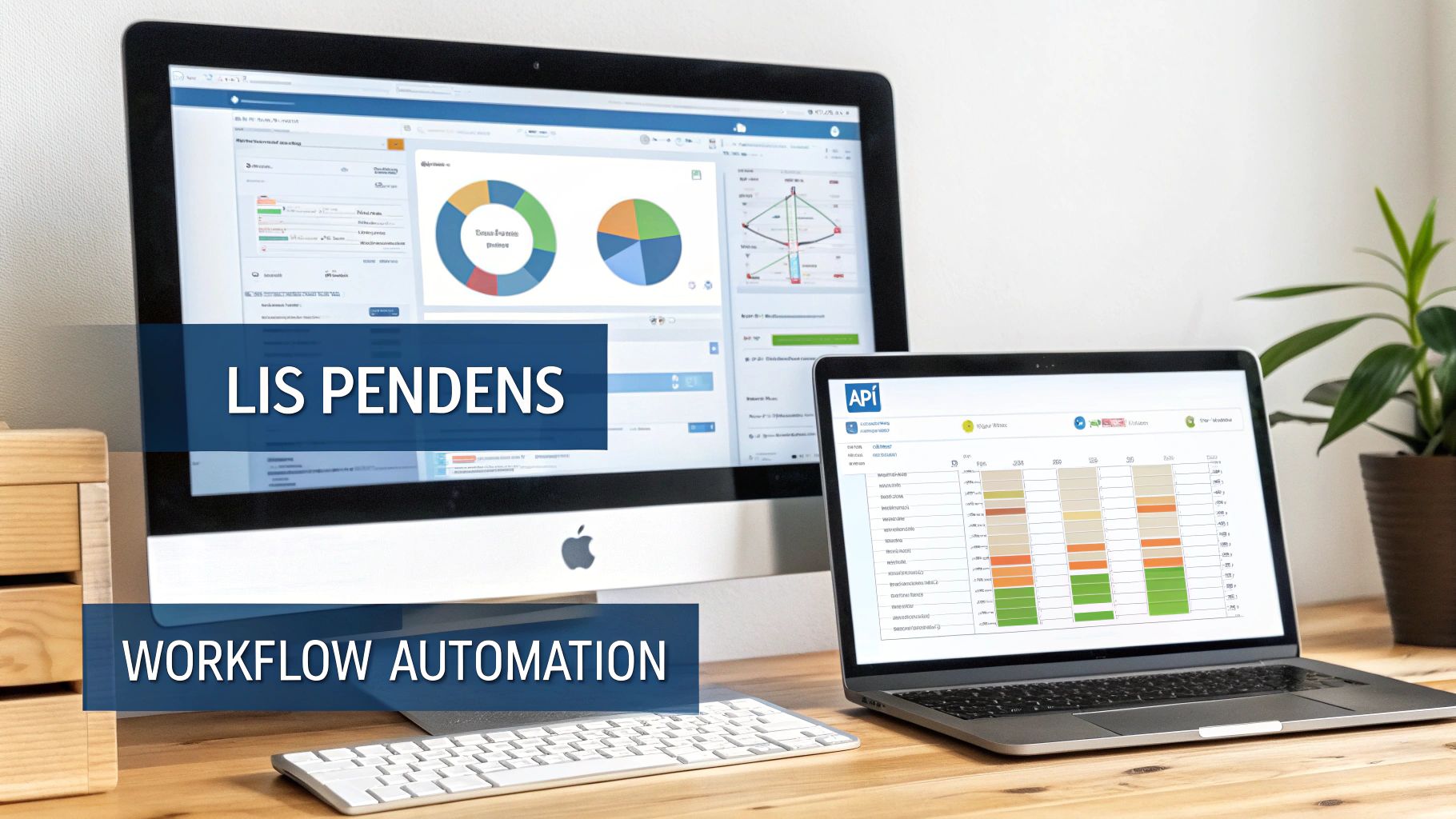
Top-tier investors and lenders integrate foreclosure lis pendens data into automated, scalable workflows, transforming a raw signal into a decisive operational advantage. This involves creating systems that automatically flag, score, and act on opportunities with speed and precision.
Marketing and Proptech Automation
For marketing agencies and proptech platforms, a lis pendens filing is a high-intent signal of a motivated seller. The competitive advantage lies in being the first to reach the distressed homeowner with a relevant offer. This is achieved through API-driven automation:
- API Integration: Connect to a data provider's API for real-time lis pendens notifications in target markets.
- Automated Enrichment: Upon detection, the system automatically initiates skip tracing to find verified owner contact information.
- Targeted Outreach: The contact data is pushed to a CRM to deploy a pre-built campaign of direct mail, texts, or emails within minutes.
Portfolio Monitoring for Lenders
Lenders use portfolio monitoring APIs for proactive risk management. A lis pendens filed against a property in their loan portfolio could signal a competing lienholder (e.g., a second mortgage or HOA) initiating foreclosure, which could jeopardize their position. By uploading their portfolio, they receive instant alerts for any lis pendens or other critical events like new liens or tax delinquencies, enabling immediate intervention.
Institutional Investor Risk Scoring
Institutional investors use bulk lis pendens data to identify opportunities that match their specific investment criteria. They merge this data with other datasets to create a proprietary risk and opportunity score for each property.
| Scoring Factor | Data Point Used | Strategic Importance |
|---|---|---|
| Equity Cushion | AVM, mortgage balances, total lien amounts | Determines if enough equity exists for a profit after satisfying all debts. |
| Lien Position | Public records, preliminary title data | Identifies if the lis pendens is from a first mortgage or a junior lien, which drastically changes the risk profile. |
| Property Status | Listing data, vacancy indicators | Flags if the property is owner-occupied, a rental, or vacant, influencing acquisition strategy. |
| Market Velocity | Days on market, sales comps, price trends | Assesses local market health to predict resale or rental speed post-acquisition. |
This data-driven approach removes emotion from decision-making. A critical step is performing a comprehensive property title search to confirm lien positions and ensure the title is clear.
What Are the Most Frequently Asked Questions About Lis Pendens?
The appearance of a foreclosure lis pendens notice raises urgent questions for homeowners, investors, and lenders. Here are direct answers to the most common ones.
How Long Does a Lis Pendens Last on a Property?
A lis pendens remains active for the duration of the lawsuit it represents. Many states require it to be renewed, often after three years, or it expires. It can be removed sooner if the court dismisses the case, the lender withdraws, the homeowner cures the default, or a judge orders it expunged. Once a final judgment is made and the foreclosure sale is completed, the lis pendens is terminated.
Can a House Be Sold With a Lis Pendens?
Legally yes, but realistically it is nearly impossible through conventional means. The lis pendens creates a "cloud on the title" that prevents traditional buyers from securing financing or title insurance. The only viable buyers are typically cash investors who specialize in distressed properties and can negotiate directly with the lender to settle the debt as part of the purchase, often via a short sale.
Does a Lis Pendens Affect Your Credit Score?
No, the lis pendens filing itself is not reported to credit bureaus like Experian, Equifax, or TransUnion and does not appear on your credit report. It is a public notice about the property, not a financial mark against an individual. However, the underlying causes—missed mortgage payments and the default status—are reported and cause significant damage to your credit score.
Is a Lis Pendens Always a Good Investment Opportunity?
No, it is an early signal of distress but not a guaranteed investment success. For example, in early 2023, foreclosure rates in Florence, SC, were 2.5 times the national average, enabling some investors to acquire properties for as little as $55,000 against a median list price of $392,450. You can discover more insights about rising foreclosure trends on Realtor.com. However, a lis pendens can also lead to a dead end if the property lacks equity, is encumbered by superior liens, or the homeowner resolves the default.
Transform raw foreclosure signals into actionable intelligence. With BatchData, you can access 155M+ property records, monitor portfolios for lis pendens alerts in real-time, and get the verified owner contact data needed to act decisively. Start building your strategic advantage today.