

































Effective data privacy best practices require a connected control system: collect only purpose-specific fields, secure every transfer and storage layer, enforce consent and access rules, delete data on schedule, and prove compliance through monitoring and response. That isn't just theory. IBM's 2024 report found the global average data breach cost reached USD 4.88 million, and organizations using AI and automation in prevention workflows averaged USD 2.2 million less in breach costs than organizations without those workflows (IBM Cost of a Data Breach Report 2024).
Encryption matters, but encryption alone does not make property data, owner-contact data, skip-trace data, or model-training data privacy-safe. A real-estate platform can encrypt S3 buckets and still fail if it returns too many fields through an API, keeps stale owner emails forever, republishes opt-outs into downstream files, or can't tell which vendor supplied a phone number.
That's the operating reality for teams moving data through APIs, Snowflake shares, flat files, enrichment systems, owner-contact workflows, and ML pipelines. Privacy breaks most often at the handoff points: a bulk export sent to the wrong customer segment, a contact record used for a new purpose without review, a deleted record left in a scoring dataset, or a vendor that can't honor downstream suppression requests.
Use these 10 controls as an operating model:
- Minimize fields and lock purpose to use case
- Encrypt stored data and backups
- Encrypt every transmission path
- Track consent, opt-outs, and suppression centrally
- Operationalize access, deletion, and rights requests
- Bind vendors to the same controls you claim
- Design architecture for privacy from the start
- Set retention rules that systems can enforce
- Prepare incident response before an incident happens
- Handle breach notification with legal and technical discipline
The legal layer matters too. Teams dealing with consumer and owner-contact data need working processes for CCPA and CPRA, GDPR, sector-specific obligations such as GLBA, and fast-changing state laws. The controls below focus on what works in production.
How Do You Minimize Data Without Breaking Real-Estate Workflows?
Data minimization works when each endpoint, export, and model gets only the fields needed for one defined purpose.
Real-estate data teams often over-collect because broad datasets are convenient. That convenience becomes a liability when the same owner profile feeds underwriting, marketing, servicing, and enrichment with no field boundaries. The fix is simple in concept and harder in execution: map every delivery path to a business purpose, then cut fields aggressively.
A mortgage originator usually doesn't need neighborhood demographic proxies if the use case is property review. An insurance team may need structure details, permit history, and core parcel attributes, but not a full ownership-history payload. A marketing team may need verified phone and email plus a ranking signal, but not lien details or historical transaction records.
What to Restrict at the Field Level

- For APIs: Default responses should exclude owner phone, owner email, and other sensitive attributes unless the requesting application and role are approved for them.
- For bulk files: Build separate schemas for underwriting, investor research, servicing, and marketing instead of sending a universal master file.
- For ML pipelines: Remove fields that aren't necessary for the model objective, especially fields that create hidden reuse of personal data.
Practical rule: If a team says, “Send the full record and we'll decide later,” the answer should usually be no.
Cisco's 2024 Consumer Privacy Survey showed that 67% of consumers said they reviewed or updated privacy settings in the past 12 months, which is a strong signal that people expect active control over their information, not passive overcollection (Cisco Consumer Privacy Survey 2024).
For implementation, tag each attribute with purpose, legal basis, customer segment, and retention rule in your metadata layer. If your team needs a starting framework, this guide to data governance best practices is relevant because privacy fails when governance stays abstract instead of field-specific.
How Should You Encrypt Data at Rest?
Encryption at rest should cover databases, object storage, backups, logs, and derived datasets, not just the primary production table.
Most privacy failures around stored real-estate data aren't caused by a missing encryption checkbox. They happen because one copy is protected and five copies aren't. Teams encrypt the core warehouse, then leave staging buckets, analyst extracts, temporary flat files, and old backups with weaker controls.
That matters because privacy isn't tied only to your “main” system. It applies to every place owner-contact details, valuation outputs, mortgage fields, or enrichment data are stored.
Where Storage Encryption Usually Breaks
- S3 and blob storage: Customer delivery buckets, temporary exports, and retry folders often drift from baseline policy.
- Warehouse copies: Snowflake, Redshift, or BigQuery clones can retain more data than intended if lifecycle controls aren't aligned.
- Analyst workflows: CSV downloads and desktop extracts can bypass stronger platform controls.
For sensitive real-estate workloads, use managed key services such as AWS KMS, Azure Key Vault, or Google Cloud KMS. Managed key infrastructure is boring in the best way. It reduces custom crypto mistakes and gives auditors a cleaner trail of who accessed keys and when.
What Good Encryption at Rest Looks Like
- Customer-separated keys: High-sensitivity clients may require tenant-level separation and tighter access boundaries.
- Encrypted backups: Backups count as live privacy risk, especially if they contain owner-contact or servicing data.
- Protected logs: Audit logs should be encrypted too, because they often contain identifiers, request metadata, or event traces.
Cisco's 2023 benchmark reported that organizations estimated an average 1.8x return on privacy spending and that the average privacy budget rose to $2.7 million, which helps explain why mature encryption programs are increasingly treated as operating investments rather than compliance overhead (Cisco Privacy Benchmark Study 2024).
If you're documenting controls for customers or procurement reviews, this overview of data encryption standards is the kind of material teams usually need on hand before security questionnaires start.
How Do You Protect Data in Transit Across APIs and Bulk Delivery?
Encryption in transit means every API call, webhook, file transfer, and internal service hop uses current transport security, with older protocols disabled.
Real-estate data stacks get messy. The production API may be clean, but a partner webhook, flat-file transfer process, or internal enrichment connector might still rely on weaker defaults. Owner-contact data and loan-level records don't care which pipe leaked them. If the path is weak, the exposure is real.
For B2B workflows, enforce TLS 1.2 or better and remove support for legacy SSL and early TLS versions. Signed URLs help with controlled downloads, but they're not a substitute for transport security. They solve access scoping, not transport confidentiality.
Where Teams Should Tighten Transit Controls First
- Partner APIs: Especially those returning owner phone, owner email, servicing fields, or valuation details.
- Webhook callbacks: They often get less attention than public APIs.
- Bulk deliveries: S3 links, managed transfers, and direct pulls need secure transport plus integrity checks.
- Internal microservices: East-west traffic matters when enrichment or suppression systems exchange personal data.
Mutual TLS is worth the operational overhead for sensitive integrations with lenders, carriers, or high-volume data customers. It's not necessary for every workflow, but it's appropriate when a single integration can expose large contact datasets.
Encrypted transport isn't just a perimeter control. It's a boundary check at every handoff where data can be copied, cached, or intercepted.
Monitoring matters as much as configuration. Teams should continuously scan for weak cipher suites, expired certificates, and forgotten endpoints. In practice, a “secure by default” transit posture works only when certificate management is owned, automated, and reviewed.
How Do You Manage Consent and Opt-Outs Across Data Pipelines?
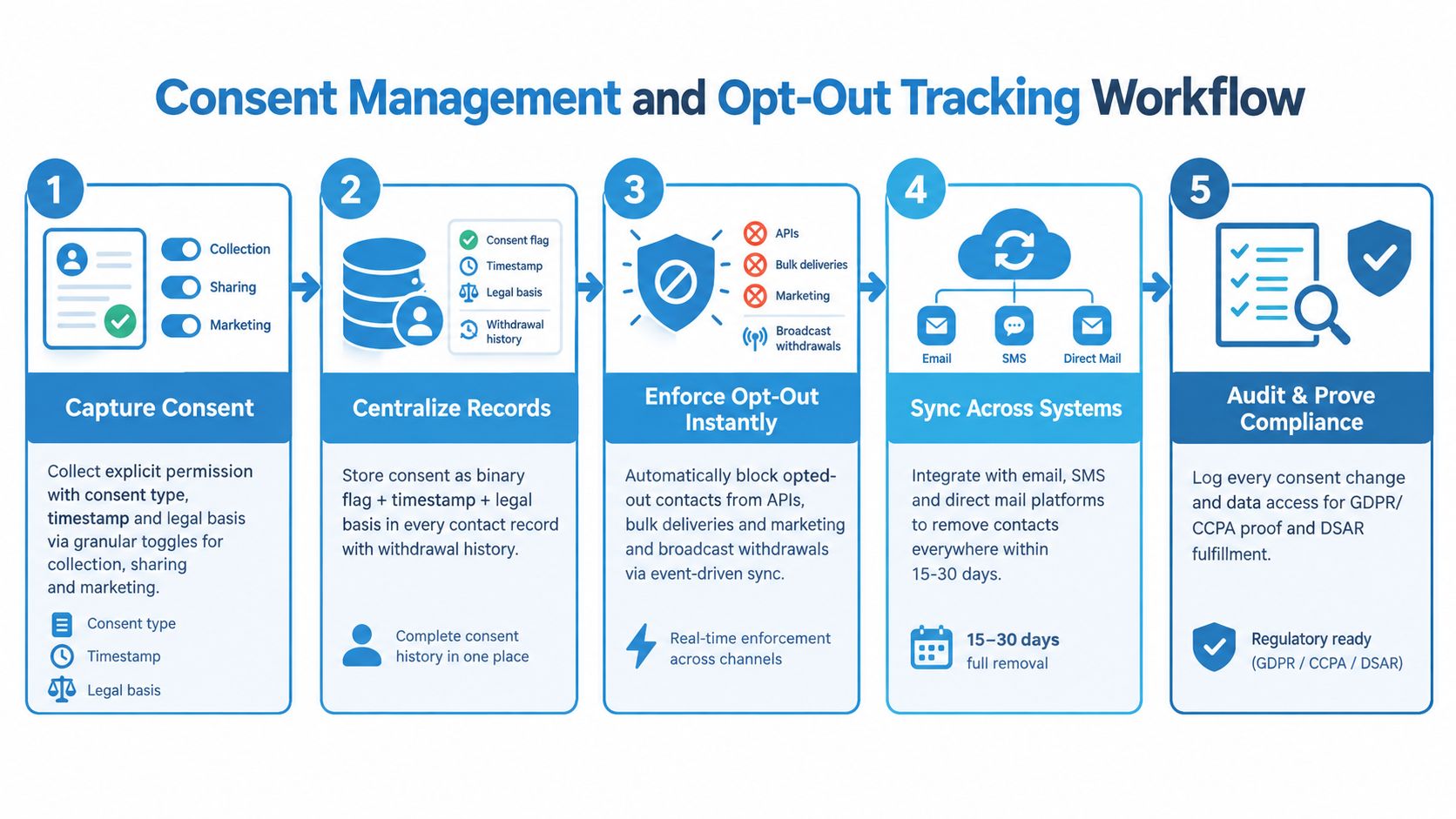
Consent management works only when the consent state travels with the record and is checked before every delivery.
A privacy policy alone won't stop a bad export. If an owner opted out of marketing or third-party sharing, that suppression has to block API responses, bulk files, CRM syncs, and audience builds. Real-estate teams often fail here because consent lives in one app while delivery happens from another.
The architecture fix is straightforward. Store consent metadata with the contact or owner record, then make downstream systems query that status before releasing data.
What the Consent Record Should Carry
- Consent state: Whether the data may be used for the specific purpose.
- Timestamp: When the permission or withdrawal was recorded.
- Legal basis: Which basis supports the use.
- Scope: Marketing, analytics, servicing, third-party sharing, or another defined use.
- Withdrawal history: So teams can prove when suppression was applied.
A common real-estate scenario is a bulk owner-contact delivery for outbound outreach. If the suppression list is checked only at export creation, the file can already be stale by the time the buyer pulls it. Event-driven updates are better because withdrawals can propagate to suppression services, CRMs, and delivery systems faster.
Cisco's 2026 Data and Privacy Benchmark Study found that 46% of organizations said clear communication about data use is the most effective way to build customer confidence (Cisco Data and Privacy Benchmark Study 2025). That matches what operational teams see in practice. Clear use boundaries reduce both complaints and internal confusion.
What Doesn't Work
- Spreadsheet suppression lists: They drift, duplicate, and get ignored.
- Channel-only opt-outs: Suppressing email but not SMS, outbound dialers, or appended contact exports.
- One-time filtering: Every downstream delivery must re-check the current state.
A separate privacy-rights suppression registry is usually necessary. Marketing preference centers and legal rights requests aren't always the same workflow, and teams shouldn't pretend they are.
How Should Teams Handle DSARs and Deletion Requests?
DSAR and deletion workflows need identity verification, system-wide search, downstream notification, and proof that the request was completed.
Privacy programs stop being policy documents and become software. If a property owner asks what personal data you hold, or asks for deletion, your team must know where that data exists across APIs, warehouses, cached scoring tables, support tools, and vendor exports.
For California requests, timing is not flexible. The CCPA requires businesses to disclose and deliver required information within 45 days of receiving a verifiable consumer request, with one extension of an additional 45 days if the consumer is notified within the first 45-day window (CCPA statutory response timing).
Start with verification, because bad deletion requests can be as damaging as ignored legitimate ones. For owner-contact workflows, that may mean email verification, account-based validation, or another controlled method before any data release or erasure happens.
Here's a useful process view:
What a Real DSAR Workflow Needs
- Identity verification: Don't release or delete records on weak signals.
- Record location mapping: Production databases, backups, caches, data lakes, model features, and vendor destinations.
- Recipient tracking: If data was shared externally, deletion and suppression requests need to propagate.
- Completion evidence: Keep an auditable record of what was found, deleted, or exempted.
This is one of the few areas where manual handling breaks quickly. Orchestration tools such as Apache Airflow or Temporal can coordinate retrieval, suppression, and confirmation across systems that don't naturally talk to each other.
The implementation challenge is less about rights theory and more about system topology. If you can't answer “where does this owner email exist right now,” your deletion process isn't mature.
A short technical walkthrough can help teams explain the workflow internally:
Why Is Third-Party Vendor Control a Privacy Requirement, Not a Procurement Task?
If a vendor touches your data, that vendor becomes part of your privacy architecture.
Real-estate data businesses depend on tax data providers, mailing vendors, enrichment partners, cloud providers, title workflows, underwriting tools, and analytics platforms. A clean internal program can still fail if one processor keeps data too long, ignores deletions, or rediscloses records outside contract limits.
This is also where “best practices” advice often turns generic. In production, vendor management means classifying vendors by what they receive, then attaching control and audit depth to that exposure.
How to Classify Vendors by Real Risk
- High sensitivity vendors: Those handling owner phone, owner email, financial details, or regulated servicing information.
- Medium sensitivity vendors: Those receiving property-level data with limited personal identifiers.
- Lower sensitivity vendors: Those handling public-record style data with narrower privacy impact.
The privacy environment is still shifting across jurisdictions. A practical summary of U.S. and international privacy developments in 2025 with compliance considerations for 2026 is useful because vendor clauses, inventories, and request workflows often need to change as state and international rules tighten.
Your contract should answer four ugly questions before anything goes wrong: Who deletes the data, who notifies whom, who approves subprocessors, and who pays when a vendor violates the rules?
What to Put in Vendor Controls
- Deletion obligations: Vendors must support suppression and deletion on your timeline.
- Notification duties: Fast notice if their environment affects your data.
- Subprocessor approval: So data doesn't spread to additional parties.
- Audit rights: Even if limited, you need evidence mechanisms.
If you need a real-estate-specific frame for this work, this real-estate data privacy vendor compliance guide fits the problem better than generic procurement checklists.
What Does Privacy by Design Look Like in a Real Data Architecture?
Privacy by design means the database schema, API contracts, access model, and data flow map are built to limit exposure before launch.
Teams often claim privacy by design when they really mean “legal reviewed the policy.” That's not enough. In a real-estate platform, privacy by design shows up in field defaults, scoped roles, region choices, cache behavior, and whether deletion is technically possible.
A clean example is role-based and attribute-based access layered together. A servicing role may view property and account-linked details that a marketing role cannot. A partner integration may retrieve valuation and parcel data by default, while owner email requires explicit entitlement and purpose approval.
Architecture Decisions That Matter

- Default-minimum APIs: Sensitive fields are omitted unless deliberately requested and permitted.
- Deletion-aware schema design: Records include lifecycle fields and relationships that support erasure and suppression.
- Copy reduction: Fewer caches, extracts, and duplicated feature stores mean fewer privacy liabilities.
- Documented decisions: Teams should keep an architecture decision log for why sensitive data is stored, where, and under which access model.
TrustArc's 2026 Global Privacy Benchmarks report said the Global Privacy Index fell to 53% from 61% in 2025, and fragmented programs averaging 21% lagged integrated leaders at 75% (TrustArc 2026 Global Privacy Benchmarks Report). That gap matters because privacy failures in real-estate systems are usually architectural, not rhetorical.
A useful design review includes engineering, security, legal, and the business owner of the workflow. If one of those groups is missing, the system usually ships with blind spots.
How Long Should You Keep Real-Estate Data?
Retention failures are architecture failures. If your team cannot prove when owner-contact data expires across APIs, bulk files, warehouse tables, and model inputs, you are keeping too much data.
Real-estate datasets tend to outlive their stated purpose. A skip-trace result lands in a CRM, gets copied into a CSV for outreach, flows into a scoring model, and then sits in object storage long after the campaign ends. Public property facts may belong in long-term systems. Personal contact data usually does not. Treat those classes differently from the start.
A retention policy needs to map to operating workflows, not just legal categories. Teams should define retention at the dataset and field level, then enforce it in the systems that distribute data.
What to Put in the Retention Matrix
| Data type | Typical real-estate use | Retention question to answer | Control to enforce |
|---|---|---|---|
| Owner-contact data | Outreach, sales, servicing, collections | Does the original purpose still exist, and has the person opted out or become unreachable? | Expiration timestamp, suppression list, downstream delete job |
| Property attributes | Valuation, comps, parcel research | Is the field public-record based, or does it identify a person directly? | Separate storage class and longer review cycle |
| Enrichment outputs | Phone append, email confidence, occupancy signals | Is the output still accurate enough to justify keeping it? | Short TTL, revalidation window, vendor refresh rule |
| Bulk exports | Customer file delivery, analyst extracts | Where did the file land, and who is responsible for deleting it? | Object lifecycle rule, signed-delivery logs, customer contract term |
| Model features and training sets | Lead scoring, contact propensity, fraud checks | Can deleted or suppressed source records still influence derived data? | Feature lineage, retraining rule, exclusion list |
The United Kingdom's Information Commissioner's Office states the storage limitation principle plainly. Personal data should not be kept longer than necessary for the purposes for which it is processed (ICO guidance on storage limitation). That is the right standard for real-estate data operations too, especially when enrichment data ages quickly and owner-contact accuracy drops over time.
What Good Retention Enforcement Looks Like
- Expiration metadata on every governed record: Store created date, last validated date, retention class, and delete-after date.
- Automated enforcement in every delivery path: Apply the rule to APIs, S3 buckets, warehouse tables, cached extracts, and CRM syncs.
- Legal hold controls: Pause deletion only for specific records, reasons, and time periods, with approval logging.
- Suppression before deletion where required: Keep the minimum data needed to honor opt-outs and prevent reacquisition.
- Failure monitoring: Alert on stalled delete jobs, orphaned snapshots, and tables with growing volumes past policy.
One hard trade-off deserves explicit review. Deleting too aggressively can break auditability, dispute handling, and customer support. Keeping everything breaks privacy commitments and expands breach scope. The workable approach is to keep the minimum artifact needed for the longer obligation. For example, retain a hashed suppression token and event log showing that an opt-out was processed, while deleting the outreach-ready phone number or email itself.
The difficult part is not writing a retention rule. It is enforcing that rule across copied files, derived tables, vendor returns, and old model-training datasets.
If retention does not cover archived exports, analyst sandboxes, BI extracts, and enrichment outputs stored outside the primary application, the policy is incomplete. In practice, that is where stale personal data usually survives.
How Should Incident Response Work for Data Privacy Events?
Privacy incident response in a real-estate data business should be built around one question: exactly which fields moved, to which systems, and which people were affected.
That standard is higher than generic security response, because real-estate data rarely lives in one application. The same owner-contact record can appear in an API response, a nightly bulk file, a warehouse table, a CRM sync, an enrichment return, and a model feature store. If the team cannot trace that spread fast, it will struggle to contain the event, assess legal exposure, and issue accurate notices.
A privacy event often starts. Common triggers include a token used for unusual API pulls, a bulk export delivered to the wrong bucket, suppression logic failing so opted-out contacts are included in outreach files, or a vendor reporting unauthorized access to enrichment outputs.
IBM found that organizations with extensive use of security AI and automation had lower breach costs and contained breaches faster in its Cost of a Data Breach research. That matters here because privacy response depends on speed and evidence, not only on policy language.
What a Privacy Response Process Should Cover
| Response step | What the team needs to do in a real-estate data stack |
|---|---|
| Triage | Confirm whether the event involves personal data, which fields were exposed, and whether the source was API, bulk delivery, internal tooling, or a vendor |
| Containment | Revoke API keys, disable user sessions, pause outbound feeds, lock affected buckets, stop CRM syncs, and suspend vendor transfers if needed |
| Evidence preservation | Preserve audit logs, object access events, query history, auth traces, job runs, file manifests, and suppression-state records before cleanup starts |
| Scope analysis | Identify affected data subjects, customers, jurisdictions, downstream copies, and any derived outputs such as scored lead lists or model inputs |
| Decision support | Give legal and privacy owners a fact pattern they can actually use for notification, customer communications, and regulator analysis |
Severity should reflect operational reality, not just alert volume. A misconfiguration exposing parcel attributes already available from public records is different from exposing owner phone numbers, email addresses, occupancy indicators, debt signals, or servicing-related records tied to outreach workflows.
Use a written runbook with named owners for security, privacy, legal, data engineering, vendor management, and customer communications. During an incident, teams lose time when they debate who can pause a feed, who contacts a processor, or who approves preserving logs that may contain sensitive values.
Minimum Actions for the First Response Window
- Stop further disclosure: Disable tokens, pause exports, quarantine affected datasets, and cut off external delivery paths.
- Freeze the evidence: Retain logs, snapshots, object metadata, workflow histories, and vendor notices.
- Map propagation: Check whether the same records also reached warehouse shares, analyst extracts, CRM destinations, model-training datasets, or downstream customers.
- Classify the data: Separate public-record fields from non-public contact, behavioral, financial, or suppression-related data.
- Start the decision log: Record timestamps, actions taken, assumptions, and unresolved questions from the first hour onward.
Tabletop exercises should use your actual architecture. Test a misrouted owner-contact file. Test an exposed S3 export containing skip-trace results. Test a vendor incident where enrichment data was cached outside the approved retention window. Those scenarios produce useful fixes because they force teams to answer practical questions about field-level lineage, processor obligations, and kill switches across delivery channels.
The strongest plans also define recovery criteria. Do not restore a feed or reopen access because the immediate alert is closed. Require proof that the root cause is fixed, suppression rules are functioning, replacement credentials are issued, and affected downstream recipients have been identified and instructed on deletion or containment.
What Are the Real Deadlines for Breach Notification?
Breach-notification deadlines are short enough that your architecture decides whether you can comply. In a real-estate data operation, the hard part is rarely finding the legal rule. The hard part is proving which records moved through APIs, bulk exports, enrichment jobs, CRM pushes, and downstream customer deliveries before the clock runs out.
Under GDPR Article 33, a controller must notify the competent supervisory authority without undue delay and, where feasible, no later than 72 hours after becoming aware of a personal data breach, unless the breach is unlikely to result in a risk to individuals' rights and freedoms. Late notice requires an explanation (GDPR Article 33 breach notification rule).
The UK ICO applies the same core timing for notifiable personal data breaches: report without undue delay and, where feasible, within 72 hours of becoming aware of the breach, and explain any delay (UK ICO personal data breach guidance). The European Commission states the same standard for breaches likely to pose a risk to individuals' rights and freedoms (European Commission business obligations on data protection).
For teams handling owner-contact data, property-linked profiles, and enrichment outputs, "aware of the breach" is not a theoretical timestamp. It usually starts when the company has enough confirmed facts to conclude that personal data was exposed, disclosed, altered, lost, or made unavailable in a security incident. That means alert triage, log retention, field classification, and lineage mapping affect legal timing.
A missed suppression file and an exposed S3 export do not create the same notification posture. If an incident involves only public-record fields already lawfully published elsewhere, risk may be lower. If it includes non-public email addresses, phone numbers, borrower-linked financial indicators, skip-trace results, or opt-out flags, the reporting analysis gets harder and faster.
What teams should have ready before the clock starts
| Preparation item | What it needs to answer |
|---|---|
| Jurisdiction map | Which laws, regulators, and contract notice clauses apply by dataset, customer, and geography |
| System-to-field lineage | Which tables, files, and API responses contained the affected fields |
| Recipient inventory | Which customers, vendors, warehouse shares, and internal tools received the data |
| Notification drafts | Pre-approved language for regulators, enterprise customers, processors, and data partners |
| Materiality criteria | How legal, security, and data teams decide whether risk to individuals is likely |
| Containment evidence | Proof that tokens were revoked, exports paused, access removed, and downstream parties contacted |
Teams also need a practical deadline model. I recommend tracking at least three clocks in the incident log:
- Legal clock: when the organization became aware of a potentially reportable breach.
- Customer contract clock: shorter notice windows in DPAs, MSAs, or enterprise security terms.
- Operational clock: how long it will take to confirm affected fields, affected people, and downstream disclosures.
The enforcement environment is active, and breach reporting is routine supervisory work, not edge-case paperwork. DLA Piper's GDPR enforcement tracker records cumulative GDPR fines across Europe, and the European Data Protection Board reports high breach-notification volumes across the region (DLA Piper GDPR Enforcement Tracker, European Data Protection Board annual report).
The practical rule is simple. Build incident response so legal can make a defensible notification decision before engineering has perfect certainty, and build data lineage so engineering can narrow the uncertainty fast.
10-Point Data Privacy Best Practices Comparison
| Control | Implementation complexity 🔄 | Resource requirements ⚡ | Expected outcomes ⭐📊 | Ideal use cases 💡 | Key advantages ⭐ |
|---|---|---|---|---|---|
| Data Minimization and Purpose Limitation | 🔄 Medium–High: document uses, audits, field controls | ⚡ Low–Medium: engineering + legal coordination | ⭐📊 Smaller breach surface, lower storage costs, easier audits | 💡 Real‑estate platforms limiting owner/contact attributes for APIs/bulk deliveries | ⭐ Reduces fines, builds trust, simplifies compliance |
| Encryption at Rest | 🔄 Medium: KMS integration, key rotation, field crypto | ⚡ High: CPU overhead, managed KMS costs, ops | ⭐📊 Stored data unreadable if breached; may exempt notifications | 💡 Databases, backups, per‑tenant storage, loan files | ⭐ Meets GLBA/HIPAA/SOC2, protects IP |
| Encryption in Transit | 🔄 Low–Medium: TLS, cipher/config management, mTLS for B2B | ⚡ Low: cert management, monitoring | ⭐📊 Prevents interception/MITM; required for secure integrations | 💡 APIs, webhooks, bulk transfers between platforms | ⭐ Complements at‑rest encryption; protects data in motion |
| Consent Management & Opt‑Out Tracking | 🔄 High: central consent store, granular checks on every delivery | ⚡ Medium–High: CMP platform, engineering, latency budget | ⭐📊 Demonstrable consent, fewer litigation risks, improved deliverability | 💡 Marketing, enrichment, consumer‑facing data deliveries | ⭐ Automates opt‑outs, proves legal basis for processing |
| DSAR & Deletion Capabilities | 🔄 High: cross‑system retrieval, identity verification, deletion orchestration | ⚡ High: orchestration tools, verification, third‑party coordination | ⭐📊 Faster compliant responses, lower per‑request cost, trust gains | 💡 Platforms receiving frequent subject requests or regulated customers | ⭐ Automates DSARs, reduces regulatory and litigation exposure |
| Third‑Party Vendor Management & Audits | 🔄 Medium–High: assessments, DPAs, ongoing audits | ⚡ High: audit labor, vendor mgmt tools, legal reviews | ⭐📊 Lower supply‑chain breach risk; contractual liability transfer | 💡 Services relying on external data feeds/enrichment vendors | ⭐ Reduces vendor risk, provides audit evidence, indemnities |
| Privacy‑by‑Design & Architecture Review | 🔄 High: threat modeling, data‑flow mapping, RBAC/ABAC changes | ⚡ Medium–High: architecture reviews, design effort up front | ⭐📊 Reduced breach surface, easier scale, fewer post‑hoc fixes | 💡 New platforms or major redesigns with sensitive PII flows | ⭐ Long‑term cost savings, faster compliance, competitive trust signal |
| Data Retention Policies & Automated Expiration | 🔄 Medium: retention matrix, deletion jobs, legal holds | ⚡ Medium: batch jobs, retention metadata, alerts | ⭐📊 Lower storage costs, faster DSARs, reduced aged‑data risk | 💡 Data‑heavy systems with variable regulatory retention needs | ⭐ Cuts costs, enforces storage limitation, simplifies audits |
| Data Security Incident Response | 🔄 Medium–High: SOC/MDR, playbooks, forensics readiness | ⚡ High: 24/7 monitoring, external forensics, IR team | ⭐📊 Faster detection & containment; reduced breach impact/cost | 💡 Large platforms subject to targeted attacks or high‑value data | ⭐ Rapid, repeatable response; preserved evidence for regulators |
| Breach Notification & Post‑Incident Management | 🔄 Medium: notification orchestration, jurisdictional workflows | ⚡ Medium–High: legal, PR, remediation spend | ⭐📊 Timely notifications, reduced penalties, preserved reputation | 💡 Organizations needing multi‑jurisdictional regulatory filings | ⭐ Consistent messaging, faster regulatory coordination and remediation |
Turn Privacy Controls Into an Operating System
Data privacy best practices work when they're built into architecture, delivery logic, and daily operations instead of left in policy documents.
That's the practical takeaway for real-estate data teams. Start with the data itself. Inventory every field you collect, buy, enrich, infer, score, or deliver. Then tie each field to a purpose, legal basis, customer type, retention rule, and approved delivery path. If a field doesn't have a clear reason to exist, remove it.
Next, classify data in a way that matches real workflows. Owner-contact fields, identity-linked request logs, property attributes, valuation outputs, servicing data, and model features don't all carry the same privacy risk. Treat them differently. That means least-privilege access in APIs, separate schemas for bulk delivery, suppression checks before release, and clear boundaries between marketing, underwriting, servicing, and analytics use cases.
Then lock down movement and storage. Encrypt stored data, backups, and logs. Encrypt every transport path. Review the unglamorous parts too: temporary exports, customer delivery buckets, analyst extracts, stale warehouse clones, and retry files. Those are common leak points because teams assume the “real” system is the only one that matters.
After that, centralize consent and opt-outs. Don't let privacy decisions live in disconnected applications. The consent state needs to travel with the data, and every downstream system needs to enforce it before returning owner email, owner phone, or other personal fields. The same applies to DSAR and deletion workflows. Build them as product capabilities with orchestration, recipient tracking, and evidence capture. Manual handling doesn't survive scale.
Vendor management comes next because third parties are part of the same privacy surface. Review where data goes, what each vendor can retain, whether they support deletion and suppression, and how fast they must notify you about incidents. If a vendor can't support your obligations, they're not just a security concern. They're a compliance gap.
Monitoring and response close the loop. Test logs, alerts, suppression propagation, deletion jobs, and breach playbooks. Run quarterly reviews that examine actual evidence: access logs, expired-data reports, consent-state enforcement, vendor attestations, and incident drill outputs. That's how privacy becomes an operating discipline instead of a one-time policy exercise.
For platform buyers, this changes how vendors should be evaluated. Coverage and delivery speed matter, but they aren't enough. Teams should also assess field-level controls, documented handling of personal data, deletion and opt-out workflows, vendor governance, and support for compliant bulk and API delivery. If you're reviewing your broader governance posture, it also helps to manage IT assets effectively because privacy controls weaken when asset ownership and lifecycle control are unclear.
That's also why platforms such as BatchData are worth evaluating through an operational privacy lens, not just a data-coverage lens. In real-estate data, the best question isn't “How much data can this platform deliver?” It's “Can this platform deliver the right data, to the right team, for the right purpose, with defensible controls?”
BatchData provides large-scale property data, valuations, and verified owner-contact workflows through APIs and bulk delivery, which makes privacy operations inseparable from product use. If you need a platform that can support field-level delivery decisions, rights-request handling, and real-estate data workflows at scale, visit BatchData.