



A single bad address costs an average of $17.10 in returned mail and wasted labor, a cost that silently drains millions from businesses annually. Address verification software is the definitive solution, acting as a real-time digital gatekeeper that automatically validates, standardizes, and corrects physical addresses before they corrupt your data. This system cross-references entries against official postal databases, ensuring every address is accurate and deliverable from the moment of capture.
Core Takeaways:
- What It Is: A tool that validates addresses against official postal databases (e.g., USPS).
- How It Works: It parses, standardizes, validates, and geocodes addresses in milliseconds.
- Key Benefit: Drastically reduces failed deliveries, marketing waste, and compliance risks.
- Core Feature: Must be CASS Certified™ and include Delivery Point Validation (DPV) for true deliverability confirmation.
This guide provides a direct, no-fluff breakdown of how this technology works, why it’s non-negotiable across industries, and what features separate basic tools from enterprise-grade solutions.
What is address verification software?
Address verification software is an automated system that confirms a physical street address is real, deliverable, and formatted correctly according to national postal standards. It functions by cross-referencing an address input against authoritative databases, like those maintained by the United States Postal Service (USPS), to instantly identify and correct errors.
The software corrects common mistakes like typos, standardizes abbreviations (e.g., “Street” to “ST”), and appends missing data such as ZIP+4 codes or apartment numbers. Its primary function is to block bad data at the point of entry, because one typo can lead to a returned package, a frustrated customer, or a serious compliance failure. Manual correction is too slow, expensive, and prone to the very errors it aims to prevent.
What core problems does it solve?
This software is a foundational tool for operational integrity, tackling common yet expensive business challenges that drain profitability and erode customer trust.
| Problem | Business Impact | How Software Solves It |
|---|---|---|
| Failed Deliveries | Shipping fees, returned item costs, and negative customer reviews average over $17 per incident. | Confirms deliverability before shipping, reducing return-to-sender rates by over 99%. |
| Data Entry Errors | Corrupted CRMs, flawed analytics, and wasted employee time fixing manual mistakes. | Standardizes and corrects addresses in real time at the point of capture. |
| Marketing Waste | Low direct mail ROI; up to 6.5% of all direct mail is undeliverable. | Cleans mailing lists to ensure marketing materials reach the intended recipient. |
| Compliance Risk | Fines and legal issues from inaccurate customer data (e.g., KYC/AML regulations). | Validates physical addresses as a key component of identity verification protocols. |
How does it go beyond basic correction?
Modern address verification software also provides geocoding—the process of assigning precise latitude and longitude coordinates to a physical address. This transforms a simple address into a powerful data point for logistics route planning, insurance risk assessment, and targeted location-based services. An address is a critical data point connecting properties, people, and financial records. Ensuring its accuracy is a fundamental requirement for any data-driven operation.
How does address verification software work?
Address verification software operates through a multi-step process that cleans, standardizes, and validates a raw address in milliseconds. It acts as an automated gatekeeper to prevent flawed data from entering your systems.
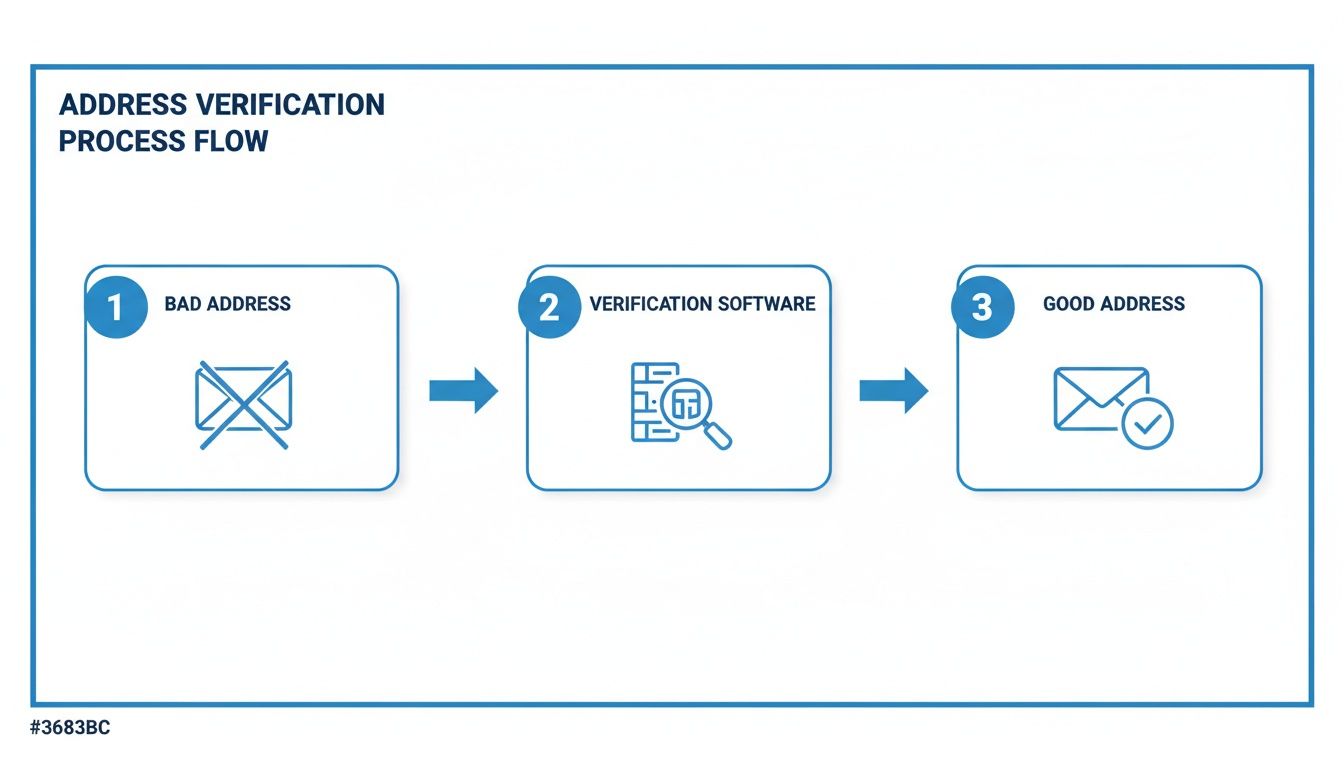
This automated workflow is exponentially more accurate and scalable than any manual process.
Parsing and standardization
The first step is parsing, where the software dissects an address string like “123 main street, new york” into its distinct components: 123 (street number), main (street name), street (street type), and new york (city).
Next is standardization. The software reformats these components to meet official postal standards.
- Abbreviation: “Street” becomes “ST,” and “Apartment” becomes “APT.”
- Correction: Misspellings like “New Yrok” are corrected to “New York.”
- Completion: Missing data like a ZIP code is appended based on the known address components.
This stage turns a jumbled entry into a clean, machine-readable format ready for validation.
Validation and geocoding
The core process is validation, where the standardized address is cross-referenced against an authoritative source like the USPS Address Matching System. An address isn’t truly verified until it’s matched against a definitive source.
The validation is highly granular. Delivery Point Validation (DPV), for instance, confirms an address is a known delivery point where mail can be physically dropped off. This is what prevents you from shipping a package to a vacant lot.
After validation, most systems perform geocoding, which attaches precise latitude and longitude coordinates to the address. You can dive deeper into how geospatial analysis enhances automated valuation models in our guide. The best systems achieve rooftop-level accuracy. This space is evolving quickly, with the address validation market projected to grow from $2.5 billion to $5.2 billion by 2035, driven by the demand for real-time, API-based solutions. Many advanced platforms also use data enrichment services to append additional context, turning a simple address into a rich data point.
Why is address accuracy so critical?
An accurate address is the unique identifier linking a physical property to financial records, legal documents, and people. A single error can cause core business operations to fail, creating immediate, measurable losses. For any business that ships products, manages properties, or assesses risk, one flawed address is a tiny error that snowballs into a massive problem.

Real Estate & Proptech
In real estate, an address is everything. Address verification software provides the foundation for accurate property record matching, ensuring a listing for “123 Main St” correctly links to the official tax record for “123 Main Street.” This prevents catastrophic errors in legal descriptions and ownership records. This accuracy is essential for Automated Valuation Models (AVMs), which depend on pulling data for the correct parcel. For investors analyzing regional market trends in our Investor Pulse reports, precise, verified addresses are non-negotiable.
Mortgage Lending & Insurance
For mortgage lenders, address verification is a primary defense against fraud. During underwriting, the software confirms the property securing the loan is a real, existing residence—not a vacant lot. Insurers use verified addresses and geocoding for precise risk assessment. The difference of a few hundred feet can drastically alter a property’s exposure to flood plains or wildfire zones, allowing for accurate policy pricing. Inaccurate data is a critical failure point in tools like commercial property management software.
E-commerce & Marketing
The impact on e-commerce is direct: 24% of customers abandon carts due to shipping problems. Address verification at checkout instantly corrects typos, creating a frictionless experience and slashing failed deliveries. For marketing, clean mailing lists are the key to better ROI. Address verification ensures expensive catalogs and brochures reach their intended recipients instead of landing in a dead-letter bin.
Address Verification Use Cases by Industry
| Industry | Primary Use Case | Key Benefit |
|---|---|---|
| Real Estate | Property record matching & AVMs | Improved valuation accuracy and portfolio analysis. |
| Mortgage Lending | Underwriting and fraud detection | Reduced risk of loan fraud and compliance penalties. |
| Insurance | Risk assessment and policy pricing | Precise premium calculation based on accurate location. |
| E-commerce | Checkout and order fulfillment | Lowered shipping costs and reduced cart abandonment. |
| Marketing | Direct mail list cleaning | Increased campaign ROI and better customer data quality. |
What are the key features to evaluate?
Not all address verification software is created equal. A basic tool might confirm a street exists, but it won’t confirm if a specific apartment number is deliverable. You must look past marketing claims and analyze the features that deliver true data confidence.

Core validation standards
Official postal certifications are non-negotiable proof that software has passed rigorous accuracy tests.
- CASS Certification: The Coding Accuracy Support System is a USPS certification confirming software can correctly parse, standardize, and correct addresses. Being CASS Certified™ is the absolute minimum requirement.
- Delivery Point Validation (DPV): DPV goes a step further by confirming an address is a known, active USPS delivery point. It tells you if you’re sending mail to a real house, a PO box, or a vacant lot. Choosing a provider without DPV is like verifying a phone number’s format but not knowing if it’s connected.
Geocoding precision
The next critical feature is geocoding. The level of precision is what separates a basic mapping tool from an enterprise solution.
- Parcel Centroid: Places a pin in the geometric middle of a property lot. This can be inaccurate for large or irregularly shaped parcels.
- Rooftop Level: The gold standard. It places the pin directly on the physical structure, providing the only level of precision that matters for logistics, insurance, and risk modeling.
API performance
The best data is useless if you can’t access it quickly. Integration capabilities are just as important as the data itself.
- API Performance and Scalability: For real-time validation (e.g., e-commerce checkout), API speed and uptime are paramount. Look for providers with transparent API status and low-latency responses.
- Bulk Processing: For cleaning large, messy databases, you need a solution built for bulk processing. This feature lets you upload a file with millions of records and receive a clean, validated, and enriched list in return.
How do you measure the ROI of address verification?
Calculating the return on investment for address verification software is about connecting operational fixes to real dollars. The easiest way is to sum the direct costs that disappear once you stop sending mail to the wrong place or paying employees to manually fix data.
A simple formula provides a starting point:
(Cost of a single failed delivery) x (Number of failed deliveries per month) x 12 = Annual Savings
The “cost of a single failed delivery” includes return shipping fees, lost product, and the labor hours spent processing the return. The total adds up quickly.
Calculating direct cost savings
To get a true picture of your return, account for all direct costs the software eliminates.
- Reduced Shipping Waste: Every returned package costs you multiple times: the original shipping fee, carrier return charges, and the cost to re-ship.
- Lowered Labor Costs: The software automates the hours your team spends manually correcting addresses, chasing deliveries, and handling “Where is my package?” calls.
- Eliminated Material Costs: For direct mail, multiply your cost-per-piece by your undeliverable rate to see exactly how much marketing spend you’re wasting.
Quantifying indirect revenue gains
Address verification also drives indirect ROI by improving revenue-generating activities. Better data quality leads to sharper market analysis, like the real estate research in our Investor Pulse reports. This is where the software becomes an offensive tool for growth.
Increased Customer Lifetime Value (CLV): A 2023 survey found that 84% of consumers won’t shop with a brand again after one bad delivery. Ensuring packages arrive on time prevents customer churn and boosts CLV.
Higher Marketing Campaign Performance: Clean mailing lists are non-negotiable. When direct mail campaigns reach the right people, response and conversion rates increase. The address verification software market, valued at $7.59 billion in 2024, is growing precisely because of this demand for efficiency. Discover more market insights on GIIRsearch.com.
What are the future trends in address verification?
The future of address verification is API-first and cloud-based. Legacy on-premise systems with quarterly updates cannot keep pace with the modern demand for real-time data, massive scalability, and seamless integration. Instead of running batch cleanups to fix past mistakes, businesses now embed verification directly into their applications to stop bad data before it ever enters a system.
Global E-commerce
As e-commerce expands into emerging markets, especially in the Asia-Pacific region, address verification becomes exponentially more complex due to non-standardized formats and changing postal systems. The cloud-based segment of the market reflects this, projected to double from $4.554 billion in 2024 to $9.12 billion by 2035. You can explore this trend in the full address verification software market analysis on fortunebusinessinsights.com.
Compliance-Driven Verification
Data privacy regulations like GDPR and CCPA have turned address verification from an operational tool into a mandatory risk management control. An inaccurate address is now a potential compliance fine. Proving you have a customer’s correct address is a cornerstone of due diligence.
Verification is now a critical component for:
- Data Subject Access Requests (DSARs): Confirming identity often depends on a verified physical address.
- Data Minimization: Regulations require companies to only keep necessary and accurate data, making invalid address scrubbing a priority.
- Right to Erasure: Finding and deleting every instance of a user’s data requires accurate address records.
This regulatory pressure ensures that investment in high-quality address verification will continue to climb.
FAQs About Address Verification Software
How long does it take to implement an address verification API?
Implementation typically takes hours or days, not weeks. Modern address verification APIs are designed for developers, with clear documentation and SDKs. The integration itself often requires just a few lines of code to connect the API to a website form, checkout page, or CRM. The technical work is minimal; the longest delays usually come from internal decision-making and testing.
What level of address accuracy can I expect?
You should expect accuracy exceeding 99%, particularly with CASS Certified™ software that uses Delivery Point Validation (DPV). These tools don’t just check if a street is spelled correctly; they confirm whether a specific house or suite number is a known, mailable destination according to the official postal service. The system often provides a confidence score, giving a clear, probabilistic measure of an address’s correctness.
Can the software verify international addresses?
Yes, any enterprise-grade address verification software provides global coverage for over 245 countries. This is non-negotiable for e-commerce, logistics, and any business with international customers. The software automatically handles complex local formats, different character sets (e.g., Cyrillic, Kanji), and country-specific postal rules, removing a massive operational hurdle for global expansion.
Is address verification the same as geocoding?
No, but they are closely related and often performed together. Address verification confirms an address is real and deliverable. Geocoding converts that verified address into precise geographic coordinates (latitude and longitude).
Think of it this way: Verification tells you if the address exists. Geocoding tells you where it exists on a map.
Most advanced platforms perform geocoding as the next step after verification. Verification is the foundation; geocoding is the value-add that unlocks location intelligence.
Ready to eliminate bad data and unlock the true value of your property records? BatchData provides the enterprise-grade accuracy you need with real-time APIs and bulk processing capabilities. Explore our solutions and see what clean data can do for your business.