


































SEO Title: Abandoned Houses in Ohio Investor Playbook
Meta Description: Learn how to find, verify, and acquire abandoned houses in Ohio using public records, municipal data, and scalable property research workflows.
Meta Keywords: abandoned houses in ohio, ohio vacant properties, ohio zombie foreclosures, find distressed properties ohio, ohio property records, vacant property investing ohio, pre-foreclosure ohio, ohio real estate data
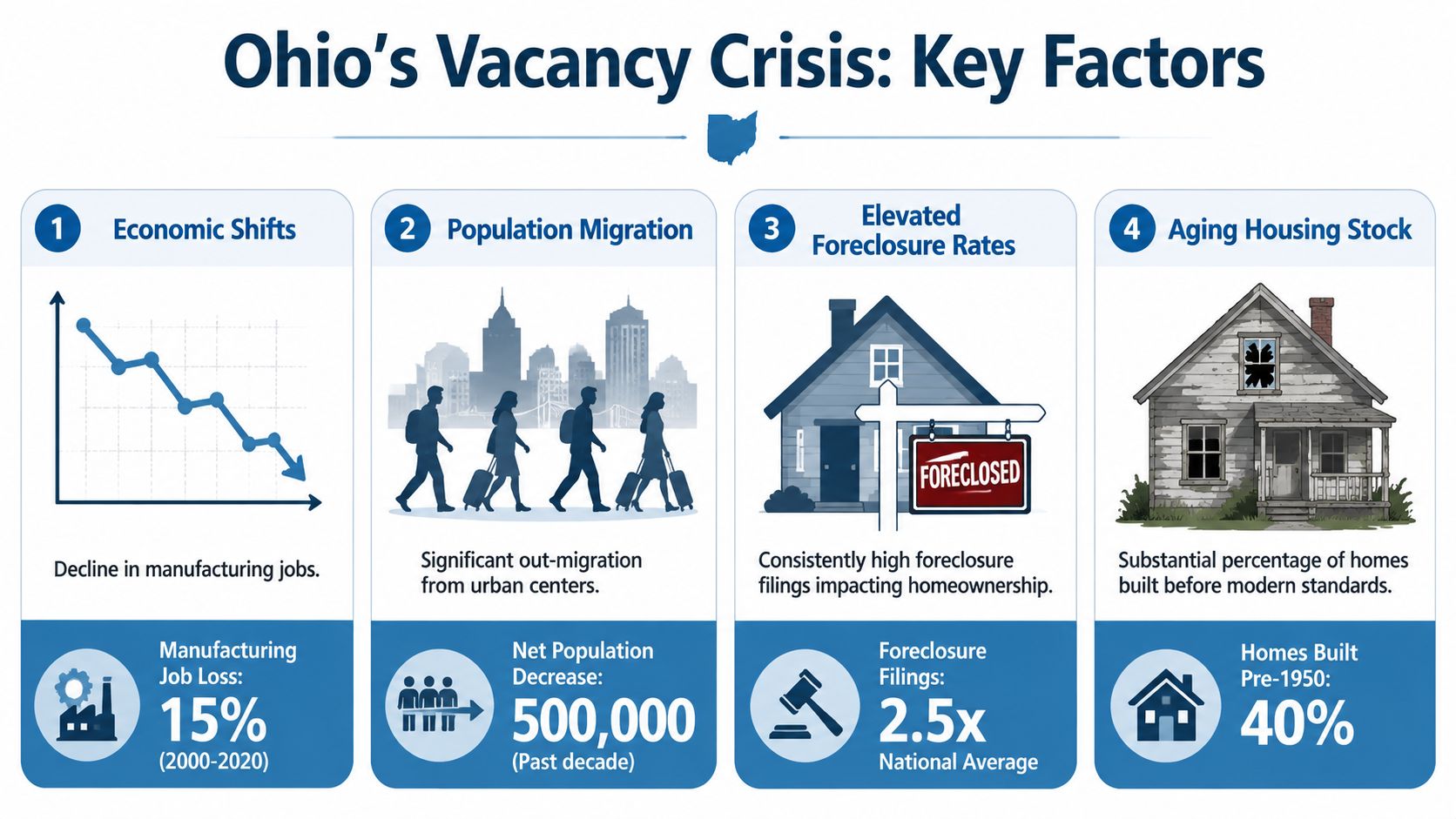
Ohio is not a fringe market for distressed housing. 2.12% of the state's 3.8 million residential properties were classified as vacant or abandoned as of Q4 2019, and 5.52% of Ohio pre-foreclosure homes were zombie properties, both above national benchmarks according to ATTOM's Ohio vacancy analysis.
If you want to invest in abandoned houses in ohio, the opportunity is real, but so is the operational drag. The investors who do well don't rely on urban-exploration style leads, random driving lists, or one-off courthouse checks. They use a repeatable process: find, verify, then pursue with the right acquisition path.
Quick takeaways
- Find at scale: Start with vacancy, code, tax, foreclosure, and ownership signals.
- Verify before valuing: Many “abandoned” properties are distressed, inherited, tied up in probate, or headed toward demolition.
- Underwrite the block, not just the house: Nearby distress changes resale risk, hold time, and rehab scope.
- Remote buying needs controls: If you can't visit in person, use structured review steps, not guesswork. A practical overview of that workflow is covered in Virtual Tour Easy on investor purchasing.
Your Playbook for Investing in Ohio's Abandoned Properties
The practical playbook is simple. Find the right properties, verify what they are, and pursue only the ones that still work after legal and operational friction is priced in.
Most abandoned-property content gets stuck at aesthetics. Boarded windows. Overgrown lots. Neighborhood stories. That's not how professionals buy. Professionals ask different questions. Is the parcel still standing or already a lot? Is the owner local, out of state, deceased, or in foreclosure? Are there liens, code issues, demolition exposure, or title defects that will slow the deal?
Three moves matter most:
- Find with intent: Build lists from public records and structured datasets, not visual guesswork.
- Verify status: Confirm vacancy, ownership, title complexity, municipal pressure, and physical condition.
- Pursue selectively: Choose direct outreach, tax sale, REO, or adjacent-lot strategy based on the property's data profile.
Practical rule: If your lead source can't tell you whether the property is vacant, distressed, litigated, or already functionally obsolete, it's not a lead source. It's a scavenger hunt.
Ohio rewards disciplined buyers because the market has enough distress to create supply, but enough legal and neighborhood variation to punish sloppy underwriting. That combination is exactly why a systematic approach works.
Why Does Ohio Have So Many Abandoned Houses?
Ohio's vacancy and zombie foreclosure rates run above national levels, as noted earlier, but those top-line figures only explain part of the inventory. For investors, the better question is why distress persists long enough for a house to become abandoned.
The answer is usually a stack of problems, not a single cause. Ohio has older housing stock in many legacy industrial markets, uneven population trends across counties, and a large share of lower-value properties where repair costs can overtake resale value. Once that happens, owners stop treating the house like an asset and start treating it like a liability.
Understanding the Core Risk
Vacancy alone does not create the best acquisition opportunities. Vacancy combined with financial or legal distress does.
A vacant house with a responsive owner, current taxes, and no municipal pressure may just be a stale listing opportunity. A vacant house tied to pre-foreclosure, delinquent taxes, code enforcement, or probate is a different asset class. Those properties tend to have deferred maintenance, slower decision-making, and a much higher chance of title or disposition friction.
That distinction matters in Ohio because a meaningful share of abandoned stock sits inside systems that create delay. Foreclosure timelines, nuisance enforcement, unpaid utilities, demolition orders, and fragmented ownership records all affect whether a property can be bought and repositioned. Investors who want a repeatable process should study the same distress indicators used to find distressed properties at scale, not just visual neglect.
Investor ownership also plays a role. Some abandoned houses are failed rentals. The pattern is familiar: non-local owner, low-rent economics, years of deferred repairs, then tax delinquency or code issues after vacancy starts. In those cases, abandonment is not driven by a one-time life event. It is the end result of a rental strategy that stopped penciling out.
What that means for investors
Ohio does not produce opportunity because houses look cheap from the street. It produces opportunity because distress shows up in identifiable layers, and each layer changes pricing, timing, and exit risk.
The most common buckets are:
- Vacant properties in pre-foreclosure or tax distress
- Investor-owned houses with chronic maintenance failure
- Properties heading toward demolition, condemnation, or land bank transfer
- Assets with probate issues, liens, or ownership disputes
I treat those buckets differently because they behave differently. A vacant pre-foreclosure may be a direct-to-owner outreach play. A code-burdened structure in a weak block may only work as a lot acquisition or adjacent-owner sale. A boarded house with title defects can absorb months of legal cleanup before any rehab starts.
That is where inexperienced buyers lose margin. They underwrite the building and ignore the process risk. In Ohio, process risk often decides whether a lead is investable at all.
How to Find Properties with Public and Municipal Records
You can find abandoned houses in ohio with free records, but you need to stitch together multiple systems. No single county page gives you the full picture.
Start local. County auditors, treasurers, recorders, courts, sheriff sale pages, and city code departments all hold part of the answer. The work is less about “searching abandoned houses” and more about building a case file from fragments.
The manual workflow
A workable public-record method looks like this:
Start with the county auditor
- Pull parcel details, mailing address, owner name, and property class.
- Look for mailing-address mismatch. Owner mail going to another city or state often raises the need for closer review.
Check the treasurer or tax portal
- Review delinquent taxes or payment irregularity.
- Tax issues don't prove abandonment, but they often help separate ordinary absentee ownership from distress.
Search court and foreclosure records
- Identify active foreclosure, lien litigation, probate, or quiet-title issues.
- This step tells you whether direct purchase is realistic or whether a legal process will control timing.
Check city code and nuisance records
- Look for boarding orders, tall grass citations, unsafe structure notices, or condemnation-related activity.
- Municipal records often surface faster than deed changes.
Review demolition and land bank signals
- Some “houses” are already effectively future lots.
- If the city has targeted the structure, your investment thesis changes immediately.
A good starting point for building that process is BatchData's guide on how to find distressed properties.
Cleveland shows why this matters
Public data gets more useful when you stop treating vacancy as one category. Cleveland is a clear example. According to the Western Reserve Land Conservancy parcel inventory summary, vacant structures declined from 8% in 2015 to 5.7% in 2023, but 20.7% of parcels are now vacant lots. It also found that 52% of remaining vacant structures are in “Deteriorated” or “Hazardous” condition.
That changes how you source. A city may look better on a structure-vacancy chart while still presenting major redevelopment and lot-disposition questions on the ground.
Data source comparison for finding abandoned properties
| Source Type | Key Data Points | Pros | Cons |
|---|---|---|---|
| County auditor and recorder | Owner name, mailing address, parcel attributes, deed history | Free, official, parcel-level | Slow to piece together, limited distress context |
| Treasurer, court, and sheriff records | Tax delinquency, foreclosure filings, sale activity, legal status | Strong legal signal, useful for timing | Fragmented by office, inconsistent search experience |
| Municipal code and demolition records | Nuisance cases, unsafe structure notices, boarding, demolition pressure | Good for operational risk | Coverage varies by city, often hard to normalize |
| Commercial data platform | Combined ownership, vacancy, liens, distress, equity, outreach data | Faster screening, scalable list building | Paid access, quality depends on provider |
Public records work best when you use them to confirm a thesis, not when you expect them to generate a clean lead list by themselves.
How to Systematically Uncover Properties with Data Platforms
If you're buying one house in one ZIP code, public records may be enough. If you're screening multiple Ohio counties, public portals become a bottleneck fast.
That's the gap most content ignores. Existing coverage of Ohio abandoned housing is mostly anecdotal and rarely addresses how tax delinquency, second-lien prevalence, or water-shutoff status can help predict long-term abandonment rather than temporary non-occupancy, as noted in this discussion of the Ohio abandoned homes information gap.
What platforms do better
A proper data platform changes the job from hunting parcels to ranking probabilities.
Instead of asking, “Which houses look abandoned?” ask:
- Which parcels show vacancy indicators plus delinquency?
- Which have pre-foreclosure plus high equity?
- Which are owned by out-of-state investors with signs of low stewardship?
- Which are likely temporary vacancies rather than true abandonment?
That distinction matters. Vacant doesn't always mean motivated. Some homes are in transition, under renovation, held in probate, or off-market for family reasons. A stronger workflow filters for combinations that signal neglect plus decision pressure.
A practical filter stack
A professional screening stack for abandoned houses in ohio often starts with layered criteria such as:
- Occupancy signal: vacant or possible vacancy
- Distress signal: pre-foreclosure, tax delinquency, or municipal code pressure
- Ownership signal: absentee, out-of-state, estate-related, or entity-owned
- Finance signal: enough equity to support a discounted sale without immediate payoff failure
- Neighborhood signal: surrounding distress that affects rehab strategy and exit route
API-accessible data becomes useful for portals and internal acquisition systems in these scenarios. Teams that want to enrich off-market search and ownership context often plug in a broader property search layer such as the RealtyAPI.io real estate data layer when they need structured off-market coverage inside their stack.
Why scale changes decision quality
Manual sourcing creates a hidden bias. You tend to pursue what you happened to find, not what best fits your criteria.
Platform-based screening lets you compare similar assets across geographies and ownership profiles. That helps in two ways:
- You can reject bad-fit leads earlier.
- You can route the right leads into the right playbook.
For example, a vacant property with tax issues and a reachable absentee owner may fit direct outreach. A similar property with active foreclosure and unresolved municipal pressure may be better watched, not chased.
This walkthrough gives a sense of how search and filtering workflows look in practice:
The advantage isn't speed alone. It's consistency. Once your filters match your buy box, you stop making emotional decisions off curb appeal and start working from repeatable criteria.
How to Verify Property Status and Confirm Ownership
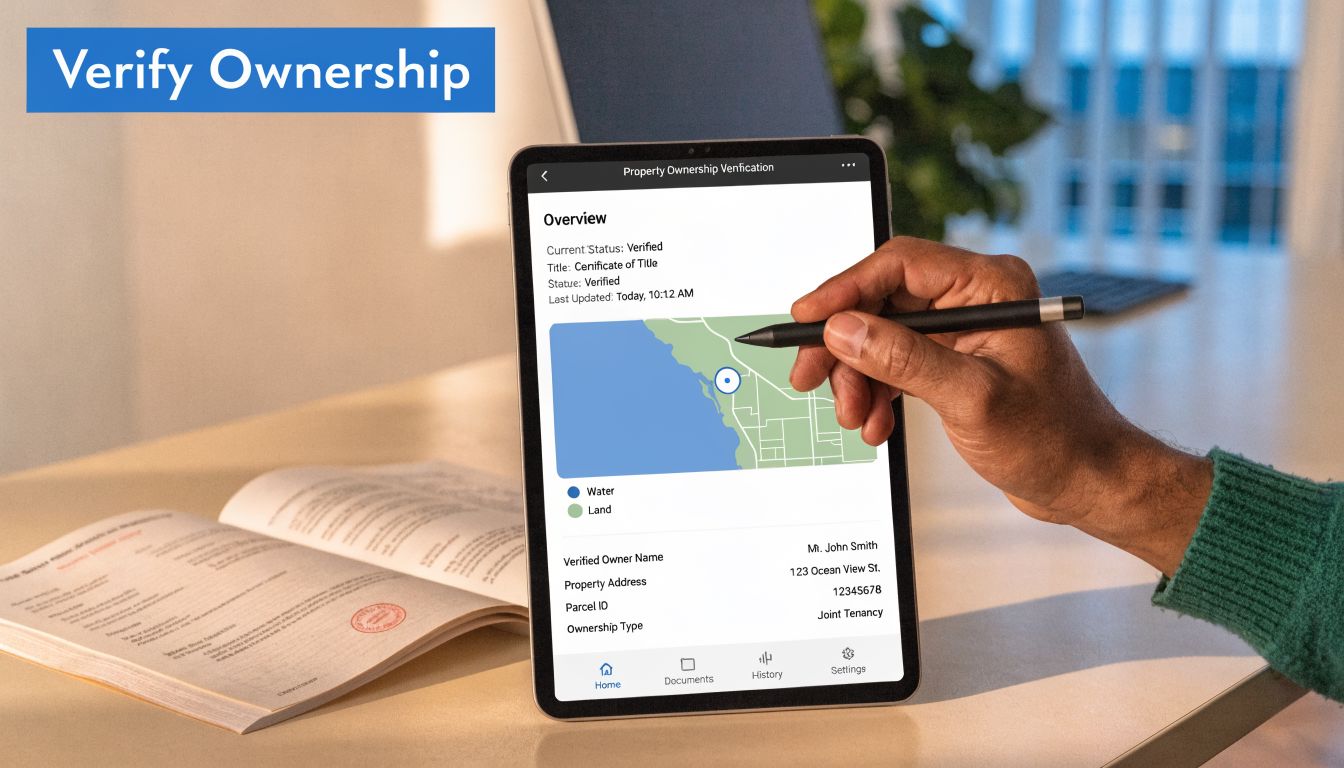
Verification is where abandoned-property investing stops being speculative and becomes real underwriting. You're not verifying one fact. You're confirming a chain of facts that affect title, possession, rehab scope, and resale value.
What to confirm before you price the deal
Use a hard checklist:
Occupancy status
- Don't trust a photo, satellite view, or old list tag.
- Confirm whether the property is vacant, partially occupied, squatted, or intermittently used.
Current owner
- Verify deeded ownership and mailing address.
- If records conflict, work backward through deed history and legal filings.
- If you need a structured process, this guide on how to find property owners is a useful reference.
Title friction
- Check for taxes, mortgages, judgments, code liens, probate issues, and other encumbrances.
- “Cheap” properties often get expensive through title cleanup.
Municipal status
- Confirm whether the structure is condemned, boarded under city order, slated for demolition, or tied to nuisance enforcement.
Physical reality
- Verify that the structure still exists and that the parcel condition matches the record.
- In some Ohio submarkets, lot conversion happens after demolition activity.
Value the house in context
A common underwriting mistake is isolating the property from its block. That produces bad ARV assumptions and weak hold-time estimates.
According to the Ohio spatial regression study by Whitaker and colleagues, homes within 500 feet of a vacant property saw a 1% to 2.7% reduction in sales price, but single-variable analysis often overestimates the effect, and accurate valuation requires modeling multiple distress indicators at the same time, including foreclosure and tax delinquency.
That matters in practice. If you only count nearby vacancy, you can over-penalize or misread the neighborhood. If you ignore correlated distress entirely, you can overpay. The right move is to review the local cluster of vacancy, foreclosure, tax delinquency, and municipal intervention together.
Don't ask, “What is this house worth?” Ask, “What is this house worth after title cleanup, possession risk, and block-level distress are all accounted for?”
What works and what doesn't
What works
- Matching deed data to court, tax, and municipal records
- Confirming ownership before outreach
- Reviewing adjacent distress before finalizing rehab assumptions
- Using local counsel or title professionals early when records look messy
What doesn't
- Pricing from exterior appearance alone
- Assuming tax delinquency equals easy acquisition
- Trusting list labels like “vacant” without current validation
- Ignoring nearby foreclosures and municipal action
What Is the Process for Acquiring an Abandoned Property?
You acquire an abandoned property in Ohio through one of a few practical channels: direct owner purchase, foreclosure-related purchase, tax-related process, or targeted acquisition after municipal change in the surrounding area.
The right path depends on what your verification work uncovered. There isn't one “best” route. There's only the route that matches the property's actual status.
The main acquisition paths
| Acquisition Path | Best Fit | Upside | Main Risk |
|---|---|---|---|
| Direct outreach to owner | Vacant property with reachable owner and manageable title | Flexible terms, possible off-market discount | Owner confusion, probate, unrecorded issues |
| REO or foreclosure-related purchase | Lender-controlled or legally advancing distress | Cleaner process than many off-market deals | Competition, delayed timelines, property condition uncertainty |
| Tax-related pathway | Longstanding tax distress with municipal visibility | Can expose overlooked opportunities | Redemption issues, title complexity, municipal baggage |
| Adjacent-lot or post-demolition strategy | Areas where demolition has reset parcel use | Different redevelopment angles | Exit strategy may depend on city policy and lot demand |
Match the tactic to the signals
If the owner is identifiable, responsive, and not deep in legal conflict, direct outreach is often the simplest path. You can negotiate around condition and close without waiting for auction processes.
If the property is moving through foreclosure, your bargaining power depends on timing. Early distress may still support a negotiated purchase. Later-stage distress may shift the advantage to auction or lender disposition.
Tax-heavy situations require caution. They attract buyers because they look administratively simple from a distance. They usually aren't. You need to know what survives the process and whether the parcel carries hidden costs after transfer.
Municipal action changes the thesis
Many investors miss Ohio-specific nuance in this context. Demolition and rehab programs can reshape a block before your business plan catches up. The issue isn't only whether a city is active. It's how that activity changes supply, comparables, and neighborhood risk.
Coverage of this is still thin. One example is that cities such as Toledo have demolished nearly 1,500 structures since 2019, yet there's limited analysis of how that changes adjacent investment risk and opportunity, as discussed in this review of Ohio demolition and rehabilitation dynamics.
That means you need a due diligence process that accounts for municipal pipeline, not just current condition. A solid operational reference point is this real estate due diligence checklist.
A boarded house next to active demolition isn't the same asset it was two years ago. The structure may be the same. The neighborhood supply picture isn't.
Before you close
Do these three things in order:
Reconfirm title and municipal status
- Records can change during negotiation.
Finalize possession and access assumptions
- Vacant on paper doesn't always mean vacant in practice.
Underwrite the first ninety days
- Focus on stabilization, security, debris, cleanup, utilities, and local compliance before cosmetic rehab.
The buyers who survive in abandoned houses in ohio aren't just good at finding deals. They're good at refusing the ones that turn into legal cleanup projects with a house attached.
Frequently Asked Questions about Ohio Abandoned Properties
Are you liable for an abandoned property before purchase?
Usually no, at least not in the same way as the titled owner. But pre-close liability is only part of the risk.
Actual exposure is transactional. Buyers spend money on inspections, skip traces, quiet title work, legal review, cleanup bids, and contractor walk-throughs, then find out the seller cannot deliver marketable title or the city has active enforcement that changes the deal economics. In practice, that is where inexperienced buyers get hurt.
A better standard is simple. Do not spend heavily until three items are confirmed: title chain, municipal status, and actual possession. If one of those is unclear, underwrite the file as a legal problem first and a property second.
How do you handle squatters or unauthorized occupants?
Handle occupancy through counsel and through Ohio procedure. Self-help lockouts, utility shutoffs, and informal cash deals can create more liability than they solve.
Start by determining whether the person in possession is a trespasser, a holdover occupant, or someone claiming tenancy. That distinction matters. In Ohio, removal often proceeds through the forcible entry and detainer process under Chapter 1923 of the Ohio Revised Code. If the occupant is treated as a tenant or claims a right to possession, expect formal notice, filing in the appropriate municipal or county court, a hearing, and then a set-out if the plaintiff prevails. Timelines vary by court and by whether service is contested, but the process is rarely instant.
For underwriting, assume occupied properties will cost more and take longer to stabilize. Budget for legal fees, sheriff or bailiff scheduling, trash-out, re-securing, and possible delays in contractor access. On distressed assets, occupancy status changes purchase price far less than it changes your first 60 days of execution.
Can out-of-state investors buy abandoned houses in ohio effectively?
Yes, but only if the operating model is local enough to catch bad assumptions before closing.
Remote buyers need more than a mailing address and a photo set. They need current ownership verification, local title support, field inspection with date-stamped occupancy notes, contractor feedback on board-up and debris risk, and a repeatable process for checking whether the municipality has tagged the property for nuisance abatement, demolition, or unpaid code fines. A remote buyer who relies on stale listing data will miss the facts that move returns.
The fix is process discipline. Use local counsel, local title, and a field vendor who can confirm access and possession within a narrow time window before funds are released.
What financing works for heavily distressed properties?
Conventional financing often fails early because the property condition, title defects, or unresolved occupancy issues make the collateral too unstable for standard underwriting.
That pushes many buyers toward cash, private lending, hard money, or portfolio lenders that can tolerate rehab risk and title cleanup risk. The trade-off is obvious. Flexible capital costs more, but it buys speed and tolerance for defects that a conventional lender will reject. After the property is secured, cleaned out, code issues addressed, and title is insurable, the exit can shift to refinance, rental debt, or resale.
Match the capital stack to the asset stage. If the house needs legal work before it needs drywall, finance for legal delay, not just construction.
Are vacant lots a substitute for abandoned houses?
Sometimes, but the underwriting logic is different.
A vacant lot removes structure risk, interior rehab, and some liability tied to unsafe buildings. It can still carry mowing costs, taxes, dumping issues, side-lot restrictions, zoning limits, and weak resale demand. In many Ohio markets, the best lot deals come from assemblage, adjacent owner sales, or targeted infill strategy, not from assuming every cleared parcel should support a new build.
Treat lots as land plays, not simplified house flips. If local absorption, zoning, and utility access do not support redevelopment, the lot may be cheap for a reason.
If your team needs to identify, screen, and verify distressed property opportunities across Ohio without stitching together fragmented county systems by hand, BatchData is built for that workflow. It gives investors, lenders, servicers, and proptech teams access to large-scale property, lien, foreclosure, ownership, and contact data so they can move from vague vacancy signals to usable acquisition and risk decisions.