





































First-party fraud is when a real customer uses their own identity to lie, manipulate, or dispute for financial gain. It has doubled from 15% in 2023 to 36% of reported global fraud events in 2024, making it the leading form of global fraud, and it costs U.S. financial institutions and merchants over $100 billion annually.
That should change how executives think about fraud risk. The biggest threat often isn't a stolen identity or a fake account. It's a legitimate-looking customer record attached to bad intent.
Business leaders need to treat this as both a loss problem and a data problem. The strongest defenses combine tighter definitions, better signal collection, and operational models that can spot intent before a dispute, default, or bust-out event lands on the balance sheet.
- What first-party fraud is: A person uses their own identity, account, or legitimate access to defraud a business.
- Why it's hard: Traditional controls are built to catch stolen credentials, not authorized users acting fraudulently.
- Where it shows up: Lending, BNPL, telecom, gaming, ecommerce, and property-related workflows.
- What works: Behavioral analytics, device and network intelligence, link analysis, and ongoing monitoring.
- What fails: Single-point checks, static rules, and fraud programs that never define the problem clearly in their own portfolio.
Fraud teams that still frame this as a chargeback issue are behind the curve.
SEO Title: What Is First-Party Fraud in Risk and Lending
Meta Description: Learn what first-party fraud is, why it's rising, and how lenders and platforms can detect and prevent it with stronger data signals.
Meta Keywords: first-party fraud, friendly fraud, fraud detection, lending fraud, chargeback fraud, bust-out fraud, identity verification, risk analytics
What Is First-Party Fraud and How Does It Differ
First-party fraud is a fraud event where someone uses their own identity to deceive a business for financial gain. The core issue isn't stolen credentials. It's intentional misrepresentation by a real person using real account access.
That definition matters because a lot of teams still aim the wrong controls at the problem. They invest heavily in third-party fraud prevention, then miss the customer who exaggerates income on an application, opens an account with intent to bust out later, or files a false dispute after receiving goods or services.
According to the LexisNexis Risk Solutions Cybercrime Report press release, first-party fraud surpassed scams as the leading form of global fraud in 2024, representing 36% of reported fraud events, up from 15% in 2023. That's not a niche issue. It's a shift in the structure of fraud itself.
Why identity alone doesn't tell you much
A clean identity file doesn't mean a clean transaction. First-party fraudsters often submit authentic personal details. What changes is the story around the transaction, the truthfulness of the application, or the intent to repay.
That's why old fraud stacks struggle here. If your models are trained to detect identity theft, synthetic identities, or account takeover, they'll often underweight the customer who looks valid on paper but behaves deceptively over time.
Practical rule: If the person is real but the representation is false, you're likely dealing with first-party fraud, not third-party fraud.
First-Party vs. Second-Party vs. Third-Party Fraud
| Attribute | First-Party Fraud | Second-Party Fraud | Third-Party Fraud |
|---|---|---|---|
| Perpetrator's Identity | Uses their own identity | Uses another person's identity with that person's involvement or permission | Uses someone else's identity without permission |
| Victim's Awareness | Business is deceived by the account holder | Another person may knowingly assist or allow misuse | Identity victim is typically unaware |
| Primary Mechanic | Misrepresentation of intent, financial situation, or transaction facts | Shared or recruited identity used for fraud | Stolen credentials or impersonation |
| Common Examples | False dispute, inflated income, bust-out behavior | Family member account misuse, recruited identity usage | Identity theft, account takeover, stolen card use |
| Control Challenge | Detecting intent | Detecting collusion | Detecting impersonation |
Where first-party synthetic fraud fits
There's also a more nuanced variant. Alloy's fraud types guide notes that first-party synthetic fraud involves a fraudster combining made-up credentials, such as a fake SSN, with their real name and date of birth. That's different from ordinary application fraud, where someone exaggerates employment or income.
This distinction matters in underwriting and onboarding. A borrower who inflates salary and a borrower who blends real and fabricated identity elements create different risks, require different reviews, and surface in different data patterns.
If you're asking what is first-party fraud in practical terms, the answer is simple: a real person weaponizes their legitimacy.
What Are Real-World Scenarios in Lending and Real Estate
In lending and real estate, first-party fraud usually doesn't arrive looking dramatic. It shows up as a borrower who looks plausible, a file that feels mostly complete, and a repayment story that breaks once funds are out the door.

Mortgage application misrepresentation
A common pattern is the borrower who misstates income, employment stability, occupancy intent, or debt obligations to qualify for financing they shouldn't receive. This isn't always a stolen identity event. Often, the applicant is real and the documents appear directionally credible. The deception sits in the details.
That's one reason lenders continue to maintain manual review lanes even when programs broaden access. In some edge cases, borrowers who don't fit standard income documentation may look at options such as alternative documentation home loans. Those products can solve legitimate borrower needs, but they also demand stronger verification discipline because reduced documentation creates more room for misrepresentation.
HELOC bust-out behavior
Bust-out risk is particularly expensive because the fraudster can behave like a normal customer for a while. They establish trust, maintain performance long enough to reduce scrutiny, then draw aggressively with no intent to repay.
Operationally, many lenders fail. They focus too heavily on onboarding and not enough on ongoing account monitoring, property distress signals, and changes in contactability. The fraud isn't always visible at origination. It often becomes visible in the period just before loss.
The highest-loss first-party events often look like good accounts until they don't.
Rental and occupancy deception
Property managers, single-family rental operators, and tenant screening teams see another version. Applicants may falsify employment, understate household risk, misrepresent prior tenancy issues, or use a mailing address that obscures actual residence patterns.
Address quality matters more than most operators realize. A weak address hygiene process creates review blind spots, duplicate records, and false confidence in applicant consistency. Teams that tighten address logic usually improve screening quality upstream, which is why workflows such as a mailing address validation process are useful in fraud-sensitive application funnels.
What breaks inside the operation
The business failure usually isn't one bad document. It's a chain of assumptions:
- Origination assumes truthfulness: The file passes because the identity is real.
- Servicing assumes early performance means low risk: The account gains trust before the fraud event matures.
- Collections arrives too late: By the time the story collapses, funds are drawn, assets are transferred, or occupancy conditions have changed.
In real estate and lending, first-party fraud is dangerous because it hides inside otherwise normal workflows. The person isn't trying to break your system from the outside. They're trying to qualify, fund, occupy, draw, and dispute from inside it.
Why Is First-Party Fraud Such a Massive Business Problem
It drains money, time, and analytical accuracy at the same time. That's what makes first-party fraud so destructive at scale.
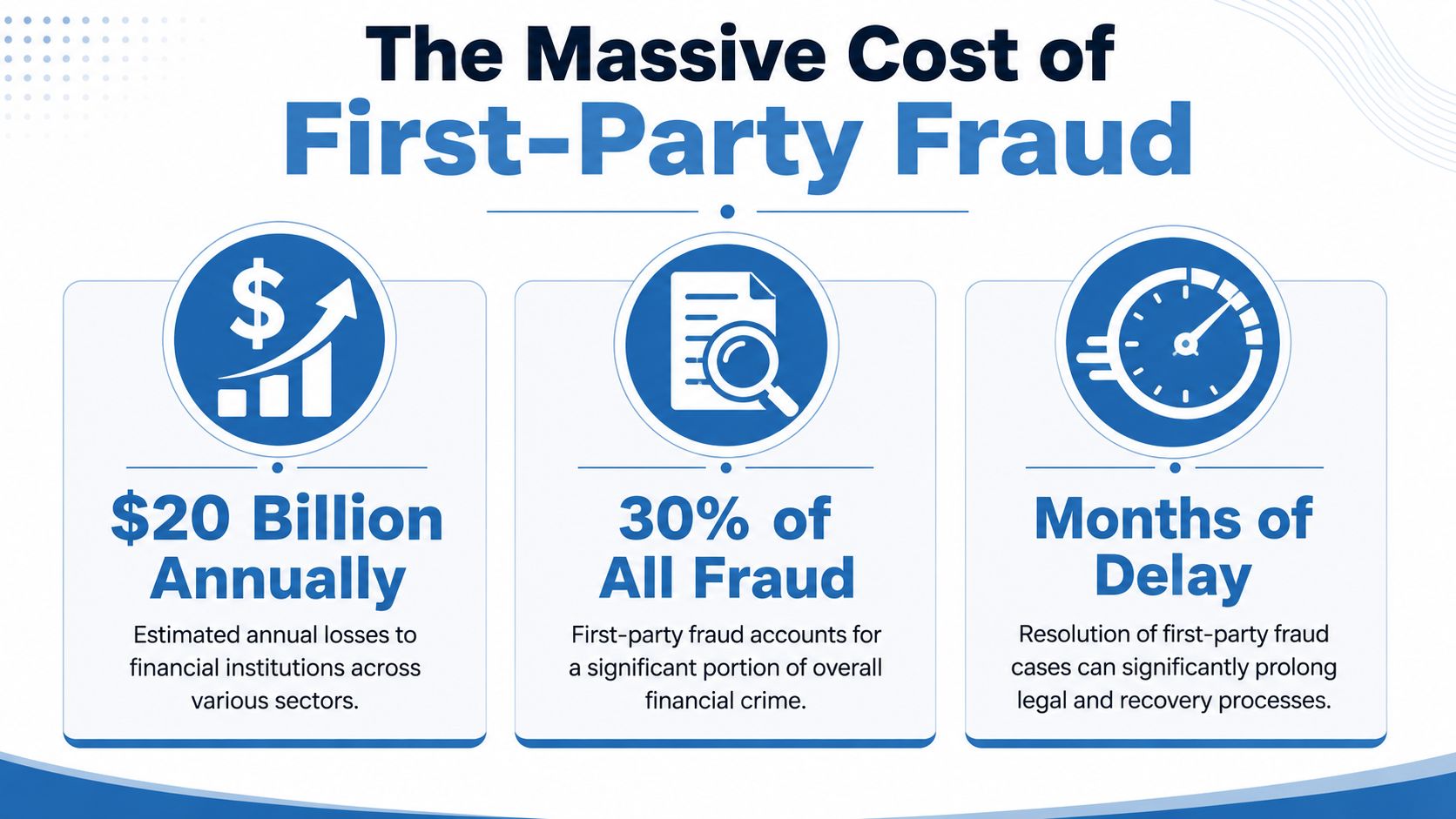
SEON's definition of first-party fraud states that first-party fraud costs U.S. financial institutions and merchants over $100 billion annually, and that false customer disputes account for as much as 70% of all credit card fraud. That should end the debate over whether this is a marginal issue.
Direct losses are only the first layer
The obvious costs are refunds, chargebacks, loan losses, write-offs, and recoveries that never materialize. In card and commerce environments, Ethoca's first-party fraud overview says false customer disputes account for as much as 70% of all credit card fraud globally, cost the industry more than £100 billion annually, and leave merchants absorbing upwards of $50 billion in direct losses. The same source notes that around 20% of all disputes reported by merchants and issuers stemmed directly from first-party fraud in 2025.
That's the visible part of the damage. The harder part is what it does to your operating model.
The hidden cost sits in operations
Fraud analysts, customer support teams, servicing agents, and collections staff all get pulled into cases that are hard to resolve because the customer identity is legitimate. That creates three expensive trade-offs:
| Operational area | What first-party fraud does | Business consequence |
|---|---|---|
| Investigations | Forces manual review to establish intent | Higher case load and slower resolution |
| Customer experience | Pushes teams toward more friction and more false alarms | Legitimate users face extra checks or declines |
| Analytics | Pollutes model training data with deceptive but valid-looking records | Weaker predictions and poor policy tuning |
A lot of leaders underestimate the third point. Fraud-contaminated data doesn't just create losses. It trains bad habits into decision systems. If deceptive accounts are labeled late or inconsistently, risk models learn the wrong signals.
If your fraud labels are weak, your underwriting and servicing models will quietly inherit that weakness.
Consumers have normalized the behavior
Ethoca also reports that 48% of consumers have disputed a transaction at least once, and 35% of Americans admit to committing first-party fraud by using their own identity for dishonest financial gain. When behavior becomes socially normalized, prevention gets harder. The fraudster no longer thinks like a criminal. They think like a customer working the system.
That's why first-party fraud keeps spreading into sectors far beyond card disputes. Once a customer realizes a business struggles to prove intent, the same logic shows up in lending, telecom, gaming, and property-linked services.
How Can You Detect First-Party Fraud Signals
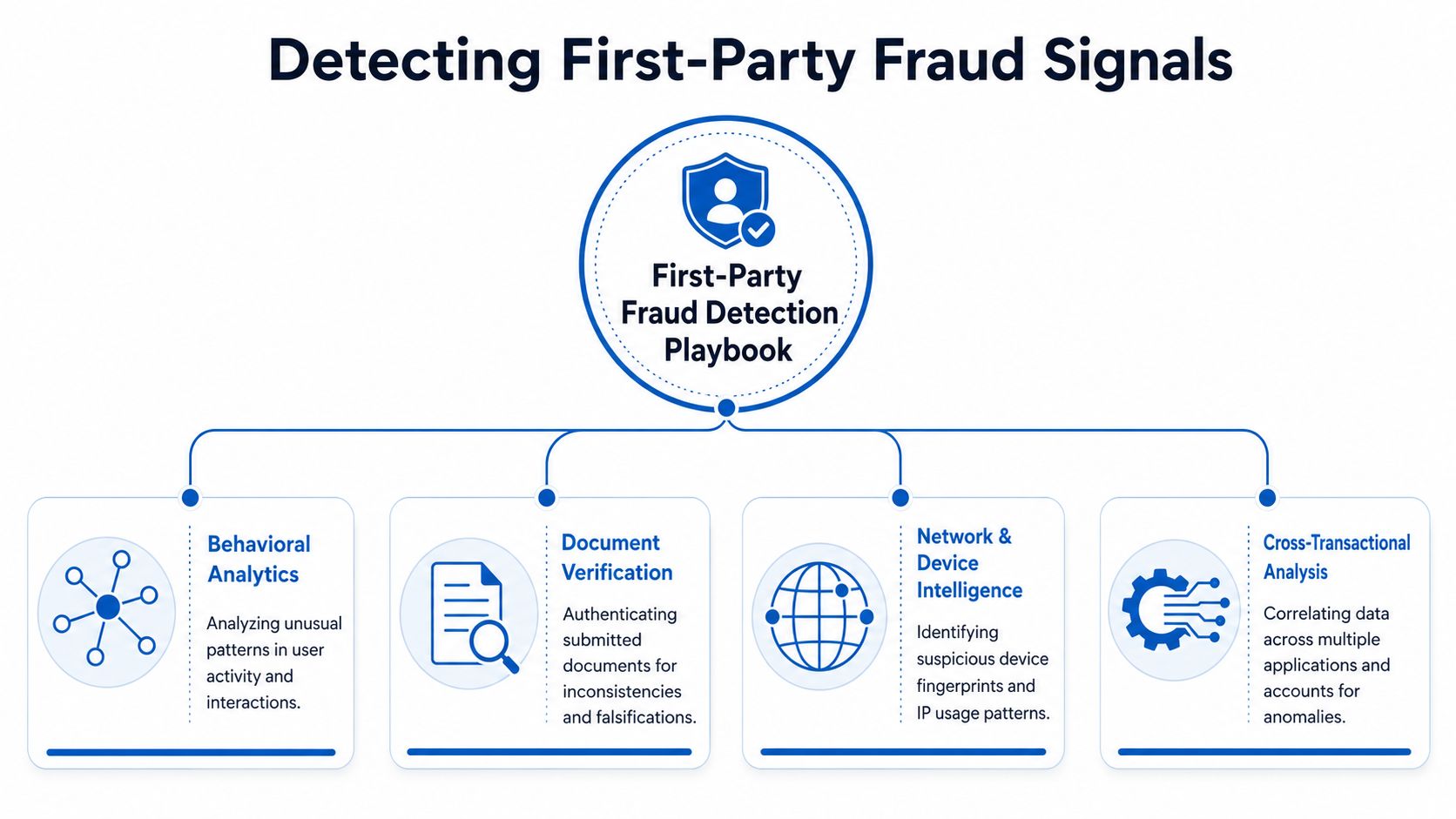
You detect first-party fraud by combining identity truth, behavioral anomalies, device intelligence, and cross-account relationship analysis. One signal rarely closes the case. The pattern does.
Traditional fraud programs miss this because they're optimized for stolen identities. First-party fraud bypasses that logic. The name, date of birth, phone number, and account ownership can all be real. What's false is the intent, the application narrative, or the later dispute.
Start with signal layers, not silver bullets
A useful detection stack looks across multiple categories at once:
- Behavioral analytics: Form completion patterns, copy-paste behavior, unusual navigation, and interaction sequences that don't match normal customer effort.
- Device and network intelligence: Device consistency, browser setup, network reputation, and environmental anomalies.
- Velocity monitoring: Repeated applications, rapid multi-account behavior, unusual dispute timing, or compressed drawdown activity.
- Link analysis: Shared contacts, addresses, devices, payment instruments, or recovery patterns across accounts that appear unrelated at first glance.
A good team doesn't ask, “Is this identity real?” It asks, “Does this customer's full pattern make sense?”
Watch for signals around transaction context
Socure's first-party fraud glossary highlights some of the most useful contextual signals. Detection can require analyzing precise mobile location via SDKs to verify transaction origin, browser language anomalies, and whether a customer is on an inbound mobile call during an online transaction, all of which can correlate strongly with intentional deception.
That last point matters because fraud often leaves traces in context rather than content. The application may look fine. The environment around it doesn't.
Build an investigation model your team can run
Teams often find they already have some of the necessary data. They just don't operationalize it well. A practical review model looks like this:
Define suspicious events clearly
- Distinguish false disputes, application misrepresentation, bust-out patterns, and post-funding abuse.
- Avoid broad labels like “customer issue” or “credit problem.”
Map signals to the customer journey
- At application, focus on identity coherence, income plausibility, and document consistency.
- During account life, watch draw behavior, servicing contact patterns, and repayment changes.
- At dispute or collections stage, review timeline contradictions and linked-account patterns.
Escalate on combinations, not isolated flags
- A single anomaly can be noise.
- Several aligned anomalies often indicate intent.
Feed outcomes back into policy
- If analysts repeatedly confirm a pattern, it should become a model feature, queue rule, or monitoring trigger.
One useful upstream control is stronger user verification on contact points that often anchor identity and communication flows. Teams working on fake-user reduction often benefit from tighter phone data controls, which is why a phone verification API approach can improve signal quality before fraud reaches downstream review teams.
Good first-party fraud detection doesn't depend on catching a lie in one field. It depends on catching inconsistency across the lifecycle.
What doesn't work well
Some controls consistently underperform:
| Weak approach | Why it fails | Better alternative |
|---|---|---|
| Static rules only | Fraudsters adapt faster than rule updates | Hybrid rules plus model-driven review |
| Front-end checks only | Many first-party events surface after funding or delivery | Ongoing monitoring across the account lifecycle |
| Single-channel analysis | Intent is hard to prove from one system alone | Cross-channel data enrichment and link analysis |
The strongest teams treat detection as a connected system, not a point-in-time gate.
How Modern Data Platforms Prevent First-Party Fraud
Modern data platforms prevent first-party fraud by turning scattered signals into a usable risk picture. Detection theory is useful. Operational coverage is what lowers losses.

A fraud team can't do much with disconnected records, stale ownership data, weak contact intelligence, and no monitoring framework. In property-linked lending and servicing, that problem gets worse because risk lives across identity, collateral, occupancy, lien position, and behavioral history.
Sardine's guide to tackling first-party fraud gets the sequence right. Effective prevention requires data enrichment, real-time monitoring, and link analysis, but organizations need to start with existing collections and bad debt data so they can define first-party fraud accurately inside their own business before they automate responses.
What a usable prevention stack actually needs
A modern stack should support four things well:
Identity and contact verification
- You need confidence that the applicant, borrower, owner, and contact record line up.
- That includes validating phone, email, mailing, and ownership relationships.
Property and collateral context
- In real estate workflows, property records, mortgage details, lien data, and ownership history help expose contradictions that a pure identity check won't catch.
Cross-record analysis
- Fraud rarely stays isolated. Shared addresses, repeated contact points, and ownership overlaps can reveal organized behavior or recycled narratives.
Portfolio monitoring
- Risk doesn't stop at onboarding. Changes in distress indicators, ownership posture, or contactability can become early warnings of bust-out or default behavior.
Practitioners should think less about “fraud tool” versus “data vendor” and more about whether the platform can support continuous verification.
Why better data quality changes outcomes
Poor-quality inputs create weak fraud decisions. That applies to models, analyst queues, and servicing workflows. Teams that want cleaner upstream identity data often also tighten email hygiene because fake, disposable, or mismatched emails degrade onboarding quality fast. A practical reference on that side of the stack is CleanMyList's 2026 API guide, especially for teams evaluating how email verification fits into broader anti-fraud workflows.
For identity-specific controls, a stronger ID verification API layer helps reduce the gap between “real identity” and “trustworthy applicant narrative.” That distinction matters because first-party fraudsters often pass superficial identity checks.
The model that works in practice
The most effective operating model usually follows this sequence:
Define the fraud types in your own portfolio
- Separate false disputes, repayment deception, application misstatement, and bust-out behavior.
Quantify where they appear
- Look at collections data, bad debt data, servicing notes, and dispute outcomes.
Enrich records before decisions
- Add stronger identity, property, contact, and relationship data.
Monitor after onboarding
- Watch for changes in behavior, exposure, and account connectivity.
Route exceptions intelligently
- Analysts should review the cases where combined signals suggest intent, not every oddity.
A short walkthrough helps make that concrete:
Better fraud prevention usually starts with better definitions. Better definitions require better data.
The lesson is straightforward. First-party fraud isn't beaten by one more checkbox at onboarding. It's reduced by connecting identity, property, behavioral, and portfolio data into one operating view, then using that view consistently across origination, servicing, and recovery.
BatchData helps property and risk teams do exactly that. If you need cleaner identity signals, deeper property context, and monitoring data that supports underwriting, servicing, and fraud review, explore BatchData.