































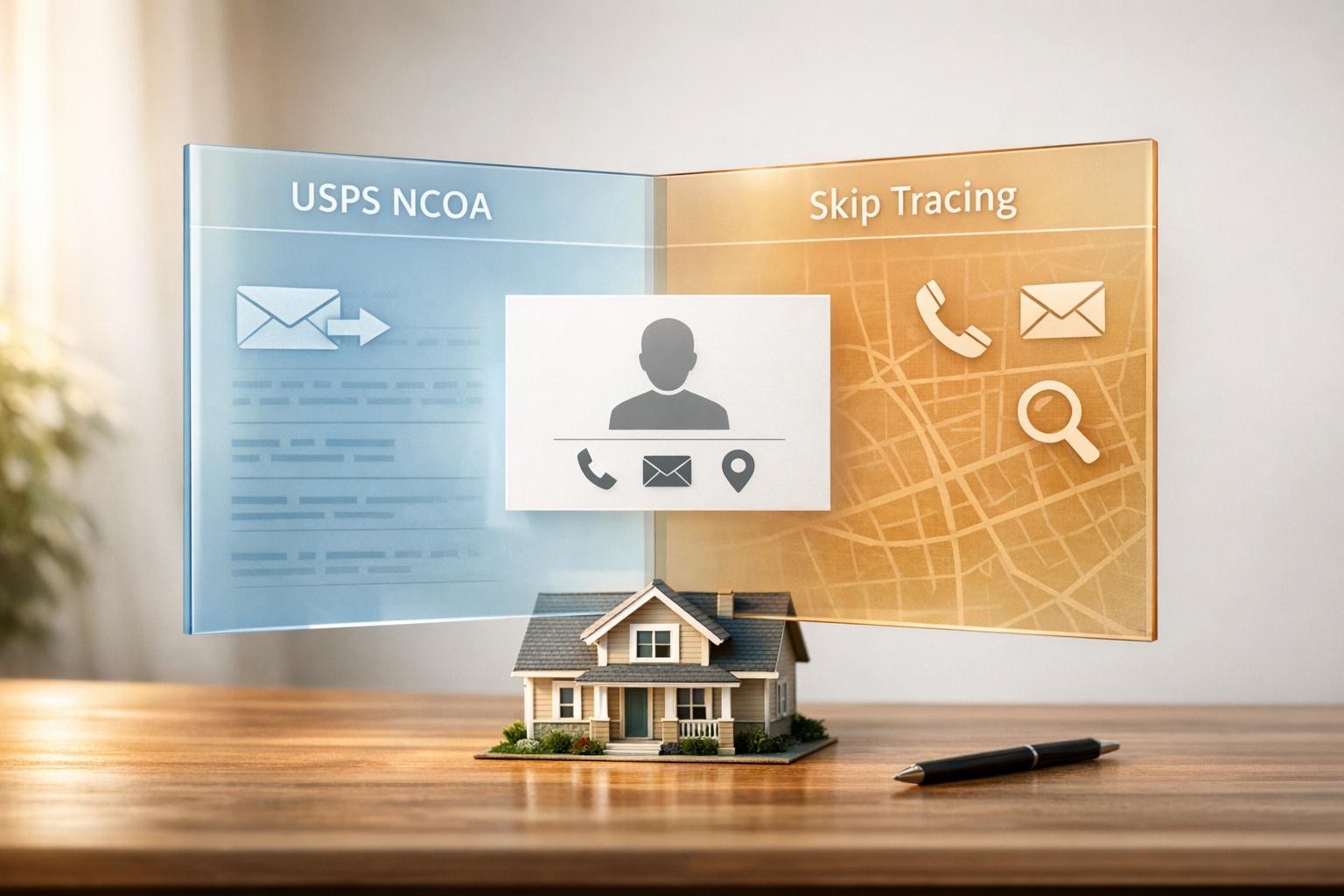
If you’re trying to locate property owners, USPS NCOA (National Change of Address) and skip tracing are two effective tools – but they serve different purposes. USPS NCOA updates mailing addresses based on official change-of-address filings, making it ideal for bulk mail campaigns. Skip tracing goes deeper, pulling phone numbers, emails, and other contact details from multiple sources, making it perfect for direct outreach.
Key Points:
- USPS NCOA: Updates mailing addresses from a database of 160M+ move records. Best for large-scale mailing lists. Affordable but limited to address changes filed with USPS.
- Skip Tracing: Finds phone numbers, emails, and ownership details by cross-referencing public and private data. Higher cost but provides more comprehensive contact info.
Quick Comparison:
| Feature | USPS NCOA | Skip Tracing |
|---|---|---|
| Data Provided | Updated mailing addresses | Phone numbers, emails, LLC details |
| Cost | $0.00075–$0.00295 per record (bulk) | $0.07–$0.15 per record (bulk) |
| Best For | Bulk mail campaigns | Direct outreach campaigns |
| Limitations | Requires move filing with USPS | Higher price, dependent on input data |
For the best results, combine both methods: use USPS NCOA to clean your address list, then apply skip tracing to add phone numbers and emails for targeted outreach.
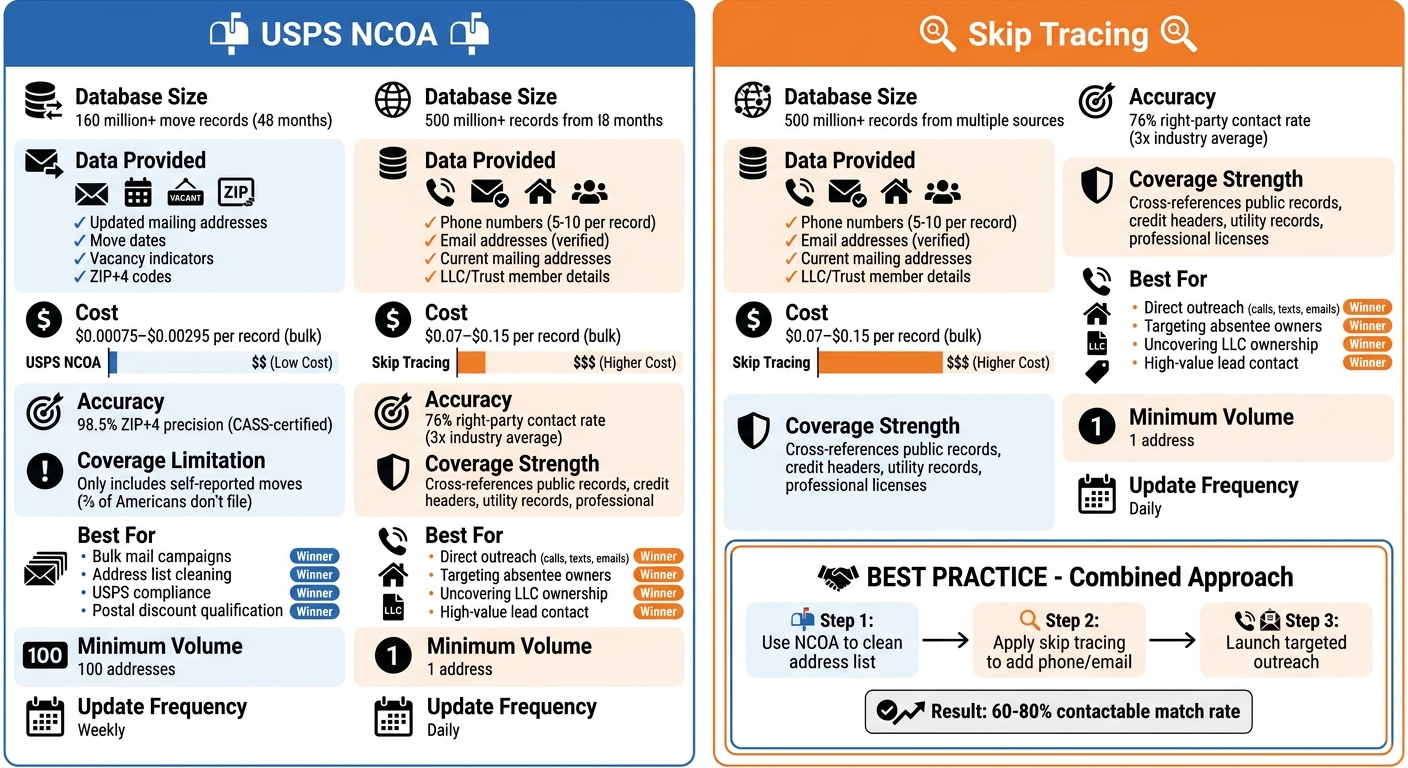
USPS NCOA vs Skip Tracing Comparison Chart for Real Estate Professionals
What is USPS NCOA?
Definition and Purpose
The National Change of Address (NCOALink) is a database managed by USPS that holds about 160 million records of permanent address changes filed by individuals, families, and businesses over the last four years. When someone files a change-of-address request, their updated information is added to this database.
For real estate professionals, this tool is essential for keeping mailing lists accurate. It ensures that marketing materials and legal notices are sent to the right recipients. USPS reports that 40 million Americans move annually, yet 8% of direct mail fails to reach its intended destination due to outdated addresses. This inefficiency cost the U.S. economy $65 billion in undeliverable mail in 2015.
NCOA also plays a role in standardizing addresses, identifying vacant or invalid locations, and adding missing ZIP+4 codes. This helps address the 2% monthly decay rate in data accuracy. By using NCOA, mailers can save up to $0.44 per incorrect address by avoiding unnecessary postage and associated fees.
Now, let’s dive into how this process works to keep your address lists up-to-date.
How USPS NCOA Works
The NCOA system compares your address list against USPS’s 48-month change-of-address database to find updates for individuals or businesses that have moved and filed a forwarding address. Before this matching happens, addresses are standardized using the CASS system and validated through DPV to ensure they’re correct and include complete ZIP+4 coding. If a match is found, you’ll receive the updated forwarding address, the date of the move, and an indication of whether the old address is now vacant. USPS updates the NCOA database weekly, keeping the information relatively current.
However, it’s important to note that about one-third of Americans do not file a change-of-address with USPS, meaning the database only reflects self-reported moves.
Once you understand how the system works, the next step is figuring out how to access this valuable data.
Access and Features
USPS does not provide direct access to the NCOA database. Instead, you’ll need to work with licensed vendors who have CASS/NCOA certification. These vendors fall into three categories:
- Full Service Providers: Offer access to the full 48-month dataset.
- Limited Service Providers: Provide an 18-month dataset.
- End User Mailers: Use the data internally for their own mailing purposes.
For the most comprehensive results, it’s recommended to choose a Full Service Provider, as they offer access to the entire 48-month dataset, which contains over 160 million records. In contrast, the 18-month version only includes about 60 million records.
Using NCOA data requires signing a Processing Acknowledgement Form (PAF). This form, mandated by USPS, ensures the data is used exclusively for mailing purposes and is typically valid for one year.
Many vendors offer services like bulk address validation, real-time APIs, and delivery likelihood scores. For example, processing up to 17,000 addresses might cost around $45.00 as a flat fee.
With these tools and services, keeping your address lists accurate becomes much easier and more cost-effective.
sbb-itb-8058745
What is Skip Tracing?
Definition and Purpose
Skip tracing is all about finding accurate, current contact details for property owners by tapping into various data sources, such as public records, private databases, and specialized tools. As BatchData explains:
"In real estate, skip tracing is the process of locating accurate, up-to-date contact information for a property owner… It’s the essential first step for investors, agents, and home service professionals who want to connect directly with owners."
Unlike the National Change of Address (NCOA) system, which relies on self-reported address updates, skip tracing actively searches for missing contact details. It does this by cross-referencing property records with massive databases – some containing more than 500 million records – to find phone numbers, email addresses, and current mailing addresses. Advanced methods can even "see behind corporate veils", linking LLCs or trusts to the individuals who actually own the properties.
How Skip Tracing Works
Skip tracing pulls together information from multiple sources, including:
- Public records: Tax assessments, probate filings, eviction records, and code violations.
- Private data: Cell phone numbers, email addresses, and social media profiles.
- USPS data: Vacancy indicators to identify undeliverable addresses.
High-end skip tracing services rely on automated systems that update daily and use real-time feedback loops from thousands of users to ensure accuracy. This process delivers multiple contact points, such as verified phone numbers (categorized as mobile or landline), deliverable email addresses, and accurate mailing addresses. Some services even provide up to 10 phone numbers and several verified emails for each property owner.
BatchData reports a 76% right-party contact (RPC) rate, which is about three times higher than the industry average.
Real Estate Applications
Skip tracing proves incredibly useful in real estate, helping professionals identify property owners, generate leads, and build contact lists for direct outreach campaigns. It’s especially effective for targeting motivated sellers, including absentee owners, seniors over 72, tax-delinquent property owners, and families dealing with probate.
The shift from traditional methods to skip tracing has been transformative. As Ivo Draginov puts it:
"Identifying a property owner once meant spending days at a county courthouse… Today, the same information is accessible in minutes."
While many investors achieve a 30–40% contactable rate with basic approaches, those who use structured skip tracing strategies can reach as high as 60–80%. This makes skip tracing a powerful tool alongside USPS NCOA for identifying property owners with precision and speed.
USPS NCOA vs. Skip Tracing: Direct Comparison
Accuracy and Coverage
NCOA relies entirely on self-reported address changes. Its database contains around 160 million records of permanent change-of-address filings from the past four years. To ensure accuracy, CASS-certified software must meet a minimum score of 98.5% for ZIP+4 precision. However, NCOA only provides updated mailing addresses, meaning if someone hasn’t filed a change-of-address, the system won’t help you locate them.
Skip tracing, on the other hand, taps into a wide range of data sources to build complete contact profiles. It pulls from credit bureau headers, utility records, professional licenses, and Secretary of State filings. Confidence scores above 95% indicate how recently the data has been verified. As Ivo Draginov puts it:
"Skip tracing is the fastest way to get direct contact info (phone, email) when public records only provide a name".
While NCOA focuses strictly on updated addresses, skip tracing goes further, offering details like phone numbers, emails, and ownership information. Advanced data analytics have improved the ability to identify qualified property owners by 300–400% compared to basic public record searches.
These differences in data depth are reflected in their costs and use cases, which are discussed next.
Cost and Scalability
NCOA is designed for large-scale mailing list updates at extremely low costs per record. For example, TrueNCOA charges a flat $20 for processing up to 2 million records, while other providers charge between $0.75 and $2.95 per 1,000 records. This pricing makes NCOA an affordable solution for bulk mailing campaigns. However, most providers require a minimum of 100 addresses per file, limiting its usefulness for one-off address lookups.
Skip tracing is more expensive per record but delivers more comprehensive data. While NCOA’s low costs make it ideal for bulk mailings, skip tracing’s higher price per record is balanced by its ability to provide verified contact details. Automated systems can achieve a 60–80% contactable match rate, reducing the effective cost per contact from $3.10 to $1.85. As Sharad Mehta from REsimpli explains:
"Most real estate investors don’t lose money on bad deals that they lose on bad data".
| Feature | NCOA | Skip Tracing |
|---|---|---|
| Per-Record Cost | $0.00075–$0.00295 (bulk) | $0.07–$0.15 (bulk) |
| Data Provided | Updated mailing address | Phone, email, LLC member details |
| Best For | Large mailing lists | Direct outreach campaigns |
| Minimum Volume | 100 addresses | 1 address |
While cost is a key consideration, each method serves distinct purposes depending on your outreach needs.
Use Cases and Applications
NCOA is perfect for maintaining mailing lists and ensuring compliance with USPS regulations. By reducing undeliverable mail and qualifying for discounted postage rates, it’s a go-to for direct mail campaigns. Using NCOA within 95 days of a mailing date ensures compliance with USPS requirements. It works best when you already have a list and just need to update addresses before mailing.
Skip tracing shines when you need to directly contact property owners through calls, texts, or emails. This is especially useful for targeting absentee owners, tax-delinquent properties, or probate estates. It’s also the only way to uncover details about LLCs, such as registered agents or managing members, by searching Secretary of State databases. Professional skip tracing services can return verified phone numbers and emails in seconds, saving hours compared to manual research.
For the best results, combine both methods. Use NCOA monthly to keep addresses current (since data can quickly become outdated), and then enrich your list with skip tracing to add phone numbers and emails before starting outreach. This combined approach minimizes wasted effort on outdated data while maximizing your chances of connecting with property owners who haven’t filed a change-of-address form.
Skip Trace PROPERTY OWNERS/OCCUPANTS with this 3 tools
Strengths and Limitations
For real estate professionals, knowing the strengths and weaknesses of different methods for obtaining property owner data can make all the difference in accuracy and cost-effectiveness.
USPS NCOA Strengths
The USPS National Change of Address (NCOA) system is a reliable way to keep mailing lists up-to-date. It uses verified change-of-address filings submitted directly by property owners. This makes it a practical, budget-friendly option for large-scale direct mail campaigns. By relying on official filings, it helps ensure that addresses are accurate and current – a key benefit for businesses sending out bulk mail.
Skip Tracing Strengths
Skip tracing takes things a step further by providing verified phone numbers and email addresses. It pulls data from a variety of non-public sources, such as credit bureau headers, utility billing records, and even professional licenses. This makes it a powerful tool for obtaining high-quality contact information. It’s particularly useful when dealing with properties owned by LLCs or trusts, as it can access Secretary of State databases to identify the individuals behind these entities.
"Finding a property owner’s contact information is the single most critical step in any real estate transaction… This efficiency is no longer a luxury; it is a requirement for competitive deal-making".
While skip tracing offers several advantages, it does have its drawbacks.
Limitations of Each Method
The USPS NCOA system, while effective for updating addresses, has its limits. It only works if property owners file a change of address, and it does not provide phone numbers or email addresses.
On the other hand, skip tracing can be more expensive, especially on a per-record basis. Although bulk searches help reduce costs, the method’s success hinges on the quality of the input data. Errors like mismatches between public records and actual ownership details can result in inaccurate contact information. Legal compliance is another critical factor – phone numbers must be checked against the National Do Not Call Registry before outreach. Violations of the Telephone Consumer Protection Act (TCPA) can lead to fines ranging from $500 to $1,500 per incident.
"Ignoring outreach regulations is illegal, with fines capable of shutting down a business overnight".
When to Use Each Method
Choosing between USPS NCOA and skip tracing depends on your goals. Each method has strengths that make it better suited for specific tasks, and understanding these can help you decide when to use them.
Best Uses for USPS NCOA
USPS NCOA is ideal for large-scale direct mail campaigns where maintaining a clean and accurate mailing list is critical. It ensures compliance with USPS standards, which is necessary to qualify for bulk mail rates and reduce the number of undeliverable pieces. By matching your list against approximately 160 million permanent change-of-address records, NCOA helps identify property owners who have moved, including those who relocated internationally or left without a forwarding address. For example, comparing property and tax mailing addresses can reveal absentee owners. This level of address validation is crucial, especially considering undeliverable mail cost the U.S. economy an estimated $65 billion in 2015.
Best Uses for Skip Tracing
Skip tracing is the go-to method for obtaining direct contact details like phone numbers and email addresses for outreach efforts. While NCOA and public records provide names and mailing addresses, skip tracing fills in the gaps by appending verified mobile numbers, landlines, and emails. It boasts hit rates of 70–90% for contact information, with right-party contact accuracy often exceeding 70%. This method is particularly effective for identifying individuals behind corporate ownership structures. For instance, in areas like St. Louis and Franklin County, Ohio, where corporations own more than 20% of residential parcels, skip tracing can uncover the decision-makers behind LLCs or trusts. Costs vary, with bulk skip tracing priced at $0.08–$0.15 per hit and single searches ranging from $0.50–$3.00 per hit.
Using Both Methods Together
Combining USPS NCOA and skip tracing creates a powerful, two-step strategy that maximizes efficiency and outreach success. Start with NCOA to validate and clean your list, removing outdated or incorrect addresses. Then, use skip tracing to append current phone numbers and email addresses to the validated records. This layered approach significantly improves outreach efforts, with over 74% of right-party contact attempts succeeding when foundational public records are combined with skip tracing enrichment.
For large-scale operations, validate addresses in bulk first, then enrich them with real-time API data. Additionally, cross-check the owner’s name on the deed with the contact information from skip tracing to ensure accuracy. Discrepancies could indicate you’re dealing with a tenant rather than the property owner. Finally, always scrub phone numbers against the National Do Not Call Registry before initiating outreach to avoid costly TCPA violations, which carry fines ranging from $500 to $1,500 per incident. This two-step process ensures a smooth transition from address validation to effective communication.
BatchData: Property and Contact Discovery Solutions
BatchData offers a streamlined solution that combines USPS NCOA (National Change of Address) data with advanced skip tracing, creating a powerful tool for real estate professionals. By integrating address verification and contact enrichment into a single platform, BatchData simplifies the process of uncovering accurate property and contact details.
With BatchData, you no longer need separate tools for address updates and contact discovery. The platform consolidates these functions, delivering verified addresses, phone numbers, and email addresses through a single, efficient process. It leverages NCOA data and robust skip tracing algorithms that tap into over a dozen public and proprietary databases – such as credit headers, utility records, and voter registrations – to achieve match rates as high as 95% for enriched data.
BatchData Skip Tracing Features
BatchData’s skip tracing feature provides real-time results, delivering 5–10 contact points in seconds by sourcing data from over 50 databases. This enrichment process results in an impressive 76% right-party contact rate, setting a high standard in the industry. Each contact profile includes:
- Multiple phone numbers (clearly marked as mobile or landline)
- Verified email addresses
- Correct mailing addresses, which may differ from property addresses
The platform also excels at uncovering hidden connections, such as linking LLCs and trusts to the individuals behind them. To ensure compliance, BatchData automatically scrubs data against the National Do Not Call (DNC) registry and identifies known TCPA litigators through a Litigator Scrub feature. Data is continuously validated using over a dozen sources and refreshed daily, powered by a self-learning engine informed by over 20,000 active users.
Flexible Solutions for All Business Sizes
BatchData offers pricing options that cater to businesses of all sizes. For smaller operations or startups handling 1,000–5,000 leads monthly, the pay-per-match model – with costs starting at approximately 7¢ per match – provides flexibility without requiring monthly fees.
For larger-scale users managing thousands to millions of records, subscription tiers offer even lower per-match costs, delivering better value. Enterprises with extensive needs can benefit from custom solutions, including unlimited API calls, dedicated support, and bulk processing capabilities with service level agreements ensuring results within 24 hours.
Integrating BatchData into Your Workflow
BatchData offers multiple ways to integrate its solutions into your workflow:
- Single skip traces: Ideal for quick, one-off lookups.
- Bulk CSV uploads: Perfect for enriching thousands of records at once, no technical expertise required.
- Contact enrichment API: Designed for seamless integration into proprietary software, delivering results in milliseconds.
The BatchLeads platform allows users to upload CSV files, map fields for automatic enrichment, and export results directly to CRMs like Salesforce or Podio – all without needing coding skills. For businesses with custom software, the API ensures low-latency performance, making it suitable for high-speed applications.
Conclusion
USPS NCOA and skip tracing each serve distinct purposes when it comes to identifying property owners. USPS NCOA is best suited for updating mailing addresses of individuals who have filed official move notifications within the past 48 months. This makes it a go-to option for maintaining accurate direct mail lists and staying compliant with postal regulations. On the other hand, skip tracing digs deeper, uncovering phone numbers, email addresses, and current locations – even for property owners who bypass USPS notifications or hold assets through LLCs and trusts.
Deciding between these methods depends on your specific needs. For bulk direct mail campaigns where postal discounts are a priority, starting with NCOA processing is a smart move. If your focus is direct outreach through phone or SMS, skip tracing provides the contact details you need. As Sean O’Toole, CEO of PropertyRadar, puts it:
"Skip trace companies are in the business of locating people, not real estate, or direct mail marketing".
Combining both approaches often yields the best results. Running your lists through CASS/NCOA before skip tracing ensures you’re not wasting resources on outdated records. This step helps standardize your data, saving time and money in the long run.
BatchData simplifies this process by offering a platform that integrates NCOA data with advanced skip tracing. With BatchData, you get verified addresses, phone numbers, and emails in one streamlined workflow. Whether you’re processing a few leads or managing millions of records, BatchData’s flexible pricing – starting at about 7¢ per match – and its integration options, like bulk CSV uploads or high-performance APIs, make it easy to fit into your current systems.
For real estate professionals handling thousands of contacts each month, this unified solution accelerates the transition from identifying leads to initiating direct communication. Features like regular data updates, DNC scrubbing, and LLC resolution ensure you’re working with compliant and actionable information.
FAQs
How often should I run NCOA on my mailing list?
Running NCOA (National Change of Address) on your mailing list every 6 to 12 months is a smart way to keep your addresses accurate and stay compliant with mailing regulations. The exact timing can vary based on your mailing volume and specific requirements. Regular updates not only ensure your data stays clean but also help improve delivery rates.
What info do I need to skip trace a property owner?
To effectively skip trace a property owner, start with two key pieces of information: the property address and the owner’s name. These details allow skip tracing services to dig into public records, deeds, tax liens, and other databases to uncover reliable contact information, such as phone numbers, email addresses, and mailing addresses. It’s crucial to ensure the data you provide is accurate and up-to-date to improve your chances of success while staying compliant with legal requirements.
How do I stay TCPA-compliant when calling or texting owners?
To comply with TCPA regulations, make sure to get written consent before sending automated calls or texts. Clean up your contact lists frequently – at least every 31 days – to ensure you’re not contacting numbers on the National Do Not Call Registry. Always address opt-out requests quickly and manage all data in line with laws like the CCPA. Relying on verified data sources and maintaining thorough records of consent and communication can further help you stay compliant and minimize potential legal issues.