
Skip tracing helps locate property owners’ contact details like phone numbers, emails, or mailing addresses, often for real estate or off-market opportunities. However, the industry struggles with low accuracy – only 25%-35% of calls connect with the right person. The main reasons? Outdated data, duplicate records, and incomplete information. Here’s how to tackle these issues effectively:
- Clean Your Data: Start with accurate records (e.g., property address, owner’s name) and remove duplicates.
- Use Multiple Data Sources: Combine public records, credit data, and other sources for complete profiles.
- Leverage Advanced Tools: Use skip tracing verification tools to confirm contact details and filter out bad data.
- Automate Workflows: Save time with APIs and batch processing while ensuring compliance with regulations.
- Track and Improve: Monitor key metrics like right-party contact (RPC) rates and refine processes using analytics.
Premium tools like BatchData can boost RPC rates to 76% – far above the industry average – by integrating multiple data sources, real-time updates, and advanced validation. Better accuracy means fewer wasted calls and more meaningful connections.
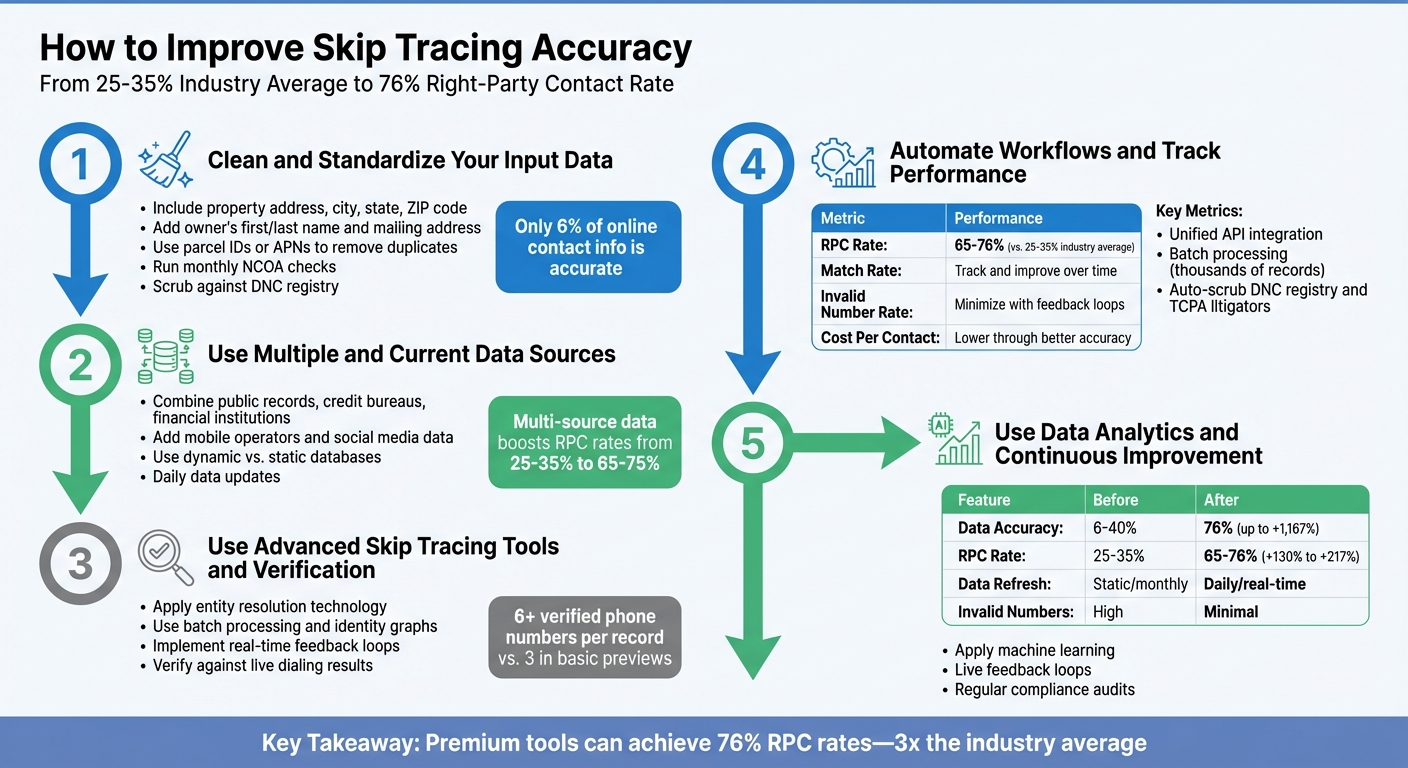
5-Step Process to Improve Skip Tracing Accuracy from 25% to 76%
Best Practices to get most accurate Property data using BatchSkipTracing and BatchLeads
sbb-itb-8058745
Step 1: Clean and Standardize Your Input Data
Before diving into skip tracing, make sure your data is clean and consistent. Messy or incomplete records can lead to poor results, wasted time, and unnecessary costs. By starting with actionable property data, you’ll see better match rates and fewer dead ends.
At a bare minimum, your records should include the property address, city, state, and ZIP code. To get even better results, add the owner’s first and last name and their mailing address if available. Mailing addresses are especially important because they often differ from the property address – owners may live elsewhere or hold properties through LLCs. Including this extra detail helps the system connect the dots more effectively. Once you’ve confirmed these key data points, take the time to remove redundancies for smoother processing.
Use unique identifiers like parcel IDs or APNs (Assessor’s Parcel Numbers) to eliminate duplicate entries. This not only keeps your costs in check but also ensures your metrics stay accurate. When uploading data in bulk, stick to standardized CSV templates with properly mapped columns. This step ensures your data is processed correctly.
Keep your records up to date by running monthly updates. For example, use National Change of Address (NCOA) checks to identify owners who have moved. Regularly scrub your lists against the Federal Do Not Call (DNC) registry and TCPA litigator lists to avoid compliance issues. It’s worth noting that only about 6% of contact information available online is accurate, so relying on outdated or static lists can lead to disconnected numbers and wasted effort.
Platforms like BatchData can simplify this process. Their property data enrichment services automatically clean up mailing lists by removing duplicates and invalid addresses, verify geocodes linked to property records, and enrich your data with over 700 property attributes. By ensuring your input data is complete and accurate, you’ll set yourself up for better results and higher right-party contact rates before you even begin skip tracing.
Step 2: Use Multiple and Current Data Sources
Relying on just one data source can leave gaps in your contact information and limit your reach. The best skip tracing methods leverage multiple sources – like public records, credit bureaus, financial institutions, mobile operators, and social media – to create a complete contact profile. This approach allows you to cut through corporate shields, linking LLCs and trusts to the real individuals behind them.
Pull from Multiple Data Sources
Combining data from various channels – such as financial transactions, social media activity, mobile device usage, and public records – helps you build detailed profiles. These profiles go beyond basic contact information, offering insights into someone’s motivations and current location. For instance, financial data and mobile operator records can reveal spending habits and location patterns. This layered strategy significantly boosts right-party contact rates. While industry averages hover around 25% to 35%, using high-quality, multi-source data can raise those rates to 65% to 75%.
"By minimizing the time gap between data collection and action, businesses can increase the likelihood of successfully locating individuals before they disappear further into the digital ether." – Tracers
Keeping data fresh is just as important as using diverse sources. Static databases, which rely on older public records, may lag behind, while dynamic systems continuously update and validate data in real time. For example, when downloading full CSV reports from bulk tools, you might find six or more verified phone numbers – far exceeding the three typically shown in on-screen previews.
Get Better Results with BatchData Services

Using advanced tools alongside diverse data sources can take skip tracing to the next level. BatchData’s skip tracing and contact enrichment services boast a 76% right-party contact rate. Their API updates datasets daily and processes results in milliseconds, ensuring you’re always working with the most recent information. By pulling from over a dozen sources and using continuous validation, BatchData eliminates disconnected numbers and invalid addresses.
"Our data undergoes continuous validation from over a dozen sources to ensure top-tier right-party contact rates." – BatchData
BatchData’s bulk services provide a wealth of information, including mobile and landline flags, email addresses, mailing addresses, and LLC ownership details – all checked against the DNC Registry and TCPA litigator lists for compliance. Whether you’re managing thousands of records at once or need real-time API access, their platform is built to handle high volumes with precision and accuracy.
Step 3: Use Advanced Skip Tracing Tools and Verification
Once you’ve compiled clean, multi-source data, the next step is to refine its accuracy using advanced tools. These tools ensure you’re reaching the right decision-maker by verifying identities and filtering out incorrect or outdated contact information. This is what sets precise skip tracing apart from guesswork.
Apply Batch Processing and Identity Graphs
Entity resolution technology plays a key role here, connecting properties, LLCs, trusts, and the individuals behind them. This process, often referred to as "piercing the corporate veil", uncovers the people controlling shell companies that might otherwise seem disconnected. For instance, if "ABC Holdings LLC" owns a property, identity graphs can trace it back to the actual decision-maker.
Batch processing adds another layer of accuracy by cross-referencing multiple data points to confirm contact information. Instead of relying on just one detail, these systems validate records across various fields to ensure you’re reaching the property owner – not an outdated or incorrect contact. Real-time feedback loops further enhance this process by validating phone numbers against live dialing results from thousands of users. Disconnected or unreachable numbers are automatically removed, keeping your contact lists accurate and up-to-date. These validations also streamline API automation, making the process even more efficient.
Automate Tracing with BatchData’s APIs
BatchData’s APIs take automation to the next level, providing verified contact information in real time and processing requests at nearly three times the industry standard. Their platform covers over 155 million properties and includes more than 700 attributes, such as phone confidence scores that help you prioritize the most reliable numbers.
The system also reduces legal risks by automatically scrubbing results against the National Do Not Call (DNC) registry and flagging known TCPA litigators. It even categorizes phone numbers by line type, enabling you to focus on mobile contacts. When exporting full CSV reports, you’ll often find six or more verified phone numbers per record – well beyond the three shown in basic previews. To get the most precise matches, include as much input data as possible, such as the property address, first and last name, and mailing address.
"What used to take 30 minutes now takes 30 seconds. BatchData makes our platform superhuman." – Chris Finck, Director of Product Management
Step 4: Automate Workflows and Track Performance
Once you’ve implemented advanced verification tools, the next logical step is to introduce automated workflows and establish ongoing performance tracking. Automation takes care of repetitive tasks, freeing up time, while performance tracking ensures your skip tracing efforts become more precise over time. This combination creates a solid foundation for integrating advanced API connections and real-time data validation.
Build Automated Systems
Unified API integration simplifies skip tracing by embedding it directly into your daily operations. Instead of juggling spreadsheets – manually uploading and downloading data – a single API connection can deliver property intelligence, verified contact details, and compliance-ready information straight into your existing systems. This eliminates the tedious process of searching for individuals one at a time and replaces it with batch processing, capable of handling thousands or even millions of records in one go.
With live feedback loops, your system can track dialing outcomes and clean your database in real time. For example, BatchData’s self-enriching engine refreshes and verifies datasets daily, ensuring your automated workflows maintain high levels of accuracy.
Additionally, automated scrubbing tools check every lead against the National Do Not Call (DNC) registry and flag potential TCPA litigators, safeguarding you from costly legal issues. Once these workflows are in place, it’s crucial to monitor them regularly to ensure they’re delivering the desired results.
Track Key Performance Metrics
One of the most important metrics to keep an eye on is the right-party contact (RPC) rate. This measures how often the phone numbers provided actually connect with the property owners you’re targeting. While the industry average hovers around 25% to 35%, advanced automated systems can push this rate up to 65% to 75%, or even higher. For instance, BatchData reports an impressive 76% RPC rate, which is about three times the industry average.
Other key metrics to track include match rate, the frequency of invalid numbers, and the cost per successful contact. These indicators help you evaluate whether your automation efforts are delivering value. BatchData’s APIs and custom datasets support this process by offering phone confidence scores, which rank numbers based on their likelihood of being active and linked to your target individual. Plus, detailed CSV reports often include up to six verified phone numbers per record, increasing your chances of making a connection even if the top-ranked numbers don’t work.
| Metric | What It Measures | Target Benchmark |
|---|---|---|
| RPC Rate | Phone numbers connecting with property owners | 65%–76% (vs. 25%–35% industry average) |
| Match Rate | Records returning usable contact information | Track and improve over time |
| Invalid Number Rate | Disconnected or incorrect numbers | Minimize with automated feedback loops |
| Cost Per Contact | Total spend divided by successful connections | Lower through better data accuracy |
Step 5: Use Data Analytics and Continuous Improvement
After setting up automated workflows and tracking performance, the next step is leveraging advanced analytics to refine skip tracing accuracy over time. This transforms skip tracing from a one-off task into an ongoing process that keeps getting better. As outlined earlier, verified data and automated systems provide the groundwork for these analytics.
Apply Machine Learning and Regular Audits
Machine learning plays a crucial role in analyzing massive datasets to uncover patterns, detect anomalies, and provide insights that would be impossible to spot manually. These algorithms can link seemingly unrelated data – like utility records, social media activity, and financial information – to build a reliable picture of someone’s location or behavior.
A critical part of this process is using live feedback loops. For example, when a multiline dialer is used to contact leads, it flags disconnected or invalid numbers and removes them from your database automatically. This mechanism ensures your data remains accurate and up to date.
Regular audits complement these automated systems. They include compliance checks, such as scrubbing against the National Do Not Call (DNC) registry and identifying known TCPA litigators to minimize legal risks. By cross-referencing skip tracing results with real-world outcomes from your dialing efforts, you create a system that continuously filters out bad data, saving your team time and effort.
Compare Before and After Metrics
Tracking your metrics before and after implementing data analytics reveals how much your processes improve. Many businesses, for instance, start with accuracy rates as low as 6% when relying on publicly available data or around 40% when using mid-tier data providers. After incorporating accurate skip tracing data and automated validation, those rates can climb to 65%–76%.
Here’s a snapshot of how these improvements play out:
| Metric | Before Optimization | After Optimization | Change |
|---|---|---|---|
| Right-Party Contact Rate | 25%–35% (industry average) | 65%–76% | +130% to +217% |
| Data Accuracy | 6%–40% | 76% | Up to +1,167% |
| Data Refresh Frequency | Static or monthly | Daily/real-time | Continuous updates |
| Invalid Numbers | High (no verification) | Minimal (live feedback loop) | Significant reduction |
These changes don’t just improve efficiency – they directly impact your bottom line. By ensuring your team consistently connects with the right people on the first or second attempt, you reduce wasted calls and marketing costs. Ultimately, this shifts the economics of your outreach efforts, making them far more effective and cost-efficient.
Conclusion: Main Points for Better Skip Tracing Accuracy
Achieving better skip tracing accuracy hinges on five key strategies. First, ensuring clean, standardized data is crucial – without it, the process risks falling into the "garbage in, garbage out" trap. Second, using multiple data sources fills in the blanks left by single databases. Combining credit headers, utility records, DMV data, and property information creates a more comprehensive view. Third, real-time verification tools, often powered by AI and identity graphs, uncover connections that manual searches might miss. Fourth, automated workflows through APIs and batch skip tracing can drastically cut down time, turning tasks that once took 30 minutes into ones completed in just 30 seconds.
Finally, continuous improvement through analytics ties everything together. By tracking metrics like right-party contact (RPC) rates and incorporating live feedback loops, you can refine the process over time. As Will Turner from TEC Services Group points out:
"The best skip trace program layers in multiple skip trace vendors to maximize cost and effectiveness".
These strategies directly address the issues of outdated and fragmented data discussed earlier. For instance, BatchData’s system aggregates information from a dozen top-tier sources, updates daily, and delivers an impressive 76% RPC rate – about three times the industry average. Its API also grants access to over 700 property attributes spanning 155 million records.
FAQs
Why is using multiple data sources important for accurate skip tracing?
Using multiple data sources is a game-changer for skip tracing, boosting accuracy by tapping into a wider and more dependable range of information. By pulling data from places like public records, court filings, tax liens, utility accounts, and even social media, you can build a more complete and current profile. This reduces the risk of relying on outdated or incomplete details. For instance, cross-checking an address in tax records with utility databases offers greater confidence in its validity.
This method also helps track down elusive individuals by revealing alternative contact points, such as secondary addresses, email contacts, or business ties. Take this example: even if someone doesn’t have a recent phone record, they might still show up in property filings or court documents. By tapping into these varied data sources, skip tracers can locate people faster, cut down on costs, and achieve more accurate results.
How does automation enhance the accuracy and efficiency of skip tracing?
Automation takes skip tracing to a whole new level by simplifying how data is collected, verified, and updated – saving both time and energy. With automated tools, you can process massive amounts of information quickly and with precision, minimizing human errors and ensuring the results are always current.
Some standout perks include the ability to pull data from multiple sources instantly, conduct batch searches to speed up workflows, and leverage automated validation to catch inconsistencies while enriching contact details. Plus, real-time updates keep the information accurate and dependable. By cutting costs and scaling operations with ease, automation has become a game-changer for delivering reliable and efficient skip tracing outcomes.
Why is it crucial to keep skip tracing data updated and accurate?
Keeping your skip tracing data current and precise is critical for reliable outcomes. If your data is outdated or incorrect, you risk missing key connections or ending up with inaccurate matches – both of which can drain your time and resources.
By consistently updating and refining your data, you ensure it stays relevant and dependable. This not only boosts your chances of successfully locating property owners or other contacts but also makes your skip tracing efforts more efficient and effective.