APIs are transforming the real estate industry by turning vast amounts of data into actionable insights. They help professionals identify high-value leads, personalize outreach, and streamline operations. Here’s why they matter:
- Data Integration: APIs connect systems like CRMs and websites to massive property databases, providing instant access to details like sales history, market trends, and verified contact information.
- Behavior Tracking: APIs analyze search habits, engagement metrics, and transaction signals to pinpoint buyer or seller intent.
- Enriched Profiles: They enhance customer and property records with real-time data, including ownership details, valuation models, and transaction histories.
- Practical Applications: From lead scoring to personalized marketing campaigns, APIs enable smarter, data-driven strategies.
For example, SOLD.com used APIs to automate property valuations, boosting monthly revenue by $10,000 while cutting costs. Tools like BatchData simplify integration with features like contact enrichment and phone verification, making it easier to connect with property owners.
Key Benefits:
- Better Lead Prioritization: Identify high-intent clients using behavioral data.
- Improved Outreach: Verified contact details increase the success of marketing campaigns.
- Enhanced Decision-Making: Real-time insights improve pricing, targeting, and timing.
Start by auditing your current systems, standardizing data, and exploring API solutions that align with your goals.
What Are The Best Practices For Property Data API Integration? – CountyOffice.org
Understanding Customer Behavior Data
3 Types of Customer Behavior Data in Real Estate
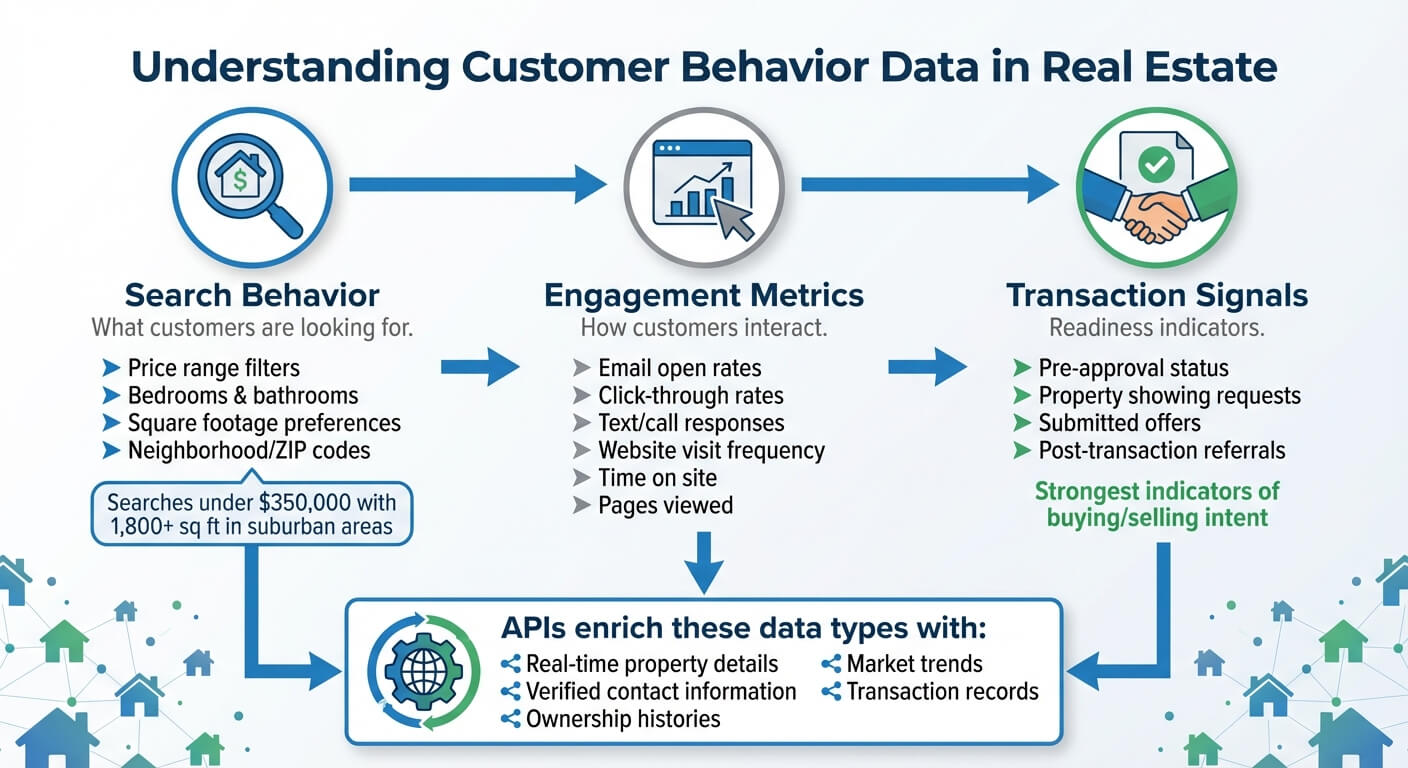
For real estate professionals, understanding customer behavior is key to making smarter, data-driven decisions. By analyzing how clients search, engage, and act during transactions, agents can tailor their strategies to meet specific needs. Customer behavior data generally falls into three main categories: search behavior, engagement metrics, and transaction signals. Let’s break these down and explore how APIs can help integrate this data into actionable insights.
Search behavior gives clues about what a customer is looking for by analyzing filters like price range, number of bedrooms and bathrooms, square footage, and preferred neighborhoods or ZIP codes. For instance, if someone repeatedly searches for homes under $350,000 with at least 1,800 square feet in suburban areas, you can infer their preferences and adjust your outreach accordingly.
Engagement metrics track how customers interact with your online content and communications. Metrics like email open rates, click-through rates, text or call responses, and frequent visits to your website can reveal a client’s level of interest.
Transaction signals are some of the strongest indicators of readiness to buy or sell. These include pre-approval status, requests for property showings, submitted offers, and even post-transaction activities like referrals. Platforms like Zillow use machine learning to analyze these signals and identify clients who are ready to move forward.
Before diving into API integration, it’s essential to gather foundational data such as:
- Basic contact information and whether they’re a buyer, seller, or investor
- Their stage in the buying or selling process, along with preferred locations
- Data on website activity, including pages viewed and search criteria
- Communication history, complete with timestamps
- Engagement in marketing campaigns, like email or SMS responses
- Pipeline details, such as lead sources, appointments, offers, and closing dates
- Consent for communication
Types of Customer Behavior Data in Real Estate
Customer behavior data can be grouped into several actionable categories:
- Search Activity Data: This includes property types viewed (e.g., single-family homes, condos), price sensitivity, and filters like location or square footage. Recognizing patterns in searches can help focus your outreach.
- Digital Engagement Data: Metrics like time spent on your website, number of page views, and email interactions can separate serious buyers or sellers from casual browsers.
- Communication Behavior: Tracking how clients respond across different channels – whether by phone, text, or email – helps identify their preferred communication methods and the best times to reach out.
- Transaction Readiness Indicators: Signals like pre-approval, property showings, and offer submissions highlight clients who are ready to act.
APIs can take this data to the next level by enriching customer and property records with real-time insights.
Using APIs to Enrich Customer and Property Records
APIs can transform basic customer and property records into comprehensive profiles. For example, when a customer views a property on your website, an API can instantly pull up details like the property’s automated valuation model (AVM) estimate, sales history, mortgage status, tax records, square footage, and even recent renovations.
Contact enrichment is another powerful tool. BatchData’s APIs, for instance, can enhance customer records with verified phone numbers, email addresses, and ownership details. With a 76% success rate in reaching property owners – three times the industry average – this ensures more effective outreach.
Property context enrichment adds layers of information, such as neighborhood demographics, school ratings, Walk Score data, recent comparable sales, market trends, foreclosure status, and days on market.
Transaction history enrichment provides a deeper understanding of a client’s past behavior, such as previous purchases, sales, refinancing activity, or multi-state property ownership. This is especially helpful when identifying active investors.
Practical Applications for Enriched Data
Enriched customer behavior data opens the door to advanced strategies in real estate:
- Propensity Modeling: By combining search behavior, engagement metrics, and property data, you can rank leads based on their likelihood to transact. Zillow, for instance, uses this method to identify high-intent prospects.
- Investor Activity Tracking: APIs can identify investor-specific behaviors, like cash purchases, ownership of multiple properties, or interest in distressed assets, enabling more targeted outreach.
- Lead Scoring and Prioritization: Instead of treating all leads equally, enriched data lets you prioritize high-value prospects based on behavioral signals and property insights.
- Personalized Marketing Campaigns: With detailed data, you can create highly targeted campaigns. For example, send refinancing offers to homeowners with high interest rates and significant equity, or target empty-nesters with larger homes who may be considering downsizing. SOLD.com, for example, used APIs from Terradatum and Attom Data to provide detailed property and market insights, boosting user trust, increasing monthly revenue by $10,000, and slashing AI-related expenses by sixfold.
Preparing for API Integration
Data Preparation Requirements
Before diving into API integration, ensuring your data is clean and standardized is a critical first step. Why? Because inconsistent or messy data can lead to API errors or incomplete results.
Start by conducting a thorough audit of your records. Check for duplicate entries, conflicting property details, or missing key information like addresses, names, and contact numbers. Inconsistent data can cause API calls to fail or produce unreliable results. For example, if your database lists an address as “123 Main Street, Any Town California”, most APIs won’t process it correctly. Instead, you’ll need to use USPS-standardized formats like “123 Main St, Anytown, CA 90210”, complete with proper abbreviations and ZIP+4 codes. Research shows that standardized addresses can reduce API rejection rates by as much as 30-50%.
Another must-have is unique identifiers for every contact or property in your system. These could include an internal customer number, property parcel ID, or MLS number. Without these identifiers, you risk overwriting the wrong records or creating unnecessary duplicates. For instance, ATTOM Data APIs use precise addresses and identifiers to accurately pull property characteristics, tax details, and sales data.
Once your data is standardized and unique identifiers are in place, your systems will be ready to integrate and manage enriched records smoothly.
Setting Up Systems for API Use
With clean, standardized data as your foundation, the next step is configuring your systems to handle enriched data efficiently. Tools like centralized CRMs – think Salesforce – are excellent for consolidating customer and property data into one unified platform, eliminating the inefficiency of spreadsheets and disconnected tools. Make sure your CRM is set up to handle both real-time API calls and batch data feeds.
Your database should also be structured with normalized tables for contacts, properties, and interactions. This makes it easier to store and manage enriched fields like ownership history, mortgage details, or phone verification statuses. A real-world example? When SOLD.com integrated Salesforce with ATTOM’s property data, they updated their database architecture and managed to cut AWS infrastructure costs by 23.5%, saving around $2,000 per month.
Establishing clear data management protocols from the start is also essential. Decide who will be responsible for maintaining data quality, how often records will be updated, and what formats you’ll use for each field. You’ll also need to plan whether to use real-time API calls for features like instant property searches or batch jobs for larger, overnight data updates. Don’t forget to include retry logic and monitor API rate limits to ensure consistency.
How BatchData Supports API Integration

BatchData simplifies API integration by connecting directly with your CRM, marketing tools, or custom software, automating workflows that would otherwise require manual data updates. Their Contact Enrichment and Skip Tracing services can fill in missing details during data preparation, while the Phone Verification API validates phone numbers, checks carrier information, and confirms line types in milliseconds. This not only helps prevent fake accounts but also boosts conversion rates during onboarding or payment processes.
BatchData’s developer-friendly APIs are designed for flexibility, offering delivery options like API calls, bulk feeds, or custom solutions to fit your existing data workflows. With a pay-as-you-go pricing model and no subscription commitments, you can test and scale your integration without upfront financial risks.
sbb-itb-8058745
Using Real Estate APIs for Customer Insights
Implementing APIs for Behavioral Analysis
APIs can track user behavior on your website, capturing actions like ZIP code searches, price filters (e.g., under $500,000), property type preferences, time spent on listings, and saved properties. This data can be integrated into your platform and combined with property attributes – like the number of bedrooms, bathrooms, lot size, year built, or neighborhood scores – using APIs for a more comprehensive view of user activity.
By merging behavioral data with property information, you can create detailed lead profiles. For instance, a user consistently searching for three-bedroom homes under $500,000 in walkable neighborhoods and frequently using mortgage calculators demonstrates strong buying intent. If multiple actions occur within a short timeframe, such as seven days, automated outreach can be triggered to engage these high-intent leads.
Even smaller brokerages can adopt this strategy. By integrating web analytics, CRM systems, and property data APIs, they can establish a seamless funnel to track the customer journey – from the initial website visit to closing a transaction. Using propensity modeling, they can identify serious buyers and sellers, personalize recommendations, and determine the best time for agents to reach out.
Transaction and market-trend APIs add even more depth by offering real-time updates on recent sales, price fluctuations, days on the market, and neighborhood-level metrics for U.S. ZIP codes and counties. Matching leads’ areas of interest with these localized trends can help identify “hot” markets – areas with rising median prices and shrinking inventory – and guide timely, data-informed outreach. These insights pave the way for creating precise customer segments, which we’ll explore next.
Building Customer Segments
With enriched behavioral data, APIs enable the creation of highly specific customer segments, allowing for more targeted marketing efforts. These APIs can enhance basic lead records with additional data points, such as ownership duration, estimated equity, property type, occupancy status, prior sales history, and local demographics.
For example:
- First-time buyers often lack ownership history, search for properties below the local median price, and use tools like mortgage calculators or educational resources.
- Move-up buyers typically own smaller homes and search for larger or higher-priced properties.
- High-value investors might own multiple properties, focus on higher price ranges, and show interest in metrics like cap rates and rent estimates.
- Owners likely to sell often have long ownership histories (over seven years), low loan-to-value ratios, and high engagement with seller resources, particularly in areas with rising property values.
Segment rules and scoring can be defined to streamline this process. For instance, a first-time buyer might score +20 points for using a mortgage calculator twice and submitting a showing request. By integrating API data with behavioral tracking, you can continuously update lead profiles, automate segmentation in your CRM, and align targeted outreach with ad platforms.
Improving Contact Data with APIs
Accurate contact data is essential for maximizing the benefits of behavioral analysis. Phone verification APIs can validate numbers at the point of lead submission, checking for validity, line type, and carrier information before adding them to your CRM. Invalid or high-risk numbers can be flagged for follow-up or rejected, while valid mobile numbers can be added to SMS campaigns – provided proper consent is obtained in compliance with U.S. regulations. Periodic bulk verification through APIs can also clean up outdated records, ensuring agents focus on the most reliable contact details.
Skip tracing APIs enhance this process by finding alternative phone numbers, email addresses, or mailing addresses for leads with outdated or unresponsive contact information. Once verified, these details can be updated in your CRM with clear tags (e.g., “skip traced on 2025-07-01”) to maintain transparency about the data source. This is especially valuable for reaching off-market property owners, absentee landlords, or older database entries, helping to revive dormant leads and uncover high-equity opportunities.
For instance, BatchData’s Phone Verification API can validate phone numbers, check carrier details, and confirm line types almost instantly, reducing fake accounts and improving conversion rates during onboarding or payment processes. Their Contact Enrichment and Skip Tracing services further enhance lead profiles, increasing reach by 76% and cutting skip tracing time from 30 minutes to just 30 seconds. Together, these tools create an efficient, data-driven system for smarter real estate decisions.
Data Governance and Compliance Best Practices
Maintaining Data Quality and Consistency
When gathering customer and property data from multiple APIs, it’s almost impossible to avoid duplicates and conflicts. To address this, standardize information like addresses and phone numbers. For properties, use a combination of identifiers such as APN/parcel ID, standardized address, latitude/longitude, and county to spot duplicates across sources. For customer records, apply approximate matching techniques to names, emails, phone numbers, and addresses. This helps identify variations like “Jon Smith” versus “John A. Smith.” Set thresholds to determine when records should be automatically merged or flagged for manual review.
Assigning a master ID to every person and property is another key step. By mapping all API responses to these IDs, you can update a single “golden record” instead of creating duplicates. Track the origin of each data field by tagging it with its source – whether it’s MLS, BatchData, or an internal CRM. This ensures traceability, making it easier to resolve conflicts, respond to data inquiries, and conduct compliance audits. Regularly refresh API data for dynamic fields and flag records that haven’t been updated in 6–12 months. Once data quality is under control, the next step is to ensure privacy standards are met when handling this enriched data.
Privacy and Compliance in U.S. Real Estate
Managing personally identifiable information (PII) – like names, phone numbers, emails, and addresses – requires strict compliance with U.S. laws. For example, the Telephone Consumer Protection Act (TCPA) and Do Not Call rules demand prior consent for automated calls and texts. Phone-verification APIs can help distinguish between mobile and landline numbers and ensure Do Not Call lists are scrubbed before outreach. For email marketing, the CAN-SPAM Act requires clear sender identification, opt-out options, and the honoring of unsubscribe requests. Additionally, state laws in places like California, Virginia, and Colorado grant consumers rights over their data, influencing how it can be shared for marketing purposes. These rules must be reflected in API-based data sharing and vendor agreements.
To stay compliant, maintain flags for do-not-call requests, SMS/email opt-outs, and preferred communication channels. Verify these preferences before using enriched data. Document the legal basis and purpose for each type of data – like skip-traced phone numbers, appended emails, or ownership histories – and keep records of consent and applicable regulations. Limit PII collection to only what is necessary for specific business needs, such as home search alerts or transaction updates. Establish retention policies to delete or anonymize data once it’s no longer needed.
Managing API Keys and Access Controls
Securing API access is just as important as maintaining data quality and privacy. Keep API keys confidential by storing them in secure configuration systems or environment variables. Never hard-code them into source code, client-side JavaScript, or shared documents like spreadsheets. Only backend services should access real estate APIs, as exposing keys in browser or mobile app code could allow unauthorized individuals to misuse them. Use separate API keys for different integrations – such as production apps, staging environments, or back-office tools – with distinct rate limits and permissions. This way, if one key is compromised, it can be revoked without disrupting other systems.
Restrict access to API keys to administrators and log all key creation and usage. Monitor for anomalies or failures to detect potential misuse or misconfiguration. Avoid practices like hard-coding keys in Git repositories, reusing the same key across environments, or sharing keys through insecure channels like email or chat. These actions increase the risk of unauthorized access or unintentional overage charges. Regularly rotate keys and review logs for unusual activity, such as unexpected usage spikes, access from foreign IP addresses, or activity outside normal business hours. This helps catch security issues early.
Conclusion
Key Takeaways
Let’s wrap up by highlighting the core benefits of integrating real estate APIs. These tools offer three major advantages that reshape how professionals interact with and understand their customers.
- Improved Data Quality: APIs enhance records with verified details like tax histories, ownership information, and phone validation. This reduces errors and makes tracking more reliable.
- Better Targeting: With enriched customer data, APIs enable the creation of detailed and actionable customer segments.
- Practical Segmentation: APIs support advanced segmentation that drives tangible results. For example, Zillow uses machine learning on behavioral data to identify high-intent buyers and sellers, while SOLD.com increased its average revenue by $10,000 per month by integrating APIs for automated property valuations and detailed insights.
By leveraging API-driven insights, real estate professionals can make smarter decisions, streamline operations, and improve their bottom line.
Next Steps for Real Estate Professionals
To get started, evaluate your existing tools – CRM, website, MLS feeds, and marketing platforms – to identify where API integration can add value. Some opportunities include:
- Enhancing property records with more detailed attributes.
- Verifying contact information to reduce bad leads.
- Using behavioral analytics to refine customer segmentation.
Begin with a specific use case, such as enriching property listings to improve pricing analysis or using contact enrichment and skip tracing to increase outreach success rates. Tools like BatchData can help with property and contact enrichment, phone verification, and bulk data delivery to simplify the process.
Next, integrate API data into dashboards to monitor key metrics like lead response time, appointment rates, client satisfaction scores, and average days on market by segment. At the same time, set up data governance protocols early. This includes standardizing U.S. data formats (e.g., addresses, phone numbers, MM/DD/YYYY dates, and properly formatted dollar amounts) and securing sensitive information through role-based access and strict API key management.
FAQs
How do APIs help analyze customer behavior in real estate?
APIs are essential in understanding customer behavior in real estate, offering quick and detailed access to critical data like property records, ownership information, and market trends. This wealth of information helps businesses uncover customer preferences, buying habits, and emerging patterns, leading to smarter decision-making.
When paired with tools like CRM systems, APIs can significantly enhance customer profiles, validate contact details, and improve workflow efficiency. For instance, property and contact data APIs enable businesses to target prospects more accurately and create personalized marketing strategies. The result? Deeper customer insights and more impactful outcomes.
How can I prepare my data for seamless API integration?
To get your data ready for API integration, the first step is to make sure it’s clean, accurate, and organized. This means standardizing formats – like using $1,000.00 for currency, MM/DD/YYYY for dates, and imperial units for measurements – to ensure everything is consistent. Also, double-check that your data is complete and free from errors or duplicates.
Once your data is clean, structure it to match the API’s specific requirements. This could involve reformatting fields, removing irrelevant details, or adding extra data to gain better insights. If the process feels overwhelming, you might want to explore services like BatchData, which can help simplify data preparation, add relevant data, and integrate it seamlessly for better results.
How do real estate APIs help prioritize leads and improve outreach?
Real estate APIs simplify the way you prioritize leads and improve outreach by offering quick access to detailed property and contact information. With this data at your fingertips, you can zero in on high-potential leads, ensuring your energy is directed where it counts the most.
These APIs also make tasks like contact verification and audience segmentation much smoother. This means you can communicate more effectively and tailor your messaging to specific needs. In short, they enable you to craft marketing strategies that resonate with your audience while boosting efficiency.