





































Tenant screening is a critical process for landlords, but it comes with strict legal requirements. Key laws like the Fair Credit Reporting Act (FCRA) and the Fair Housing Act (FHA) govern how tenant data is collected, verified, and used. Failing to comply can lead to fines, lawsuits, and reputational damage. Here’s what you need to know:
- FCRA Compliance: Obtain written consent for background checks, follow proper adverse action procedures, and securely store data.
- FHA Compliance: Apply screening criteria consistently to avoid discrimination claims based on protected classes like race, religion, or national origin.
- State-Specific Rules: Screening fees and rules vary by state, such as California’s $62.02 fee cap or New York’s $20 limit with portable reports.
- Data Security: Encrypt sensitive data, limit access, and securely dispose of records to meet FTC guidelines.
Landlords should also verify tenant identities, income, and rental histories while implementing fraud detection measures. Tools like BatchData streamline validation with features like address verification, skip tracing, and secure API integrations. Regular audits, secure storage, and clear record-keeping are essential to staying within the law.
Bottom Line: Proper tenant data validation protects your business from legal risks, ensures fair treatment of applicants, and creates a reliable screening process.
Tenant Screening-A Trap For Landlords
sbb-itb-8058745
Legal and Compliance Requirements
Tenant Screening Compliance Requirements by State and Federal Law
Key Regulations You Need to Know
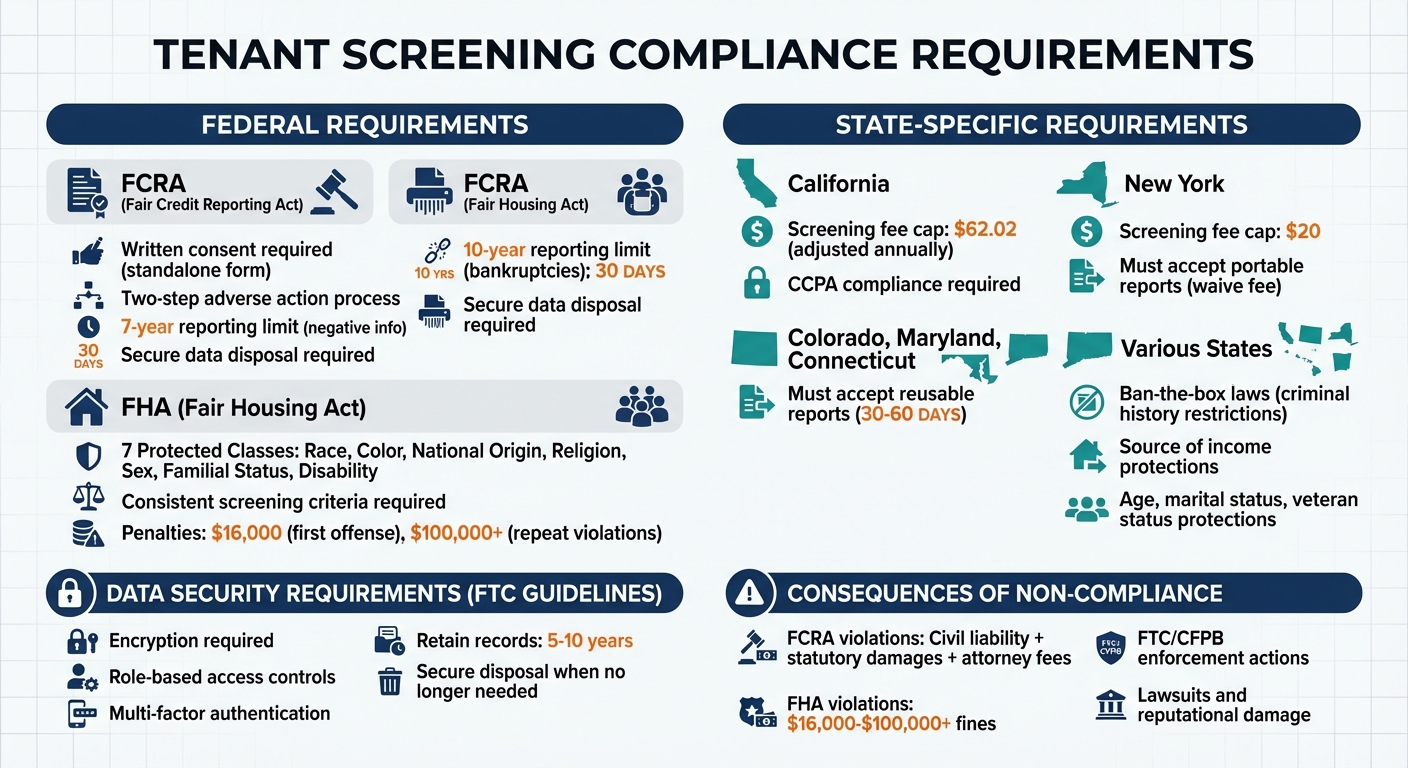
The Fair Credit Reporting Act (FCRA) outlines how landlords must handle consumer reports, such as credit checks, criminal records, and eviction histories. To comply, landlords must obtain written consent on a standalone form before conducting any background checks. If a report influences your decision, you are required to follow a two-step adverse action process.
The Fair Housing Act (FHA) prohibits discrimination based on seven protected classes: race, color, national origin, religion, sex (including gender identity and sexual orientation), familial status, and disability. Many states expand these protections to include factors like source of income (e.g., Section 8 vouchers), marital status, age, veteran status, and student status. Tenant screening remains a common area for housing discrimination complaints.
"The cornerstone of Fair Housing compliance is consistency. You must apply identical criteria, ask the same questions, and follow the same process for every applicant who walks through your door." – RentLateFee.com
State-Specific Rules: California limits screening fees to roughly $62.02, adjusted annually for inflation. New York caps fees at $20 and requires landlords to waive the fee if applicants provide a portable screening report. States like Colorado, Maryland, and Connecticut mandate acceptance of reusable tenant screening reports within 30–60 days. Additionally, "ban-the-box" laws in some areas regulate when and how landlords can ask about criminal histories.
Under the FCRA, reporting timelines are crucial. Negative information older than seven years (10 years for bankruptcies) is generally excluded, while criminal convictions have no federal time limit. Disputes over inaccuracies must be resolved within 30 days.
What Happens When You Don’t Comply
Failure to comply with these regulations can lead to severe penalties. FCRA violations may result in civil liability, including actual damages, statutory damages, and attorney’s fees. Violating the Fair Housing Act carries fines starting at $16,000 for first offenses, with repeat violations exceeding $100,000.
"Non-compliant tenant screening is a ticking time bomb. Over the past ten years, the number of FCRA claims has risen, and settlement payments can easily amount to tens of thousands of dollars." – Taylor Wilson, Rent With Clara
Landlords may face enforcement actions from the Federal Trade Commission (FTC) and the Consumer Financial Protection Bureau (CFPB). Even if you use AI-driven or automated screening tools, you remain accountable for any discriminatory outcomes. Blanket policies, such as rejecting all applicants with criminal records, are increasingly seen as discriminatory and may conflict with HUD guidelines.
The FTC’s Safeguards Rule also requires landlords to securely dispose of sensitive data when it is no longer needed. Failure to properly dispose of consumer reports can result in additional penalties. To protect against potential claims, landlords should retain records of adverse action notices for at least five years.
These legal requirements shape every aspect of tenant data handling. The next section will explore how to collect and validate tenant data while staying within these legal boundaries.
How to Collect and Validate Tenant Data
Getting Consent and Setting Up Secure Forms
Before landlords can access consumer reports like credit checks, criminal records, or eviction histories, they must obtain clear, written consent from each applicant. Federal law, under the FCRA, requires this consent to be presented on a separate, standalone form – not buried within a general rental application. The form must explicitly state that a consumer report will be used for screening purposes.
To meet the legal requirement for "clear and conspicuous" consent, use a dedicated form specifically for background checks. Once collected, store sensitive applicant data securely on encrypted servers with multi-factor authentication to prevent unauthorized access. The National Association of Realtors advises retaining these records for at least 10 years to safeguard against potential disputes down the line. With consent secured and secure forms in place, the next step is to verify the applicant’s identity and background.
Confirming Identity and Background Information
Start by requesting a government-issued photo ID, such as a driver’s license or passport, and verify its authenticity either in person or through a video call to minimize the risk of identity fraud. Conduct a Social Security Number (SSN) trace to confirm that the applicant’s identity aligns with their credit reports, employment records, and address histories. Be on the lookout for red flags, such as SSN issuance dates that don’t match the applicant’s age or inconsistent address details.
For background checks, use only FCRA-compliant Consumer Reporting Agencies to review criminal records, eviction filings, and credit scores. Modern tools now allow for faster processing, with most applications being screened within 48 hours. It’s important to note that applicants cannot be automatically denied based on criminal records. Instead, follow HUD guidelines by evaluating the nature, severity, and timing of any offenses. Once identity and background checks are complete, move on to verifying income and employment.
Checking Income and Employment
A common standard for tenant screening is the 3x income-to-rent rule, which ensures the applicant’s gross monthly income is at least three times the rent. To verify income, request 2–4 recent pay stubs, W‑2 forms, or tax returns. When confirming employment, it’s a good idea to contact employers directly through verified business directories or platforms like LinkedIn rather than relying solely on applicant-provided contact details.
Automated income verification tools, which use banking APIs, are becoming more popular as they provide real-time insights into income levels and spending habits, reducing the need for manual document reviews. Additionally, reach out to at least the two most recent landlords for references. Current landlords may sometimes give overly favorable reviews to encourage a tenant’s departure. Keep in mind that the average eviction costs between $3,500 and $10,000 when factoring in lost rent, legal fees, and turnover expenses. After verifying income and employment, it’s essential to implement fraud detection measures to ensure accuracy.
Detecting Fraud and Identifying Anomalies
Tenant identity fraud has become a growing concern, with a 40% increase reported between 2023 and 2024. In Florida alone, 6.5% of multifamily applications were found to be fraudulent. Compounding the issue, the ability of property managers to manually identify altered documents has dropped from 90% to 75%. This underscores the importance of using automated fraud detection tools to catch inconsistencies.
Watch for visual signs of document tampering, such as mismatched fonts, blurry images, altered edges, or missing holographic features. Cross-reference application details with background reports, credit histories, and independent verifications from employers or landlords to identify discrepancies. Utility bills can also be useful in confirming the applicant’s reported address. To ensure compliance with the Fair Housing Act, apply the same fraud detection standards uniformly across all applicants.
Using BatchData for Tenant Data Validation

Data Validation Features
BatchData simplifies tenant data validation with tools like address verification, which checks tenant-provided addresses against USPS databases, property records, and geocoding services. This process identifies issues such as invalid ZIP codes or addresses linked to historical vacancies. With an impressive 98% accuracy rate, these checks help uncover fraudulent activities like identity theft or false residencies, all while adhering to FCRA requirements for consumer reports.
The platform also includes phone number verification, which confirms the status of phone lines and carrier information using real-time APIs. Its skip tracing feature compiles detailed contact profiles from over 50 data sources, making it easier to locate hard-to-find individuals through public records and proprietary data. Additionally, contact enrichment enhances tenant profiles by appending verified emails, phone numbers, and even relatives, ensuring reliable information throughout the screening process.
For example, a mid-sized U.S. property firm managing 5,000 units used BatchData to fill in missing information for 80% of incomplete tenant applications. This resulted in a 60% reduction in manual verification time and identified 15% of synthetic identities, significantly cutting fraud losses. These features integrate smoothly into existing screening workflows.
Connecting with Your Current Systems
Integrating BatchData into your current systems is straightforward. Start by generating an API key through the BatchData dashboard, then use real-time API calls for validation. The platform works seamlessly with property management systems like AppFolio, Yardi, and Rent Manager, using webhooks and bulk CSV uploads. Developers can also leverage SDKs for Python and Node.js. The setup process takes less than an hour, automating screening tasks and ensuring FCRA audit compliance with logged consents.
For larger operations, BatchData supports bulk data delivery, processing up to 100,000 records daily through secure SFTP with encrypted files. This method speeds up screening by 40% for high-volume portfolios, while encryption and access logs ensure compliance with FCRA standards for data security and proper disposal after tenancy. Beyond its standard integration options, BatchData customizes solutions to align with your compliance needs.
Custom Compliance Solutions
BatchData also provides tailored compliance services, including custom API workflows, TDPA/FCRA-aligned data mapping, and compliance audits. For example, a California-based property firm worked with BatchData to integrate CCPA-compliant data deletion workflows into their Yardi system. This automated the removal of tenant data after lease termination, reduced non-compliance risks by 75%, and generated audit-ready logs. Custom dashboards also tracked FCRA consents and verification success rates.
During onboarding, users must certify that they are using the platform solely for permissible purposes, such as tenant screening. BatchData also provides FCRA notices, logs all queries for audits, and automates adverse action letters with dispute instructions. These features help maintain a 99% client compliance rate across multi-state operations. By tailoring its solutions, BatchData ensures that tenant data validation stays aligned with regulatory requirements at all times.
Staying Compliant and Protecting Data
Setting Up Secure Storage and Access Controls
To meet FCRA and FTC requirements, safeguarding tenant data is non-negotiable. Use both technical and physical security measures to protect sensitive information. Encrypt data during storage and transit, and implement tools like role-based access controls, multi-factor authentication (MFA), and strong passwords. These measures ensure employees only access what they truly need. For instance, a leasing agent might require basic tenant details but not financial records, while maintenance staff should never have access to credit reports.
For physical records, store them securely and shred them when no longer needed. When working with third-party vendors – whether for IT, maintenance, or software services – verify that their security practices align with compliance standards. As Arjav Jain, CEO of Rentrovio, aptly states:
"The cost of prevention is a fraction of the cost of a breach."
Be proactive about security by revoking access for departing employees immediately. Regular security training is also crucial, equipping staff to recognize phishing attempts and properly handle sensitive data.
Keeping Audit Logs and Documentation
Once tenant data is secure, maintaining thorough audit logs is key for compliance. A robust property management system should automatically track every action taken on an application – who accessed it, when it was viewed, and any changes made. For example, Univesco, Inc., which manages 17 properties in Florida and Texas, uses a fully electronic filing system. Dorothy Smith, VP of Operational Support, leads biannual audits to ensure documents are consistently named and uploaded.
Audit logs should typically be retained for 2–5 years, depending on local laws. For example, the Fair Housing Act allows complaints to be filed within one year of alleged discrimination, while lawsuits can be initiated within two years. Some service providers may also require written authorizations to be kept for at least five years. Compliance dashboards can be a helpful tool, providing real-time monitoring of data across properties and flagging potential issues before they escalate.
Updating and Reviewing Your Database
Securing data is only part of the equation – regular database reviews are equally important. Silent failures, like delayed file submissions or changes in data schemas, can disrupt operations and compliance. To avoid this, set up alerts for expected file submissions and automate checks for missing or inconsistent data. For example, ensure critical fields like PropertyID or LeaseDate are filled, and validate logical details, such as lease end dates following start dates and occupancy percentages staying within 0–100%.
Noah Goldman, COO at Snappt, highlights the ongoing nature of compliance:
"Compliance starts with understanding tenant screening regulations. And it doesn’t end – you’ll always need to adapt your policies to meet new ordinances."
Periodic audits help ensure that data retention policies align with current regulations. The National Association of Realtors suggests retaining tenant records for at least 10 years to safeguard against disputes. However, typical retention periods range from 2 to 7 years, depending on jurisdiction. When records exceed their required retention period, shred physical copies and securely delete digital files to minimize identity theft risks and maintain compliance.
Conclusion
Validating tenant data isn’t just a best practice – it’s a safeguard against potential financial and legal pitfalls. Federal laws like the Fair Credit Reporting Act (FCRA) and the Fair Housing Act, along with local regulations such as New York City’s Tenant Data Privacy Act (TDPA), create a complex web of compliance requirements. Failure to adhere to these laws can lead to hefty fines, discrimination lawsuits, and operational penalties.
Effective tenant screening starts with obtaining clear consent, securely collecting data, and thoroughly verifying identity, income, and background details. Adding fraud detection and anomaly tracking further strengthens your process. Once collected, tenant data must be encrypted, access should be restricted based on roles, and audit logs should be maintained to meet regulatory standards and prevent breaches.
Advanced tools can simplify these intricate requirements. For instance, BatchData – Ivo Draginov (https://batchdata.io) offers solutions like property and contact data enrichment, skip tracing, phone verification, and developer-friendly APIs that integrate with your systems. These tools not only ensure compliance but also enhance efficiency. Users have reported processing times cut by up to 50% and significant reductions in fraud.
Remaining compliant is not a one-time effort – it demands constant vigilance and updates. With evolving regulations like the California Consumer Privacy Act (CCPA) and new biometric data requirements, regular database reviews, staff training on consent procedures, and vendor audits are crucial. Implement alerts for missing information and maintain retention policies that align with current laws. By staying proactive and refining your processes, you can build a secure and efficient tenant screening system that meets both current and future compliance demands.
FAQs
What’s the safest way to handle adverse action notices under the FCRA?
To ensure compliance and transparency, it’s best to issue clear notices that detail the specific reasons for a denial, inform tenants of their rights, and adhere to the FCRA’s two-step process: pre-adverse action notices followed by final adverse action notices. Make sure there’s at least a five-business-day waiting period between these two notices to remain within the guidelines.
How can I set screening criteria that avoid Fair Housing violations?
To steer clear of Fair Housing violations, it’s crucial to keep your screening criteria consistent, impartial, and free from discrimination. Stick to objective measures like credit scores, income levels, rental history, and background checks – all tied to legitimate business requirements. Ensure these standards are applied equally to every applicant. Avoid implementing policies that might unintentionally disadvantage protected classes, and take time to review your policies regularly to ensure they align with Fair Housing laws. Ultimately, housing providers bear the responsibility for making fair and lawful decisions.
What tenant records should I keep, and how long should I retain them?
To stay compliant with legal standards and safeguard against disputes, it’s important to hold onto tenant records such as application forms, credit reports, rental payment history, and communication logs. These should be kept for the entire duration of the tenancy and for an additional 1 to 3 years afterward. This practice not only aligns with recordkeeping requirements but also provides a safety net in case any issues arise.