

































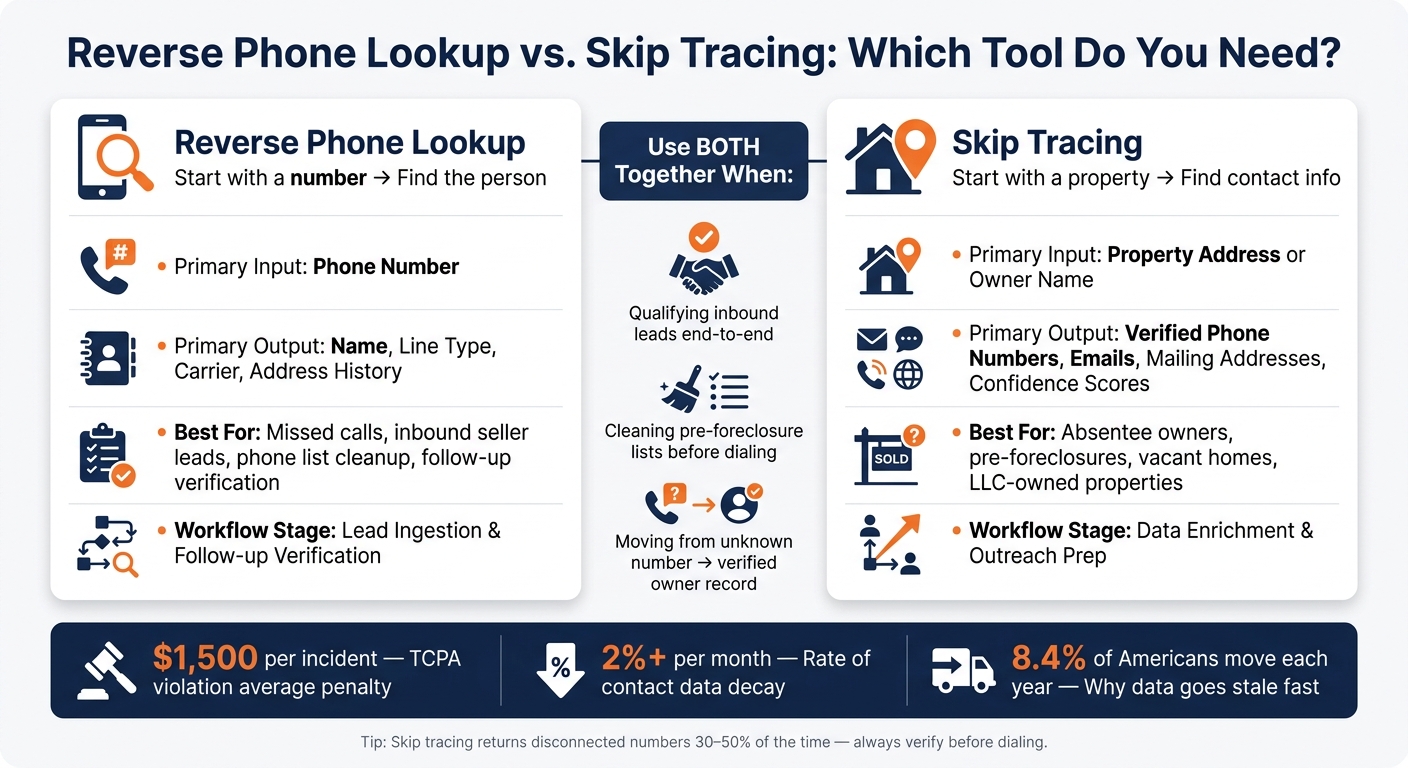
If you have a phone number, use reverse phone lookup. If you have a property or owner record, use skip tracing. That’s the whole decision in one line.
I’d break it down like this:
- Reverse phone lookup = start with a number and check who it belongs to
- Skip tracing = start with a property, address, or owner name and find contact info
- Use both together when you want cleaner lead records before calls, texts, or mail
- Compliance matters because TCPA penalties can reach $1,500 per incident
- Data goes stale fast: contact data can decay by 2%+ per month, and 8.4% of people move each year
If I’m working inbound calls, missed calls, or old phone lists, I’d use reverse phone lookup first. If I’m working absentee owners, pre-foreclosures, vacant homes, or LLC-owned property, I’d start with skip tracing.
Reverse Phone Lookup vs. Skip Tracing: Which Tool Do Real Estate Investors Need?
You’re Wasting Money on Skip Tracing. There’s a Better Way!
sbb-itb-8058745
Quick Comparison
| Method | Start With | Main Goal | Common Output | Best Use |
|---|---|---|---|---|
| Reverse Phone Lookup | Phone number | Identify the person tied to the number | Name, address history, line type, carrier, phone status | Missed calls, inbound seller leads, phone list cleanup |
| Skip Tracing | Property address or owner name | Find current contact info | Phone numbers, emails, mailing addresses, match/confidence data | Off-market owner outreach, list building, pre-foreclosure contact |
In short, reverse phone lookup helps me verify a number, while skip tracing helps me find one. That’s the split this article covers, along with where each method fits in a real estate lead pipeline.
Reverse Phone Lookup: Start With a Number, Identify the Owner
Reverse phone lookup starts with a phone number and works backward to find the person tied to it. It pulls identity data from public and commercial records and turns that into a usable profile. In an acquisition pipeline, this is the verification step that happens before contact.
What matters next is simple: what can that number actually give you back?
Inputs, Outputs, and What Data You Can Realistically Expect
The input is straightforward. You enter one phone number, or upload a batch of numbers with a CSV for bulk processing.
The output depends on the line itself and the data tied to it. But a solid lookup will often return the owner or subscriber name, current and past mailing addresses, line type (mobile, landline, or VoIP), carrier, and phone status (active, inactive, or disconnected).
Line type matters more than most people think. Postpaid mobile and landline numbers usually return deeper and more dependable identity data. Prepaid SIMs, nonfixed VoIP lines, and app-based numbers often come back thin – or with nothing at all. So treat every result like a lead, not hard proof, until you check it against county records.
| Output Field | What It Tells You | Reliability Note |
|---|---|---|
| Owner or subscriber name | Who the number is registered to | Strong for postpaid mobile/landline; weak for VoIP/prepaid |
| Current address | Where to send mail or verify ownership | Cross-check against property records |
| Address history | Past locations tied to the identity | Useful for absentee owner research |
| Line type | Mobile, landline, or VoIP | Key for contact strategy |
| Carrier | Which network or provider the number uses | Helps validate the record |
| Phone status | Active, inactive, or disconnected | Filters dead numbers before outreach |
| Email address | Secondary contact channel | Available in some cases, not guaranteed |
That data only helps if it changes what you do next – call, text, or verify the owner first.
When Reverse Phone Lookup Is the Right Tool
The clearest use case is this: you already have the number, and now you need the person behind it.
Say an investor is running a direct-mail campaign to out-of-state owners and uses a dedicated tracking number. A missed call comes in from an unknown number, and there’s no voicemail. A reverse lookup returns "Maria Lopez" with a mailing address in Phoenix, AZ. It also shows the line as mobile and active. County records then confirm she owns a single-family rental in Dallas, TX – one of the properties on the original mailing list. In one step, that unknown number turns into a workable lead profile, while dead or mismatched records get screened out before outreach.
Reverse phone lookup also works well as a list-cleanup tool. If you’re about to run a follow-up campaign on hundreds of old phone records, a batch lookup can show which numbers are still active, which have been disconnected, and which now point to a different owner profile. That kind of filtering saves time before records ever hit a dialer and cuts down on wrong-party contact.
If a number comes back tied to someone whose name doesn’t match the property owner of record, verify it before you treat that person as the owner.
When you don’t have the number yet, skip tracing handles the opposite task: it starts with the property or owner record and finds the contact data.
Skip Tracing: Start With a Property or Owner Record, Find Current Contact Data
Skip tracing starts with a property or owner record. You begin with a property record or an owner name, then use that to find current contact data. It’s the find step when you know the property but don’t have a direct way to reach the owner.
Unlike reverse phone lookup, skip tracing works the other way around. It builds contact data from the property record itself.
Inputs, Outputs, and Why List Quality Matters
Typical inputs include the owner’s name, the subject property address, the tax assessor mailing address, and the APN. That’s why list quality matters so much right from the start.
Typical outputs include:
- Multiple phone numbers
- Email addresses with deliverability status
- Updated mailing addresses
Clean, standardized inputs help fuzzy matching do its job. That means fixing typos, normalizing abbreviations, and keeping names and addresses in a consistent format. If your source data is messy, the match quality usually drops with it.
Bad data burns time and money. It wastes outreach effort, payroll, and deal flow. And the problem gets worse faster than many people expect: contact data decays at over 2% per month, and about 8.4% of the U.S. population moves each year. So a list that looked solid six months ago can already have a decent chunk of stale records.
When Skip Tracing Is the Right Tool
Skip tracing makes sense when you’re starting with a property or owner record and need to build a contact profile from scratch. In real estate, that often means absentee owners, vacant properties, pre-foreclosure lists, inherited properties, and LLC-held properties.
For absentee owners, the tax assessor mailing address is often a strong place to start because that’s where the county sends the tax bill. In many cases, that’s the owner’s main home, not the rental or investment property. From there, skip tracing can surface verified phone numbers, email addresses, and updated mailing addresses, even when public records are incomplete or old.
The same idea applies to pre-foreclosure outreach. If you can get current contact data before a property hits the open market, you have a shot at making contact early and reaching the owner before everyone else piles in.
The best use case depends on the record you already have.
| Scenario | Why Skip Tracing Fits |
|---|---|
| Absentee owners | Identifies the owner’s current primary residence via mailing address history |
| Vacant properties | Finds the right party behind a property that has no active utility records or current residents |
| Pre-foreclosure lists | Enables proactive communication before the property hits the open market |
| LLC-held properties | Skip tracing also helps map LLC-owned properties back to a contactable owner |
Reverse Phone Lookup vs. Skip Tracing: Inputs, Outputs, and Workflow Role
Use reverse phone lookup when you already have a phone number. Use skip tracing when you have a property record or owner record and need contact details. That difference matters because investors usually don’t need both at the same moment.
The Clearest Way to Tell Them Apart
Reverse phone lookup tells you who a number belongs to. Skip tracing helps you find a path to the owner. That split shows up in the output, too. Reverse phone lookup returns a name, line type, carrier, and address history. Skip tracing returns verified phone numbers, email addresses with deliverability status, mailing addresses, and confidence scores.
Line type matters because it affects how you contact the number and how much risk you’re taking on. TCPA violations can average $1,500 per incident.
Here’s the cleanest side-by-side view.
| Method | Primary Input | Primary Output | Typical Real Estate Use Case |
|---|---|---|---|
| Reverse Phone Lookup | Phone Number | Name, Line Type, Carrier, Address History | Verifying inbound leads or missed calls |
| Skip Tracing | Property Address or Owner Name | Verified Phone Numbers, Email Addresses, Mailing Addresses, Confidence Scores | Finding owners of off-market properties |
Where Each Method Fits in an Acquisition Pipeline
The main edge comes from using each method at the right point in the pipeline.
| Workflow Stage | Reverse Phone Lookup | Skip Tracing |
|---|---|---|
| Lead Ingestion | X | |
| Data Enrichment | X | |
| Outreach Prep | X | |
| Follow-up Verification | X |
In practice, investors often use both methods in the same acquisition flow, just not at the same step. An inbound seller call can trigger a reverse lookup to confirm that the caller’s name matches the property owner on record and to flag the line as mobile. Later, a pre-foreclosure list with no contact data can go through skip tracing to build current contact data in batch.
Each method fits the job it was made to do.
Why Investors Use Both Together and How BatchData Supports the Workflow
Once you know which method fits the data already in front of you, the next step is simple: use both to qualify and enrich the lead. When they work together, reverse phone lookup and skip tracing can move a lead from an unknown number to a verified owner record. On their own, each one only solves part of the issue. That’s how leads slip through the cracks.
A Combined Workflow for Better Lead Qualification and Outreach
Here’s what that looks like in practice.
In the first case, an unknown number calls your acquisition line. A reverse lookup gives you a name and line type right away. That name matches the owner of record on a distressed property two counties over. Now you’re not just staring at a mystery caller – you’ve got a qualified inbound lead. From there, you can run a skip trace on that owner and pull more contact points before calling back. One unknown caller turns into a record your team can actually work.
The second case flips the process. Say you’re working a pre-foreclosure list of 500 properties with no contact data. Skip tracing fills many of those records with phone numbers and emails. After that, phone verification strips out disconnected numbers, landlines, and VoIP records before anyone starts dialing. That matters because VoIP lines require extra compliance review. And there’s another reason to clean the list first: skip tracing often returns disconnected numbers 30% to 50% of the time. Filtering those out before outreach keeps bad data out of the dialer.
How BatchData Fits Into Skip Tracing, Enrichment, and Phone Verification
BatchData ties both workflows together by linking skip tracing, phone verification, and data enrichment in one pipeline.
Here’s the practical part:
- Phone verification checks line type and carrier status in real time.
- Email verification runs live SMTP checks.
- Confidence scores help teams sort outreach by priority.
That scoring helps teams work smarter. High-confidence mobile numbers can go straight to senior reps for direct dials. Mid-confidence records can move into automated drip campaigns. Instead of jumping from tool to tool, investors can verify, enrich, and filter leads in one place. The flow stays clean: identify, verify, then contact.
Conclusion: Choose the Method Based on the Data You Already Have
Start with a number, and use reverse phone lookup. Start with a property or owner record, and use skip tracing. Reverse lookup checks unknown numbers. Skip tracing fills in missing contact data. Used together, they make outreach cleaner and safer.
FAQs
What is a reverse skip trace?
A reverse skip trace starts with a phone number and uses it to identify, verify, and build a profile around an unknown person.
It goes beyond a basic reverse phone lookup. Instead of just showing who a number might belong to, it checks whether the number is valid, looks for risk signals, and confirms identity across sources like public records and credit headers.
For real estate investors, that matters a lot. A reverse skip trace can turn a raw phone number into a workflow-ready lead before anyone reaches out.
Can reverse phone lookup confirm property ownership?
No. A reverse phone lookup can link a phone number to a person or business, but it can’t confirm who owns a given property.
In real estate, ownership checks depend on matching the legal owner – whether that’s a person, LLC, or trust – to a specific address through public records, tax records, or deed data. By itself, reverse lookup data can be out of date. It may also point to a resident, relative, or business instead of the current owner.
How often should investors refresh skip-traced data?
Refresh skip-traced data at least quarterly to keep contact lists accurate and cut wasted outreach. For high-velocity sales and marketing teams, monthly is the gold standard.
Here’s why that matters: contact data decays by more than 2% each month as people move, ownership shifts, and contact details change. And if a contact attempt fails, refresh the data right away to confirm it’s still current.