





































For decades, inconsistent data systems in the real estate industry created inefficiencies. The outdated RETS protocol, introduced in 1999, struggled to keep up with modern needs. Enter the RESO Web API, a solution built on open standards like REST, JSON, and OData. This API standardizes data fields, eliminates manual mapping, and enables real-time data access.
Key Points:
- Why it matters: RESO Web API replaces RETS, offering faster, more secure, and standardized data sharing.
- Technologies used: RESTful architecture, OData V4, JSON, and OAuth 2 for security.
- Adoption: Over 500 MLSs now use the RESO API, benefiting nearly 2 million professionals.
- Advantages:
- Real-time data queries without replication.
- Standardized field names via the RESO Data Dictionary.
- Simplified integrations for developers.
The transition from RETS to the RESO Web API is now industry-standard, mandated by the National Association of REALTORS®. It enables faster updates, reduced costs, and better compatibility across platforms.
“Understanding the RESO Web API Workshop” – 2019 RESO Fall Conference
1. RESO Web API
The RESO Web API addresses previous inefficiencies by introducing a modern, streamlined approach to data interaction using updated protocols.
Protocol Type
The RESO Web API is built on RESTful architecture, HTTP, and OData V4, leveraging widely recognized open standards instead of proprietary systems. For data representation, it uses JSON, a lightweight format that simplifies handling and processing. To ensure data security, it employs OAuth 2 with Bearer tokens or Client Credentials, alongside TLS 1.2+ for secure data transfers.
These core features form the foundation for the API’s advanced query capabilities.
Query Capabilities
The Web API supports real-time queries, eliminating the need to wait for scheduled updates. This is made possible by OData system query options, which give developers precise control over the data they retrieve and how it is organized.
Key query options include:
$filter: Enables complex logical comparisons.$select: Allows retrieval of specific fields, reducing payload size and boosting performance.$expand: Includes related resources within a single query.$orderby: Sorts results in the desired order.
The API also supports single-record queries, allowing direct access to individual records by their unique key, such as Property('ID'), without the need to search through an entire dataset.
In addition to data retrieval, the API features an Add/Edit specification, which standardizes how data is entered and updated across systems. This helps minimize errors and ensures consistent handling of tasks like updating listing prices or adding new property records.
Scalability
The API is designed to handle both small-scale queries and large-scale data replication efficiently. Real-time updates are managed through the EntityEvent Resource and Webhooks Push specification, which notify systems immediately when data changes, removing the need for constant polling.
For further ease of use, server metadata is available at a standardized endpoint (/$metadata) in XML format. This metadata provides client applications with a programmatic understanding of the schema, field types, and relationships, serving as a built-in guide to the available data and its organization.
Adoption and Compliance
The RESO Web API has gained widespread adoption, with certification confirming its acceptance across the real estate industry. REALTOR®-operated MLSs are required by the National Association of REALTORS® to offer production-level data access via the RESO Web API.
The transition from RETS to the RESO Web API typically takes MLSs about six to nine months to complete. Since 2020, the implementation of RESO standards has expanded globally, reaching MLSs and technology companies in regions such as Europe, the Middle East, Australia, and the Americas. As RESO staff put it:
“The Web API is real estate’s path to efficiency and streamlined technology experiences through modern standards”.
2. RETS Protocol
The RETS protocol, introduced in 1999 by the National Association of Realtors, was a game-changer for the real estate industry. It provided a standardized way for MLSs, brokers, and technology vendors to exchange data using an XML-based framework.
Protocol Type
RETS was built as a proprietary, XML-based protocol specifically tailored for the real estate sector. While this design addressed the industry’s unique needs, it also made the protocol less adaptable for use outside of real estate. As a result, its adoption remained largely confined to North America.
Query Capabilities
RETS offered specific query functionalities that allowed users to perform targeted searches. For example, users could query for “new listings since yesterday” or conduct advanced searches using filters like location, square footage, or amenities. However, the protocol required a full replication of MLS databases on local servers to function effectively. This reliance on local copies often made the system less efficient.
Scalability
Although RETS used pull technology to synchronize only data changes, maintaining local database replicas came with significant challenges. Storage costs were high, and performance issues became more pronounced as data volumes grew. In some cases, updating an MLS feed took over 25 hours due to the need for custom field remapping and format translation.
Adoption and Compliance
Despite its limitations, RETS remained the dominant protocol for real estate data exchange for nearly 20 years. In 2018, the Real Estate Standards Organization (RESO) announced the protocol’s retirement and ceased issuing new certifications. Support for legacy RETS integrations officially ended on December 31, 2024. As RESO staff explained:
“RETS is an older standard that is proprietary to the real estate industry. It has been deprecated and is no longer supported by RESO because the industry needs to move to a more well-known technology standard”.
sbb-itb-8058745
Comparison: Advantages and Disadvantages
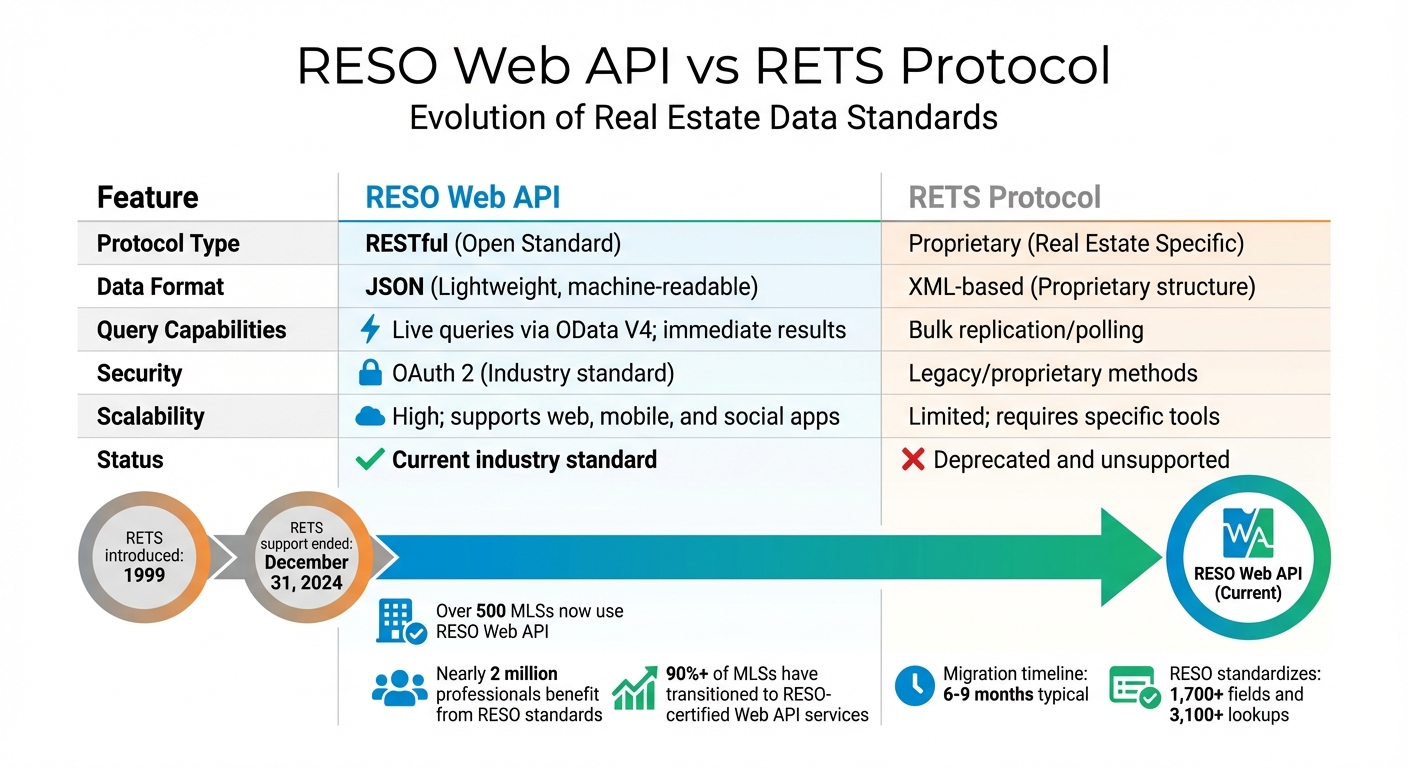
RESO Web API vs RETS Protocol Comparison Chart
RESO Web API and RETS Protocol stand apart in their design and functionality. Here’s why the industry has overwhelmingly shifted to the newer standard.
The RESO Web API excels by leveraging modern, open technology standards. Its foundation on a RESTful architecture, combined with OData V4 and JSON formatting, allows it to integrate smoothly with widely used development tools and frameworks. Developers can use ready-made clients in various programming languages, unlike RETS, which relies on proprietary XML integrations.
Another key difference lies in how they handle queries. The RESO Web API supports live queries, delivering real-time results directly from the MLS database. This eliminates the need for local data replication, cutting down on hosting costs and simplifying infrastructure compared to RETS.
| Feature | RESO Web API | RETS Protocol |
|---|---|---|
| Protocol Type | RESTful (Open Standard) | Proprietary (Real Estate Specific) |
| Data Format | JSON (Lightweight, machine-readable) | XML-based (Proprietary structure) |
| Query Capabilities | Live queries via OData V4; immediate results | Bulk replication/polling |
| Security | OAuth (Industry standard) | Legacy/proprietary methods |
| Scalability | High; supports web, mobile, and social apps | Limited; requires specific tools |
| Status | Current industry standard | Deprecated and unsupported |
These differences in protocol, data format, query capabilities, security, and scalability highlight why the RESO Web API has become the go-to solution.
The shift to this modern standard has been swift. The National Association of REALTORS® now mandates that REALTOR®-operated MLSs offer production-level access through the RESO Web API. At the same time, RETS has been officially phased out, with RESO ending all support and certifications for it. Most organizations complete the migration from RETS to the RESO Web API in just six to nine months, demonstrating how manageable the transition can be with proper planning.
How BatchData Works with RESO Web API

BatchData takes the robust framework of the RESO Web API and transforms it into practical, efficient tools for the real estate industry.
By aligning with RESO standards, BatchData ensures seamless integration of standardized data into real estate applications. The platform handles an impressive 155 million property records with 800+ data points. These records are delivered through low-latency endpoints, enabling swift and direct connections to applications. This approach supports the industry’s push for faster and more reliable data management.
One of BatchData’s standout features is its ability to eliminate manual data mapping. It automatically translates field names (like converting “Ask Price” to “List Price”), making it easier for MLS data, when provided in RESO formats, to be instantly enhanced. BatchData’s APIs enrich this data with verified owner contacts, automated valuations, equity estimates, and detailed property information.
Chris Finck, Director of Product Management, highlighted the platform’s efficiency:
“What used to take 30 minutes now takes 30 seconds. BatchData makes our platform superhuman.”
For those transitioning from legacy RETS systems, BatchData offers customized matching and dataset creation services. These solutions integrate seamlessly with modern infrastructures, delivering data through platforms like Snowflake, Amazon S3, or real-time APIs. This flexibility allows for both immediate property searches and large-scale market analysis, adapting to a variety of operational needs.
Conclusion
The transition from outdated RETS protocols to the RESO Web API has reshaped how real estate data is handled. the RESO Web API ensures consistency for terms like “List Price”, eliminating the need for tedious manual mapping.
This shift brings clear advantages: quicker development timelines, reduced costs, and easier system interoperability. As Michael Wurzer, CEO of FBS, explained:
“The cost benefits of adopting the RESO API and Data Dictionary become clear by making future implementations far less work”.
With modern technologies like REST, JSON, and OAuth leading the way, RESO adoption guarantees long-term efficiency and reliability.
For real estate professionals, embracing RESO-compliant solutions isn’t just a recommendation – it’s a necessity. Mandated by the National Association of REALTORS®, these solutions offer real-time data, stronger security, and the ability to scale globally. This commitment to modern standards is driving the industry forward.
When selecting partners, look for the “RESO Certified” logo to ensure compliance. Doing so minimizes onboarding time and lowers integration costs. As Sam DeBord, CEO of RESO, emphasized:
“The universal language of standards makes interoperability more accessible”.
Adopting RESO Web API compliance isn’t optional – it’s the key to staying competitive in a transforming industry.
FAQs
How does the RESO Web API enhance data security compared to RETS?
The RESO Web API takes a big step forward in data security by moving away from the outdated RETS protocol and adopting modern, open-technology standards. It relies on encrypted transport through HTTPS and token-based authentication methods like OAuth. This approach ensures access is not only more secure but also easier to revoke compared to the plain-text credentials often associated with RETS.
With features like strong encryption, standardized authentication processes, and detailed permission controls, the RESO Web API aligns with today’s best practices for web security. These updates help protect sensitive property and client data, giving MLSs and applications tighter control while lowering the chances of unauthorized access.
What are the key advantages of using the RESO Web API for real estate professionals?
The RESO Web API provides a streamlined solution for real estate professionals to manage and access property data efficiently. By relying on open and widely recognized standards, it ensures consistent property information, eliminating the complications of dealing with fragmented data sources.
This API’s standardized interface allows for real-time data queries and smooth integration with MLS databases, ensuring listings update instantly across websites and apps. It also adheres to the RESO Data Dictionary, which standardizes field names and values. This not only reduces integration errors but also saves development time.
Additionally, the RESO Web API is designed for cross-platform compatibility, meaning a single integration can support websites, mobile apps, and third-party tools. Its reliability and efficiency make it a valuable resource for improving data management, enhancing accuracy, and simplifying operations in the real estate sector.
How long does it usually take for MLSs to switch from RETS to the RESO Web API?
The timeline for MLSs to shift from RETS to the RESO Web API can differ greatly. Factors such as the complexity of the system, available resources, and specific technical needs all play a role in determining how long the process will take. While there’s no universal timeframe, the transition typically requires close collaboration between MLS providers and their technology partners to ensure everything goes as smoothly as possible.
For MLSs preparing for this change, prioritizing thorough planning, rigorous testing, and clear communication is key. These steps help reduce disruptions and ensure the full potential of the RESO Web API is realized.