

































In real estate, accurate and compliant data is essential for smooth transactions, fair valuations, and avoiding legal risks. Poor data quality can lead to errors in property appraisals, flawed strategies, and potential lawsuits, while non-compliance with regulations like FinCEN or CCPA can result in severe fines or even imprisonment. Here’s what you need to know:
- Compliance Challenges: Federal rules (e.g., FinCEN, FTC Safeguards Rule) and state laws (e.g., CCPA) require strict data handling practices. Non-compliance can cost thousands in daily fines or harsher penalties.
- Data Security: Real estate professionals handle sensitive information like Social Security numbers and financial details. Encryption, employee training, and secure disposal of data are critical.
- Data Quality: Errors in property data can cost businesses millions annually. Processes like data enrichment and automated validation improve accuracy, saving time and reducing risks.
- Unified Strategy: Combining compliance and quality efforts ensures legal adherence while maintaining reliable data for business operations.
The BEST Way to Ensure Data Security in Real Estate Deals
sbb-itb-8058745
Key Compliance Requirements for Real Estate Data
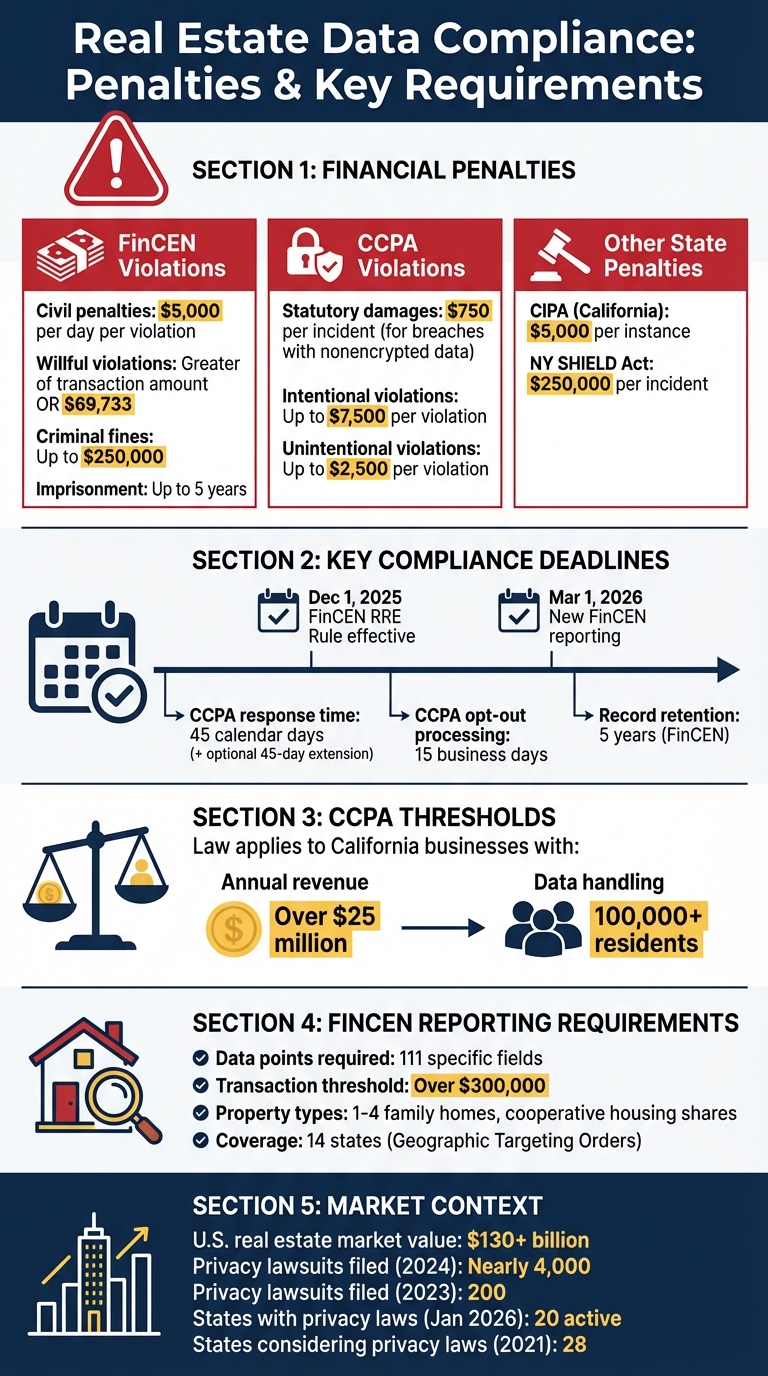
Real Estate Data Compliance Penalties and Requirements Overview
Real estate professionals must navigate a maze of federal and state data regulations. The landscape became more challenging on March 1, 2026, with the introduction of new FinCEN reporting requirements targeting money laundering in non-financed residential real estate transactions involving entities or trusts. Non-compliance can result in civil penalties of $5,000 per day for each violation, while willful violations carry even harsher consequences – penalties equal to the greater of the transaction amount or $69,733, along with potential criminal fines up to $250,000 and imprisonment of up to five years.
Federal Regulations That Affect Real Estate Data
Federal rules set the stage for compliance in the real estate sector:
- FinCEN Real Estate Reporting Rule: This rule mandates reporting for specific non-financed residential real estate transactions, including 1-4 family homes and cooperative housing shares. A written designation agreement – typically assigning a closing agent – must be in place to ensure compliance. Without this, the reporting obligation may fall on multiple parties.
- FTC Safeguards Rule: Real estate and mortgage companies are required to maintain written information security programs to safeguard consumer data.
- DOJ Data Security Program Rule: This regulation imposes strict controls on transferring sensitive data – like geolocation or health information – to "countries of concern." The use of AI tools demands extra scrutiny to prevent unauthorized access to sensitive information.
- Gramm-Leach-Bliley Act (GLBA): This act establishes a federal standard for financial data privacy.
- Protecting Americans’ Data from Foreign Adversaries Act of 2024 (PADFA): This law prohibits the sale of sensitive personal data to specified foreign adversary nations.
- CFPB Regulation X (RESPA): Overseen by the Consumer Financial Protection Bureau, this regulation governs federally related mortgage loans, settlement services, and mortgage servicing.
While federal regulations create a foundation, state-specific laws add further complexity.
State-Level Compliance Rules
State privacy laws introduce additional challenges, particularly in high-regulation states like California:
- California Consumer Privacy Act (CCPA): Under the CCPA, consumers have rights such as the ability to know, delete, correct, and opt out of the sale or sharing of personal information. This law applies to for-profit businesses in California with over $25 million in annual revenue or those handling data for 100,000 or more residents.
Statutory damages for breaches involving nonencrypted personal information can reach $750 per incident. Businesses must respond to requests to know or delete personal data within 45 calendar days, with an optional 45-day extension if the consumer is notified. Opt-out requests must be processed within 15 business days.
Publicly available information, such as real estate and property records (e.g., Assessor’s Parcel Numbers or APNs), is typically excluded from the definition of personal information under the CCPA. However, professionals need to distinguish between general "personal information" (e.g., names, Social Security numbers) and "sensitive personal information" (e.g., precise geolocation, financial account credentials, genetic data), as the latter has stricter usage restrictions.
Operating across multiple states requires adapting strategies to meet these diverse requirements.
How to Handle Compliance Across Multiple States
Managing compliance across state lines demands a well-structured approach. Many organizations now rely on continuous monitoring and conduct quarterly testing of controls. One effective strategy is regulation-to-control mapping, which translates broad legal requirements into specific, actionable internal procedures.
To ensure accountability, assign control owners responsible for implementing and documenting compliance measures. Instead of relying on vague policies like "we protect data", companies should adopt concrete steps such as multifactor authentication and quarterly access reviews to create a clear audit trail. For property identification using Assessor’s Parcel Numbers, cross-reference data with professional-grade platforms to avoid errors. Even a single-digit mistake could invalidate critical legal or financial records.
High-risk controls should be tested quarterly, while mid-risk controls can be reviewed bi-annually. With the U.S. real estate market exceeding $130 billion in value, the financial stakes for compliance failures continue to grow.
A strong compliance framework not only satisfies legal requirements but also enhances the overall quality and reliability of data management.
Data Security and Privacy in Real Estate
Real estate professionals are entrusted with highly sensitive client information, including Social Security numbers and financial details. The stakes for safeguarding this data have grown significantly, with nearly 4,000 online privacy lawsuits filed in 2024, a steep rise from just 200 in 2023. Protecting this information goes beyond meeting legal requirements – it demands robust systems to secure data at every stage. Let’s take a closer look at what qualifies as nonpublic personal information and how to protect it effectively.
What Is Nonpublic Personal Information (NPI) in Real Estate?
Nonpublic Personal Information (NPI) refers to private consumer data used in financial transactions. Under the Gramm-Leach-Bliley Act (GLBA), this includes Social Security numbers, credit scores, bank account details, and loan application data. While NPI is sometimes confused with Personally Identifiable Information (PII), the two differ: NPI specifically addresses financial privacy under federal law, whereas PII is a broader category that includes any data identifying an individual.
Adding to this complexity, the California Consumer Privacy Act (CCPA) introduces Sensitive Personal Information (SPI), which covers data like precise geolocation from mobile apps and financial account login credentials. For real estate, this often involves data from smart home devices, property showing apps, or digital lockboxes. Publicly available records – such as property deeds or mortgages – generally fall outside these definitions. Understanding these distinctions is crucial for compliance, as penalties vary widely. For example, violations of California’s Invasion of Privacy Act (CIPA) can result in fines of $5,000 per instance. With 93% of homebuyers now using the internet to search for homes, the risks tied to digital data continue to grow.
Best Practices for Protecting Data
Securing sensitive data in real estate requires a multi-faceted approach, combining administrative, technical, and physical safeguards. The FTC Safeguards Rule mandates that businesses develop a written information security program, with stricter requirements for services like mortgage brokering.
Here are some key steps:
- Encrypt sensitive data both at rest and during transmission, and limit employee access to only the information they need.
- Recognize state-specific regulations: 25 states now require specific security measures for PII, and 35 mandate proper disposal of personal data.
- Train employees regularly on security protocols. The National Association of REALTORS® emphasizes this responsibility in its code of ethics:
"The REALTOR® Code of Ethics and Standards of Practice explicitly acknowledges a REALTOR®’s obligation to preserve the confidentiality of personal information provided by clients in the course of any agency or non-agency relationship".
- Conduct regular risk assessments to identify vulnerabilities. Under New York’s SHIELD Act, penalties for data breaches can reach $250,000 per incident, no matter where a brokerage is physically located.
- Pay close attention to vendor relationships. Before engaging third-party providers, perform thorough security audits and include data protection clauses in contracts.
- Establish formal disposal procedures to securely delete or destroy PII no longer needed for business or legal purposes.
Building a Data Security Infrastructure
A strong data security framework starts with governance. Assign an Information Security Officer or dedicated IT team to oversee your protection efforts. From there, implement tools like Security Incident Event Management (SIEM) and Endpoint Detection and Response (EDR) to monitor systems for unauthorized access. Automated systems should also provide audit trails for data access and modifications. The FTC Safeguards Rule now requires businesses to report security updates more frequently to their boards and adopt specific authentication measures.
Physical security is equally critical. Use biometric door locks, CCTV surveillance, and secure protocols for handling and destroying physical data. Real estate transactions are increasingly targeted by wire fraud and "title pirates", making comprehensive security measures essential.
Modern infrastructure is leaning toward event-driven architectures, utilizing APIs and webhooks to transfer data securely to CRMs. This model requires robust monitoring to keep data safe during transfers. While the FTC Safeguards Rule exempts businesses managing fewer than 5,000 customer records, most brokerages surpass this limit quickly.
| Safeguard Category | Infrastructure Components |
|---|---|
| Administrative | Risk assessments, employee training, vendor audits, policy documentation |
| Technical | SIEM tools, EDR tools, encryption (at rest and in transit), multi-factor authentication, least privilege access |
| Physical | Biometric locks, CCTV, secure media disposal, facility access logs |
Automation is key for navigating the complex web of state laws. Standardize procedures to automatically purge outdated PII, and ensure your systems can adapt to varying regulations. With 20 states actively enforcing privacy laws as of January 2026, and federal legislation like the American Privacy Rights Act still in limbo, real estate professionals must independently manage this evolving landscape.
How to Maintain Real Estate Data Quality and Accuracy
Poor data quality comes with a hefty price – organizations lose an average of $12.9 million annually, while U.S. businesses collectively face a staggering $3.1 trillion in losses each year. For real estate professionals juggling thousands of property records and client details, accuracy is critical. It impacts everything from closing deals to assessing risks and staying compliant with regulations. Setting clear standards for data quality is the foundation of success, covering six key dimensions: accuracy, completeness, uniqueness, timeliness, validity, and integrity. Without these benchmarks, you’re navigating without a compass. Strong data quality standards not only support compliance but also provide insights that drive better decision-making.
How Data Enrichment Improves Real Estate Data
One effective way to boost data quality is through data enrichment. This process transforms basic property information into detailed profiles filled with actionable insights. By adding missing details – like square footage, room counts, HVAC systems, and building materials – you save hours of manual research. Data enrichment can reduce manual validation efforts by 70% and speed up dataset preparation by 50% compared to non-enriched data. Advanced APIs now provide over 700 data points per property, including mortgage details, equity levels, tax assessments, and risk factors like flood zones or seismic activity.
BatchData’s property and contact enrichment services are a great example of how this works. By cross-referencing records with multiple trusted sources, they detect errors, standardize formats, and keep ownership data, valuations, and contact information up-to-date. For investors, enriched data can unlock targeted searches – like finding properties with 40%+ equity or those owned for over 10 years – leading to better conversion rates. One analysis found that data enrichment services achieve a 90% field completion rate while slashing data processing costs by 40%.
Setting Up Quality Assurance Processes
Quality assurance begins with data profiling, which involves analyzing your database to identify missing values, inconsistencies, and outdated information. Once you know where the gaps are, you can implement automated validation rules to catch errors before they enter your system. For example, range checks ensure property ages fall within logical bounds, while format checks verify that zip codes and email addresses follow proper patterns. These checks should run continuously, not just during occasional audits.
Dealing with duplicate records is just as essential. Duplicate client entries or property listings can create confusion and waste resources during lead management. AI-powered fuzzy matching tools can spot subtle differences – like "123 Main St." versus "123 Main Street" – and merge them into a single, accurate record. Regular physical verification audits are also important for matching digital data to official documents, ensuring everything aligns.
The industry is moving toward data observability, which combines monitoring, testing, and deeper visibility to address quality issues on a larger scale. Modern tools can streamline this process with automation, making it easier to maintain high-quality data.
Using Technology for Data Quality Management
Technology has taken much of the manual labor out of data management. APIs and automated workflows now flag errors during data entry and provide real-time updates, keeping your information accurate and current. This is especially useful for consolidating fragmented data from spreadsheets, physical documents, and cloud platforms into one centralized system.
But there’s a cautionary note: Gartner predicts that by 2027, 60% of organizations will fail to achieve the full potential of their AI projects due to weak data governance frameworks. To avoid this, assign clear ownership for data maintenance and train your entire team on quality standards – this isn’t just an IT responsibility. The rise of Data Quality as a Service (DQaaS) offers a scalable solution, giving businesses access to advanced tools without heavy upfront costs. For instance, BatchData’s APIs integrate property search, phone verification, and address validation directly into your workflows, simplifying the process even further.
Creating a Combined Compliance and Data Strategy
To meet legal standards and ensure data accuracy, real estate firms should integrate compliance directly into their data workflows. Treating these as separate tasks often leads to duplicated efforts, wasted resources, and potential gaps in regulatory adherence. The better approach? Develop a unified strategy that embeds compliance requirements into your data processes while maintaining the precision and completeness essential for operations.
Aligning Compliance and Quality Goals
A unified compliance strategy connects legal obligations with data reliability. Start by defining policies that align federal regulations with data quality benchmarks. For instance, the FinCEN Residential Real Estate Rule (RRE Rule), effective December 1, 2025, mandates the reporting of 111 specific data points for non-financed residential transfers over $300,000. By integrating these regulatory requirements with quality assurance processes, you can ensure each data point is accurate and compliant. Unified KPIs, such as maintaining 99% data accuracy while safeguarding nonpublic personal information (NPI) under the CCPA, help avoid conflicting priorities.
Conduct a gap analysis to identify overlaps or conflicts between reporting requirements and data enrichment processes. For example, the RRE Rule requires retaining beneficial ownership certifications for five years. Build workflows that automate dual checks – verifying property transaction details against enriched datasets while flagging NPI for consumer rights like deletion or opt-out.
Incorporate privacy by design principles into your data collection practices. Collect only the information necessary for business operations, secure it properly, and dispose of it responsibly. For example, when adding mortgage and equity data to property records, gather only what compliance mandates. Firms using this method have reported a 95% drop in reporting errors by cataloging personal information under CCPA standards.
With these integrated policies, your team can confidently maintain both compliance and data quality.
Training Teams on Compliance and Data Management
Training is a cornerstone of consistent compliance and accurate data handling. Violations of the CCPA can result in fines of up to $7,500 per intentional violation and $2,500 per unintentional violation, while FinCEN imposes civil penalties for noncompliance. A well-trained team ensures data accuracy while supporting daily operations.
Create training programs that cover both compliance laws and data management techniques. Key topics include the RRE Rule’s reporting requirements, CCPA consumer rights (e.g., know, delete, opt-out), and the REALTOR® Code of Ethics’ confidentiality standards. Include hands-on workshops where teams practice using data enrichment tools and simulate FinCEN reporting scenarios. Offer role-specific training, such as teaching agents how to handle NPI, IT staff about security protocols like FTC Safeguards Qualified Individual requirements, and operations teams about automated data workflows.
"We want to supplement your work and make you superhuman so you can do things in seconds not hours. That’s where BatchData comes in. What used to take 30 minutes now takes 30 seconds." – Chris Finck, Director of Product Management
Schedule annual training refreshers to align with regulatory updates and track participation. Reinforce learning through certification programs, simulations, and post-training audits while maintaining records for five years.
Once your team is trained, monitor and refine your compliance framework to keep pace with regulatory changes.
Monitoring and Updating Compliance Frameworks
Regulations evolve constantly, and your compliance framework should too. As of 2021, 28 states had enacted or were considering privacy laws, creating a complex web of requirements for real estate firms. New developments include Oregon’s 2024 data broker registration, California’s Delete Act effective in 2026, and FinCEN’s expanding Geographic Targeting Orders (GTOs) across 14 states.
Perform quarterly audits and use automated dashboards to track error rates and audit performance. Subscribe to alerts from FinCEN and CCPA to stay informed about changes. Adjust your compliance framework based on KPIs; for example, if CCPA opt-out requests exceed expectations, review your data deletion policies to ensure compliance.
Conduct annual reviews of your compliance and data strategies, updating them to reflect new regulations and business priorities. After the 2025 FinCEN enforcement, consider biannual audits of beneficial ownership processes and utilize enrichment tools like BatchData’s APIs to maintain quality amid expanding GTOs. Establish breach response protocols, including containment and communication plans, and register as a data broker where required. Modern systems that use an event-driven "push" architecture – where property status changes trigger instant notifications via webhooks – help your team respond to real-time data instead of outdated snapshots.
Conclusion
Navigating the intricate web of regulatory requirements and data quality standards is no small task for real estate professionals. Federal mandates like FinCEN’s Residential Real Estate Rule – set to take effect on December 1, 2025 – combine with state-level laws such as the CCPA, creating a challenging compliance landscape. The consequences are steep: violations can result in hefty penalties, and consumers may pursue legal action for damages caused by breaches.
However, focusing on compliance and data quality doesn’t just help avoid fines – it can also unlock meaningful business benefits. By aligning federal and state regulations with robust quality assurance practices like data enrichment, verification, and automated workflows, firms can build trust with clients, reduce security risks, and make smarter decisions based on accurate data. Adopting strong security measures, as outlined in the FTC Safeguards Rule, and maintaining thorough record retention policies further positions your business as a reliable and compliant leader in the industry.
BatchData provides tools to help meet these goals, offering services such as property and contact data enrichment, skip tracing, APIs for property searches, phone verification, and bulk data delivery. The platform’s real-time updates and verification features ensure data accuracy while supporting compliance efforts. With flexible pay-as-you-go pricing and scalable enterprise plans, BatchData makes it easy to access verified and compliant data when you need it.
As regulations evolve, staying ahead requires more than just reactive measures. Regular audits, subscribing to regulatory updates, and training your team on compliance laws and effective data management strategies are critical steps to maintain a competitive edge.