
Ever wonder how real estate platforms like Zillow or Redfin pull up property details in the blink of an eye? The magic behind that speed and accuracy isn’t magic at all—it’s a real estate data API. For any business in proptech, home services, or real estate investment, this technology is the engine for data-driven decision-making, turning raw information into a powerful competitive advantage.
What Is a Real Estate Data API?
Think of an API (Application Programming Interface) as a direct, secure line between your software and a massive, constantly updated library of property intelligence.
Instead of the old way—sifting through public records, downloading static spreadsheets, or buying outdated data files—your application can send a precise request. It’s like asking the librarian, “Give me the owner’s name, equity, and roof age for 123 Main Street,” and getting a clean, structured answer in milliseconds. This is the core of data enrichment: taking a simple piece of information and adding layers of valuable context.
This technology makes clunky spreadsheets and manual data entry a thing of the past. It replaces them with automated, real-time data flows that can power just about any modern real estate tool you can imagine.
API Access vs Traditional Data Methods
To really grasp the difference, let’s compare how APIs stack up against the old-school methods of gathering property intelligence.
| Feature | Real Estate Data API | Manual Data Collection | Bulk File Downloads |
|---|---|---|---|
| Speed | Instant, real-time access | Slow, labor-intensive | Delayed, periodic updates |
| Accuracy | Data is continuously updated | High risk of human error | Data becomes outdated quickly |
| Scalability | Handles millions of requests easily | Nearly impossible to scale | Difficult to manage and integrate |
| Integration | Designed for direct software integration | Requires manual data entry | Requires complex ETL processes |
| Cost | Pay-as-you-go, cost-effective at scale | High labor costs, inefficient | High upfront costs, often for unused data |
As you can see, APIs offer a fundamentally more efficient and reliable way to work with property information, which is why they’ve become the standard for any serious proptech or data-driven business operation.
The Engine of Modern Proptech
The demand for this kind of instant access is reshaping the industry. The IT market within real estate hit USD 11.63 billion in 2025 and is on track to reach USD 17.68 billion by 2030. Cloud-based solutions, which are the backbone of most APIs, already make up over 56% of this market.
This shift is what allows proptech startups to build powerful investor tools, home services companies to pinpoint ideal customers, and platforms to provide instant automated valuation models (AVMs). It’s no longer just a niche technology; it’s a core business driver.
A real estate data API isn’t just a technical tool; it’s a strategic asset that transforms raw property information into actionable business intelligence, giving companies the ability to move faster and smarter than their competitors.
Who Benefits From This Technology?
The applications go far beyond just buying and selling homes. A real estate data API is a game-changer for any business whose success depends on accurate property and homeowner information. For a deeper dive, check out our ultimate guide to real estate APIs.
Here’s a quick look at who’s using this data to get ahead:
- Home Services (Roofing, Solar, HVAC): These companies can instantly spot homes with older roofs, specific HVAC systems, or perfect sun exposure, letting them create hyper-targeted marketing campaigns that actually convert.
- Lending and Insurance: Lenders use it to automate property valuations and risk assessments. Insurers can accurately price policies based on specific property characteristics and location data.
- Real Estate Investors: Investors can analyze potential deals in seconds by pulling up property history, equity information, and owner details for skip tracing to find motivated sellers.
- Proptech Platforms: Companies can build sophisticated tools for market analysis, automated valuation models (AVMs), and predictive analytics, offering unique value to their users.
Unlocking Key Insights with Property Data
A powerful real estate data API delivers far more than just an address and a sale price. It peels back the layers of a property, revealing a detailed story that businesses can turn into direct action and a serious competitive edge. Each data point is a clue; together, they paint a complete picture of the opportunity.
Think of it like an iceberg. The address you see is just the tip. Below the surface lies a massive foundation of intelligence that determines a property’s true potential. Tapping into that deeper information is what separates a data-driven strategy from simple guesswork.
The Core Layers of Property Intelligence
To really get a feel for a property, you have to look at it from multiple angles. A quality real estate data API organizes this information into distinct, interconnected categories. Each one builds on the last, creating a rich, three-dimensional view.
The main categories break down like this:
- Property Characteristics: This is the foundational stuff—the physical DNA of the property. We’re talking square footage, the number of bedrooms and bathrooms, year built, lot size, and even granular details like roof type or whether it has a pool.
- Financial & Transactional History: This layer tells the property’s financial story. It includes everything from automated valuation models (AVMs) and estimated equity to mortgage details (loan amount, date, lender), sales history, and any active liens or pre-foreclosure flags.
- Ownership Details: Knowing who owns a property is critical. This data gives you current owner names, confirms if they’re an individual or a corporation, and provides their mailing address—a must-have for any direct communication or skip tracing effort.
From Raw Data to Actionable Strategy
These data points aren’t just static facts; they’re triggers for smart business decisions. For example, a solar company can use an API to instantly find single-family homes with a specific roof type and south-facing exposure, building a high-potential lead list in seconds.
In the same way, a real estate investor can zero in on motivated sellers by searching for properties with high equity and long-term ownership, which often signals that an owner might be ready to make a move. This is the essence of data-driven decision-making in real estate.
By weaving together property characteristics, financial data, and ownership information, businesses can move beyond generic marketing and create highly targeted, effective outreach campaigns that resonate with the right audience at the right time.
The sheer scale of this data is massive. Modern real estate APIs now provide access to over 150 million residential and commercial properties. That includes everything from property characteristics and ownership details to contact enrichment, AVMs, equity metrics, mortgage histories, MLS listings, and permit records, all from a single source. You can explore more about these extensive property datasets to see the full scope of what’s available.
The Power of Data Enrichment and Skip Tracing
One of the most valuable things a modern real estate API can do is enrich the information you already have. A simple list of property addresses is just a starting point. Through a process called skip tracing, that list can be appended with verified owner contact information, including phone numbers and email addresses.
This data enrichment turns a basic list of locations into a powerful lead-generation machine. Instead of just knowing where a potential customer lives, you know who they are and how to reach them. For marketing, sales, and investment teams, that’s a game-changer that enables precise and efficient communication. Once you understand these different data layers, you can see how an API becomes less of a simple lookup tool and more of a core engine for business growth.
How Essential API Endpoints Drive Business
To really get what a real estate data API can do, stop thinking of it as a single tool. Instead, picture a digital workshop filled with specialized instruments. Each of these instruments is an endpoint, and each one is built for a specific job. Calling an endpoint is like picking up that tool—you give it a task, and it delivers a precise result, automating work that would otherwise take hours, if not days.
This is where code translates directly into business value. You don’t need to be a developer to understand what these endpoints accomplish. Once you see how they work, you can start imagining new ways to automate your business operations, uncover leads, and just plain operate more efficiently.
This diagram shows how different data points from an API—property, financial, and ownership—are all connected to paint a complete intelligence picture.
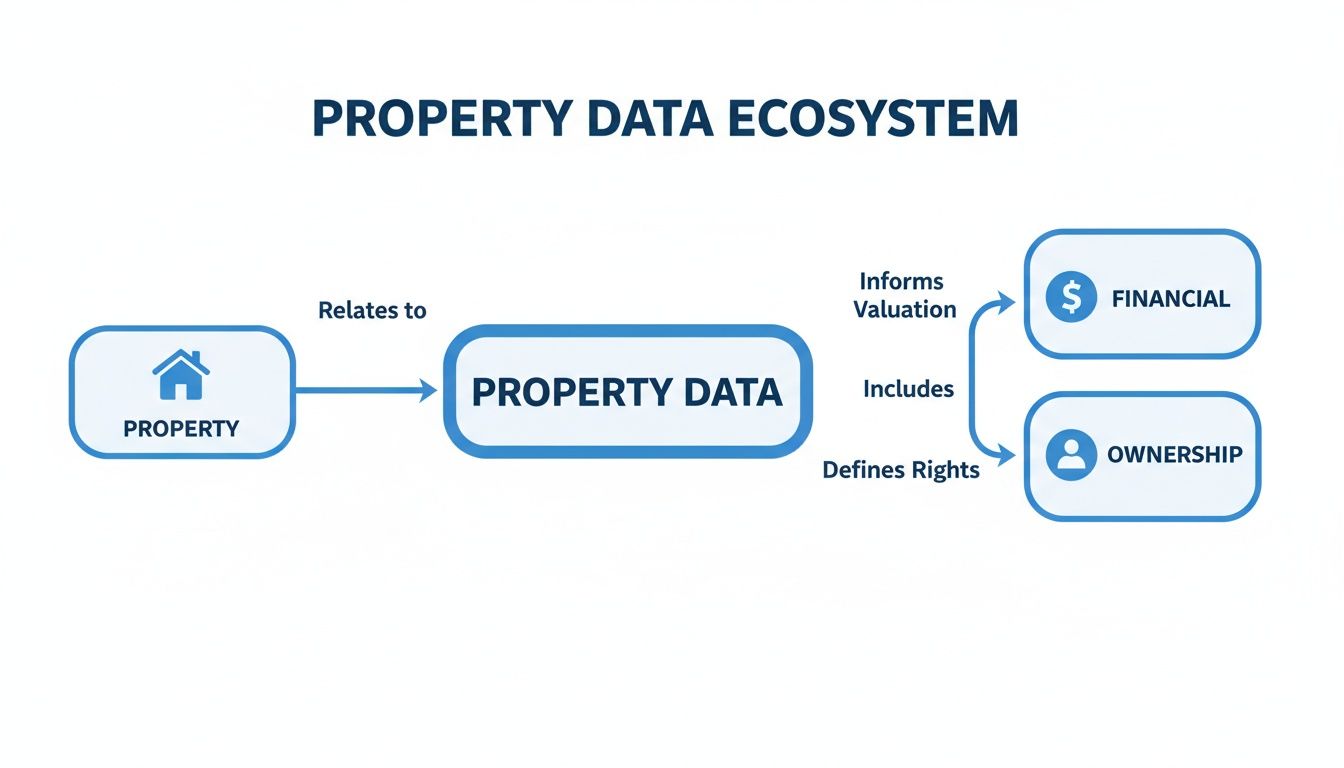
This interconnectedness is what makes the API so powerful. Every endpoint taps into this rich ecosystem to deliver insights you can actually act on.
The Digital Scout: Property Search
Imagine you need to find every single three-bedroom home in Phoenix, Arizona with at least 40% equity that was built before 1990. Doing that manually is a monumental task. But with a Property Search endpoint, it becomes a simple, targeted request.
You just define your criteria, and the API acts like a digital scout, instantly scanning millions of property records to return a perfectly filtered list. This is the engine that powers every automated property search portal and investment analysis tool out there.
Here’s what a simplified request might look like:
GET /properties/search- Parameters:
city=Phoenixstate=AZbedrooms=3min_equity_percent=40max_year_built=1990
The API responds with a clean, structured list of every property that matches those exact specs, ready for your team to take action.
The Automated Detective: Contact Append (Skip Tracing)
Okay, so now you have that list of properties. An address alone isn’t going to cut it; you need to connect with the owner. The Contact Append endpoint (often called skip tracing) acts as your automated detective.
You provide the property address, and the endpoint instantly enriches it with verified owner contact information, like phone numbers and email addresses. It cross-references multiple databases to find the most accurate contact details available, turning a list of addresses into a high-potential lead pipeline.
This endpoint is the key to unlocking direct communication at scale. It transforms a passive list of properties into an active outreach campaign, allowing marketing and sales teams to connect with homeowners efficiently and effectively.
The Instant Valuator: Property Details
When you need a complete profile on a single property, the Property Details endpoint is your go-to tool. Think of it like requesting a comprehensive background check on a house.
With just a property ID or an address, this endpoint returns a treasure trove of information. You get everything from basic characteristics (square footage, lot size, roof type) to critical financial data (AVM, mortgage history, liens) and transaction records.
This single endpoint powers instant quote tools for home services like roofing and solar, helps lenders automate their risk assessments, and gives investors a quick, detailed snapshot of a potential deal. For developers, this functionality is often the core of their application. To see how these requests and responses are actually structured, you can explore some detailed real estate API documentation with examples.
By understanding these essential endpoints, the abstract idea of a “real estate data API” becomes a concrete set of business actions. Each one is designed to solve a specific problem, automate a tedious process, and create opportunities that drive real growth.
Real-World Applications That Win Markets

A real estate data API isn’t just a technical tool; it’s a strategic engine that turns raw property information into real business growth. The magic happens when you apply this technology to specific industry problems, converting data points into dollars and winning market share. These practical applications show exactly how different sectors are using property intelligence to work smarter, not just harder.
The goal is to shift from reactive gut feelings to a proactive, data-driven strategy. Whether you’re a startup trying to shake things up or an established company looking to find new efficiencies, an API gives you the data foundation to make it happen. Let’s see how this plays out in the real world.
Powering The Next Generation Of Proptech
For any proptech startup, building a dynamic property search portal from scratch is a massive undertaking. The real headache isn’t just designing a slick interface; it’s feeding it with accurate, up-to-the-minute data for millions of properties. Trying to do this manually by piecing together messy data files from hundreds of different counties is a non-starter for a small team.
That’s where integrating a real estate data API changes the game.
- Problem: A new proptech wants to build a Zillow-like experience for real estate investors but has zero data infrastructure.
- Solution: They use a
Property Searchendpoint to let users filter properties by investor-focused criteria like cap rate, equity, or pre-foreclosure status. When a user clicks, aProperty Detailsendpoint instantly pulls in a comprehensive profile for that specific property, including automated valuation models (AVMs). - Result: The startup launches a powerful, data-rich platform in a fraction of the time and cost. They can compete by offering niche insights that the bigger players often miss, quickly attracting a loyal user base of serious investors.
Automating Mortgage And Lending Decisions
In the mortgage world, speed and accuracy are everything. Lenders have always been bogged down by the slow, manual process of property valuations and risk assessments. These delays frustrate customers and can easily lead to lost deals. A real estate data API is the perfect solution for this bottleneck.
By automating the retrieval of property characteristics, sales history, and lien information, lenders can slash underwriting timelines from days to hours. This efficiency gain not only improves the customer experience but also allows them to process more loans with the same resources.
A mortgage lender can wire an API directly into their workflow to automate critical steps. The API’s Automated Valuation Models (AVMs) provide an instant, reliable property value estimate. It can also flag potential risks by pulling data on existing mortgages, liens, or pre-foreclosure filings, giving underwriters a complete picture without any manual digging. This automation means faster approvals and a much stronger competitive edge.
Precision Targeting For Home Services
Imagine a roofing company in a storm-prone area like Florida. Their old marketing strategy of blanketing entire neighborhoods with flyers is a massive waste of money. They need a smarter way to find homeowners who actually need their services right now.
This is where a real estate data API becomes a surgical marketing tool.
- Problem: The roofer is burning marketing cash on homes with brand-new roofs or owners who have no interest in their services.
- Solution: They use the API to pinpoint homes with roofs older than 15 years, filtering for specific materials like asphalt shingles. They then use skip tracing endpoints to get owner contact information.
- Result: Their marketing becomes hyper-focused. Instead of generic ads, they send personalized offers directly to homeowners who are statistically the most likely to need a roof replacement. Their conversion rates skyrocket, and their marketing ROI goes through the roof.
Crafting Hyper-Targeted Marketing Campaigns
For marketing teams, success is all about reaching the right people with the right message. A real estate data API unlocks the ability to build incredibly detailed audience segments based on property and owner data. Take a wealth management firm that wants to connect with homeowners sitting on a lot of home equity.
By using an API, the firm can identify properties where the estimated value is way higher than the outstanding mortgage balance. This instantly creates a targeted list of high-equity homeowners. They can then layer on other data points, like property type or how long the person has owned the home, to refine the audience even more. The result is a highly relevant campaign that speaks directly to the homeowner’s financial situation, leading to far better engagement and higher-quality leads.
To better illustrate how this works across different industries, here’s a breakdown of common use cases and the data points that make them possible.
Real Estate API Use Cases by Industry
This table summarizes how various business sectors apply real estate data to solve core challenges and the specific types of data they rely on.
| Industry | Primary Use Case | Key Data Points Utilized |
|---|---|---|
| Proptech | Building investor-focused property portals and analytics tools. | Property characteristics, ownership details, sales history, pre-foreclosure status, estimated equity, AVMs. |
| Lending & Mortgages | Automating underwriting and property valuation processes. | Sales comparables, lien data, tax assessment history, flood zone information, property type. |
| Insurance | Performing risk assessments and calculating accurate premiums. | Year built, roof type, building materials, flood/fire risk scores, proximity to hazards. |
| Home Services (Solar, Roofing) | Identifying and targeting high-intent homeowners. | Roof age/type, HVAC system age, square footage, lot size, owner contact information (skip tracing). |
| Marketing | Creating hyper-targeted audience segments for campaigns. | Owner demographics, estimated home equity, length of ownership, absentee owner status. |
As you can see, the applications are incredibly diverse, but they all share a common thread: using specific, reliable data to drive smarter business decisions and gain a competitive advantage.
How to Choose the Right API Provider
Picking a real estate data API provider is a bit like choosing a foundational partner for your business. The right one becomes a silent, reliable engine powering your growth, while the wrong one can leave you sputtering on the starting line, bogged down by bad data and technical debt. This decision goes far beyond a simple vendor relationship; it’s a long-term commitment that will directly shape your product’s success.
Don’t get swayed by flashy marketing. A thoughtful evaluation process that digs into the core pillars of data quality, performance, and the developer experience is non-negotiable. Asking the tough questions now will save you from painful, expensive migrations later on.
Data Quality and Coverage
It all starts with one question: how good is the data? An API is just a delivery mechanism; its real value lies in the accuracy and depth of the property intelligence it provides. Incomplete or incorrect data doesn’t just frustrate users—it leads to flawed business decisions and can seriously damage your reputation.
Your first step should be to investigate their data sources and how often they’re updated. A quality provider will be transparent about where their data comes from, which is typically a mix of public records, direct MLS feeds, and their own proprietary sources.
Here’s a practical checklist for evaluating data quality:
- Comprehensiveness: Does the API cover the specific geographic areas and property types your business needs? More importantly, does it go deep, offering datasets on financial history, ownership details, liens, and physical characteristics?
- Update Cadence: How fresh is the data? For many applications, real-time information is everything. If you need daily or even intra-day updates, a provider refreshing their data weekly just won’t cut it.
- Accuracy Guarantees: Can they provide any metrics on data accuracy or fill rates? Don’t be afraid to ask for a sample dataset so you can run your own validation tests before signing a contract.
- Historical Depth: How far back does their data go? For anyone building predictive models or analyzing market trends, access to years of historical transaction and property data is absolutely essential.
API Performance and Reliability
A great dataset is useless if you can’t access it quickly and reliably. High latency—the lag between your request and the API’s response—can kill the user experience in a customer-facing app. Similarly, frequent downtime can grind your entire operation to a halt.
When it comes to performance, look for a concrete Service Level Agreement (SLA). An SLA isn’t just marketing fluff; it’s a formal promise from the provider about uptime and performance. It’s a strong signal of their commitment to reliability. A provider offering a 99.9% uptime guarantee is putting their money where their mouth is.
Drill down with these performance questions:
- What is your average API response time? For any real-time use case, you should be looking for responses in the low milliseconds.
- What is your guaranteed uptime? Ask to see their system status page and historical uptime data. Transparency is key.
- How does your system handle traffic spikes? The API needs to perform just as well under a heavy load of a million requests as it does with a hundred.
Documentation and Developer Experience
Even the most powerful API in the world is worthless if your developers can’t figure out how to use it. Clear, comprehensive, and well-organized documentation is the hallmark of a modern, developer-first company. It speeds up API integration, slashes troubleshooting time, and lets your team build faster.
You can often spot legacy data providers by their convoluted, PDF-based documentation and non-existent support, which leaves developers to figure things out on their own. Modern providers, in contrast, invest heavily in making their developers’ lives easier.
Here’s what to look for in a great developer experience:
- Clarity and Organization: Is the documentation easy to search and navigate? Are the explanations for each endpoint clear and concise?
- Code Samples: Do they provide practical, copy-paste-ready code examples in multiple languages (like Python, JavaScript, etc.)?
- Sandbox Environment: Is there a free testing environment where your team can experiment with the API without worrying about costs or affecting live data?
- Support Channels: What happens when your developers get stuck? Is there a dedicated support team, a community Slack channel, or a direct line to actual engineers?
Pricing and Scalability
Finally, the pricing model has to make sense for your business, both today and in the future. The two most common models are pay-per-call and subscription tiers. Pay-per-call can be a great, low-cost entry point for startups with unpredictable volume. Subscriptions, on the other hand, offer predictable costs for established businesses with consistent, high usage.
It’s also critical to make sure the provider can scale with you. As your user base grows, so will your data needs. A provider with rigid pricing tiers or technical bottlenecks can quickly become a roadblock to your growth. You need a partner whose infrastructure and pricing are built to support you on your journey from startup to enterprise.
Best Practices for a Seamless API Integration
Getting a real estate data API into your application is a huge win, but making that integration smooth and secure is what really counts. Moving from a plan on paper to a live product means having a clear strategy to sidestep the usual traps—security holes, performance bottlenecks, and surprise costs.
Get it right, and the API becomes more than just a tool; it’s the engine driving your business operations.
Think of it like building a custom home. You wouldn’t just start throwing up walls without a solid blueprint, a set of safety rules, and a plan for upkeep. The same principle applies here. A well-planned API integration makes sure your app is tough, fast, and ready to handle growth right from the start.
Fortify Your Foundation with Technical Essentials
Before you even think about making your first live API call, you need to lock down the basics. These aren’t just suggestions; they’re non-negotiable practices for building a stable application that won’t crumble under real-world pressure.
Safeguard Your API Keys: Treat your API keys like the keys to your office—don’t leave them out in the open. Store them as environment variables or use a dedicated secrets manager. Never hardcode them directly into your source code where a simple mistake could expose them to the world.
Respect Rate Limits: Every API has rate limits, which are basically speed limits for how many requests you can make in a certain amount of time. If you constantly speed, you’ll get your access temporarily blocked, which means your users will see nothing but errors. You need to build logic into your code, like exponential backoff, to handle rate limit errors gracefully and retry requests without hammering the server.
Leverage Webhooks for Real-Time Efficiency: Instead of constantly polling the API and asking, “Anything new yet?”, webhooks let the API tell you when something happens. It’s way more efficient. Think of it as getting a text notification versus hitting refresh on your email every thirty seconds. Use webhooks for things like property status changes or new listings to get instant updates without burning through your API calls.
Build Smarter with Strategic Best Practices
Beyond the code itself, thinking strategically about your integration will save you a ton of time, money, and headaches. This is all about testing properly, keeping an eye on things, and planning for what’s next so your integration stays healthy and affordable as you grow.
Considering essential API management best practices is a critical piece of the puzzle, ensuring your setup is not just functional but also maintainable.
A truly seamless integration isn’t just about writing code that works today. It’s about building a system that is testable, monitorable, and adaptable enough to meet the challenges of tomorrow.
Solid planning and execution are everything. A well-planned API integration ensures your application is robust, scalable, and secure from day one, laying the groundwork for sustainable growth.
Plan for Scale and Performance
As your app gets more popular, your API usage will shoot up. You need to plan for that growth from day one to keep things running fast and control your costs.
Test Rigorously in a Sandbox: Before connecting to live data, use the provider’s sandbox environment. It’s a free, safe playground where you can test every feature, simulate weird scenarios, and squash bugs without making real API calls or spending a dime.
Monitor Your API Usage: Keep a close eye on your API consumption through the provider’s dashboard. This isn’t just about watching costs—it helps you spot inefficient queries, understand usage patterns, and predict future bills. This kind of proactive monitoring prevents sticker shock at the end of the month.
Plan for Data Updates and Versioning: APIs change over time. Providers add new data points, update endpoints, and release entirely new versions. You need to stay in the loop on your provider’s roadmap and have a plan to adapt your application, so you don’t find yourself scrambling when a change breaks your code.
Frequently Asked Questions
When you’re diving into the world of real estate data APIs, a few key questions always come up, especially around performance, accuracy, and getting everything hooked up. Here are the straight answers to the most common queries we hear from developers, investors, and business leaders.
Getting these fundamentals right from the start is the key to building reliable, high-performing apps.
Data Accuracy and Freshness
How accurate is the data from a real estate API?
This is the million-dollar question, and the answer varies wildly between providers. Top-tier platforms don’t just pull from one place; they aggregate data from multiple authoritative sources like county assessor records, deed filings, and direct MLS feeds. The real magic happens next, when they run it all through sophisticated validation and cleansing processes.
For example, a provider might cross-reference public records with postal service data just to make sure a mailing address is perfect. Always ask a potential partner about their specific data sources and how often they update—daily updates are the gold standard for high-quality, actionable data.
What is the difference between a real-time API and a bulk data file?
Think of it like getting directions. A real-time API is like using a GPS—you ask for directions to one specific place and get an instant, turn-by-turn answer. It’s perfect for powering a live property search portal or an instant quote generator where you need an immediate response for a single property.
A bulk data file, on the other hand, is like a road atlas. It’s a huge, static map of all the properties in a state, delivered to you periodically. This is what you need for large-scale projects like market analysis, training machine learning models, or doing an initial load of your entire database.
Integration and Usability
Can I integrate a real estate data API with my existing CRM?
Absolutely. Modern real estate APIs are built specifically to play nicely with other software. They’re designed for smooth integration with your CRM, marketing automation tools, or internal dashboards.
With an API, you can automatically enrich your existing contacts with detailed property and homeowner information. This lets you set up workflows based on property events—like a new listing or a sale—and keeps your customer data fresh without anyone having to lift a finger. Look for providers who offer clear documentation and SDKs for popular programming languages to make the process even easier.
The real power of a real estate data API isn’t just having it as a standalone tool. It’s when you weave it directly into your business workflow, automating data enrichment and triggering intelligent actions across your entire tech stack.
Ready to power your business with the most accurate and comprehensive property intelligence available? BatchData provides a modern real estate data API with access to over 155 million property records and thousands of data points. Explore our API solutions today.