




































Real estate APIs manage sensitive data like property records, financial details, and tenant information. Securing this data is non-negotiable. Here’s what you need to know:
- Authentication: Use API keys for simplicity or OAuth 2.0 for advanced, token-based security.
- Role-Based Access Control (RBAC): Restrict access based on user roles to minimize risks.
- Encryption: Protect data in transit with TLS/HTTPS and at rest with AES-256 encryption.
- Input/Output Validation: Prevent injection attacks and ensure only authorized data is exposed.
- Compliance: Follow industry standards like RESO Web API and OWASP API Security Top 10.
- Monitoring: Use logging, rate limiting, and anomaly detection to identify and respond to threats.
APIs are a target for cyberattacks, making robust security measures essential for protecting data and maintaining trust. Whether you’re managing property listings or financial details, these practices ensure your systems remain secure and compliant.
API Security That Works: From Real-World Breaches to Practical Fixes | Treblle Webinars
sbb-itb-8058745
Authentication and Authorization Methods
Securing API access starts with authentication (proving identity) and authorization (defining permissions). Without these safeguards, even the strongest encryption won’t protect your data from misuse.
API Keys and OAuth2
API keys act as simple shared secrets included with each request, often in headers like X-API-Key. They’re easy to set up and can be deactivated quickly if compromised. However, API keys have limitations: they don’t support detailed permissions and remain valid until manually updated.
OAuth 2.0, on the other hand, offers a more advanced, token-based solution. Instead of sharing passwords, it uses access tokens to grant temporary, scoped permissions to third-party apps. This is especially relevant in real estate, where the Real Estate Standards Organization (RESO) Web API mandates OAuth for secure authentication, moving away from older protocols like RETS.
"OAuth is used to provide secure authentication and authorization for accessing a RESO Web API service." – Sam DeBord, CEO, RESO
OAuth 2.0 introduces four roles: the Resource Owner (end-user), the Resource Server (hosting data), the Client (application), and the Authorization Server. This setup allows delegated access without exposing sensitive credentials. It also supports refresh tokens, which let apps renew access tokens without requiring users to log in repeatedly.
For real estate apps needing detailed permissions or third-party integrations, OAuth 2.0 reduces risks like credential theft. Meanwhile, API keys are better suited for simpler, service-to-service communication in controlled settings where OAuth might feel unnecessarily complex. Whichever method you choose, always secure data transmission with encrypted connections (TLS/HTTPS) to prevent interception.
These methods provide the groundwork for applying role-based access control.
Role-Based Access Control (RBAC)
After verifying user credentials, role-based access control (RBAC) limits what users and apps can do based on their roles. RBAC ensures actions align with job responsibilities by organizing access through three entities: Roles (permission sets), Principals (users or API keys), and Groups. Instead of assigning permissions directly to individuals, roles are tied to groups, which users join.
For example, in real estate APIs, a Consumer role might allow viewing property data, while a Contributor role could enable importing or exporting records using a real estate API. Administrative roles manage permissions and databases. This hierarchy supports the principle of least privilege, ensuring users only access what’s necessary for their role.
A major API vulnerability, Broken Object Level Authorization (BOLA), tops the OWASP API Security Top 10 for 2023. To tackle this, implement layered authorization checks:
- Object Level: Restrict access to specific records.
- Property Level: Limit access to certain data fields.
- Function Level: Control access to specific API actions.
Every API endpoint handling object identifiers should verify users can only access their authorized data.
To streamline this, create access-rights-based groups for teams sharing data and permission-based groups for users with similar roles. This structured approach balances security with operational flexibility, reducing risks while ensuring smooth functionality.
Data Encryption: In Transit and At Rest
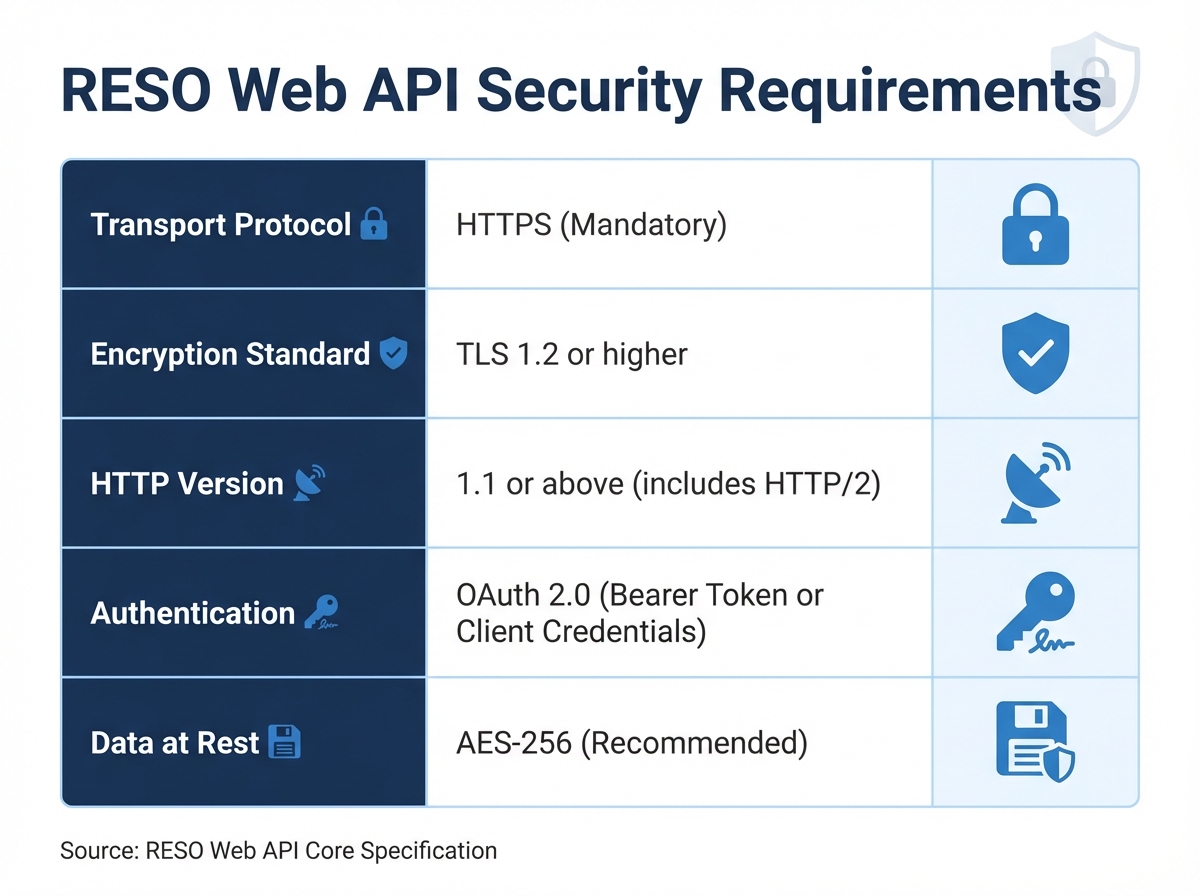
RESO Web API Security Requirements and Best Practices for Real Estate APIs
Encryption ensures that sensitive API data – like property addresses, financial information, and contact records – remains unreadable during both transmission and storage. Combined with strict authentication protocols, encryption provides an added layer of defense for protecting real estate data.
TLS/HTTPS Protocols
HTTPS and TLS protocols play a crucial role in safeguarding data as it moves between systems. For real estate APIs adhering to RESO standards, HTTPS is a mandatory protocol for all server URLs. Additionally, all RESO-certified implementations must use Transport Layer Security (TLS) version 1.2 or higher to encrypt data during transmission.
"Since the RESO Web API requires that HTTPS and the OAuth2 protocols are used, all server implementations MUST implement Transport Layer Security (TLS)." – RESO Web API Core Specification
TLS establishes an encrypted connection between the client and server, effectively preventing unauthorized access. Randall Degges from Okta explains, "Transport security adds privacy and integrity for messages between two parties. In common usage, it’s the ability to transmit data over a network without exposing that data to untrusted third parties".
In 2026, Amazon API Gateway will enforce HTTPS for all API endpoints, requiring TLS 1.2 or higher, completely eliminating unencrypted HTTP endpoints. This shift reflects the industry’s commitment to secure connections. RESO also mandates HTTP/1.1 or higher (including HTTP/2) to maintain modern security standards. TLS is paired with OAuth 2.0 authentication methods – such as Bearer Tokens or Client Credentials – for added protection. Whenever possible, opt for Client Credentials, as they offer stronger resistance to man-in-the-middle attacks. Lastly, ensure your OData service root URL ends with a forward slash to enable proper metadata and resource pathing.
This encryption layer, when combined with authentication and RBAC measures, creates a robust API security framework.
Data Encryption Standards
While TLS protects data in transit, encryption at rest safeguards information stored in databases. AES-256 (Advanced Encryption Standard) is the industry benchmark, using a 256-bit key to defend against brute-force attacks. This algorithm encrypts sensitive data – such as property and contact information – at the application level before it is stored. Even if someone gains physical access to the storage medium, the data remains inaccessible without the proper decryption key.
"Encryption protects the confidentiality of information by preventing unauthorized individuals from accessing it" – Canadian Centre for Cyber Security
To further secure your systems, store API keys in environment variables or secrets management systems, and rotate them regularly. When selecting encryption tools, look for products certified through Common Criteria (CC) or the Cryptographic Module Validation Program (CMVP) to ensure they meet stringent security standards.
| Security Component | RESO Web API Requirement |
|---|---|
| Transport Protocol | HTTPS (Mandatory) |
| Encryption Standard | TLS 1.2 or higher |
| HTTP Version | 1.1 or above (includes HTTP/2) |
| Authentication | OAuth 2.0 (Bearer Token or Client Credentials) |
| Data at Rest | AES-256 recommended |
Input Validation and Output Sanitization
To maintain secure and reliable data flow, real estate APIs must go beyond encryption and authentication by implementing robust input and output controls. These measures help block malicious inputs and prevent accidental data leaks. Input validation ensures only clean, expected data enters the system, while output sanitization safeguards against exposing sensitive information.
Preventing Injection Attacks
Input validation plays a critical role in defending APIs from threats like injection attacks, data tampering, and denial-of-service (DoS) attacks. As the National Cyber Security Centre puts it:
"Effective input validation is essential for preventing various security vulnerabilities, including injection attacks, data tampering, and denial-of-service (DoS) attacks which can compromise the confidentiality, integrity, and availability of API resources".
This process involves two layers:
- Syntactic validation: Ensures data follows the correct format, such as verifying that an email address is properly structured.
- Semantic validation: Confirms data makes logical sense, like checking that a property’s listing date isn’t set in the future.
APIs built to RESO standards often rely on strong typing to block injection attempts. For example, defining a property price as an Edm.Decimal rather than a generic string ensures only numeric values are accepted, automatically rejecting malicious inputs. Schema validation using JSON or XML metadata provides another layer of defense by enforcing strict input rules. For instance, a property status field might only allow values like "Active", "Pending", or "Closed."
Additional measures include:
- Setting request size limits to reduce DoS risks.
- Rejecting requests with unexpected
Content-Typeheaders using HTTP status codes like 406 or 415. - Sanitizing input data before logging to prevent log injection attacks.
When combined, these practices create a strong barrier against unauthorized or harmful inputs.
Output Filtering
Output filtering works hand-in-hand with input validation to ensure that sensitive or unnecessary data doesn’t slip through. APIs should enforce property-level authorization, ensuring users only see data they’re permitted to access. For instance, a public API might display listing prices and square footage but exclude personal contact details or internal notes.
Error handling is another critical area. Detailed backend information – such as stack traces, internal IP addresses, or system names – should never appear in error messages. Instead, APIs should present generic error responses and validate the requester’s Accept header, defaulting to safe formats like JSON.
To prevent resource exhaustion, large datasets should be managed with pagination or callback handlers rather than delivering thousands of records in a single response. The RESO Single Feed proposal even supports field-level visibility rules based on licensing, allowing different levels of data access for IDX and VOW feeds.
Lastly, security headers like X-Content-Type-Options: nosniff can help prevent browsers from interpreting data as executable code, adding another layer of protection.
Compliance and Monitoring Practices
Compliance with Standards
Real estate APIs must align with established regulations to protect sensitive data. The RESO Web API Core 2.0.0 has become the go-to standard for data transport in the industry, replacing the outdated RETS protocol when its certification was discontinued in 2018. Today, at least 90% of MLSs offer RESO-certified Web API services, making it a widely adopted framework.
The OWASP API Security Top 10 serves as a key guide for identifying vulnerabilities such as Broken Object Level Authorization (BOLA) and Broken Authentication. APIs are particularly vulnerable targets because they expose personally identifiable information (PII) and sensitive application logic. To address these risks, the National Association of REALTORS (NAR) mandates that REALTOR-operated MLSs comply with the latest RESO standards, ensuring a uniform baseline for security across the industry.
The RESO Data Dictionary and RESO Common Format work together to standardize data fields, enabling consistent and secure interoperability between systems. These standards complement essential encryption and authentication protocols, creating a well-rounded security framework.
Logging and Anomaly Detection
Beyond compliance, continuous monitoring is key to maintaining API security. API gateways gather real-time metrics – such as 4xx/5xx error rates, request volumes, and latency – to identify unusual activity or service disruptions. Execution and access logs, which capture detailed API usage data and payloads (up to 1 MB), provide valuable tools for auditing.
A notable example comes from August 2024, when Xome introduced a cloud-based monitoring system for its Property Insights API using Microsoft Azure. By leveraging the Azure API Management (APIM) gateway, the technical team tracked statistics, managed authentication, and handled versioning. Performance tests using Apache JMeter revealed the system could handle between 100,000 requests per hour and 1 million requests daily.
Rate limiting mechanisms, often implemented with a "token bucket" algorithm, help protect APIs from being overwhelmed by excessive requests. When limits are exceeded, the system responds with a "429 Too Many Requests" error, mitigating potential attacks. Additionally, behavioral analytics tools monitor for suspicious activities, such as credential stuffing, bot traffic, and API abuse. Automated responses can analyze logs and block malicious IP addresses by integrating with web application firewalls (WAF).
The EntityEvent Resource standardizes how data changes are tracked and communicated, offering a more reliable method for replication and audit trails without relying solely on timestamps. As RESO explains:
"Standardizing entity events ensures consistent handling, tracking and communication of changes across different systems and platforms".
How BatchData Ensures API Security

Secure API Integration
BatchData uses a multi-layered approach to keep its APIs secure while providing access to over 155 million properties with 700+ attributes. The platform’s Organization structure for user accounts enables centralized management, allowing companies to control permissions for sub-users, even those transitioning from older systems. This setup ensures that businesses can maintain oversight while delegating specific levels of access to individual team members.
To protect API interactions, BatchData enforces HTTPS with TLS 1.2+ encryption. This is especially critical in an environment where 84% of security professionals have reported at least one API security incident in a year. With APIs accounting for 71% of web traffic, BatchData focuses on both security and efficiency across its services, including property search, phone verification, and data enrichment.
By building on this solid security framework, BatchData ensures that its data enrichment processes are as secure as they are effective.
Real Estate Data Enrichment with Security
BatchData extends its security measures to its data enrichment processes, ensuring both accuracy and compliance. For example, the platform automatically checks contact data against Federal DNC (Do Not Call) lists and known litigator databases, helping users avoid potential legal issues.
Address data is verified and standardized through CASS (Coding Accuracy Support System) Certification and DPV (Delivery Point Validation), aligning with USPS guidelines. This meticulous process not only enhances data reliability but also contributes to BatchData’s impressive 76% right-party contact accuracy rate – nearly three times higher than the industry standard. This level of precision minimizes wasted efforts while keeping data secure and consistent.
"What used to take 30 minutes now takes 30 seconds. BatchData makes our platform superhuman."
This quote from Chris Finck, Director of Product Management, highlights the platform’s efficiency. Even when properties are held by corporate entities, BatchData’s entity resolution features ensure users can identify true property owners and retrieve accurate contact details – all while maintaining strict data protection protocols.
Conclusion
Real estate APIs handle some of the most sensitive data out there – property records, financial details, and more. Without safeguards like OAuth, TLS encryption, and input validation, this information could be at risk of breaches or non-compliance. These protections aren’t just about meeting industry standards; they’re crucial for maintaining trust and ensuring business continuity.
Choosing a secure API provider isn’t just a tech decision – it’s about protecting your business and your clients. BatchData addresses these concerns with features like CASS certification, DPV for accurate deliverability, and real-time Federal DNC and litigator scrubbing to meet TCPA compliance. Plus, with a 99.9% uptime SLA, the platform ensures consistent access while maintaining rigorous security standards.
Strong security protocols don’t just protect data – they make operations smoother. By minimizing errors and automating compliance, real estate professionals can focus on what matters most: closing deals. BatchData’s certified processes and real-time validation are a great example of this, delivering a 76% right-party contact accuracy rate. This combination of security and efficiency helps drive better performance and higher conversion rates.
A solid security framework also reduces legal risks and gives businesses a competitive edge. Whether you’re integrating property search tools, verifying contact information, or enriching databases, these measures are essential for managing legal exposure and staying ahead in the market.
As the real estate industry continues to embrace API-driven workflows, understanding security fundamentals is key to evaluating providers and safeguarding your operations. BatchData’s multi-layered approach, including TLS 1.2+ encryption and sandbox testing, equips developers with the tools they need to build secure and reliable integrations for today’s real estate challenges.
FAQs
When should I use OAuth 2.0 instead of an API key?
When security and flexibility are top priorities – like granting third-party access or handling delegated permissions – OAuth 2.0 is the way to go. It allows for limited access through scoped, time-sensitive tokens, eliminating the need to share user credentials directly.
On the other hand, API keys provide a simpler option but come with fewer security measures. They’re best suited for internal applications or server-to-server communication where risks are lower. If you’re dealing with sensitive real estate data, OAuth 2.0 is usually the smarter choice.
How do I prevent BOLA in real estate API endpoints?
To tackle Broken Object Level Authorization (BOLA) in real estate API endpoints, it’s crucial to enforce robust access controls. This means verifying a user’s permissions for every resource they interact with – not just relying on object IDs. Simply put, an authenticated user should only perform actions on data they’re explicitly authorized to access.
Beyond access controls, take additional precautions to protect sensitive data:
- Validate Permissions: Ensure users have the correct rights for specific actions, such as viewing or modifying a property listing.
- Adopt Authentication Standards: Use protocols like OAuth to manage secure and reliable authentication.
- Conduct Regular Security Testing: Periodically test APIs to uncover potential vulnerabilities.
- Monitor for Anomalies: Implement systems to detect unusual behavior that could signal unauthorized access attempts.
By combining these strategies, you can significantly reduce the risk of unauthorized access or data tampering in your API endpoints.
What should I log and monitor to detect API abuse early?
To catch API abuse early, it’s crucial to log and monitor request patterns – look out for unusual spikes in traffic. Keep an eye on authentication attempts, such as repeated failed logins or invalid token usage, as these can signal potential misuse. Also, track details like source IP addresses, user agents, and geolocation data to spot anomalies, such as access from unexpected regions or flagged malicious IPs. By setting up real-time alerts for these metrics, you can quickly detect and respond to suspicious activity.