
Want to transform your mortgage platform with real-time property insights? Property data APIs are the key. They bring over 700 property attributes – like tax data, sales history, and foreclosure updates – straight into your system, sourced from a database covering 155 million U.S. properties. With updates available within 24 to 48 hours, these APIs help you stay ahead with instant notifications and smarter workflows.
Here’s what you need to know:
- Real-time updates: Push notifications via webhooks ensure you never miss critical changes like new liens or equity shifts.
- Efficiency: automate underwriting, streamline loan origination, and reduce manual errors with enriched data.
- Accuracy: BatchData APIs boast a 76% right-party contact accuracy, tripling the industry average.
- Compliance: Built-in tools scrub borrower data against DNC and TCPA lists to reduce legal risks.
- AI Integration: Use natural language queries to simplify data access and speed up decision-making.
BatchData APIs are designed to fit seamlessly into your mortgage workflows, from underwriting to borrower outreach, ensuring your platform operates faster, smarter, and more securely.
Ready to modernize your mortgage platform? Keep reading for technical integration insights and use cases.
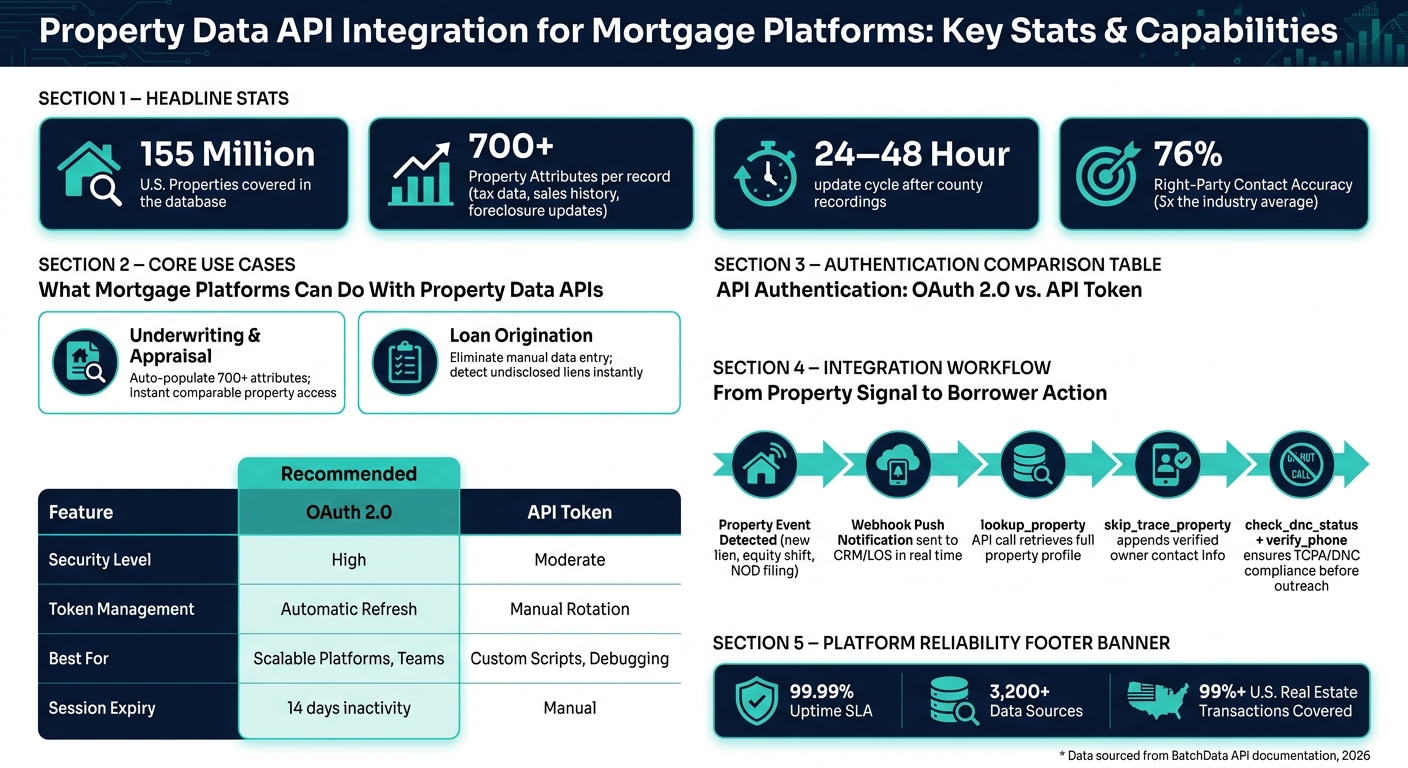
Property Data API Integration: Key Stats & Capabilities for Mortgage Platforms
Core Use Cases for Property Data API Integration
Building on the real-time insights mentioned earlier, let’s explore how direct API integration enhances mortgage platforms at every stage of the lending process.
Improving Underwriting and Appraisal Processes
Accurate underwriting depends on reliable, detailed data. By tapping into over 700 property attributes – including construction details, tax history, and sales records – automated underwriting systems can make quicker and more informed decisions, reducing the need for manual research. For instance, the verify_address feature ensures address standardization by aligning them with USPS-verified records, eliminating discrepancies. Similarly, the comparable_property_preview tool provides instant access to up to 10 comparable properties from active, sold, or expired listings, ensuring appraisals are backed by up-to-date market data. With database updates occurring within 24 to 48 hours of county filings, the information stays current.
These enhancements streamline underwriting and appraisal workflows, setting the stage for greater efficiency in loan origination.
Streamlining Loan Origination and Processing
Manual data entry in loan origination is a common source of errors. Property data APIs address this by automatically populating loan origination system (LOS) fields with verified property details, tax information, and financial histories as soon as an address is entered.
During due diligence, lenders can uncover undisclosed liens, judgments, or early foreclosure warnings instantly. At the closing stage, APIs verify recorded document details, ensuring the chain of title and recording dates are accurate for servicing transfers. Compliance measures are also embedded – lenders can scrub borrower outreach lists against the National Do Not Call (DNC) Registry and TCPA litigator lists, reducing legal risks.
This automated process not only reduces errors but also lays the foundation for more effective risk management across the loan portfolio.
Risk Monitoring and Portfolio Management
With the real-time push architecture discussed earlier, mortgage platforms can shift from reactive to proactive risk management. Instead of manually checking for potential issues, the system sends alerts the moment a risk signal is detected.
For example, webhooks can be set to trigger notifications for pre-foreclosure filings, new liens, or significant equity changes, allowing risk teams to act immediately. This is particularly useful for tracking loan-to-value (LTV) ratio shifts across large portfolios, where even minor equity changes can impact the valuation of multiple loans. Daily valuation updates for over 155 million U.S. properties make it possible to monitor portfolios efficiently and on a large scale.
"Our Smart Search API is built on a modern, event-driven ‘push’ architecture. You set your criteria once, and we do the work." – BatchData
This proactive approach also opens doors to improved borrower engagement strategies.
Borrower Acquisition and Retention
Timing is everything when it comes to borrower outreach, and property data APIs are designed to solve this challenge. By combining equity data with verified contact details, mortgage platforms can pinpoint homeowners who are prime candidates for refinancing or HELOC options before they start exploring other options.
With a single API call, lenders can retrieve a high-equity homeowner’s verified mobile number, email address, and property financials, achieving right-party contact accuracy that’s approximately three times higher than industry norms. This means fewer wasted outreach attempts and more meaningful conversations with qualified leads. For retention efforts, the same process identifies existing borrowers nearing a refinance milestone, giving loan officers a valuable head start in maintaining customer relationships.
Technical Integration Patterns for Property Data APIs
Now that you understand how property data APIs can enhance borrower acquisition and risk management, the next step is integrating these capabilities into your mortgage platform in a secure and reliable way. These technical approaches strengthen real-time data operations, ensuring your mortgage processes remain efficient and safe.
Building Event-Driven Data Workflows
One of the biggest improvements you can make to your mortgage platform is shifting from a polling model to an event-driven, webhook-based approach. In a traditional polling setup, your system repeatedly queries the API at set intervals, which can waste resources and lead to outdated data. By contrast, a webhook-based "push" model allows you to set criteria once and receive instant notifications when those conditions are met. For example, this could include alerts for a new lien filing, a Notice of Default, or an equity threshold being crossed.
With webhooks, your CRM or Loan Origination System (LOS) gets real-time updates, eliminating the need for manual checks and ensuring loan officers always have the latest information. The infrastructure supporting this model is built to maintain a 99.99% uptime SLA, providing a reliable foundation for time-sensitive mortgage workflows.
API Gateway and Security Best Practices
Security is non-negotiable when integrating mortgage APIs due to strict regulatory requirements. The preferred authentication method is OAuth 2.0, which simplifies token management by handling automatic refreshes, synchronizing across devices, and allowing centralized access controls. This enables team administrators to grant or revoke permissions without needing to modify code. While API tokens can still be useful for debugging or custom automation scripts, they require manual rotation and carry more risk if not managed carefully.
| Authentication Method | Security Level | Token Management | Best Suited For |
|---|---|---|---|
| OAuth 2.0 | High | Automatic refresh | Scalable platforms, team environments |
| API Token | Moderate | Manual rotation required | Custom scripts, debugging |
In addition to authentication, all API communications should be encrypted end-to-end. As BatchData emphasizes, "Security is a top priority. All communication with the MCP Server is encrypted. Your queries are processed securely, and we adhere to strict data privacy standards." OAuth sessions typically expire after 14 days of inactivity, which balances user convenience with security best practices. To further enhance compliance, consider embedding checks against Federal DNC and TCPA lists directly into the data intake process.
Data Normalization Across Mortgage Systems
After ensuring secure and event-driven workflows, the next priority is standardizing raw data to prevent mismatches across different systems. Property data from over 3,200 sources often arrives in inconsistent formats. County assessors, MLS feeds, and public records may use varying address conventions, field names, and data structures. Without a normalization layer, this inconsistency can disrupt downstream systems like your LOS, CRM, or data warehouse, leading to errors in automated workflows and underwriting models.
To address this, use USPS-compliant verification and a unified schema to standardize property attributes. This ensures consistency across your portfolio, which is critical for accurate risk management and loan processing workflows. A solid data foundation allows for reliable insights into properties sourced from various counties, supporting the broader efficiency goals discussed earlier.
Implementing BatchData APIs in Mortgage Workflows
This section focuses on how to integrate BatchData’s APIs into mortgage workflows, building on secure integration and data normalization. By leveraging BatchData’s extensive dataset – sourced from over 3,200 providers and covering more than 99% of U.S. real estate transactions – you can streamline processes ranging from single-loan underwriting to full portfolio risk monitoring.
Core BatchData Capabilities and Use Cases
BatchData’s API toolkit is designed to align with key stages in the mortgage process. Here’s how its tools connect to specific use cases:
| Tool Category | Key Endpoint | Mortgage Use Case |
|---|---|---|
| Property Details | lookup_property |
Underwriting and property due diligence |
| Market Analysis | comparable_property_page |
Appraisal support and value estimation |
| Contact Intelligence | skip_trace_property |
Borrower outreach and retention |
| Compliance | check_dnc_status, verify_phone |
TCPA/DNC risk mitigation for marketing |
| Geographic Search | search-properties-by-boundary |
Targeted regional lending campaigns |
These tools provide a solid foundation for implementing efficient API calls tailored to everyday mortgage tasks.
Designing API Calls for Common Mortgage Scenarios
A good starting point is the lookup_property endpoint, which delivers a complete property profile using an address, parcel ID, or BatchData property ID. For underwriting, this endpoint provides critical data like loan-to-value ratios, loan type (e.g., FHA, VA, Conventional), interest rate type, and financial distress markers such as Notice of Default status – all in a single call.
When appraisal reviews require comparable sales data, the comparable_property_page endpoint supports paginated results, ensuring memory efficiency even for large datasets.
For geographic targeting, like a refinance campaign in a specific metro area, the search-properties-by-boundary endpoint allows you to define map boundaries and filter results by factors like equity level, loan type, or distress status. This eliminates the need for manual filtering of county-wide datasets, saving time and resources.
Search-to-Contact Workflow for Targeted Outreach
This workflow streamlines the process of connecting property matches to verified owner contacts without switching between tools. Once a property meets your lending criteria – such as high equity, an adjustable-rate loan, or a recent lien filing – you can use the skip_trace_property endpoint to append verified owner contact details, including phone numbers and emails, in the same workflow.
BatchData boasts a right-party contact accuracy rate of 76%, which is three times higher than the industry average. This accuracy reduces wasted outreach efforts and helps initiate meaningful conversations with qualified leads.
For properties owned by LLCs or trusts, BatchData can identify the individual behind the entity, a critical feature for lenders focusing on investor-owned portfolios. Before initiating outreach, you can use the verify_phone and check_dnc_status endpoints to scrub contact details against Federal DNC and TCPA litigator lists, ensuring compliance with regulations.
Bulk Data and Portfolio Enrichment
When managing hundreds or thousands of loans, individual API calls may not be practical. BatchData addresses this with bulk data delivery via SFTP or S3 in formats like Parquet or CSV. This method is ideal for updating machine learning models or data warehouses, allowing risk teams to enrich entire portfolios overnight.
Bulk data can help flag properties where equity has dropped, liens have been filed, or distress indicators have changed, enabling proactive risk management. Combined with event-driven webhooks, this approach provides both a comprehensive portfolio overview and real-time alerts, ensuring timely responses to emerging risks.
Future-Proofing Mortgage Platforms with BatchData
The mortgage industry is evolving fast, and staying ahead means having dynamic data pipelines. BatchData is built for this challenge, offering AI integration, compliance tools, and a solid data infrastructure to support the next wave of mortgage innovations. Let’s dive into how AI, compliance, and advanced analytics are reshaping mortgage platforms.
Integrating AI and Natural Language Search
BatchData’s Model Context Protocol (MCP) transforms how mortgage professionals interact with data. It allows users to input natural language queries, which are instantly converted into structured API calls. Forget the need for complex query building – this system makes data retrieval as simple as typing in plain English. For instance, a loan officer could type, "Find 3-bedroom homes in Phoenix with high equity and adjustable-rate loans," and immediately receive structured, actionable results.
"Our Managed Model-Context Protocol (MCP) server translates your natural language prompts directly into API calls. Integration time drops from weeks to minutes." – BatchData
The MCP server is designed to integrate seamlessly with major AI assistants and AI-powered IDEs. Once authenticated, users can sync the connector across desktop and mobile platforms effortlessly. For production environments, Docker Compose ensures a secure setup with built-in health checks, all while operating in a non-root environment. OAuth is recommended for authentication, as it automates token refresh cycles and minimizes credential exposure risks.
Data Governance and Compliance
While AI enhances the user experience, maintaining strict data governance is non-negotiable – especially in the mortgage industry. BatchData tackles compliance challenges head-on with tools specifically designed for U.S. regulations. Key API endpoints like check_dnc_status and verify_phone allow real-time screening against Federal Do Not Call and TCPA litigator lists, ensuring automated outreach complies with legal standards. OAuth further strengthens security by handling token refresh automatically.
Using BatchData for AI-Driven Mortgage Insights
Access to a constantly updated dataset is the backbone of AI-driven mortgage insights. BatchData ensures this by providing transaction data – such as deeds, mortgages, and liens – within 24–48 hours of county recording. Assessor data is refreshed daily for most counties, keeping AI agents equipped with the latest information.
"We want to supplement your work and make you superhuman so you can do things in seconds not hours. What used to take 30 minutes now takes 30 seconds." – Chris Finck, Director of Product Management, BatchData
This infrastructure empowers mortgage platforms to develop predictive risk models, automate portfolio monitoring, and identify refinance opportunities as market conditions shift. With low-code tools like Zapier and Make.com, BatchData can seamlessly enrich workflows when new leads are added to a CRM. This transforms static data storage into a real-time decision-making engine, amplifying the speed and efficiency of event-driven architectures throughout the lending process.
Conclusion and Key Takeaways
Relying on passive property data is no longer enough for mortgage platforms aiming to stay competitive. The future belongs to those who use data actively – transforming it into an event-driven tool that triggers immediate decisions as market conditions evolve.
This is where BatchData stands out. By providing property data updated within just 24–48 hours of county recordings, mortgage teams gain a significant speed advantage over systems that still depend on static, weekly updates. For example, when a borrower’s equity hits a critical threshold or a new lien is recorded, BatchData’s webhooks enable instant action – eliminating the delays of periodic batch processing.
The platform also excels in contact accuracy, boasting a right-party contact rate that’s three times the industry average. This precision reduces wasted outreach and helps teams connect directly with borrowers faster. Built-in DNC and TCPA scrubbing ensures compliance, making contact intelligence both effective and legally sound. Combined with these features, BatchData’s approach paves the way for seamless AI integration across workflows.
Its AI-native infrastructure, powered by the MCP server, bridges the gap between complex data and its users. With AI-driven natural language queries, professionals like loan officers, underwriters, and analysts can instantly access real-time property insights – no need for lengthy developer involvement. As Chris Finck, Director of Product Management at BatchData, puts it:
"We want to supplement your work and make you superhuman so you can do things in seconds not hours. That’s where BatchData comes in. What used to take 30 minutes now takes 30 seconds."
For mortgage platforms aiming to lead in today’s data-driven market, the solution is clear: adopt event-driven data pipelines, integrated contact intelligence, and AI-ready infrastructure. BatchData delivers all of this through a single, developer-friendly API with a 99.99% uptime SLA. These tools redefine what’s possible for mortgage platforms in a fast-evolving industry.
FAQs
How do webhooks work for property-change alerts in a mortgage platform?
Webhooks in a mortgage platform work using an event-driven "push" system. This means the application gets instant notifications when a property meets certain criteria – like changes in equity or foreclosure status. By eliminating the need for constant polling, webhooks ensure real-time updates, allowing for quicker responses to important property changes.
What data should we normalize before syncing property records into our LOS and CRM?
When managing real estate data, it’s crucial to standardize key information for smooth integration into systems like your LOS (Loan Origination System) and CRM (Customer Relationship Management). Here’s what to focus on:
- Property details: Include the exact address, number of bedrooms and bathrooms, and square footage.
- Owner contact information: Standardize phone numbers and email addresses for consistent formatting.
- Valuation and equity data: Ensure property valuation and equity figures are accurate and formatted correctly.
- Property status indicators: Track flags like occupancy status, foreclosure risk, or any other relevant statuses.
- Financial details: Organize mortgage amounts, lien information, and other financial data in a clear and consistent format.
Properly normalizing this data helps maintain accuracy and ensures seamless integration across your platforms.
How can we use MCP natural-language search safely with OAuth and compliance checks?
To safely use MCP natural-language search with OAuth and ensure compliance, it’s essential to follow a few key practices. Start by using OAuth 2.0 for secure authentication, which helps safeguard user credentials during the process. Manage these credentials effectively with Named Credentials, a tool designed to streamline and secure credential handling.
Additionally, implement server-side validation to verify all incoming requests and ensure they meet security standards. Pair this with rate limiting to control the number of API calls, preventing misuse or overloading of the system. These steps work together to protect user data while ensuring API interactions remain secure and compliant.