





































If you collect property, owner, and contact data, privacy rules need to shape your process from day one. In PropTech, that means limiting what you collect, blocking bad outreach before it starts, and setting clear rules for access, retention, and deletion.
Here’s the short version:
- Collect less data by using targeted property and contact data APIs. Only pull fields tied to a clear use case.
- Use data for one defined job. Don’t reuse it for credit, housing, insurance, or employment decisions unless the source is a certified CRA.
- Screen records before outreach. DNC, TCPA, litigator, and deceased flags should be checked at ingestion, not after import.
- Limit access by role. Marketing, acquisitions, engineers, and AI tools should not see the same fields.
- Delete stale PII. Skip-trace data often has a short shelf life, while property history may stay longer.
- Log use without exposing raw PII. Track who accessed data, when, and why.
A few numbers stand out. The article points to 90–180 days as a common window for unused skip-trace PII, 15–30 days for refreshing DNC and TCPA flags, and 5–7 years for some transaction records where state rules apply.
The core idea is simple: narrow schemas, inline compliance signals, and auditable access. If I had to boil the whole piece down to one line, it would be this: good data governance cuts waste and lowers risk at the same time.
Core Privacy Rules for PropTech Data
Data Minimization, Purpose Limits, and Lawful Use
Decide why you need each field before you collect it. A lead scoring workflow should not pull the same data as a valuation request or an outreach workflow. Each use case needs its own field set.
For property valuation, stick to the basics: size, layout, year built, and sale history. You do not need ownership details or mortgage data for that job.
There’s also a hard line around how this data can be used. Standard property and skip-trace data cannot be used to make decisions about credit, insurance, employment, or housing eligibility under FCRA unless the provider is a consumer reporting agency. That limit should live in your written data policies and in day-to-day team rules, not only in legal disclaimers.
After you narrow field collection, the next step is simple: suppress data at ingestion.
Consent, Opt-Outs, and Consumer Rights Workflows
Consent, opt-outs, and suppression need to be enforced in two places: at the vendor level and inside your CRM. Put those checks in place before a record gets to an agent or dialer.
Many vendors can send inline compliance signals right in enrichment or skip tracing responses. That can include DNC, TCPA, litigator, and deceased flags, so suppression happens at ingestion instead of during messy post-import cleanup. Your team still owns the internal side of this work, including:
- maintaining suppression lists
- tracking consent records
- following state-specific calling-hour rules
Inbound contacts need the same treatment. Run those checks in real time so a caller or lead is screened for DNC or litigator status before a representative responds.
Privacy by Design in Products and Data Pipelines
In the pipeline itself, privacy by design starts with limiting what each endpoint returns. Ownership, valuation, and contact data should sit behind separate endpoints so each workflow only sees the fields it needs.
That separation is more than a technical choice. It’s a governance control. It limits what any one system or team member can access based on the job in front of them. If a workflow doesn’t need a field, leave it out of the default response. Only expose it on explicit request. That cuts down on unnecessary data exposure across downstream systems.
sbb-itb-8058745
Agentic Proptech Webinar Series – session 6: Permissions, policies & guardrails
Governance Controls: Access, Retention, Vendors, and Audit Logs
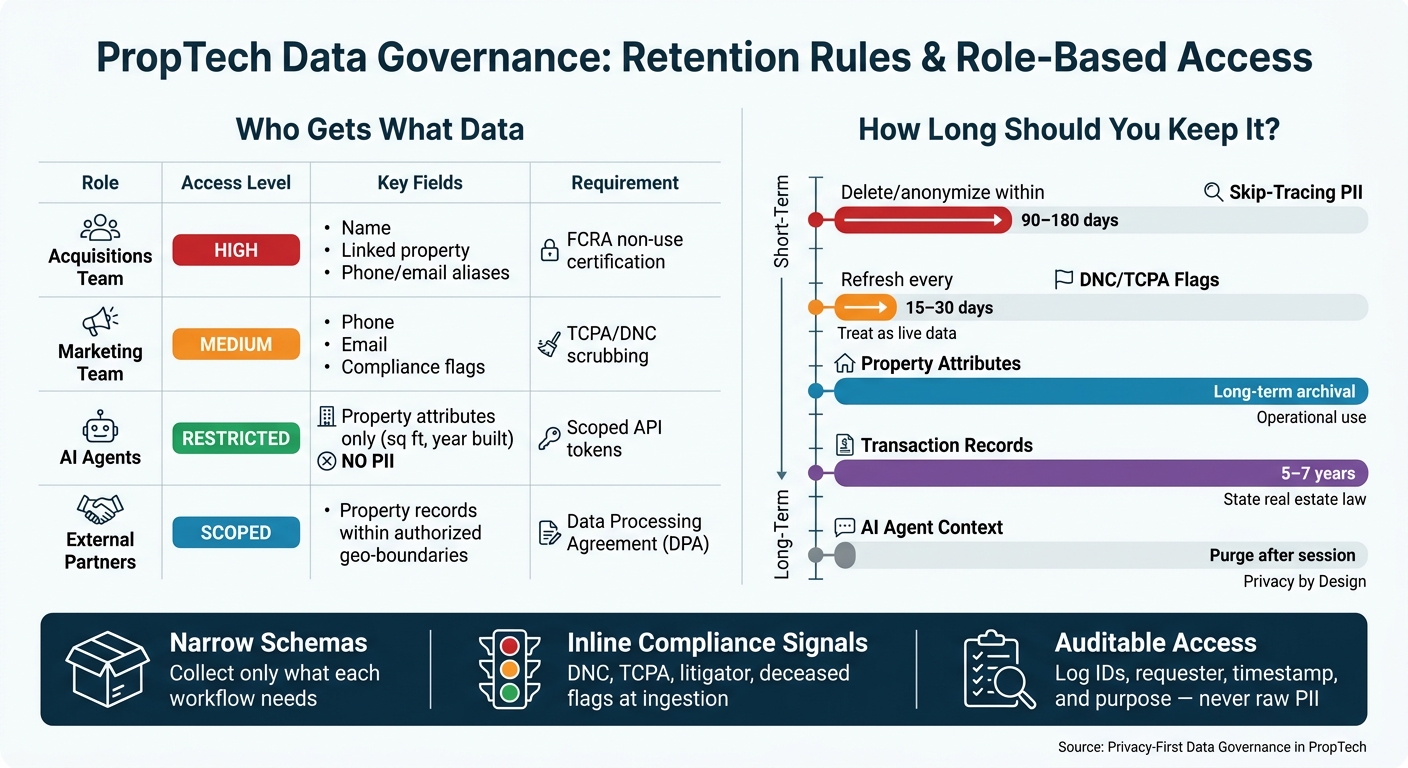
PropTech Data Governance: Retention Rules & Role-Based Access at a Glance
Role-Based Access Rules for Teams, Tools, and APIs
Policies don’t do much on their own. They need controls behind them. That means enforcing least privilege with role-scoped tokens and field-level API responses. Each person, tool, and API connection should get only the fields needed to do the job. Once workflows limit fields, the next layer is access, retention, vendor use, and logging.
Different teams need different slices of data. Acquisitions teams need property-linked identity data to how to skip trace property owners and qualify leads, while marketing teams need contact reachability and compliance signals. Engineering teams and AI agents should use scoped tokens that return only the fields required for the task, not full PII payloads.
| Role/Service | Access Level | Key Data Fields Required | Compliance Requirements |
|---|---|---|---|
| Acquisitions Team | High (Identity + Property) | Name, linked property, phone/email aliases | FCRA non-use certification |
| Marketing Team | Medium (Contact + Signals) | Phone, email, compliance flags | TCPA/DNC scrubbing |
| AI agents | Restricted (Task-Specific) | Property attributes such as square footage and year built, no PII | Scoped API tokens |
| External Partners | Scoped (Market-Specific) | Property records within authorized geo-boundaries | Data Processing Agreement (DPA) |
Field-level access keeps API responses predictable and safer from a privacy standpoint. Role-scoped tokens also make audits easier because access stays tied to purpose. For external partners, API access should stay limited to approved markets through geo-fenced controls by polygon or radius.
Access controls cut down exposure. Retention rules decide how long that exposure can stick around.
Retention Limits, Deletion Schedules, and Archival Decisions
Public-record property attributes usually deserve a longer life than identity data. Skip-trace PII doesn’t. It has a short working life and shouldn’t hang around after its purpose is gone.
| Data Type | Retention Approach | Compliance Driver |
|---|---|---|
| Skip-Tracing (PII) | Delete or anonymize within 90–180 days if no meaningful contact or transaction occurs | Privacy (Data Minimization) |
| DNC/TCPA Flags | Refresh every 15–30 days; do not rely on aged data | TCPA / National DNC Registry |
| Property Attributes | Long-term archival for public-record property attributes | Operational (Valuation History) |
| Transaction Records | 5–7 years, or as required by state real estate law | Regulatory / Audit |
| AI Agent Context | Purge after session completion or task resolution | Privacy by Design |
If a skip-traced lead never turns into anything, there’s usually no reason to keep that PII forever. A good rule of thumb is simple: if the data no longer serves the workflow, it should go. For outreach, suppression and compliance flags should be treated as live data. Pull them at the point of use instead of trusting stale records.
Once retention rules are in place, audit logs show whether those rules were followed.
Vendor Oversight and Audit Logging for High-Risk Data Use
External vendors should follow the same discipline as internal teams: narrow scope, approved use, and masked logs. Every outside partner should work under a Data Processing Agreement (DPA) that spells out permitted use, named data categories, and scheduled reviews to check that the scope still fits the work.
Don’t log raw PII. Log IDs, flags, requester, timestamp, and purpose instead. Masked logging should be the default. Logs aren’t just paperwork for compliance. They’re the evidence trail for access, use, and vendor accountability.
For higher-risk lookups such as identity resolution and skip tracing, track the matched person records returned, not just the number of API calls sent. When a lookup returns a match or near-match, keep a clear record of who asked for it, when they asked, and the stated purpose behind it.
Applying Governance to APIs, Enrichment, and Skip Tracing
The easiest place to put governance to work is inside the tools teams already use every day: APIs, enrichment, and skip tracing. That’s where policy stops being a slide deck and starts shaping what people can see, return, and act on.
Those controls become much more useful when they’re built into schemas, enrichment responses, and skip-trace workflows.
Real Estate APIs: Schema Design, Field Exposure, and Monitoring
One of the most common API mistakes is simple: exposing too much data by default. A better setup is to split sensitive data into separate endpoints, so general property calls stay lean and predictable.
For AI workflows, MCP helps agents ask for only the fields they need. That keeps the context window smaller and cuts down on extra data exposure.
Enrichment and Skip Tracing: Permissible Use, DNC Handling, and Record Quality
Enrichment and skip tracing need different guardrails based on the job they’re being used for. BatchData data is informational only and can’t be used for FCRA-regulated eligibility decisions.
For lead generation, the day-to-day controls are pretty clear: DNC and TCPA scrubbing, plus inline suppression signals. Skip tracing APIs can return DNC registry flags, TCPA flags, litigator indicators, and deceased indicators right in the response. That matters because the compliance signal travels with the data instead of sitting in some separate system.
Phone reachability and email deliverability signals can also cut wasted outreach and improve record quality. For reverse lookups, it helps to return match strength indicators and ranked results. And pricing should be tied to matched records, not raw API calls, so teams are rewarded for higher-quality use.
Once field exposure is narrowed, the next move is to control what enrichment can return and how teams are allowed to use it.
How BatchData Fits Into a Governed PropTech Stack
In a governed stack, BatchData is a good example of how narrow payloads and inline compliance signals can support these controls. Its Comparables API returns a narrow, grouped payload. That keeps sensitive ownership and mortgage data behind separate, permissioned endpoints instead of packing it into general search results.
For skip tracing and contact enrichment, BatchData includes DNC, TCPA, litigator, and deceased indicators inline, so suppression logic stays tied to the data itself. Its Reverse Skip Trace resolves a phone number or email into a person, their aliases, reachable contacts, and linked property in a single call. Its output is informational only, not for FCRA-regulated decisions.
Governance needs change by workflow. Lead generation depends on short-term retention, real-time DNC and TCPA scrubbing, and suppression logging. Collections outreach adds deceased indicators and line-type checks. Different use cases, same three controls:
- Narrow schemas
- Inline compliance signals
- Auditable access
Conclusion: A Practical Privacy-First Governance Model for PropTech Teams
Put it all together, and privacy-first governance becomes the day-to-day layer that helps PropTech teams keep data limited, usable, and defensible. Inline compliance flags, lean APIs, identity-linked records, explainable matching logic, and metered-by-match pricing cut waste, build trust, and support less wasted outreach across each workflow.
At the vendor level, compliance signals can support suppression. But consent, internal suppression lists, registries, and calling-hour rules still sit with the customer.
A good place to start is simple: shift suppression left, narrow real estate API schemas, and document permitted use cases. For most teams, that’s enough to get moving.
FAQs
How do we start privacy-first governance?
Start by building compliance signals into your data workflows instead of tacking them on at the end. For proptech teams, that means returning DNC, TCPA, litigator, and deceased indicators inline, so you can suppress records before any outreach happens.
You’ll still need to keep your own suppression lists, consent records, and state calling-hour compliance in order. BatchData can help surface these signals inside your CRM or lead-gen tools.
What data should PropTech teams avoid collecting?
PropTech teams should be careful about the data they collect. If that data could be used to decide whether someone qualifies for credit, insurance, employment, or housing, it may fall under the Fair Credit Reporting Act.
They should also avoid using property data or automated valuation outputs as stand-ins for professional appraisals or certified reports. And third-party indicators shouldn’t be treated as certified suppression files.
How often should DNC and TCPA data be refreshed?
DNC and TCPA data should be refreshed right before any outreach attempt to support compliance.
Don’t rely on periodic updates alone. Use inline compliance signals to scrub records at the point of contact, so suppression happens before an agent places a call. BatchData provides these signals to support internal governance workflows.