
































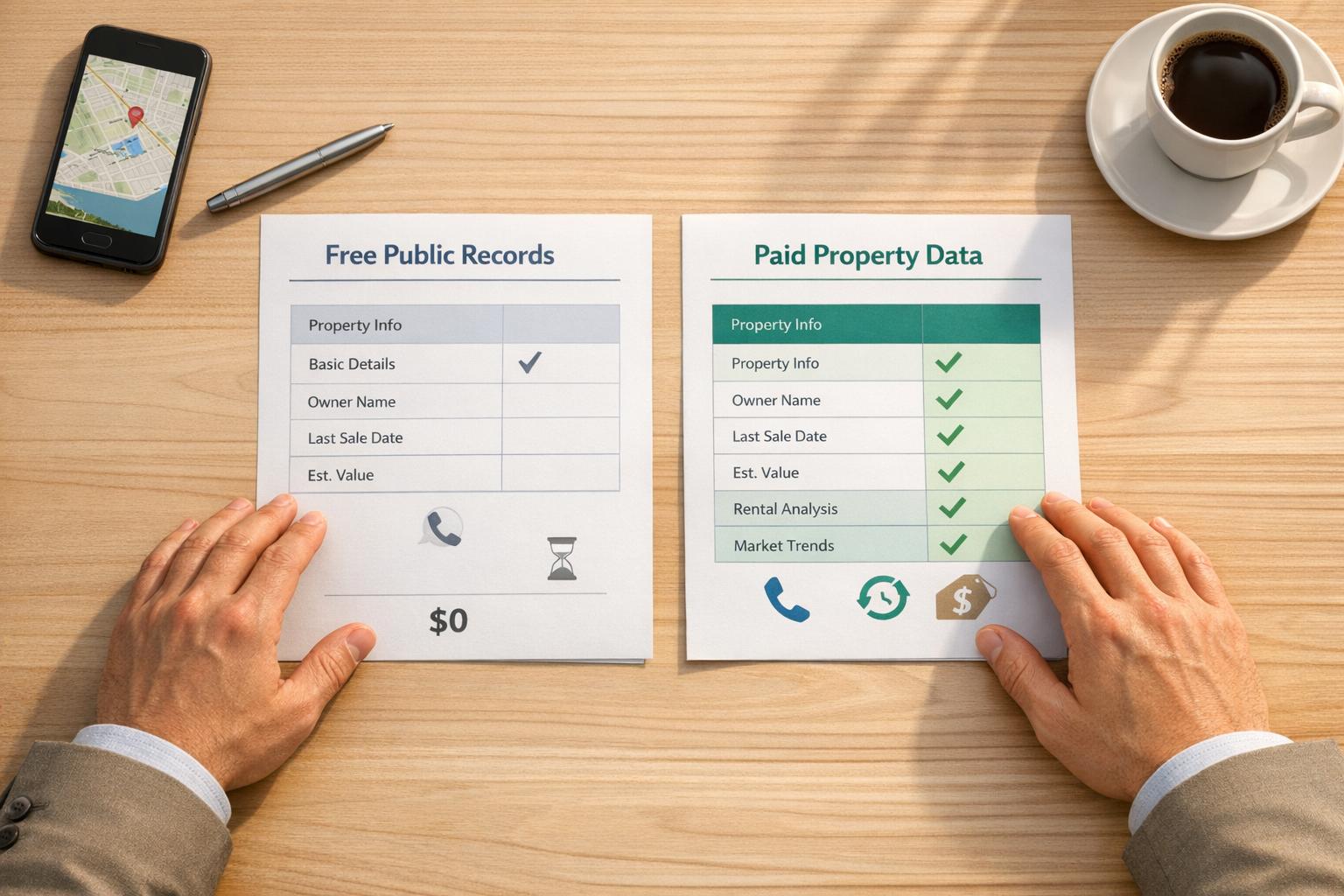
When deciding between free and paid property data, the choice boils down to time, accuracy, and efficiency. Free data sources, like public records, offer basic ownership details from comprehensive real estate datasets but often lack contact information and are time-consuming to access. Paid platforms provide faster, more accurate data with verified contact details and frequent updates, but they come with a cost.
Key Takeaways:
- Free Data: Accessible via public records but limited in scope, outdated, and time-intensive.
- Paid Data: Faster, more precise, and includes enriched contact details, but requires a subscription or pay-per-use fees.
Quick Comparison:
| Feature | Free Property Data | Paid Property Data |
|---|---|---|
| Accuracy | Basic ownership details | 95%+ accuracy with validation |
| Cost | No direct fee, time-intensive | $80–$200/month or pay-per-use |
| Contact Info | Rarely available | Verified, up to 76% accuracy |
| Update Frequency | Quarterly to annually | Daily or 24–48 hours |
| Ease of Use | Precision property searches | Automated with APIs |
For small-scale investors, free data may suffice. However, if you’re scaling or need speed and precision, paid platforms are often worth the investment.
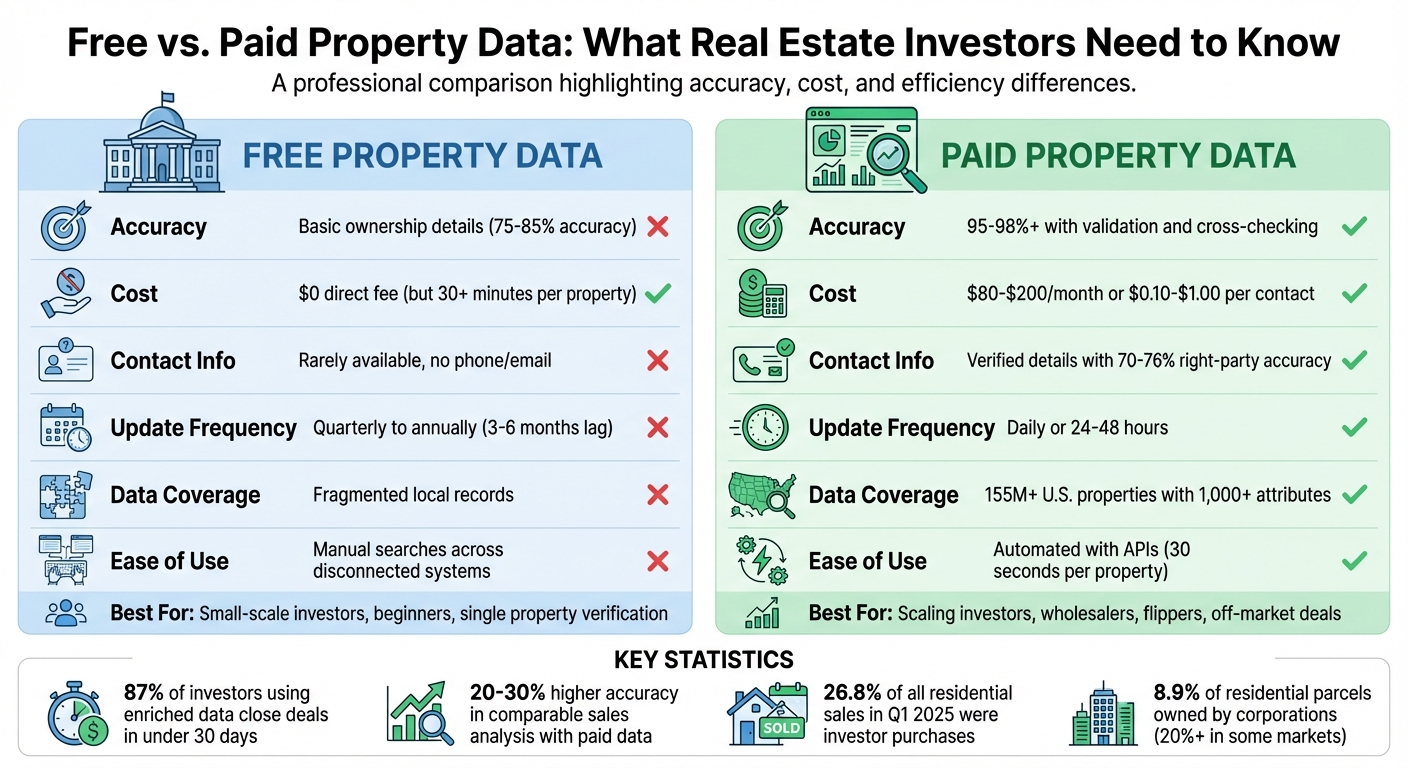
Free vs Paid Property Data Comparison for Real Estate Investors
Real Estate Data Masterclass 2025: AI + Automation
sbb-itb-8058745
1. Free Property Data
Free property data is typically sourced from county assessor offices, recorder’s offices, and other government resources. These public records focus on ownership details, tax assessments, and legal transfers. While you can access essential information like the property owner’s name and mailing address, the scope of property data enrichment is pretty limited.
Data Accuracy
Public records are highly reliable for verifying ownership and title information. If you need to confirm who legally owns a property or validate a recent sale, county records are a dependable go-to. However, they fall short when it comes to providing contact details. For example, 8.9% of residential parcels in the U.S. are owned by corporations, with that number jumping to over 20% in markets like St. Louis. Properties held under LLCs or trusts only list the legal entity, leaving you in the dark about the actual decision-maker behind the scenes. This creates a significant gap in actionable information.
Owner Contact Details
Don’t expect to find phone numbers or email addresses in county records – they’re rarely included. Paid platforms, on the other hand, can achieve right-party contact (RPC) accuracy rates of over 70%, but free records lack this depth. This means if you’re relying on public data, you’ll likely spend extra time digging for contact information, which slows down your process and delays critical decisions.
Update Frequency
Government databases operate on their own timelines, updating anywhere from quarterly to annually, depending on the jurisdiction. This delay poses challenges for investors. Contact information, for instance, ages quickly – a phone number that’s valid today might be disconnected in six months. Outdated records lead to higher bounce rates in outreach campaigns and wasted time chasing leads that are no longer viable. For investors needing current data, these lags can significantly impact results.
Cost Structure
While free data doesn’t come with a price tag, the real cost is your time. Pulling property details manually from county websites can take hours or even days per property. While verifying a single property might be manageable, scaling this process to 500 properties becomes a logistical nightmare. Plus, you’re restricted to individual searches, making it impossible to automate workflows or analyze entire markets efficiently.
2. Paid Property Data
Paid property data platforms address the shortcomings of free options by offering greater accuracy and faster updates. These platforms gather information from verified sources like county records, MLS feeds, foreclosure filings, and proprietary databases. By cross-referencing and validating data, they achieve 98%+ accuracy for property valuations and ownership details – far exceeding the 75–85% accuracy typical of free tools like Zillow Zestimates. For real estate investors, this level of precision is critical. Even small errors in valuations or outdated ownership records can throw off comparative analyses and lead to costly mistakes.
Data Accuracy
Paid platforms rely on rigorous validation processes, cross-referencing multiple databases, and regular audits to minimize errors. This meticulous approach ensures that investors encounter fewer surprises when conducting comparable market analyses or verifying ownership structures. In fact, some services report that investors can achieve 20–30% higher accuracy in comparable sales analysis by using paid data. This improved accuracy can directly impact investment returns. Additionally, these platforms excel at providing precise owner contact details, which are often crucial for deal-making.
Owner Contact Details
One standout feature of paid platforms is their ability to deliver comprehensive and verified owner contact information. This includes phone numbers, email addresses, and current mailing addresses, often enhanced through skip tracing and data enrichment techniques. Top-tier services boast hit rates of 70–90% for retrieving contact details, with right-party contact accuracy exceeding 70%. A 2024 survey revealed that 87% of investors using enriched owner contact data were able to close deals in under 30 days, underscoring the importance of having up-to-date communication channels.
Update Frequency
Another key advantage of paid platforms is their frequent updates. Many services refresh their databases daily or within a 24–48 hour window, ensuring access to the most current information. In contrast, free sources often lag by 3–6 months, which can be a significant disadvantage when trying to connect with motivated sellers quickly. Staying ahead with fresher data can make all the difference in competitive markets.
Cost Structure
These benefits come at a cost, but pricing is flexible. Subscription plans typically range from $80 to $200 per month for individual investors, while pay-per-record options cost $0.10 to $1.00 per contact, depending on the data’s depth. For those managing 1,000–5,000 leads monthly, a budget of $200–$400 per month is usually sufficient for mid-tier plans. Many providers also offer trial periods of 7–14 days, allowing users to test data accuracy against local market information before committing.
Advantages and Disadvantages
Paid property data platforms deliver results in as little as 30 seconds, while manual searches through free sources can take upwards of 30 minutes – or even longer.
Free sources typically provide just the basics, like legal ownership details. In contrast, paid platforms offer over 95% accuracy thanks to extensive cross-checking. This includes mortgage histories, liens, and updated contact information. Such precision is invaluable when analyzing comparable sales or reaching property owners quickly. As Chris Finck, Director of Product Management, put it:
"What used to take 30 minutes now takes 30 seconds. BatchData makes our platform superhuman".
Here’s a side-by-side comparison of the key differences:
| Feature | Free Property Data | Paid Property Data |
|---|---|---|
| Accuracy | Basic legal ownership | 95%+ through comprehensive cross-checking |
| Cost | No direct fee, but time-intensive | Monthly subscriptions or pay-per-use pricing |
| Data Coverage | Fragmented records from local sources | Over 155M U.S. properties with 1,000+ attributes nationwide |
| Ease of Use | Manual searches across disconnected systems | Unified interface with real estate API or bulk delivery options |
| Owner Contact Info | Outdated contact details | Up to 76% right-party accuracy |
Conclusion
When it comes to choosing between free and paid data tools, the best approach depends on the size of your portfolio and your investment goals. If you’re managing a smaller portfolio or just getting started, free resources – like public records and basic calculators – can be a practical way to gather insights without adding to your expenses. This is especially relevant for small investors, who make up 90% of the investor-owned housing market and hold 85% of all investor inventory, accounting for 15.6 million properties.
For those aiming to scale their operations or improve efficiency, paid platforms become indispensable. As Sharad Mehta explains:
"The right tool depends on your needs and budget. Begin with a free data solution to streamline your workflow and upgrade to paid options as your business grows."
Investors involved in wholesaling, flipping, or pursuing off-market deals often benefit from paid tools that allow for faster lead processing. For example, combining distress indicators – like tax liens and code violations – helps transform scattered data into actionable leads.
With investor purchases making up 26.8% of all residential sales in Q1 2025, the competition is intense. The key to staying ahead lies in tailoring your data strategy to match your deal pipeline effectively.
FAQs
When is paid property data worth it for my investing strategy?
Paid property data becomes indispensable when your strategy hinges on precise, thorough, and current information. It proves particularly valuable for tasks like in-depth analysis, assessing risks, or staying ahead in competitive, large-scale, or data-focused decisions. If accuracy can directly influence your investment results, this type of data is a must-have.
How can I verify owner contact info before I reach out?
Start by looking into county records to gather ownership details such as legal names and addresses. These records are a reliable starting point for identifying property owners.
Next, use skip tracing to locate verified phone numbers and email addresses. This method helps you dig deeper to find accurate contact details. Once you have the information, make sure to validate it for accuracy.
To ensure the address is valid and deliverable, utilize USPS address verification. This step is particularly useful for identifying absentee property owners who may not reside at the property in question.
For a more efficient process, consider automating the task with data enrichment tools like BatchData. These tools provide updated and reliable contact information, saving you time and increasing the likelihood of successful communication.
What data fields matter most for finding off-market deals?
Key information to uncover off-market deals includes ownership details, the property’s current status (such as pre-foreclosure or tax delinquency), and distress signals like liens or code violations. A powerful strategy is signal stacking, which involves combining multiple distress indicators to pinpoint highly motivated sellers. This approach allows investors to focus on properties with a greater likelihood of turning into successful deals.