




































Skip tracing is the process of finding accurate contact information – like phone numbers, emails, and mailing addresses – for property owners when public records are outdated or incomplete. It’s a critical tool in real estate for connecting with absentee landlords, distressed property owners, or those behind LLCs and trusts. Here’s what you need to know:
- Purpose: Locate property owners to negotiate off-market deals or connect with hard-to-reach sellers.
- Process: Starts with public records, uses advanced skip tracing tools (like credit bureaus or utility data), and verifies details for accuracy.
- Effectiveness: Advanced skip tracing achieves up to a 76% right-party contact rate, far exceeding the industry average of 25%.
- Tools: Platforms like BatchData streamline the process by aggregating data from over 3,200 sources, verifying phone types, and ensuring compliance with regulations.
- Compliance: Stay within legal boundaries by adhering to the FCRA, TCPA, and DNC registry rules.
Skip tracing turns property addresses into actionable leads, making it easier to reach motivated sellers and secure off-market properties. Whether you’re targeting distressed homes or absentee owners, this guide covers the steps, tools, and legal considerations to help you succeed.
What is Skip Tracing?
Definition and Core Principles
Skip tracing is the process of finding someone’s contact details – like phone numbers and email addresses – when that information isn’t easily accessible through public records. In real estate, it usually starts with a property address and ends with confirmed contact details for the current owner. The process typically involves four steps: identifying the owner through property records, cross-referencing multiple databases, gathering contact information, and verifying the accuracy of the data. Some advanced providers even pull data from over 3,200 independent sources to ensure accuracy, which explains why data quality can vary significantly.
Modern skip tracing goes beyond the basics, uncovering the real individuals behind LLCs and trusts. This is especially helpful when properties are owned by corporate entities, as it lets you connect directly with decision-makers rather than generic registered agents. This detailed process helps professionals bypass outdated records, making it a valuable tool in the real estate industry.
Why Real Estate Professionals Need Skip Tracing
Skip tracing takes outdated public records a step further by providing verified contact details like mobile numbers, landlines, and emails. Public records might help you identify distressed properties or absentee owners, but they often lack the precise contact information needed to start a conversation. Skip tracing fills this gap by delivering multiple verified contact points.
The benefits are clear. High-quality skip tracing boasts a 76% right-party contact (RPC) rate, which is nearly three times the industry average of around 25%. This means less time wasted on wrong numbers and more opportunities to connect with property owners. Additionally, having multiple verified contact methods allows for multi-channel outreach, letting you test strategies like cold calling, text messaging, and email campaigns to see what works best for each lead.
sbb-itb-8058745
How to Make the Most of Skip Tracing
Watching this video is a great start, but you can also follow our step-by-step guide on how to skip trace property owners to master the process.
How Skip Tracing Works
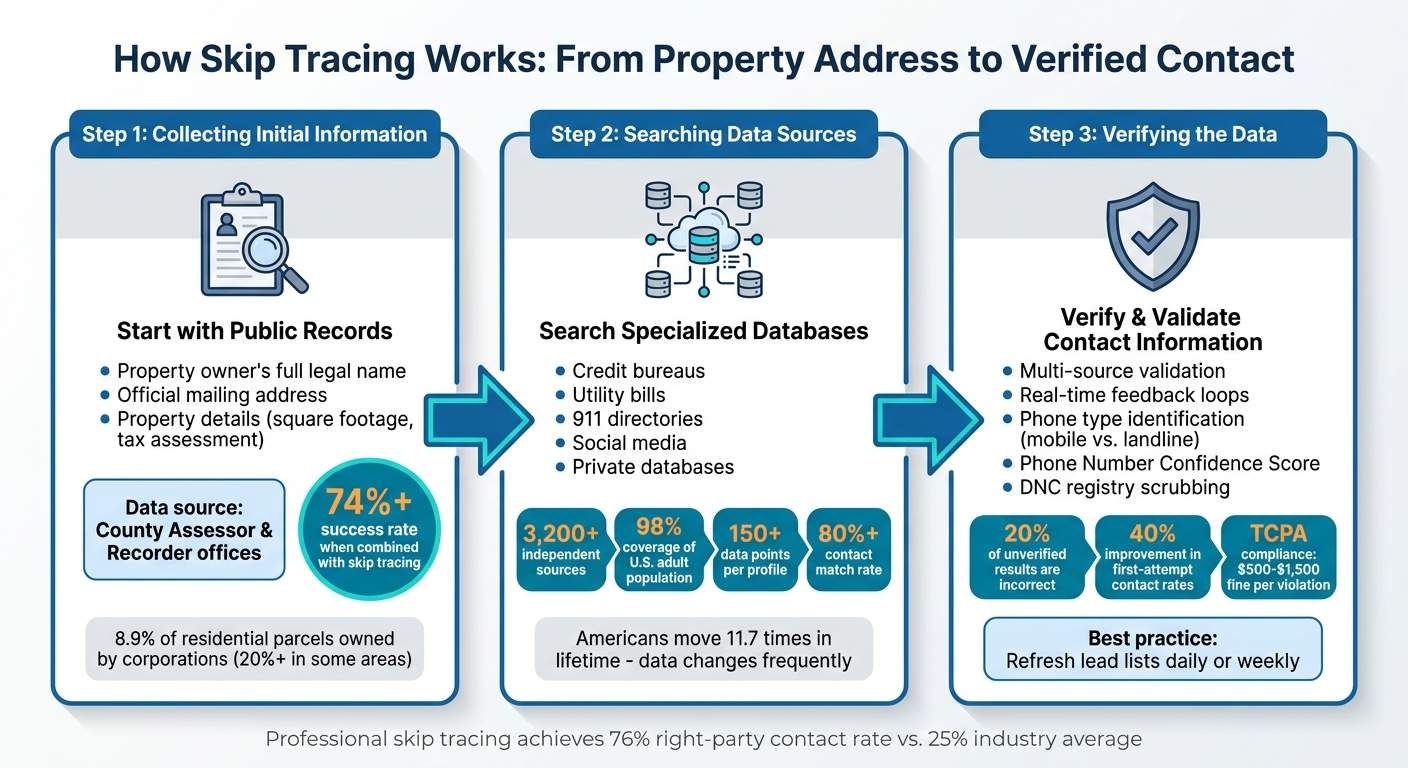
How Skip Tracing Works: 3-Step Process for Real Estate Professionals
Skip tracing transforms a property address into verified contact details through a structured, three-step process. This method minimizes wasted time on outdated data by building a complete and accurate contact profile at every stage.
Step 1: Collecting Initial Information
The process kicks off with real estate wholesale lead generation using data from government-verified public records, such as those available at county assessor and recorder offices. These records serve as the foundation for ensuring accuracy in subsequent steps. Key details to gather include the property owner’s full legal name, their official mailing address (which often differs from the property address), and basic property information like square footage and tax assessment values.
To confirm legal ownership, visit your County Assessor’s office – either in person or online. For additional verification, the County Recorder’s office provides access to recorded deeds and liens, which document ownership history. This step is crucial because combining public records with skip tracing increases the success rate of right-party contact attempts to over 74%.
However, corporate ownership can complicate matters. For example, corporations own 8.9% of residential parcels in the U.S., with this number exceeding 20% in areas like St. Louis. LLCs often obscure the true decision-maker, requiring advanced tracing methods to uncover the responsible party. Keeping detailed records during this phase is essential, especially for any future legal verification needs.
Step 2: Searching Data Sources
Professional skip tracers go beyond public records, tapping into specialized databases to create a detailed contact profile. These databases pull data from sources like credit bureaus, utility bills, and even 911 directories to locate current phone numbers and addresses.
The most effective platforms aggregate information from thousands of sources, including social media and private databases, into a single, searchable profile. Some services boast coverage for over 98% of the adult population in the U.S.. Advanced platforms rely on more than 150 data points to achieve contact match rates of over 80%. Choosing a platform that sources data from credit bureaus and 911 directories is particularly important because, on average, Americans move 11.7 times in their lifetime, making contact details prone to frequent changes. Once the data profile is assembled, the next step is to verify its accuracy.
Step 3: Verifying the Data
Verification is what separates accurate leads from ineffective ones. Without proper validation, around 20% of skip tracing results are incorrect. Leading platforms address this issue by using multi-source validation and real-time feedback loops to keep contact information up-to-date. This step sets advanced skip tracing apart from basic methods that rely solely on public records.
Before reaching out, it’s important to verify whether a phone number is mobile or landline. This distinction is critical for connection strategies and compliance with the Telephone Consumer Protection Act (TCPA), as violations can result in fines ranging from $500 to $1,500. Professional platforms often assign a "Phone Number Confidence Score" to prioritize the most reliable contact points and automatically scrub numbers against the National Do Not Call registry.
Improved skip tracing tools and techniques have boosted first-attempt contact rates by 40%. Since contact information can quickly become outdated, it’s essential to refresh and verify lead lists daily or weekly to avoid using disconnected numbers.
How Real Estate Professionals Use Skip Tracing
Skip tracing transforms property addresses into actionable leads by connecting professionals directly with property owners. The challenge lies not in identifying properties but in initiating contact. Skip tracing bridges that gap by linking verified contact details to property records, making it easier to reach owners who aren’t actively listing their homes.
Finding and Contacting Leads
Once contact data is verified, skip tracing allows professionals to directly connect with property owners. It provides multi-channel data – like mobile numbers, landlines, and email addresses – that can be used for cold calling, SMS, or email outreach. For example, BatchData’s skip tracing boasts a 76% right-party contact (RPC) rate, which is roughly three times the industry average. This means their data is more likely to connect you with the actual property owner rather than a wrong number or disconnected line.
The best workflows integrate skip tracing with tools like CRM systems and automation platforms such as Zapier or Make.com. These systems can automatically skip trace new leads as they’re added to your database, allowing for instant outreach. To maximize your resources, pre-qualify your lists before using skip tracing credits. Focus on properties with 40% or more equity, ownership of 15+ years, or signs of distress to ensure you’re targeting high-value prospects.
Advanced skip tracing tools also identify phone types (mobile or landline) and offer features like DNC (Do Not Call) scrubbing to stay compliant with TCPA regulations. Violating these rules can result in penalties ranging from $500 to $1,500 per call. Prioritize leads using confidence scores from skip tracing APIs to focus your efforts on the most reliable matches.
Reaching Property Owners
Skip tracing is especially helpful for finding owners who’ve moved, changed their contact information, or ignore traditional mail. This includes absentee landlords, probate heirs, or individuals facing foreclosure – groups that often represent valuable opportunities because their circumstances may drive them to sell.
Timing is critical when dealing with distressed properties. For instance, lenders cannot foreclose on a property until the borrower has been delinquent for at least 120 days. This period gives real estate professionals a chance to assist owners before their property goes to auction. By tracking filings like "Notice of Default" (NOD) or "Lis Pendens", you can use skip tracing to contact owners during this crucial window.
Before launching large-scale calling campaigns, validate skip-traced data. You can cross-check details on social media or send a small outreach, like a postcard, to confirm the lead is still active. Using a multi-channel approach – combining phone calls and emails – can further increase your chances of connecting with property owners. This strategy transforms verified data into real opportunities for engagement.
Finding Off-Market Properties
Skip tracing is a powerful tool for uncovering off-market properties – homes not listed on the MLS. It helps locate owners of vacant homes, distressed properties, or those in disrepair. Real estate investors often layer data to identify owners who may be motivated to sell due to life events or financial challenges, such as pre-foreclosure, tax delinquency (3+ years), probate cases, or divorce.
Having direct contact information allows professionals to negotiate with owners before their properties hit the market. This reduces competition and can lead to deals below market value. Additionally, skip tracing can identify portfolio landlords – owners with multiple properties in a specific area – offering opportunities to acquire several assets in one transaction.
Here’s a breakdown of key lead sources and their target profiles, along with motivation signals:
| Lead Source | Ideal Target | Motivation Signal |
|---|---|---|
| Public Records | Long-term owners (15+ years) | High equity; potential for downsizing |
| Absentee Owners | Out-of-state landlords | "Tired landlord" syndrome; ready to liquidate |
| Pre-Foreclosure | Homeowners in default | Time-sensitive need to protect credit/equity |
| Lien Records | Owners with tax/mechanic liens | Financial pressure not yet visible in foreclosure |
| Expired MLS | Owners who failed to sell | Frustrated by market; demonstrated intent to sell |
To streamline your efforts, automate triggers so that new pre-foreclosure filings kick-start skip tracing and add contacts to your CRM for immediate follow-up. By layering data – such as long-term ownership, lien records, and absentee status – you can create a highly focused Ideal Customer Profile (ICP) that highlights the most motivated sellers.
Skip Tracing Tools and Services for Real Estate Professionals
Finding the right skip tracing tool can save you hours of chasing dead-end leads and connect you with motivated sellers in no time. These tools are designed to fit seamlessly into the workflows of real estate professionals, turning raw data into actionable insights. BatchData stands out as a platform tailored to the unique challenges of locating property owners who may have moved or are hidden behind corporate structures.
BatchData Skip Tracing Features
BatchData’s skip tracing engine processes results in milliseconds, enriching property records with verified contact data in real time via its API. The platform pulls data from multiple sources, refreshing its datasets daily and using feedback from over 20,000 users. This approach delivers a 76% right-party contact (RPC) rate – about three times the industry average.
One of its standout features is LLC and trust unmasking, which links LLCs and trusts to the individuals behind them. This eliminates the need to go through registered agents, allowing you to reach decision-makers directly. This is especially important for off-market deals involving properties held by corporate entities.
"Our technology is designed to see ‘behind corporate veils’ by connecting LLCs and trusts to the actual individuals who own them." – BatchData
Each skip trace provides multiple phone numbers (categorized as mobile or landline), deliverable email addresses, and the current mailing address of the owner. To help prioritize outreach, the platform includes phone confidence scores and automatically scrubs phone numbers against the National Do Not Call (DNC) registry. It also flags known TCPA litigators, minimizing legal risks during campaigns.
Accessing skip tracing data is straightforward. You can perform single lookups for high-value properties, upload bulk CSV files using the BatchLeads platform (no coding required), or integrate directly via API for automated workflows. For high-volume operations, the bulk skip tracing feature allows you to enrich thousands of records at once, saving time compared to manual searches.
| Plan Name | Price | Description | Features |
|---|---|---|---|
| Pay-As-You-Go | Variable | Flexible pricing for skip tracing | Access to property and contact data, APIs, bulk delivery, and professional services; pay only for what you use |
| Custom Solutions | Custom | Tailored data solutions for businesses | Custom datasets, professional services, flexible delivery methods; pricing and features depend on specific business needs |
In addition to these features, property data enrichment ensures your leads are as complete and actionable as possible.
Property Data Enrichment
Property data enrichment bridges the gaps left by public records. BatchData connects property addresses to ownership history, transaction details, lien data, tax assessments, and mortgage information. This gives you a comprehensive view of the property and its owner’s financial profile. For investors targeting properties held in LLCs, the platform’s ability to pierce the corporate veil is invaluable. Instead of being stuck with a registered agent’s address, you gain access to the personal contact details of the actual owner, streamlining negotiations and bypassing intermediaries.
Phone and Address Verification
After enriching property data, verifying contact details ensures your outreach efforts are effective. BatchData standardizes addresses using USPS formatting, validates them for accuracy, and employs geocoding to convert them into coordinates. Tools like Residential Delivery Indicator (RDI) and Delivery Point Validation (DPV) confirm that addresses are valid and reachable, so your mailers land in the right hands.
For phone verification, the system identifies phone types, allowing you to tailor outreach – like prioritizing SMS for mobile numbers. Additionally, the Litigator Scrub feature flags known TCPA litigators before you launch SMS or calling campaigns, reducing legal risks. When combined with the platform’s high RPC rate, these verification tools ensure your marketing budget is spent on leads that connect.
Legal and Ethical Requirements for Skip Tracing
Skip tracing in real estate operates under strict federal and state regulations, with significant penalties for non-compliance. The Fair Credit Reporting Act (FCRA) mandates that you must have a legitimate purpose before accessing consumer reports from credit bureaus. For example, you can’t use FCRA-regulated data for general lead generation – it must be tied to a specific business need, such as verifying property ownership for acquisition purposes. Violating this law could cost up to $3,750 per incident.
The National Do Not Call (DNC) Registry also impacts how you can approach potential leads. This registry prohibits unsolicited telemarketing calls to numbers listed on it unless you have prior consent or an existing business relationship. To comply, you need to scrub your phone lists against the registry, which is updated quarterly, and keep records for at least five years. As of 2023, violations can result in fines of up to $43,792 per call.
Another key regulation is the Telephone Consumer Protection Act (TCPA), which limits autodialed or prerecorded calls and texts to mobile phones without express written consent. Penalties range from $500 to $1,500 per violation. For instance, in 2023, a company faced a $1.2 million fine for TCPA violations involving skip-traced leads.
| Regulation | Key Requirement | Maximum Penalty |
|---|---|---|
| FCRA | Permissible purpose | Up to $3,750 per violation; class actions |
| DNC | Scrub lists regularly against updated registry | Up to $43,792 per call (2023) |
| TCPA | Written consent for autodialed calls/texts | $500–$1,500 per violation |
| CAN-SPAM | Include opt-out links and accurate email headers | Up to $51,744 per email |
State laws add another layer of complexity. For example, California’s CCPA requires businesses to provide opt-out options for personal data sales, limit data collection, and ensure secure handling of information. To comply, you should collect only essential data, use encryption for security, and restrict data access to authorized personnel. Implementing workflow checklists and conducting annual compliance training can reduce legal risks by 67%.
Some tools, like BatchData, simplify compliance by automatically scrubbing phone numbers against the National DNC registry and flagging known litigators. One Florida agent avoided a $50,000 fine by maintaining detailed five-year records. To protect your business, keep documentation of data sources, access dates, and contact attempts for at least five years.
Best Practices for Real Estate Professionals
Integrating Skip Tracing into Your Workflow
To make the most of your lead management efforts, it’s smart to weave skip tracing into your daily workflow. Tools like BatchData can be linked to your CRM through automation platforms like Zapier, allowing seamless data integration. By processing skip tracing in weekly batches, you can focus on high-value leads and maintain consistent outreach. Documenting this process ensures that new team members can quickly get up to speed without needing extensive training.
Start small with 100-record test batches to evaluate your return on investment (ROI) before scaling up. Track metrics like connect rates and cost per contact to fine-tune your approach. To keep your team organized, use project management tools like Asana or Trello to assign skip tracing tasks, set clear deadlines, and monitor progress.
Keeping Your Data Accurate
Lead data can degrade by as much as 30% each year, making regular updates a must for successful skip tracing. Cross-check your information against multiple reliable sources before reaching out, aiming for an accuracy rate of at least 90%.
Review your contact database every quarter to eliminate outdated entries. Re-skip your lists every 90 days to refresh phone numbers and addresses that may have changed. Create a feedback loop where your team records which contact details were accurate during outreach. Use this information to refine your data sources. BatchData’s pay-as-you-go model makes it cost-effective to keep your data fresh without committing to long-term contracts.
Following Legal and Ethical Standards
Accuracy is important, but so is staying on the right side of the law. Develop written procedures for every stage of skip tracing, from data collection to follow-up, to ensure consistency and compliance. Set up clear approval workflows and designate sign-off responsibilities before initiating outreach. Use skip tracing tools that automatically scrub phone numbers against the National Do Not Call registry and flag known TCPA litigators to minimize legal risks.
Maintain detailed records of your skip tracing activities for at least five years. This includes documenting the sources you used, the dates they were accessed, and any contact attempts made. These records can safeguard your business in case of compliance inquiries. Train your team on ethical communication practices, such as clearly stating your purpose and immediately honoring opt-out requests. Regularly audit your team’s compliance to ensure standards are upheld. By following these practices, you can improve efficiency, maintain accuracy, and stay compliant throughout your skip tracing process.
Conclusion
Skip tracing turns outdated leads into actionable opportunities by helping you gather and verify contact details, giving you direct access to property owners and uncovering off-market deals. It’s particularly effective for locating absentee owners, reaching distressed property holders, and securing properties at prices often 20% below market value.
BatchData takes this process to the next level with its skip tracing features, achieving a 76% right-party contact rate – about three times the industry average. This is made possible by pulling data from over 3,200 independent sources. Their tools include property data enrichment, phone and address verification, and automated compliance screening, ensuring that your contact information stays accurate and meets FCRA and TCPA regulations. Plus, with a pay-as-you-go pricing model ranging from $0.08 to $0.15 per record for bulk tracing, you can keep your data current without committing to long-term contracts.
Real estate professionals who adopt skip tracing report faster deal cycles – up to twice as quick – and 30–50% higher contact rates compared to traditional methods. By automating data enrichment with CRM integrations, processing records in batches, and conducting regular database audits, you can improve lead quality, speed up acquisitions, and scale your operations efficiently while staying compliant.
Want to see the benefits firsthand? Start by testing BatchData’s skip tracing on 100 records to measure your ROI. Track connect rates, refine your workflows, and train your team on ethical outreach practices. With these steps, you’ll turn hard-to-reach property owners into closed deals and gain a competitive edge over those still relying on outdated techniques.
FAQs
When should I skip trace a lead versus relying on public records?
Skip tracing works best when public records fall short – like when they’re outdated or missing key details. This is often the case with absentee property owners, LLCs, or trusts. Public records typically don’t include accurate contact information, such as phone numbers or email addresses. That’s where skip tracing steps in. By pulling data from a variety of sources, it delivers up-to-date, reliable contact details. This makes reaching elusive property owners much more manageable, boosting your chances of closing deals faster and with less hassle.
How can I tell if skip-traced phone numbers are safe to call or text?
To make sure skip-traced phone numbers are safe to use, it’s essential to stick to legal and ethical practices. Always rely on compliant sources and double-check that the data you’re using complies with applicable laws. Additionally, ensure your intended use aligns with privacy regulations like the Telephone Consumer Protection Act (TCPA).
Many reputable skip-tracing services include built-in safeguards, such as access to "Do Not Call" lists and litigator scrub checks, to help you avoid potential legal trouble. Following these steps not only reduces risks but also ensures your outreach efforts remain responsible and respectful.
How often should I re-skip trace my lists to keep contacts accurate?
Re-skip tracing is an important step to keep contact information accurate over time. Since data can change frequently, it’s a good idea to update it on a regular basis. How often you should do this depends on how quickly your information becomes outdated. Reviewing the accuracy of your lists and the frequency of changes can help you decide on the right schedule for updates.


