


































Scenario analysis helps real estate investors prepare for market changes by modeling different future scenarios – best-case, worst-case, and most likely. It evaluates how factors like interest rates, property values, and operating expenses impact investment outcomes, offering a structured way to assess risks and opportunities.
Key Takeaways:
- What it is: A method to predict financial outcomes under varying market conditions.
- Why it’s useful: Helps investors anticipate risks, adjust strategies, and make data-driven decisions.
- How it works: Combines variables (e.g., GDP, rental income, interest rates) with financial metrics (e.g., NOI, IRR, cap rate) to model scenarios.
- Example: A 1% rise in interest rates could reduce ROI by 8%, highlighting the importance of locking in favorable financing terms.
By tracking economic indicators, property-specific metrics, and using tools like Monte Carlo simulations, investors can make smarter decisions about acquisitions, portfolio management, and market shocks. Regular updates to assumptions and data are critical for accuracy.
Sensitivity Analysis – What-If Scenarios In Real Estate Financial Modeling
sbb-itb-8058745
Core Elements of Scenario Analysis
Scenario analysis becomes a powerful tool when grounded in three key components: market variables, financial metrics, and assigned probabilities. Without these, the process risks becoming speculative instead of strategic. Below, we dive into the market variables that form the backbone of robust scenario planning.
Market Variables to Track
Tracking the right market variables is like having a compass in uncertain waters. Economic indicators such as GDP growth, inflation, interest rates, employment levels, and consumer confidence are foundational. These macroeconomic factors shape property demand and pricing trends on a broad scale.
For more granular insights, property-specific metrics are indispensable. Keep an eye on rental rates, occupancy and vacancy levels, property values, and tenant turnover. These details help gauge how individual assets perform within the broader market. For example, in March 2025, Coldwell Banker Horizon Realty analyzed a $4,000,000 multifamily property in Toronto generating $400,000 in annual rental income. Their scenario testing showed that a 5% increase in rental income raised the cash-on-cash return by 1.5%, while a 10% rise in operating expenses reduced Net Operating Income (NOI) by $12,000.
Operational costs are another critical piece of the puzzle. Expenses like maintenance, property management fees, taxes, insurance, and utilities can shift dramatically depending on market conditions. A 5% rise in operating costs could cut NOI by 3% to 5%, underscoring the importance of stress-testing these variables. External factors, such as zoning law changes or property tax adjustments, can also have an immediate and significant impact on investment outcomes.
Financial Metrics for Evaluation
Once market variables are identified, financial metrics translate these changes into measurable investment performance. Net Operating Income (NOI) is a cornerstone metric, reflecting gross operating income minus operating expenses. It isolates a property’s performance from financing variables, making it ideal for scenario testing. Shifts in rental income or operating expenses flow directly into NOI, offering a clear performance snapshot.
Capitalization rate (cap rate) connects NOI to property value. Even slight changes in cap rates – say, 0.25% to 0.5% – can significantly alter property valuation and sale proceeds. For instance, reducing the exit cap rate from 6% to 5% on a multifamily property can elevate the Internal Rate of Return (IRR) from 14.23% to 17.99%.
"A small change in cap rates can make or break a deal".
Cash-on-Cash (CoC) return measures annual pre-tax cash flow relative to total cash invested, making it essential for evaluating financing scenarios. For instance, a 1% hike in interest rates could lower Return on Investment (ROI) by about 8 percentage points while increasing monthly mortgage payments by roughly 10% on a standard 30-year fixed mortgage. Meanwhile, Internal Rate of Return (IRR) accounts for the time value of money, allowing investors to compare profitability across best-case, worst-case, and baseline scenarios over the entire holding period.
The Debt Service Coverage Ratio (DSCR) ensures a property can withstand financial stress. Scenario testing often evaluates vacancy rates to confirm the property maintains a DSCR above the typical minimum threshold of 1.25. For more precise modeling, tools like Excel’s XIRR and XNPV functions are recommended, as they account for irregular cash flow timings and specific dates.
By applying these metrics, investors can quantify market impacts and assign realistic probabilities to various scenarios.
Assigning Probabilities to Scenarios
Assigning probabilities is where scenario analysis transitions from theoretical to actionable. Historical data analysis provides a solid foundation by examining past market cycles, price fluctuations, and vacancy trends. This approach helps identify patterns that might repeat, grounding projections in reality.
Expert judgment adds a qualitative layer. Insights from industry professionals, urban planners, and economists complement quantitative data, enriching the plausibility of "best", "worst", and "most likely" scenarios. For more complex portfolios, stochastic modeling techniques like Monte Carlo simulations can combine macroeconomic forecasts with asset-specific risks to generate a spectrum of potential outcomes.
Statistical methods further refine probability assignments. For example, calculating the standard deviation of returns helps estimate the likelihood of extreme market shifts. Regression analysis, on the other hand, examines how specific variables – like GDP growth – correlate with property values, enabling more precise predictions. If an outcome has only a 5% probability, analysts often use this as a threshold to focus on more probable scenarios.
"Scenario analysis is only as good as the inputs and assumptions made by the analyst".
Regular updates are crucial. Real estate markets evolve quickly, and outdated assumptions can lead to flawed strategies. With these tools in place, investors can allocate resources effectively and align risks with their comfort levels.
| Method | Description | Primary Use Case |
|---|---|---|
| Historical Benchmarking | Reviewing past cycles and price trends | Validating baseline assumptions |
| Monte Carlo Simulation | Modeling multiple variables stochastically | Portfolio-level risk assessment |
| Standard Deviation | Measuring return variance | Assessing extreme market shifts |
| Expert Delphi Method | Gathering qualitative insights | Evaluating regulatory or societal impacts |
| Regression Analysis | Correlating variables statistically | Predicting economic indicator effects (e.g., GDP) |
How to Conduct Scenario Analysis: A Step-by-Step Process
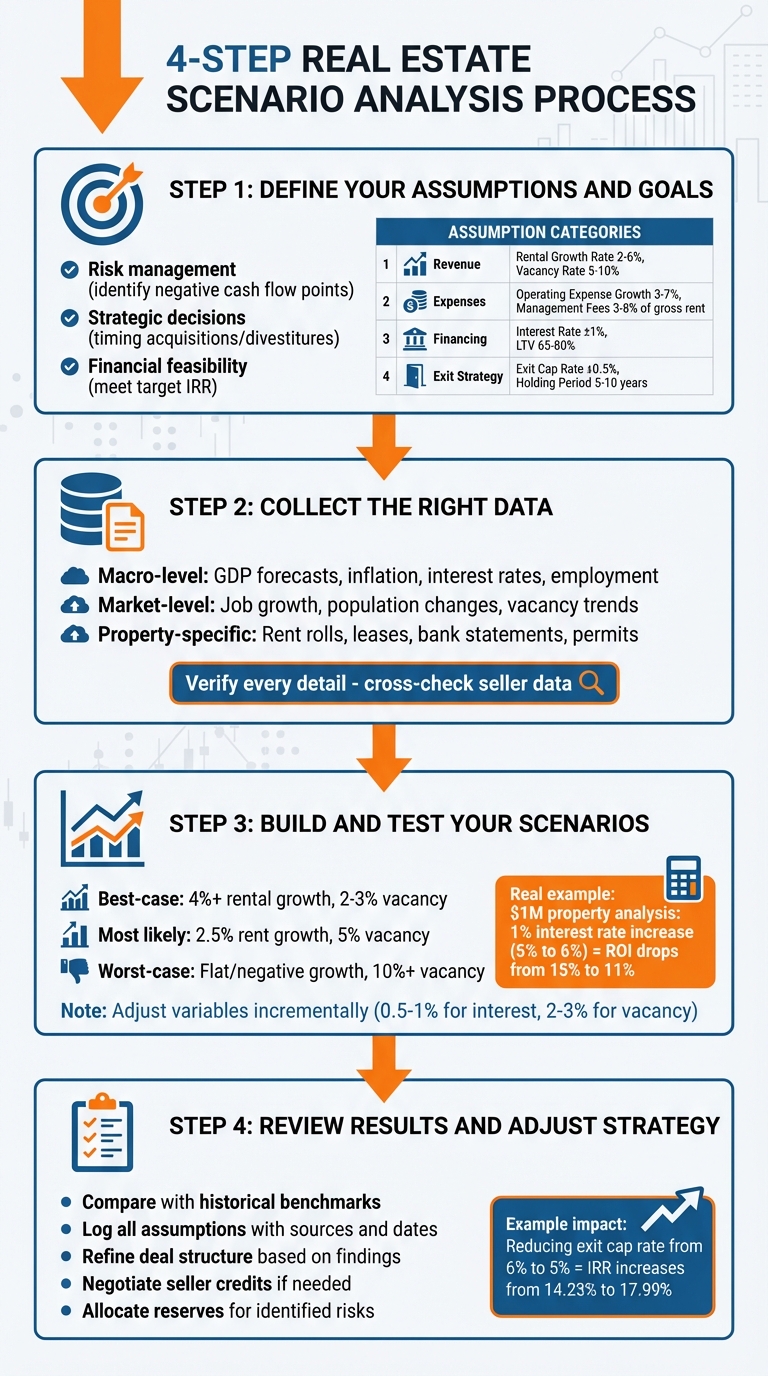
4-Step Real Estate Scenario Analysis Process for Investors
Scenario analysis is where theory meets action, helping you prepare for a range of possible futures. Here’s a straightforward guide to creating scenarios that lead to well-informed investment decisions.
Step 1: Define Your Assumptions and Goals
Start by clarifying your goals and assumptions. Your goals might revolve around managing risks (like identifying the point where cash flow turns negative), making strategic decisions (such as timing acquisitions or divestitures), or ensuring financial feasibility (confirming that a project meets your target internal rate of return [IRR]). Without clear objectives, you’ll risk drowning in irrelevant data.
Break your assumptions into two categories: certainties and uncertainties. Certainties are fixed factors, like a property’s agreed purchase price or current property taxes. Uncertainties involve variables like future interest rates, rental growth, or exit cap rates. This separation helps you focus on what matters most. Set baseline expectations for broader economic indicators, and on the property level, define acquisition costs, operating expenses (e.g., taxes, insurance, maintenance), capital expenditures, rental income growth, and vacancy rates.
"A property’s asking price is a suggestion. Its true value is revealed only through rigorous, unbiased analysis of its potential income and liabilities."
– BatchData
| Assumption Category | Key Variables to Define | Typical Range/Benchmark |
|---|---|---|
| Revenue | Rental Growth Rate, Vacancy Rate | 2%–6% growth; 5%–10% vacancy |
| Expenses | Operating Expense Growth, Management Fees | 3%–7% growth; 3%–8% of gross rent |
| Financing | Interest Rate, Loan-to-Value (LTV) | ±1% of current rates; 65%–80% LTV |
| Exit Strategy | Exit Cap Rate, Holding Period | ±0.5% of entry cap; 5–10 years |
Step 2: Collect the Right Data
The quality of your analysis depends on the data you gather. Focus on three levels: macro, market, and property-specific.
- Macro-level data: Look for GDP forecasts, inflation trends, interest rate projections, and employment statistics. Reliable sources include the Federal Reserve and the Bureau of Labor Statistics.
- Market-level insights: Track local job growth, population changes, new construction, and vacancy trends. Real estate boards and property data platforms are good starting points.
- Property-specific data: Verify every detail. For example, cross-check a seller’s rent roll with signed leases and confirm income with 12 months of bank statements. Review permit files for any unapproved renovations that could lead to fines. Professional inspections can uncover issues with HVAC systems, roofing, or foundations.
"Due diligence is not about finding a perfect property; it’s about paying the right price for an imperfect one."
– BatchData
Go beyond documents – speak with local property managers for on-the-ground insights into rent growth and vacancy rates. Historical benchmarking, such as reviewing past price movements and vacancy cycles, can help validate seller-provided data. Tools like BatchData’s enrichment services streamline this process by providing verified property information and historical trends, ensuring your analysis starts with reliable inputs.
With accurate data in hand, you’re ready to move to the next step.
Step 3: Build and Test Your Scenarios
Create three main scenarios: best-case, most likely, and worst-case. For example:
- Best-case: High rental growth (4%+) and low vacancy (2%–3%) to explore maximum upside potential.
- Most likely: Moderate assumptions, like 2.5% rent growth and 5% vacancy, which form your primary investment thesis.
- Worst-case: Flat or negative rent growth and elevated vacancy (10%+) to test resilience.
Adjust variables incrementally to isolate their impact. For example, tweak vacancy rates by 2%–3% or interest rates by 0.5%–1% above and below your base assumptions. This helps pinpoint critical tipping points.
Here’s a real-world example: In March 2025, Coldwell Banker Horizon Realty analyzed a $1,000,000 multifamily property. A 1% rise in interest rates (from 5% to 6%) caused ROI to drop from 15% to 11%, while a 1% decrease (to 4%) boosted ROI to 19%. This 8-point swing justified locking in a fixed-rate mortgage.
For more advanced modeling, assign probability weights to different outcomes. For instance, if you estimate a 50% chance of moderate growth, a 30% chance of a mild recession, and a 5% chance of stagflation, you can tailor your strategy accordingly. Use Excel functions like XIRR and XNPV to handle irregular cash flow timing, which is common in real estate. When modeling exit scenarios, add a 1%–2% buffer to your entry cap rate as a safeguard against market shifts.
Step 4: Review Results and Adjust Your Strategy
The final step is turning your analysis into action. If your worst-case scenario predicts losses at a 7% interest rate, you could renegotiate terms, focus on boosting occupancy, or even walk away from the deal. Compare your findings with historical benchmarks to ensure they’re realistic.
Keep a log of all assumptions, including your reasoning, data sources, and dates, to maintain clarity for future adjustments. Use the results to refine your deal structure. For instance, if stress testing shows that a 5% rise in operating expenses cuts NOI by 3%–5%, you might negotiate seller credits for deferred maintenance or allocate more to reserves. Similarly, if reducing the exit cap rate from 6% to 5% raises IRR from 14.23% to 17.99% – adding $6 million in sale proceeds on a $10 million property – it could justify capital improvements.
The ultimate aim is to stay flexible and prepared to adapt as market conditions evolve.
Real-World Applications of Scenario Analysis
Scenario analysis transforms forecasts into practical strategies, offering a roadmap for navigating acquisition timing, managing portfolio risks, and preparing for unexpected market shifts.
Timing Acquisitions and Exits
Deciding when to buy or sell can significantly impact your returns. Scenario analysis allows you to compare metrics like the Internal Rate of Return (IRR) and Equity Multiple for holding an asset versus selling it to reinvest elsewhere. For a hold-sell analysis, use your property’s current net market value to determine whether holding or selling will yield better results.
Take this example: past analyses revealed that locking in a 5% interest rate secured a 20% profit margin, while higher rates led to reduced profitability.
When planning exits, modeling various economic scenarios can pinpoint specific markets or asset types likely to outperform national trends, even during downturns. To ensure accuracy, align your hold period and financing terms – like loan-to-value (LTV), interest rates, and loan terms – across both "hold" and "sell/reinvest" scenarios.
Managing Portfolio Risk
Scenario analysis acts as a stress test, uncovering hidden risks in your portfolio. It can identify value traps – assets that seem stable under normal conditions but are vulnerable to rare, high-impact events. For instance, modeling how increased remote work may reduce demand for office space while boosting residential interest can help you prepare for sector-specific risks.
This approach also informs smarter capital allocation. When analyzing physical risks, consider how hazards might compound. For example, a hurricane could cause simultaneous wind and flood damage. Studies show that the number of U.S. properties at flood risk is 1.7 to 3.1 times higher than federal maps indicate.
"The ability to anticipate and prepare for various market conditions sets successful CRE firms apart from their competitors."
– Shelley Cernel, Thirty Capital
Regularly update your baseline assumptions as markets evolve. Consult debt advisors at least 18 months before loan maturities to explore refinancing scenarios under different interest rate conditions. This proactive strategy helps you decide whether to refinance or exit the market altogether. Once risks are identified, you can also prepare for major market disruptions.
Preparing for Market Disruptions
Beyond day-to-day risk management, scenario analysis equips you to handle rare but impactful shocks. Stress testing for extreme scenarios – like natural disasters, sudden policy changes, or severe recessions – can reveal cash flow vulnerabilities before they become critical. For example, Cushman & Wakefield’s 2023 modeling assigned a 50% probability to a "mild recession", predicting U.S. property values could drop by about 20% over two years, with variations of 4% to 23% depending on the asset type.
Scenario planning also evaluates regulatory changes, such as rent control or tax increases, that could squeeze profitability. Testing for worst-case interest rate hikes helps determine whether a deal can withstand financial tightening or if adjustments to financing terms are needed to avoid default.
"Property is a long-term investment… The long-term demand drivers and reasons for investing in commercial real estate do not change because of near-term ups and downs in the cycle."
– Cushman & Wakefield
To safeguard against sector-specific downturns, diversify across asset types and locations. Use stress-test results to maintain liquidity reserves, ensuring you have enough cash to weather periods of high vacancy or rising costs. Despite short-term challenges, unlevered core property returns in the U.S. have grown over 150% since 2012, highlighting the resilience of long-term investments.
Data and Tools for Effective Analysis
Accurate scenario analysis hinges on two critical components: reliable data and advanced analytical methods. Together, they transform market trends into actionable strategies. Simply put, the quality of your data directly impacts the accuracy of your analysis. Building on the key metrics and market variables discussed earlier, this section dives into the essential data and tools you’ll need for a comprehensive approach.
Types of Data You Need
To start, you’ll need foundational metrics like Net Operating Income (NOI), Cap Rates, Cash-on-Cash Return, and broader economic indicators such as GDP growth and interest rates. But that’s just the beginning. Add historical property data into the mix – think past price trends, rental yield fluctuations, vacancy rates, and how properties performed during prior market cycles. Don’t forget Gross Rent Multiplier (GRM) and a detailed breakdown of operating expenses, separating fixed costs (like taxes and insurance) from variable ones (such as utilities and maintenance).
You’ll also want to keep a close eye on market supply and demand metrics, including months’ supply of inventory, new construction starts, building permits issued, and absorption rates. And here’s where things get interesting: alternative data sources are becoming increasingly valuable. This includes web traffic, mobile footfall patterns, satellite imagery, and even sentiment analysis from social media. Finally, don’t overlook risk and compliance data – lien records, permit and violation histories, title searches, and insurance premiums. For instance, insurance costs in some areas have surged by 8% to 12% annually.
Tools and Techniques for Analysis
Once you’ve gathered reliable data, the next step is choosing the right tools to extract meaningful insights. Monte Carlo simulations are a go-to method for assessing risk and uncertainty through repeated random sampling. Statistical time series models, like ARIMA or exponential smoothing, are ideal for analyzing stable, seasonal trends. When data relationships become more complex, machine learning techniques – such as tree-based models, gradient boosting, or neural networks – can uncover patterns traditional methods might miss.
To test how specific variables (like interest rates or occupancy levels) affect your outcomes, use sensitivity analysis. For seamless integration of real-time data, APIs from platforms like BatchData can plug institutional-grade property data – such as permit histories and lien records – directly into your financial models. AI-powered underwriting tools are also gaining traction, with over 1,500 investors using them to process thousands of underwritings monthly. These tools allow for rapid "what-if" scenarios and stress-testing assumptions like rent growth or exit cap rates.
If you’re just starting out, keep it simple. Basic models often outperform overly complex ones until you have clear evidence that added complexity improves accuracy. Ensemble forecasting, which combines multiple models, is another effective approach. It minimizes biases and often delivers more reliable results than relying on a single method.
Why Data Quality Matters
The importance of accurate data can’t be overstated. A single error in a core metric like NOI can throw off every return calculation in your pro forma. For example, independent analyses show that the number of U.S. properties at flood risk is 1.7 to 3.1 times higher than what federal maps indicate. Many investors still rely on outdated public data, which often overlooks risks like pluvial flooding or urban stormwater issues.
To avoid costly mistakes, verify seller disclosures thoroughly. Match every tenant on a rent roll to an executed lease and cross-check 12 months of bank statements to confirm that deposits align with reported income. Use third-party platforms to uncover hidden liens, validate ownership history, and examine municipal permit records for any unpermitted renovations. Finally, don’t fall into the trap of underestimating operating expenses. The "50% Rule" – assuming half of gross income goes to expenses – is far too simplistic. Instead, rely on detailed, data-driven models for more accurate projections.
Conclusion
Scenario analysis offers investors a powerful tool to navigate market uncertainty. By modeling various potential futures, you can spot risks before they escalate, adjust your portfolio to handle diverse market conditions, and make smarter decisions about when to buy or sell properties. As Cushman & Wakefield aptly states:
"Real estate is a long-term investment and will continue to provide healthy cumulative returns".
The key lies in preparing for inevitable market fluctuations. This approach sets the stage for actionable insights, as outlined below.
Key Takeaways
Scenario analysis provides several clear advantages. Risk management becomes proactive rather than reactive, allowing you to uncover vulnerabilities like exposure to rising interest rates or overlooked flood risks – issues that affect 1.7 to 3.1 times more properties than federal maps suggest. Strategic adaptability ensures you’re ready for any market condition, whether it’s a mild recession or unexpected growth. Portfolio adjustments become more precise, showing how different asset types – such as residential or commercial properties – respond to various economic scenarios.
Moreover, scenario analysis goes beyond just managing risks. It sheds light on how investments might perform under adverse conditions. This helps you sidestep "value traps" – seemingly safe assets with hidden dangers – and uncover "deep value" investments that others might miss. Investors who excel are those who anticipate changes rather than merely reacting to them.
Next Steps for Investors
To implement scenario analysis, start by defining your baseline assumptions using up-to-date data on property values, rental trends, and occupancy rates. Then, identify key variables like interest rates, employment figures, demographic shifts, and regulatory changes. Construct scenarios – best-case, base-case, and worst-case – and assign realistic probabilities to each.
The accuracy of your analysis hinges on the quality of your data. Double-check all inputs, review seller disclosures carefully, and use external sources to uncover potential issues like hidden liens or permit violations. Tools like BatchData can simplify this process by offering institutional-grade property data, including lien records, permit histories, and enriched contact details, all accessible through APIs that integrate seamlessly with financial models.
Finally, remember that scenario analysis is an ongoing process. Markets evolve quickly, and outdated assumptions can lead to costly mistakes. Regularly update your models, share findings with stakeholders through clear visuals, and adjust your strategy as new data emerges. Continuous monitoring is not just recommended – it’s essential for staying ahead in an ever-changing market.
FAQs
Which assumptions matter most in a real estate scenario model?
Key elements in a real estate scenario model include purchase price, rental income, operating expenses, interest rates, vacancy rates, and exit cap rates. These variables play a crucial role in shaping cash flow, profitability, and overall property valuation. Paying close attention to these factors is essential for creating projections that are both accurate and insightful.
How do I choose realistic probabilities for best, base, and worst cases?
To choose probabilities that feel grounded in reality, start by examining economic indicators, market conditions, and historical data. Use statistical principles and keep an eye on current trends to ensure your assumptions align with likely outcomes. Key factors to evaluate include economic growth rates, interest rate changes, and demographic trends. Adjust your probabilities based on a thoughtful analysis of how likely each scenario is, always anchoring your assumptions in measurable, reliable data to maintain accuracy.
When should I use Monte Carlo simulation instead of simple scenarios?
Monte Carlo simulation shines when you need to delve into risk and uncertainty. Instead of just examining a few fixed scenarios – like the best-case or worst-case outcomes – it creates a large number of random samples based on probability distributions. This approach offers a comprehensive view of possible outcomes, making it especially useful for analyzing intricate factors like cash flows, discount rates, or predicting the chances of different market shifts.