

































Real estate is transforming with data automation. Today, over 60% of firms use AI and machine learning to analyze thousands of data points in minutes – cutting manual processes and enabling faster, smarter decisions. Automation streamlines deal sourcing, underwriting, and due diligence, allowing firms to evaluate more markets, uncover off-market opportunities, and reduce costs. Predictive analytics, enriched datasets, and real estate APIs are driving this shift, helping investors identify undervalued properties and manage portfolios efficiently. By 2030, the industry is projected to save $34 billion in efficiency gains. If you’re not leveraging automation, you’re falling behind.
Key takeaways:
- Speed: AI reduces underwriting from 40 hours to 3 hours per deal.
- Scale: Automation enables firms to analyze 20–30 markets monthly, up from 2–3.
- Cost Savings: AI-powered due diligence costs $2,000–$5,000 per deal vs. $15,000–$50,000 manually.
- Accuracy: Automated tools achieve 95–99% accuracy, cutting errors from manual processes.
Automation is no longer optional – it’s the backbone of modern real estate success.
Real Estate Data Masterclass 2025: AI + Automation
How Data Automation Improves Deal Sourcing
With the rise of data-driven strategies, deal sourcing has undergone a major transformation – shifting from time-consuming manual processes to automated systems that can identify opportunities in mere minutes. Automation platforms now compile billions of data points from sources like public records, tax liens, pre-foreclosures, and municipal code violations into easily searchable databases. This eliminates the need for in-person courthouse visits and tedious research. Instead, investors can focus on "signal stacking", a method of combining multiple indicators (like a tax lien and a code violation) to zero in on properties with higher chances of motivated sellers.
The real edge here is in speed and accuracy. Automated alerts allow investors to act the moment a property meets their criteria, often reaching out to owners before the property hits public auctions or the MLS. The results speak for themselves: marketing teams leveraging automation have reported a 451% increase in qualified leads, and contacting leads within 5 minutes makes them 9 times more likely to convert.
The numbers highlight the potential. In the U.S. commercial real estate market, distressed property balances recently reached $116.4 billion, with private owners holding 37% of that value. At the same time, individual apartment asset sales surged by 20%, totaling $136.8 billion, as investors targeted distressed Class C properties. For those equipped with the right tools, the opportunities are vast. This shift also sets the stage for advanced strategies like predictive analytics and enriched data workflows, which are explored in the following sections.
Using Predictive Analytics to Find Off-Market Properties
Predictive analytics takes automation a step further, using historical sales data, rental trends, and real-time demand signals to predict which properties might hit the market before they’re officially listed. AI models analyze spending behaviors and other cues to identify undervalued or distressed properties, enabling investors to proactively approach owners. By assigning "propensity to sell" scores based on factors like equity percentage, market trends, and homeowner demographics, predictive analytics streamlines due diligence and eliminates manual bottlenecks. According to Northspyre, these models often uncover off-market opportunities that traditional methods overlook.
The adoption of AI in commercial real estate has grown rapidly. Just three years ago, only 5% of companies were experimenting with AI pilots; today, that number has jumped to 92%. Machine learning adds another layer of refinement, helping forecast property performance, simulate returns, and model scenarios like waterfall distributions under varying conditions. For example, in one multifamily case, AI leasing bots cut response times by over 60%, boosting tenant satisfaction and indirectly aiding off-market deal sourcing.
For those looking to get started, the first step is consolidating legacy data into clean, unified datasets. From there, integrating AI platforms that scrape rental data and run predictive models based on historical trends can significantly enhance deal sourcing efficiency.
Data Enrichment and Skip Tracing with BatchData
BatchData takes property data to the next level by enriching records with verified ownership details, contact information, and other key attributes. This system consolidates over 155 million U.S. property records sourced from county tax assessors and recorder’s offices into a user-friendly, searchable database. With features like data enrichment, skip tracing, and phone verification, BatchData simplifies the process of finding and contacting property owners for off-market deals.
Skip tracing automation is a game-changer, slashing the time it takes to locate and verify owner contact details from weeks to just hours. BatchData even provides confidence scores for owner contacts, helping investors prioritize the most reliable leads. Its Property Intelligence APIs make it easy to retrieve ownership details, mortgage balances, and contact information directly into existing workflows – speeding up decision-making and reducing manual work. For large-scale operations, the cost ranges from $0.08 to $0.15 per record, offering a cost-effective alternative to manual research.
"A property with a single tax lien is a lead; a property with a tax lien, code violation, and a notice of default is a high-priority target." – BatchData
To further refine their approach, investors are encouraged to cross-reference owner names from county assessor files with the latest deeds and skip trace results. This triangulation ensures accurate and actionable data.
Automating Financial Analysis and Underwriting
Manual underwriting consumes a significant portion of analysts’ time, pulling them away from more strategic tasks. On average, analysts dedicate 60% to 70% of their time to data extraction – work that automation can complete in just minutes. While manual processes limit acquisition teams to screening 30% to 40% of incoming deals, automated systems allow for 100% pipeline evaluation, drastically increasing deal throughput.
Automation fundamentally reshapes team efficiency. For example, a two-person acquisitions team equipped with automated software can handle the same workload as a traditional team of five or six people. As one platform CEO overseeing $2.4 billion in assets explained:
"The operational cost isn’t in the 20% that advance. It’s in the 80% you have to touch before killing".
By automating the evaluation of deals destined for rejection, teams can reclaim valuable hours and redirect their focus toward high-impact strategic decisions. This newfound efficiency also enables deeper financial modeling and more robust risk analysis.
AI-Powered Financial Modeling
AI tools are revolutionizing financial modeling by transforming unstructured PDFs into audit-ready data in just 30–60 minutes, compared to the 2–3 days it takes to do the same work manually. These systems can standardize data from platforms like Yardi and RealPage into a single framework, eliminating the need for manual cross-referencing, which typically takes 65–130 minutes per deal.
Dynamic sensitivity analysis is another game-changer. AI can simulate thousands of scenarios – adjusting for variables like cap rates, interest rates, and rent growth – in minutes rather than hours. This is especially critical in today’s market, where U.S. office vacancy rates reached record highs of 19–20% in 2023-2024. For example, one automated sensitivity analysis revealed:
"Your IRR drops below 12% if vacancy exceeds 8% for more than two years".
Insights like these help teams pinpoint deal risks before committing capital, providing a clear advantage.
Additionally, automation minimizes the risk of manual spreadsheet errors. By linking every extracted data point to its original source document, AI tools create an immutable audit trail. This ensures that every figure in a pro forma can be traced back to a specific page, a critical feature for regulatory reviews and investor transparency.
Automated Risk Assessment and Compliance
Automation extends beyond modeling to enhance risk assessment and streamline compliance processes. These systems can flag critical details like co-tenancy clauses, termination rights, or renewal options that might affect exit cap rates or cash flow – details that are often overlooked in manual reviews, especially when analysts are juggling dozens of deals each week.
Version control is another area where automation shines. By maintaining a clear audit trail for every assumption, automated tools eliminate confusion caused by multiple spreadsheet versions (e.g., "Model_v27_FINAL2"). For lenders, automation speeds up loan processing by automating financial data extraction and risk ratio calculations, cutting decision times by approximately 50%. This can reduce median loan approval times from five days to just ten minutes, delivering a 70% productivity boost.
Cost savings are another key benefit. Automated tools lower per-deal costs below those of junior analysts ($270–$360) or offshore teams ($80–$107). With flat monthly pricing for unlimited deal volume, AI extraction tools can drive even greater savings at scale. But the real value lies in the ability to evaluate more deals without increasing headcount, allowing teams to shift their focus from data entry to making smarter deal decisions.
Improving Due Diligence with Automation
In commercial real estate, due diligence often takes 45–60 days. Automation has changed the game by enabling multiple analyses – financial, legal, environmental, and physical – to run simultaneously instead of one after another. This shift reduces timelines to just 20–30 days without cutting corners. Traditionally, manual due diligence costs between $15,000 and $50,000 per transaction.
One common issue is incomplete documentation. On average, three contracts are missing from a typical due diligence binder, which can lead to expensive surprises after closing. AI platforms solve this by monitoring data rooms in real time, instantly flagging missing documents like leases or environmental reports. This proactive approach eliminates last-minute chaos and ensures nothing is overlooked.
These advancements pave the way for focused automation in areas like lease analysis and document validation.
Automated Lease Abstraction and Document Management
Manually abstracting leases for a property with 50 tenants takes over 40 hours and costs around $3,000–$4,000 per deal. AI-powered tools, using Natural Language Processing (NLP) and Optical Character Recognition (OCR), can process a commercial lease in just 2–5 minutes, achieving 90–95% accuracy on the first pass. These systems go beyond rent extraction – they identify rent escalations, renewal options, tenant obligations, and critical provisions like termination rights or exclusive use conflicts that might slip through in manual reviews.
A real-world example highlights the impact of automation. In 2025, the Urban Renaissance Group (URG) used Prophia‘s AI platform to analyze leases for a 100-tenant retail property in Portland, Oregon. Jeff Vorhies, URG’s Director of Investments, led his team through a condensed due diligence period, relying on AI to flag inconsistencies and missing details that might have been discovered only after closing. Vorhies summed up the experience:
"The impact [of AI] on due diligence is immeasurable".
Modern platforms also offer hyperlinked validation, linking extracted data directly to the original document clauses. This feature speeds up human reviews by allowing analysts to verify AI findings without combing through hundreds of pages. Additionally, extracted data integrates seamlessly into property management systems like Yardi or Procore via API, eliminating manual data entry and reducing transcription errors.
Automated Data Validation Processes
Accuracy is just as important as speed in due diligence. AI tools include built-in rules to flag inconsistencies – for instance, lease expiration dates that come before commencement dates or incorrect escalation formulas. After validation, these systems typically achieve error rates below 3%, a noticeable improvement over manual reviews where fatigue can lead to mistakes.
These tools also cross-check rent rolls against bank statements and lease agreements to identify discrepancies. For example, if a rent roll lists $10,000 in monthly rent but bank deposits average only $8,500, the system flags the issue for further investigation. Tasks like this, which could take hours manually, are handled in moments.
AI-powered tools also streamline legal and environmental reviews. Legal review times drop by 58%, allowing attorneys to focus on negotiating complex clauses instead of extracting routine data. For environmental assessments, tools priced between $200 and $800 per property analyze regulatory databases and historical land use records, automating initial risk evaluations. Overall, AI-driven due diligence costs $2,000–$5,000 per transaction, a fraction of the $15,000–$50,000 needed for manual reviews.
sbb-itb-8058745
Using Property Data APIs for Scalability
As real estate portfolios grow, managing property data manually becomes a major hurdle. API integration solves this by automating data collection and analysis, replacing outdated spreadsheets with real-time data streams. These APIs deliver property insights in milliseconds, allowing teams to handle increasing data demands seamlessly. The shift to API-driven processes is undeniable – JLL found that the percentage of commercial real estate companies experimenting with AI, including API integrations, skyrocketed from 5% to 92% in just three years.
APIs excel in handling massive data requests without slowing down. This makes them indispensable for institutional investors and large-scale operators who need to process thousands of properties quickly. With this scalability, custom APIs tailored specifically for real estate data have become a game-changer.
Custom APIs for Real Estate Data
Custom APIs integrate directly into acquisition workflows, delivering structured, on-demand property data. For example, property search APIs can comb through millions of records in seconds, filtering by criteria like lien status, equity percentages, or property age. Meanwhile, property detail APIs provide a deeper dive, offering automated valuations, mortgage histories, and active lien details.
BatchData’s API is a standout, providing access to over 155 million properties with specialized endpoints for tasks like property searches, contact enrichment, skip tracing, and phone verification. Impressively, it boasts a 76% right-party contact accuracy rate. Chris Finck, Director of Product Management, highlighted its efficiency:
"What used to take 30 minutes now takes 30 seconds. BatchData makes our platform superhuman."
Advanced features include entity resolution, which identifies individuals behind LLC-owned properties – an essential tool for sourcing off-market deals. These APIs also incorporate compliance safeguards, like scrubbing Federal DNC lists and known litigators, to shield businesses from potential legal risks during outreach.
Bulk Data Delivery for Large-Scale Operations
While APIs are perfect for real-time data needs, bulk data delivery addresses large-scale batch processing requirements. This method provides massive, customized datasets that allow firms to analyze extensive property portfolios efficiently, without the need for repeated API calls. BatchData specializes in this area, offering datasets with over 700 property attributes through flexible integration methods. Their professional services ensure smooth data integration, enabling automated pipelines that feed predictive analytics and financial modeling tools.
Measuring ROI and Impact of Automation
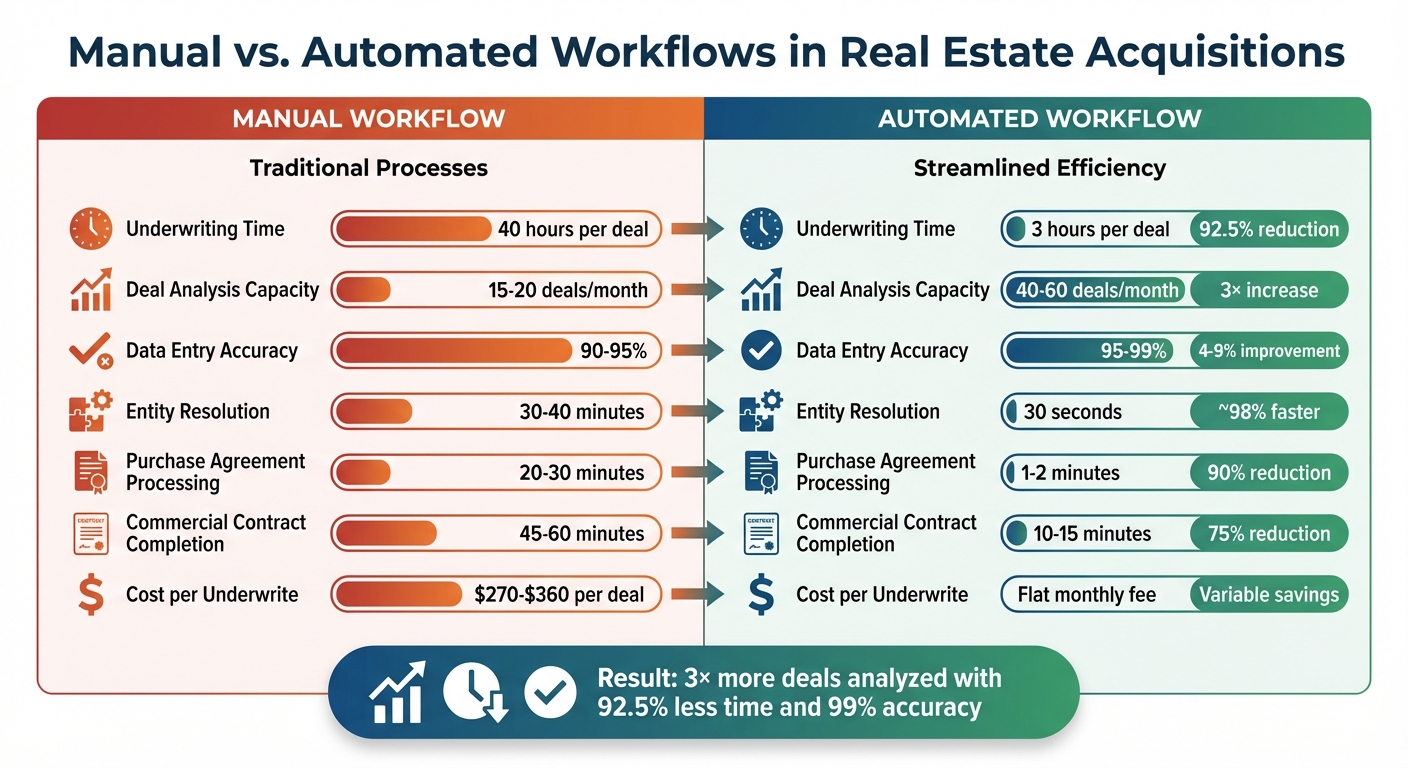
Manual vs Automated Real Estate Workflows: Time Savings and Efficiency Gains
When leveraging scalable data pipelines, the return on investment (ROI) for automation becomes much clearer, especially in the context of real estate acquisitions. The benefits of automation are often measured through three key metrics: labor cost savings, capacity-enabled revenue growth, and error-cost reduction. Real estate firms, for example, typically spend 15–20% of their working hours on paperwork and documentation. By automating these tasks, firms enable analysts to shift their focus from time-consuming data entry – which can take up 60–70% of underwriting time – to higher-value activities like deal selection and strategic judgment. This allows companies to take on more deals without increasing headcount.
Speed is another major advantage. Firms that respond to brokers within minutes instead of days are better positioned to secure high-quality off-market opportunities. Automation also eliminates what industry professionals call the "dead deal tax" – the 20–30 minutes wasted on the 80% of deals that are eventually rejected. By accelerating the screening process, resources can be directed toward properties that truly meet investment criteria.
Time Savings and Accuracy Gains
Automation doesn’t just save time – it transforms workflows entirely. Automated systems can cut initial deal evaluation times by as much as 80–95%. For instance, in 2025–2026, a multifamily real estate firm reduced its underwriting process from 40 hours per deal to just 3 hours – a 92.5% reduction. This allowed the firm to scale its deal capacity from 50 to 250 deals per quarter.
Accuracy also sees significant improvement. Manual data entry typically results in an error rate of 5–10%, but automated systems achieve first-pass accuracy rates of 95–99%. In the same multifamily case study, error rates dropped from 15% to 3% after automation was introduced.
Consider this: in February 2026, a Milwaukee-based real estate investor automated Zillow research using an n8n and Apify pipeline. This upgrade increased property screening from 10–15 properties per hour to over 300 properties weekly. The automation setup cost just $144 per month but saved approximately $1,356 in monthly labor costs. Similarly, Mortigo, a Dubai-based mortgage broker, used AI to automate multi-bank application forms. This reduced processing times for 50 clients from 25–33 hours to just 30–40 minutes – a 75% time savings. This shift enabled same-day quotes and reduced bank rejection rates from 12% to under 2%. Every hour saved from manual tasks is an hour gained for strategic deal analysis.
Manual vs. Automated Workflows Comparison
The following table highlights the stark differences between manual and automated workflows:
| Metric | Manual Workflow | Automated Workflow | Improvement |
|---|---|---|---|
| Underwriting Time | 40 hours per deal | 3 hours per deal | 92.5% reduction |
| Deal Analysis Capacity | 15–20 deals per month | 40–60 deals per month | 3× increase |
| Data Entry Accuracy | 90–95% | 95–99% | 4–9% improvement |
| Entity Resolution | 30–40 minutes manually | 30 seconds per record | ~98% faster |
| Purchase Agreement Processing | 20–30 minutes per agreement | 1–2 minutes per agreement | 90% reduction |
| Commercial Contract Completion | 45–60 minutes per contract | 10–15 minutes per contract | 75% reduction |
| Cost per Underwrite | $270–$360 per deal | Flat monthly fee | Variable savings |
These efficiency gains directly support better acquisition strategies by freeing up resources for deeper analysis. For example, Panther Capital Group, an investment firm operating in Texas and Florida, automated the creation of 15-page commercial contracts in 2025–2026. This reduced contract completion time from 60 minutes to just 10–15 minutes per contract, reclaiming 20–40 hours of administrative work each month. Similarly, K&S Real Estate in Pittsburgh cut the time to complete Broker Price Opinion forms from over 10 minutes to just 2 minutes, while achieving accuracy rates exceeding 99%.
Automation also reshapes cost structures. For instance, a two-person team manually reviewing 10 deals per week costs around $78,000 annually in labor. By comparison, enterprise commercial real estate (CRE) screening platforms cost between $500 and $2,000 per month, while self-hosted automation using APIs can cost as little as $150 per month [35, 34]. With automation, firms can significantly cut costs while scaling their deal capacity, enabling smarter, data-driven acquisition strategies for growing portfolios.
Future Trends in Real Estate Data Automation
As we’ve seen with AI-driven deal sourcing and automated due diligence, the future of real estate data automation is on an exciting trajectory. By 2026, it’s expected that 90% of finance teams will rely on AI tools to streamline routine tasks and enhance decision-making processes. Similarly, by late 2025, over 87% of real estate brokerages will have implemented AI tools, marking a 7% rise from the previous year. This rapid adoption highlights a clear shift: automation is becoming a necessity for firms aiming to remain competitive. These advancements don’t just simplify operations – they also enable smarter, data-driven decisions in property acquisition.
What to Expect in 2026-2028
The role of automation is evolving. In the near term, AI systems will go beyond supporting tasks – they’ll take on active management roles. Within the next year, expect AI to handle processes like generating disclosures and performing compliance checks through natural language queries. Looking further ahead, over the next three to five years, autonomous AI agents could independently manage internal policies and seamlessly interact with vendors and enterprise resource planning (ERP) systems.
Propensity modeling will also become more advanced. These systems will analyze hundreds of variables to trigger immediate actions based on market signals. For example, when a property enters pre-foreclosure, AI can assign a "propensity to sell" score and automatically launch targeted marketing efforts. Ivo Draginov, founder of BatchData, explains:
"Your goal is to build a ‘nervous system’ for your business. When a piece of data changes, your system should react instantly and intelligently".
However, despite these advancements, only 21% of real estate leads currently convert to sales, with just 1.5% making it to closing.
AI is also revolutionizing document processing. Accuracy rates for extracting property specifications and financial data from complex listings and legal documents have reached 99%. Automation can cut manual data entry in systems like SAP by up to 70%. A compelling example is Shriram Properties Limited, which implemented hyper-automation with UiPath and Catnip Infotech in 2024–2025. This initiative automated 45 processes, achieving 99% data accuracy for 150,000 invoices annually, saving 1,000 working days, and slashing manual SAP data entry by 70%. Hariharan Subramanian, Vice President of Information Technology at Shriram Properties, noted:
"Automation is pivotal to our growth strategy. By optimizing core processes, we enhance cash flow visibility for project funding, strengthen supplier relationships with timely invoicing, and scale our workforce efficiently".
On the regulatory front, federal advocacy is pushing for national frameworks to ensure transparency, fairness, and data privacy in AI. The National Association of REALTORS® emphasizes:
"Congress must support the responsible development and use of artificial intelligence (AI) with clear national standards that ensure transparency, fairness, data privacy, and copyright protections".
Clear regulations will help professionals scale automation effectively. Ronald Kamdem of Morgan Stanley highlights:
"Operating efficiencies, primarily through labor cost savings, represent the greatest opportunity for real estate companies to capitalize on AI in the next three to five years".
Steps to Full Automation Integration
To fully embrace these trends, firms need to revamp their data infrastructure now. A centralized data platform is essential – it creates a single source of truth, enabling AI to handle complex calculations and automate bulk actions across portfolios. For example, NTUC FairPrice adopted Nakisa‘s AI-powered lease accounting platform, which cut month-end closing cycles in half and saved 50% of man-hours by eliminating manual tracking of lease information.
Firms should also refine their Ideal Customer Profile (ICP) using detailed data points like equity percentages, ownership tenure, and distress signals. This granular approach allows lead scoring systems to prioritize high-value opportunities. For instance, a property in pre-foreclosure might earn a score of +50 points, while equity above 40% adds +25 points. These scores can then automatically route the best leads to top acquisition managers.
Integration is another crucial step. Firms should connect property search tools directly to CRM platforms to enable seamless outreach. Automated triggers can replace manual list-pulling, launching marketing campaigns as soon as specific events occur – like a property entering pre-foreclosure. As Ivo Draginov puts it:
"The single biggest differentiator between top-performing investors and everyone else is the ability to systematically identify and engage motivated sellers before they hit the open market".
Compliance is equally important. Firms must adhere to regulations like the TCPA, ensuring contact lists are scrubbed against state and national Do Not Call registries. Verification services can help distinguish between line types.
Lastly, data literacy is vital. Teams need to develop skills to interpret AI outputs and translate insights into actionable client strategies. Mastering tools like AI copywriting and marketing platforms is quickly becoming a must-have competency for agents. By focusing on these steps, firms can build automation systems that are scalable, compliant, and results-driven for the future.
Conclusion
Data automation has reshaped how real estate professionals approach acquisitions. Tools like predictive analytics uncover off-market opportunities, while AI-driven financial modeling eliminates the need for error-prone spreadsheets. The benefits are striking: leads contacted within five minutes are nine times more likely to convert, and marketing teams report a 451% increase in qualified leads. In today’s fast-paced market, these aren’t just perks – they’re essential for staying competitive, where accuracy and speed often determine success.
The shift from manual processes to integrated platforms has also streamlined workflows, replacing up to 24 separate tools with unified solutions. Take BatchData, for instance. This platform consolidates property data enrichment, owner verification, and API delivery into one seamless system. With an 82% accuracy rate in predicting property sales and users reaching 76% more homeowners, it’s a clear example of how the right tools turn raw data into actionable deals. As Ivo Draginov puts it:
"Data freshness means daily updates and real-time checks for content accuracy. It is what separates productive deal-making from wasted effort".
Looking ahead, automation is set to evolve even further. By 2026, AI is expected to move beyond insights to autonomous decision-making – handling tasks like valuations, compliance checks, and portfolio management. The global PropTech market is projected to hit $40.4 billion by then, with 72% of portfolios already adopting smart building systems and 61% of property owners using automation to boost efficiency. Clearly, the industry is heading toward a future where scale and technology outweigh location as the key drivers of success.
For professionals aiming to thrive in this landscape, integrating automation into every phase – deal sourcing, underwriting, and asset management – is no longer optional. Centralized platforms that combine predictive analytics, automated due diligence, and bulk data delivery are now the backbone of scalable strategies.
FAQs
What data should I automate first in acquisitions?
Automating property ownership details, transaction histories, and contact information is a smart first step. This streamlines the process of identifying off-market opportunities and spotting motivated sellers faster. By automating skip tracing, you can access verified contact details – like phone numbers and email addresses – making your outreach efforts more effective.
Once these foundational datasets are in place, you can take it a step further. Integrating tools for property valuation and market trend analysis can help fine-tune your acquisition strategies, giving you a stronger edge in decision-making.
How do I connect property data APIs to my CRM?
To link property data APIs with your CRM, the BatchData API is a great option for real-time data updates and smooth integration. Start by obtaining an API key. Then, set up triggers using webhooks or automation tools to ensure data flows seamlessly. Next, map the enriched property and contact data fields directly to your CRM. This setup also allows you to automate tasks like lead management and data syncing, simplifying workflows and keeping your CRM consistently up to date.
How do I measure automation ROI per deal?
To gauge ROI from automation on a per-deal basis, focus on measurable improvements such as better property data accuracy, faster decision-making, and higher deal closure rates. For instance, automation can slash process times from minutes to mere seconds, cutting down on labor costs while boosting efficiency. To calculate ROI, weigh these savings against the additional revenue generated through quicker deal closures and more precise property valuations. Prioritize metrics like speed, accuracy, and cost savings for a straightforward evaluation.