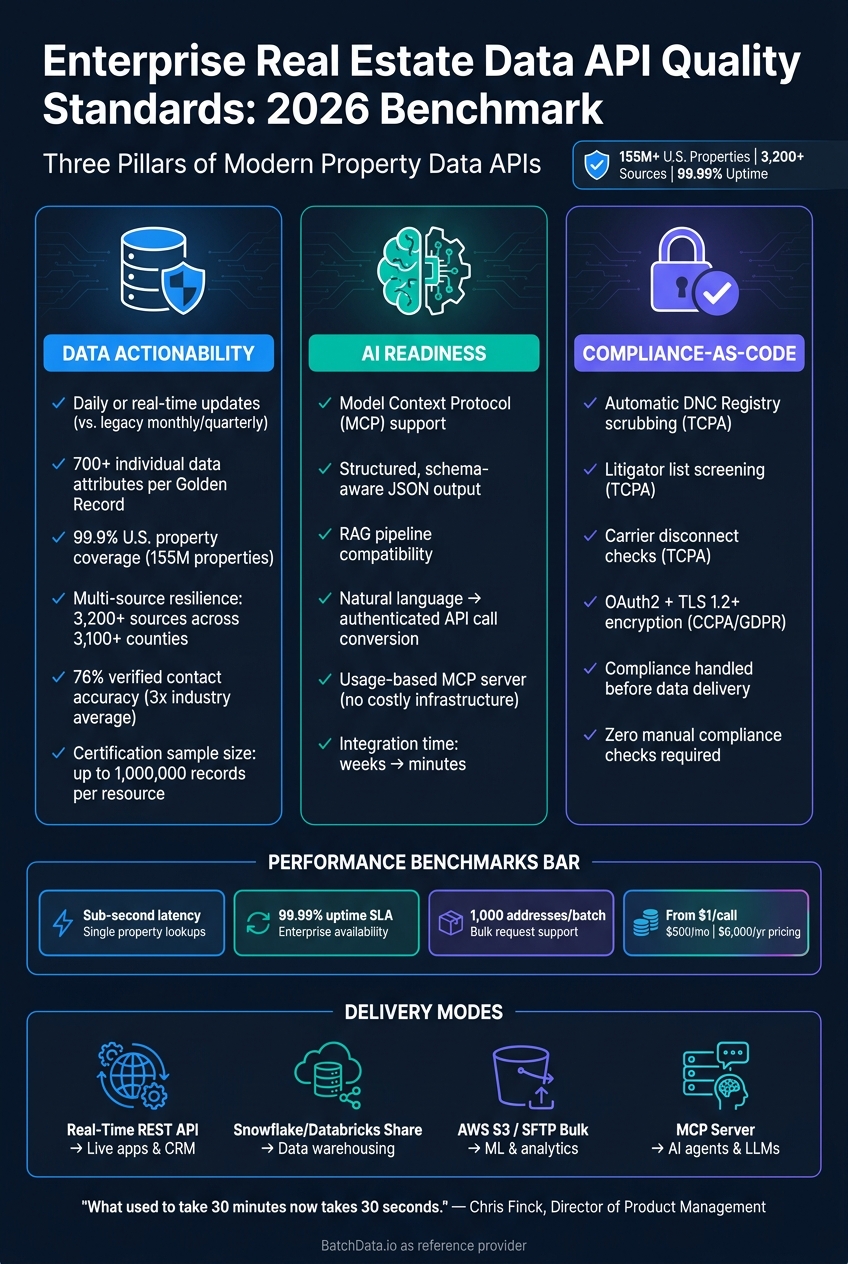
The 2026 standard for enterprise real estate data APIs focuses on three key pillars: Data Actionability, AI Readiness, and Compliance-as-Code. These benchmarks ensure APIs deliver reliable, actionable property data while meeting modern technical and regulatory requirements. Here’s what matters most:
- Data Actionability: APIs must provide actionable property data that is accurate, up-to-date, and complete, including tax records, sales history, and verified contact details. Multi-source integration ensures resilience against disruptions.
- AI Readiness: APIs should support AI workflows with structured, schema-aware data and tools like the Model Context Protocol (MCP) for seamless integration.
- Compliance-as-Code: Built-in safeguards, such as DNC scrubbing and secure data handling, help enterprises stay compliant with regulations like TCPA, CCPA, and GDPR.
Modern APIs like BatchData.io set the bar with daily updates, 99.99% uptime, sub-second response times, and support for real-time, bulk, and warehouse-native delivery methods. These features streamline operations, enhance AI-driven insights, and reduce compliance risks.
The future of real estate data APIs is about delivering fast, reliable, and secure property intelligence that integrates effortlessly into enterprise workflows.
Enterprise Real Estate Data API Quality Standards 2026: The 3-Pillar Benchmark
Core Quality Standards for Real Estate Data APIs in 2026
By 2026, the expectations for real estate data quality have grown significantly. It’s no longer just about standardization; it’s about delivering actionable insights. The standards are built around three key pillars: Data Actionability, AI Readiness, and Compliance-as-Code. For enterprises evaluating real estate data APIs, it’s critical to understand the baseline requirements and how providers differentiate themselves beyond them.
The Baseline: RESO Data Dictionary Compliance
At the foundation of any enterprise-grade real estate API is RESO Data Dictionary compliance. This is the essential starting point, ensuring a common language across systems. With consistent field names, data types, and formatting conventions, RESO compliance eliminates the need for manual mapping, which can introduce costly errors and delay development.
The industry has shifted away from the older Real Estate Transaction Standard (RETS) in favor of the RESO Web API, which uses RESTful design and OData V4 protocols. According to RESO:
"The RESO Web API is the modern way to transport data in the real estate industry. It is built on well-known, open technology standards so that any organization can use it to deliver or receive data quickly and efficiently."
Currently, Data Dictionary 2.0 or higher is the benchmark, featuring a more rigorous certification process. This includes steps like metadata validation, variations reporting, and schema validation. Certification now requires testing with sample sizes of up to 1,000,000 records per resource, a significant leap from the previous 100,000-record standard.
Quality Metrics That Go Beyond Standardization
While RESO compliance ensures data is structured properly, it doesn’t guarantee that the data is accurate, timely, or complete. These gaps can lead to serious issues – like broken data pipelines, unreliable AI model inputs, or errors in critical processes like mortgage underwriting.
Here’s a breakdown of the key metrics that define enterprise-grade data in 2026:
| Quality Dimension | 2026 Enterprise Requirement | Impact on Enterprise Systems |
|---|---|---|
| RESO Compliance | Data Dictionary 2.0/2.1 & Web API Core 2.0.0 | Provides reliable interoperability and predictable data mapping |
| Freshness | Daily or real-time updates | Essential for accurate market trends and property valuations |
| Schema Consistency | 100% alignment between payload and metadata | Prevents ingestion errors and system breakdowns |
| Accuracy | Multi-source integration + human-in-the-loop QA | Minimizes risks in underwriting and insurance workflows |
| Contact Quality | Scrubbed for DNC, litigators, and disconnected numbers | Supports compliance with marketing regulations |
Update frequency is a particularly critical metric. Many legacy systems still operate on monthly or quarterly refresh cycles. For 2026 standards, daily updates are the expectation, especially for data sourced directly from county assessor and recorder feeds. In time-sensitive scenarios – like identifying pre-foreclosure properties – a 30-day-old record is essentially useless.
Multi-source resilience is another essential factor. Depending on a single county feed introduces risk; a system outage could disrupt operations. Instead, blending data from over 3,200 sources ensures reliability. For example, BatchData.io aggregates information from public records, tax assessors, deed histories, and verified contact layers to cover over 155 million U.S. properties – representing 99.9% of properties nationwide. This approach guarantees continuous data flow, even when local systems experience downtime.
The Golden Record: A Unified Standard for Property Data
When it comes to enterprise decision-making, having RESO compliance and up-to-date data from multiple sources is just the beginning. What organizations truly need is a Golden Record – a unified property profile that delivers a complete and reliable view of a property. This isn’t just a collection of data points; it’s a structured, standardized "source of truth" created by merging fragmented information from thousands of sources into one cohesive record. By eliminating the need to manually reconcile mismatched datasets, this unified approach enables automated workflows and more accurate risk assessments.
What Makes Up a Golden Record
A Golden Record combines five essential layers of property data, often scattered across different systems, into one cohesive profile:
| Component | What It Includes | Enterprise Value |
|---|---|---|
| Tax Assessor Data | APN, lot size, year built, construction type, tax history | Provides baseline property specs and valuation context |
| Deed & Sales History | Transaction price, sale date, buyer/seller names, ownership transfers | Offers market insights and an ownership timeline |
| Mortgage & Liens | Loan-to-value ratio, lender info, open liens, foreclosure status, equity position | Reveals financial motivation and potential distress signals |
| Verified Contact Details | Right-party phone/email, mailing address (CASS-certified), DNC status | Enables actionable outreach with compliance built in |
| Identity Resolution | Identifies true owners behind LLCs/trusts, occupancy status, portfolio-wide insights | Improves ownership transparency and clarity |
BatchData.io delivers this Golden Record for over 155 million U.S. properties, covering 99.9% of the country. Each record includes more than 700 individual data attributes, pulled from 3,200+ sources simultaneously. This ensures uninterrupted coverage, even if a county recorder system experiences downtime.
One standout feature of BatchData.io’s Golden Record is its entity resolution capability, which identifies the true owner of a property, even when it’s held in an LLC or trust. This allows organizations to analyze entire ownership portfolios instead of viewing properties as isolated assets. Beyond simply consolidating data, accuracy in ownership identification is critical for making informed decisions.
How Match Rates and Identity Resolution Drive Results
The true power of a Golden Record lies in its ability to connect properties with their actual, reachable owners. Two key metrics – Match Rate and Right Party Contact (RPC) accuracy – are essential here. Match Rate measures how often a property record is successfully linked to a verified owner’s phone number or email. RPC accuracy, on the other hand, evaluates whether that contact information genuinely belongs to the owner. Together, these metrics determine how effectively enriched data can translate into actionable results.
"What used to take 30 minutes now takes 30 seconds. BatchData makes our platform superhuman." – Chris Finck, Director of Product Management
BatchData.io achieves a verified contact accuracy rate of 76%, reportedly three times higher than the industry average. This level of precision can dramatically improve the success of outreach efforts, turning potential leads into real opportunities.
Additionally, strong identity resolution enhances the value of each match. Instead of viewing properties individually, a well-constructed Golden Record links ownership across portfolios. For instance, if an investor owns multiple properties under various LLCs, the unified record identifies these connections. This enables better risk assessments and more targeted engagement strategies, making the Golden Record an indispensable tool for enterprises.
Performance Benchmarks for Enterprise Real Estate Data APIs
High-quality data doesn’t mean much if it can’t be delivered quickly and reliably. The value of a Golden Record lies in how efficiently it can be accessed. Performance transforms detailed property profiles into actionable insights in real time. By 2026, enterprise-grade APIs are expected to go beyond just uptime guarantees – they’re judged by their speed, reliability, and ability to support real-time applications, automated workflows, and large-scale analytics.
Latency, Throughput, and Concurrency Requirements
For a single property lookup, the standard is millisecond-level response times. This isn’t just a nice-to-have – it’s essential for real-time applications like populating property detail pages, triggering underwriting logic, or powering CRM workflows. Delays here aren’t just inconvenient; they can create bottlenecks in systems handling thousands of requests daily.
"In the fast-moving PropTech landscape, static data files aren’t enough. You need intelligence that lives and breathes with your application." – BatchData
Beyond speed, enterprise APIs must also handle high-concurrency spikes without slowing down. Think about traffic surges during a portfolio review or a major marketing campaign – the API needs to stay responsive even under heavy loads.
"Architected for scale, our API supports high-concurrency requests, ensuring your application remains snappy even during traffic spikes." – BatchData
For bulk operations, the expectation is clear: support for up to 1,000 addresses per batch request. This capability enables enterprises to enrich entire portfolios or update CRM data in a single call. Additionally, uptime standards have become stricter, with a baseline SLA of 99.9% and many providers aiming for 99.99% availability.
These demanding performance metrics highlight the importance of flexible and scalable cloud-native delivery options.
Cloud-Native Delivery and Bulk Ingestion Options
While real-time REST APIs are ideal for live applications, enterprise data teams often need delivery methods that align with their existing systems. Modern API providers now offer multiple options to suit various workflows:
| Delivery Method | Best Use Case | Key Characteristic |
|---|---|---|
| Real-Time REST API | Live apps, CRM form-filling, search portals | Sub-second latency, high concurrency |
| Snowflake / Databricks Share | Enterprise analytics, data warehousing | No-code sync, direct warehouse access |
| AWS S3 / SFTP Bulk | ML training, historical analysis, snapshots | Efficient Parquet format and scheduled updates |
| MCP Server (AI-Native) | AI agents, natural language querying | Rapid integration, low-code automation |
For bulk data delivery via AWS S3, the Parquet format is a game-changer. It reduces storage costs and speeds up queries in analytical environments compared to traditional CSV files. Across all delivery modes, data from over 3,100 U.S. counties is normalized into a standardized JSON schema, eliminating the need for custom parsers and reducing technical overhead for enterprise teams.
AI Readiness and Compliance-as-Code
Let’s dive deeper into how Compliance-as-Code ensures enterprise operations stay secure and efficient, building on the earlier discussion of Data Actionability and AI Readiness. While speed and flexibility are essential, the future of enterprise real estate data APIs in 2026 hinges on two things: seamless integration with AI systems and robust protection from regulatory risks.
AI Readiness: Structuring Data for RAG Pipelines
An API’s AI-readiness isn’t just about speed – it’s about delivering data that’s immediately usable, eliminating the need for manual pre-processing. This is where Model Context Protocol (MCP) comes into play. Think of MCP as a bridge between natural language prompts and structured data queries. It cuts integration times drastically, turning what used to take weeks into mere minutes.
Here’s how it works: An MCP-enabled API can take a plain-English query like, “Find 10 distressed properties in Phoenix,” and automatically convert it into an authenticated API call. The result? Clean, consistent JSON output with metadata that gives AI models the context they need to operate effectively.
For Retrieval-Augmented Generation (RAG) workflows, the structure of the data is just as important as its quality. Poorly structured schemas or data that requires pre-processing can lead to inaccuracies in AI-generated property descriptions or market analyses. Providing structured, schema-aware data is like handing the AI a detailed map before asking it to navigate.
"We want to supplement your work and make you superhuman so you can do things in seconds not hours. That’s where BatchData comes in. What used to take 30 minutes now takes 30 seconds." – Chris Finck, Director of Product Management, BatchData
BatchData’s MCP server is offered on a usage-based model, making it scalable for companies looking to expand AI-driven queries without committing to costly infrastructure. Once AI-readiness ensures smooth data integration, the next step is embedding compliance directly into the API.
Compliance-as-Code: Handling Regulatory Risk at the API Level
The regulatory landscape for real estate contact data is becoming stricter. Violations of the TCPA can lead to hefty fines, and enforcement of CCPA and GDPR regulations is becoming more aggressive. Relying on manual compliance checks or cleaning data after it’s entered your system is no longer practical.
With Compliance-as-Code, the API itself takes care of regulatory screening before delivering the data. For instance, BatchData automatically checks homeowner contact information against the National Do Not Call (DNC) Registry, known litigator lists, and carrier-level disconnect databases in real time. This ensures your team never receives flagged, disconnected, or restricted contact numbers, shifting the compliance burden to the data provider rather than your legal team.
Additionally, this approach ensures privacy regulation compliance at the data layer. All API communications are encrypted using TLS 1.2+ and authenticated via OAuth2, ensuring that sensitive data meets CCPA and GDPR requirements for secure handling. Combined with accurate identity resolution and skip tracing, this means your Golden Records are not only complete but also verified, secure, and ready for action.
| Compliance Feature | Regulation Addressed | How It Works |
|---|---|---|
| DNC Registry Scrubbing | TCPA | Filters out restricted numbers before data delivery |
| Litigator List Screening | TCPA | Removes known serial plaintiffs from results |
| Carrier Disconnect Check | TCPA | Blocks disconnected numbers from reaching your dialer |
| OAuth2 + TLS 1.2+ Encryption | CCPA / GDPR | Secures data in transit for AI and CRM workflows |
A Practical Checklist for Evaluating Enterprise Real Estate Data APIs
With compliance and AI-readiness now baked into APIs, the next step is understanding how to evaluate providers effectively. A structured approach can help avoid costly mistakes when selecting a vendor. This checklist builds on the earlier pillars of Data Actionability, AI Readiness, and Compliance-as-Code.
Key Criteria to Assess
Start by confirming the technical fundamentals. Ensure the provider complies with the RESO Data Dictionary 2.1 standard and supports OData 4.0 or 4.01. You can verify RESO Dictionary 2.1 compliance by checking the provider’s /$metadata endpoint for essential fields like ModificationTimestamp.
Once the basics are squared away, dig deeper into these four critical areas:
- Data Depth: Does the API provide access to over 300 property data points? This should include key details like AVM, deed history, tax assessor data, and verified owner contact information.
- Match Accuracy: What is the documented Match Rate for connecting properties to verified owner phone numbers and emails? Always request a sample dataset to validate these metrics with your own address list.
- Performance SLA: Confirm that single lookups are delivered with sub-second latency and look for a written uptime guarantee of 99.9% to 99.99%. Test the API’s ability to handle high-volume, simultaneous requests as part of your evaluation.
- Compliance Controls: Check if the API includes built-in compliance features like DNC scrubbing and litigator list screening before delivering data.
Additionally, ensure the API uses OAuth2 with TLS 1.2+ to secure sensitive consumer contact data.
Delivery Modes Compared
Once technical and compliance requirements are confirmed, evaluate the data delivery methods to find the best fit for your operations. The choice will depend on factors like latency needs, data volume, and your infrastructure. Here’s a comparison of the main delivery modes:
| Delivery Mode | How It Works | Ideal Use Case |
|---|---|---|
| Real-Time REST API | Live HTTP requests with sub-second responses | Property detail pages, instant underwriting, live search |
| Bulk Ingestion (S3/SFTP) | Full data pulls with scheduled updates | CRM backfills, historical analysis, large portfolio updates |
| Warehouse-Native | Direct sharing within your cloud environment | Data science teams and BI workflows aiming to avoid API latency |
| On-Demand / List Export | Batch exports or professional services | One-time campaigns and targeted lead generation |
Providers like BatchData support all four delivery modes, including direct Snowflake sharing and AWS S3 bulk delivery. This flexibility makes it easier for teams to handle both real-time lookups and large-scale data pipelines without juggling multiple vendors.
Pricing and Pilot Testing
Pricing typically starts at $1 per API call for low-volume or testing phases. Monthly licenses begin at around $500/month, while annual plans start at $6,000/year. Enterprise-level pricing is negotiated separately.
The best way to evaluate an API isn’t by relying on demo datasets. Instead, run a pilot using your actual use case. This will give you a clear picture of the API’s Match Rate, latency, and compliance features under real-world conditions.
Conclusion: What the Gold Standard Looks Like in 2026
By 2026, enterprise real estate data APIs have evolved far beyond basic field standardization. To meet the demands of modern enterprises, these APIs must excel in three critical areas: Data Actionability, AI Readiness, and Compliance-as-Code. Together, these elements define the benchmarks for cutting-edge performance.
Data Actionability ensures that every property record is transformed into a verified Golden Record. This means integrating essential details like tax information, deed history, mortgage data, and owner contacts into a seamless, reliable dataset.
AI Readiness focuses on structuring APIs to support contemporary workflows. For example, with compatibility for the Model Context Protocol (MCP), large language models can directly query property data, bypassing the need for tedious manual reformatting.
Compliance-as-Code takes care of regulatory requirements right within the API call. This ensures compliance is handled automatically before any data is delivered.
BatchData embodies all three pillars. Leveraging comprehensive real estate datasets from over 3,200 sources, it offers a 99.99% uptime SLA and lightning-fast sub-second response times. These features align perfectly with the technical demands of today’s enterprise workflows.
As Chris Finck, Director of Product Management at BatchData, puts it:
"What used to take 30 minutes now takes 30 seconds." – Chris Finck, Director of Product Management, BatchData
FAQs
What defines a property record as a ‘Golden Record’?
A property record becomes a ‘Golden Record’ when it combines reliable, actionable information – like tax assessor data, deed history, mortgage liens, and verified homeowner contact details – into one cohesive profile. This approach breaks down data silos and provides a complete, trustworthy view of the property.
How can I test match rate and RPC accuracy on my own addresses?
To test the match rate and RPC accuracy, sign up for a free API key. This key lets you make live calls in your development environment, helping you see how well the data connects properties to verified owners. It’s a hands-on way to assess the API’s performance using your own address data.
What does “Compliance-as-Code” actually block before data is returned?
Compliance-as-Code streamlines the process of checking homeowner contact data against critical regulatory databases. These include the National Do Not Call Registry, litigator lists, and carrier disconnect databases. By automating this filtering, it reduces legal risks and ensures adherence to privacy and telemarketing laws.