
Competitive benchmarking in real estate helps investors evaluate properties by comparing them to similar assets. This process uses data on rental rates, occupancy levels, market trends, and more to guide smarter decisions. Tools like BatchData, Lone Wolf BrokerMetrics, Real Capital Analytics, and Privy simplify this by offering features like geospatial mapping, predictive analytics, and real-time market insights. For example:
- BatchData: Provides 155M property records, geospatial tools, and predictive algorithms to identify high-potential deals.
- Lone Wolf BrokerMetrics: Uses MLS data for market share analysis and agent performance tracking.
- Real Capital Analytics: Tracks $50 trillion in global transactions for deep market insights.
- Privy: Automates comparative market analysis and helps spot profitable deals.
These tools rely on metrics like days on market, occupancy rates, and price per square foot to provide actionable insights. Whether you’re assessing retail, multifamily, or office properties, leveraging the right data is essential for staying competitive.
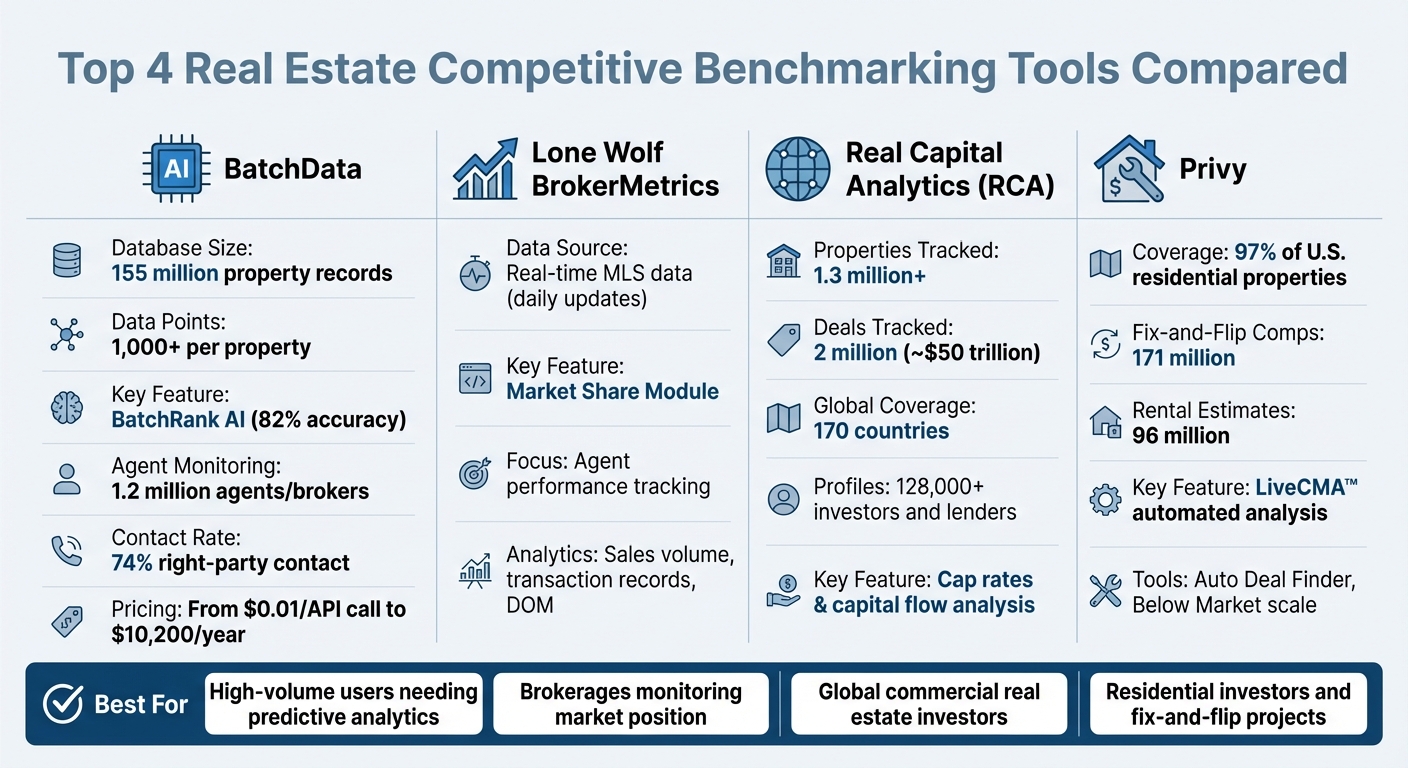
Comparison of Top 4 Real Estate Competitive Benchmarking Tools
Competitive Analysis Walk-Thru for Commercial Real Estate
sbb-itb-8058745
BatchData: Real Estate Data Solutions
BatchData isn’t just another data provider – it’s a powerful intelligence platform with an extensive database of 155 million property records, each packed with over 1,000 data points. It delivers real-time property insights, covering key details like property characteristics, sales history, ownership records, and contact information. This data is critical for benchmarking and identifying opportunities in the real estate market.
One standout feature is the BatchRank AI algorithm, which predicts with 82% accuracy which properties are most likely to sell. This tool helps investors evaluate portfolio liquidity and zero in on high-potential deals. With daily updates and real-time data checks, BatchData ensures its users always have the most accurate and up-to-date information.
"Data freshness means daily updates and real-time checks for content accuracy. It is what separates productive deal-making from wasted effort."
- Ivo Draginov, President, BatchData
For competitive analysis, BatchData monitors 1.2 million agents and brokers, providing detailed insights into their listings, including agent and brokerage data. Its geospatial tools allow users to analyze local market conditions using latitude/longitude coordinates and property search APIs. This is particularly useful for evaluating development sites and understanding neighborhood trends.
BatchData goes beyond just providing data. Their team offers white-glove support for tasks like creating custom datasets, migrating from outdated systems, and uncovering property ownership hidden behind LLCs. With a 74% right-party contact rate, BatchData users connect with 76% more homeowners than those using other platforms. These features make BatchData a go-to solution for real estate professionals looking for actionable insights.
Features and Benefits of BatchData
BatchData’s platform offers a wide range of advanced features designed to simplify and enhance real estate decision-making:
- Extensive Data Enrichment: Each property record includes 700–1,000 data points, covering building specs, zoning codes, permits, and even up to three years of historical data for trend analysis.
- Compliance-Driven Contact Enrichment: Skip tracing tools verify contact details against DNC and litigation lists, ensuring users stay compliant.
- Real-Time API Access: The property search API delivers low-latency results for immediate queries, while bulk data delivery options (via S3, Snowflake, SFTP, or flat files) support large-scale analyses.
- Geospatial Benchmarking: This feature integrates parcel data, geocoordinates, and lot characteristics, offering insights for remote feasibility studies and competitive positioning.
- Listing Data Insights: Track active, pending, and sold listings, along with days on market (DOM) and agent details. These metrics are vital for understanding market share and staying ahead of competitors.
- Streamlined Workflows: Compound queries enable users to retrieve multiple datasets in a single API call, reducing latency and improving efficiency.
"What used to take 30 minutes now takes 30 seconds. BatchData makes our platform superhuman."
- Chris Finck, Director of Product Management, Crexi
The BatchRank predictive model is another game-changer. It identifies the top 50 properties most likely to sell in a given area, allowing users to focus marketing efforts where they’ll have the most impact.
Pricing and Plans
BatchData’s pricing is designed with flexibility in mind, catering to businesses of all sizes and needs. Unlike many legacy providers, BatchData avoids rigid, long-term contracts.
| Plan | Pricing | Key Features | Best For |
|---|---|---|---|
| Pay-As-You-Go | $0.01 per API call | Real-time API access, property search, and contact enrichment; no contracts | Businesses scaling operations or testing the platform |
| One-off Purchase | $500 per purchase | Specific bulk list acquisitions and non-recurring data needs | Single-project requirements |
| Yearly License | $10,200 per year | Full access for high-volume users with a predictable cost structure | Enterprises with consistent data demands |
| Custom Solutions | Contact for quote | Tailored services, including custom datasets and migration support | Organizations needing bespoke data solutions |
Whether you’re a small business exploring real estate data or a large enterprise with complex needs, BatchData offers options to fit your goals.
Other Tools for Competitive Benchmarking
Beyond BatchData’s offerings, several other platforms provide powerful tools for competitive benchmarking and market analysis.
Lone Wolf BrokerMetrics
Lone Wolf BrokerMetrics leverages real-time MLS data, updated daily, to help brokerages monitor their market standing with precision. Its Market Share Module enables comparisons between brokerages based on sales metrics, market share percentages, and average days on market. Additionally, its Proficiency Metrics highlight top-performing agents by analyzing their sales volume and transaction records. Georgia Alpizar, Regional Director at Keller Williams, shared:
"BrokerMetrics has transformed our recruiting process, offering detailed insights into agent performance and unlocking smarter decision-making".
The platform’s interactive charts and graphs make it easier to identify neighborhoods with high buying or selling potential. This feature transforms raw market data into actionable insights, particularly for data-driven recruiting strategies.
Real Capital Analytics (RCA) by MSCI
Real Capital Analytics is a comprehensive tool for tracking over 1.3 million properties and nearly 2 million deals, representing approximately $50 trillion in global capital market transactions across 170 countries. It provides detailed insights into cap rates, capital flows, price trends, and transaction volumes, while profiling over 128,000 investors and lenders. Its Trends module offers customizable charts for submarket analysis, and features like the RCAnywhere mobile app and MSCI RCA Add-In for Excel simplify real-time reporting.
Privy
Privy offers a vast database of MLS data, covering 97% of U.S. residential properties. It includes 171 million fix-and-flip comparables and 96 million rental estimates. One standout feature is its proprietary LiveCMA™ technology, which automates comparative market analysis with clear visual comparisons. Privy also provides tools for tracking investor activity and identifying profitable deals through features like Auto Deal Finder and Below Market scale. Integrated calculators further enhance its utility by delivering instant metrics for fix-and-flip projects and both long- and short-term rentals. As Stephen, an investor, remarked:
"Privy is the software that every investor should have in their toolbox. It provides precise comping analysis that make finding deals 10x easier and in a fraction of time".
Metrics for Competitive Benchmarking
Tracking the right metrics can turn raw market data into actionable insights. Days on Market (DOM) is a key measure of market speed, reflecting local demand trends. Paired with sales volume and median sale price, these figures offer a broad view of market activity and pricing patterns, helping professionals anticipate where the market might be heading.
Metrics like inventory levels and months of supply gauge the balance between supply and demand, effectively acting as indicators of whether the market leans toward buyers or sellers. For a more standardized comparison, price per square foot normalizes property values across various building sizes, making it easier to evaluate properties regardless of their class. In the rental market, occupancy rates are crucial for assessing demand and estimating potential rental income. Together, these metrics form the foundation for advanced visual analytics.
Modern visualization tools now synchronize daily with MLS data, offering real-time rankings for agents, offices, and franchises. Features like heatmaps highlight high-performing neighborhoods based on listing prices, cash-on-cash returns, and occupancy rates. Interactive charts from platforms such as InfoSparks or Redfin Data Center make it easier to track changes in median sales prices and inventory over time, simplifying complex datasets into client-friendly formats.
Glenn Wellbrock, Senior Director at Berkshire Hathaway HomeServices | California Properties, shared his thoughts on the power of market share tools:
"We’re excited about the new Relitix Market Share tool. We see our high-performing agents using this in their listing presentations. Our offices can also use this to clearly demonstrate local expertise and real market dominance in our recruitment efforts —often supported by contact enrichment APIs to identify and reach top talent— – all while showcasing the data-driven support and competitive edge we offer to every agent in our company."
This example highlights how precise benchmarking can drive real-world success.
Expanding on these metrics, advanced features like granular filtering and automated reporting offer even deeper insights into market dynamics. Granular filters allow users to analyze market share by property type, ZIP code, neighborhood, or price range, while side-by-side comparisons provide a clearer picture of market positioning. Tracking performance over the last 12 or 24 months can help identify trends early, and automated tools like Homebot or Altos Research deliver branded market updates, keeping clients engaged and informed.
Conclusion
In today’s fast-paced real estate market, competitive benchmarking isn’t just helpful – it’s a must. Without the right tools, you risk overpaying, missing out on deals, and making decisions based on incomplete or outdated information. With the real estate software market expected to hit $12.7 billion by 2025 and growing at 8.5% annually, it’s clear that data-driven decision-making is no longer optional – it’s the standard.
The gap between manual analysis and automated benchmarking is wide. Traditional Comparative Market Analyses often miss the mark by 5–7% compared to AI-driven valuations. In a fast-moving market, that margin of error can mean the difference between securing a deal and losing it. Benchmarking tools not only remove human error but also deliver the speed needed to stay competitive. BatchData’s advanced platform stands out by offering both precision and efficiency.
BatchData is the go-to data engine for professionals who demand high-scale intelligence. With daily property updates, low-latency APIs, and bulk data delivery through S3 or Snowflake, it transforms raw market data into actionable insights. Its proprietary BatchRank feature focuses specifically on high-intent opportunities, making it easier to target the right deals.
The first step to success is tackling data challenges head-on. If finding deals or identifying motivated sellers is your main hurdle, building a reliable data infrastructure should be your top priority. Once that’s in place, services like skip tracing and phone verification can turn property insights into actionable outreach, bridging the gap between data and results.
Ultimately, success in competitive benchmarking isn’t about having the most data – it’s about having the right data at the right time. Whether you’re analyzing market share by ZIP code, tracking occupancy trends, or back-testing investment strategies, your tools will determine whether you lead or lag behind. The fusion of speed and accuracy is what defines modern real estate benchmarking – and it’s what separates the leaders from the rest.
FAQs
What are the key metrics for benchmarking a deal?
Key metrics to evaluate when benchmarking a deal include property valuations, market share, occupancy rates, operating expenses, rental income, and tenant retention. These figures are essential for spotting performance gaps, improving operational efficiency, and making well-informed decisions.
How can geospatial data improve my comps and targeting?
Geospatial data brings a new level of precision to your property evaluations and marketing strategies. By providing detailed property risk assessments, location-specific market insights, and real-time hazard updates, it enables more accurate property valuations. This data also sharpens market segmentation and supports smarter, more informed investment decisions.
What should I check before trusting property and contact data?
To make sure the information you rely on is dependable, check its accuracy, completeness, and timeliness. Confirm that the data is current and comes from credible sources. This ensures it’s reliable and fits your specific requirements.