
































When deciding between cloud and on-premise storage for real estate data, the right choice depends on your business size, needs, and priorities. Here’s the key takeaway:
- Cloud storage is ideal for flexibility, remote access, and low upfront costs. It’s managed by third-party providers like AWS or Google Cloud, making it easier for small to medium-sized firms to scale without heavy IT investments.
- On-premise storage offers complete control, stronger security, and predictable long-term costs. However, it requires high initial investment, ongoing maintenance, and in-house IT expertise, making it better suited for larger firms with stable data needs.
Quick Overview:
- Cloud Pros: Scalable, accessible from anywhere, no maintenance burden, disaster recovery built-in.
- Cloud Cons: Internet-dependent, recurring costs, limited control over data.
- On-Premise Pros: Full control, local access, customizable for specific needs, no internet reliance.
- On-Premise Cons: High setup costs, complex maintenance, limited scalability.
For many real estate businesses, a hybrid approach works best – storing sensitive data on-premise while using cloud solutions for tasks like marketing and seasonal demand.
On Prem VS Cloud | Which is Right for You in 2024?
Cloud Storage for Real Estate Data
Cloud storage allows real estate professionals to store their data on remote servers managed by providers like Amazon Web Services, Microsoft Azure, or Google Cloud Platform. This eliminates the need to maintain physical hardware on-site. With cloud storage, listings, client information, transaction records, and market analytics can be securely accessed from anywhere with an internet connection.
Benefits of Cloud Storage
Using cloud storage offers several advantages for real estate professionals:
- Flexibility for Growth: As your business grows, cloud storage can automatically provide additional space and resources to handle increasing data demands.
- Cost Management: Instead of a hefty upfront investment in hardware, you pay based on usage, making it easier to predict and manage expenses.
- Easy Accessibility: Whether you’re at a property showing, in a meeting, or traveling, you can retrieve or update data from any device connected to the internet.
- Less Maintenance Hassle: Cloud providers handle updates, security, and hardware upkeep, freeing you to focus on your business.
- Disaster Recovery: Cloud services replicate data across multiple locations, protecting it from localized disruptions or outages.
Cloud Storage Limitations
While the benefits are clear, cloud storage does come with some challenges:
- Limited Control: Since your data is managed by a third-party provider, you have to rely on their policies and infrastructure, which may not always align with your preferences.
- Dependence on Internet Connectivity: Accessing cloud storage depends on a stable internet connection. In areas with poor connectivity, this can become a significant issue.
- Regulatory Compliance: Real estate data is often subject to strict privacy and location-specific regulations. Ensuring your cloud provider meets these requirements requires consistent oversight.
- Long-Term Costs: While initial costs are lower, recurring fees can accumulate, especially as your data storage needs grow over time.
- Vendor Lock-In: Switching providers can be costly and complicated, potentially limiting your ability to adapt to new technologies or negotiate better terms.
Cloud storage offers a powerful solution for managing real estate data, but understanding both its strengths and limitations is essential to making the most of it.
On-Premise Storage for Real Estate Data
When it comes to managing real estate data, on-premise storage offers an option that emphasizes control and security. Unlike cloud-based solutions, this approach involves maintaining your data on physical servers located within your office or facility. Simply put, you own and oversee the hardware, giving you direct authority over how your information is stored and accessed.
Real estate firms opting for on-premise storage typically invest in equipment like server racks, hard drives, and networking tools. This setup allows you to establish your own security protocols, manage who can access specific files, and create backup schedules without being tied to external policies.
Benefits of On-Premise Storage
On-premise storage brings several key advantages to the table for real estate firms:
- Full Control Over Data: You decide everything – security measures, access permissions, and backup routines. This is particularly useful when dealing with sensitive client financial records or private property details.
- Stronger Physical Security: By keeping your data on-site, you can implement custom security measures, such as biometric access controls or surveillance systems. Since your data never leaves your premises, you avoid risks associated with third-party data centers or external transmissions.
- Tailored Customization: Your storage system can be configured to align perfectly with your business operations. Whether it’s optimizing file structures for your workflow or integrating with existing real estate software, you have the flexibility to make changes without waiting on a service provider.
- Predictable Costs Over Time: While the initial investment is higher, you avoid recurring subscription fees tied to cloud storage. For agencies with consistent data needs, this can lead to lower total costs in the long run.
- No Internet Dependency: With your data stored locally, you won’t lose access during internet outages. Your team can continue working on critical files and documents, unaffected by connectivity issues.
On-Premise Storage Limitations
However, on-premise storage isn’t without its challenges. Here are some potential drawbacks to consider:
- High Initial Costs: Setting up an on-premise system requires a significant upfront investment. For mid-sized real estate firms, expenses for hardware, networking equipment, and installation can range from $50,000 to $200,000. And that doesn’t include future hardware replacement costs.
- Scalability Concerns: Expanding storage capacity means purchasing and configuring new hardware, which takes time. Unlike cloud solutions, you can’t instantly scale up during busy periods when data needs spike.
- Ongoing Maintenance: Maintaining the system is entirely your responsibility. From software updates and security patches to handling hardware failures, you’ll need skilled IT staff to keep things running smoothly – potentially pulling resources away from your core business.
- Complex Disaster Recovery: Protecting your data from disasters requires a well-thought-out backup and recovery plan. Without it, equipment failures or unforeseen events like fires could result in permanent data loss. Often, this involves maintaining duplicate systems in separate locations, further increasing costs.
- Limited Remote Access: Accessing data remotely often involves setting up a VPN, which can be complicated and may result in slower performance compared to cloud-based solutions.
These limitations make on-premise storage a better fit for real estate firms with stable data requirements and dedicated IT expertise on hand.
sbb-itb-8058745
Cloud vs On-Premise: Side-by-Side Comparison
When deciding between cloud and on-premise storage, the choice often depends on your specific business priorities. Cloud storage is all about flexibility – it offers quick scalability and the convenience of remote access. On the other hand, on-premise systems provide greater control and predictable costs. To help clarify the distinctions, here’s a breakdown of the key features.
Feature Comparison Table
The table below highlights the major differences between cloud and on-premise storage, tailored to the needs of real estate professionals:
| Feature | Cloud Storage | On-Premise Storage |
|---|---|---|
| Initial Cost | Lower upfront costs via subscription models | High initial investment for hardware and setup |
| Ongoing Costs | Subscription fees and service charges | Maintenance, utilities, and IT staffing expenses |
| Scalability | Scales up or down with ease | Requires purchasing additional hardware |
| Remote Access | Accessible from any internet-enabled device | Needs VPN configuration for remote use |
| Maintenance | Handled by the provider | Managed internally by your IT team |
| Security Control | Shared responsibility with the provider | Full control over security measures |
| Customization | Limited by the vendor’s offerings | Highly customizable to fit specific needs |
| Disaster Recovery | Built-in backup and recovery options | Requires a self-managed recovery plan |
| Internet Dependency | Relies on a stable internet connection | Operates on a local network with less reliance |
| Compliance | Providers handle many compliance updates | Organization handles compliance independently |
Cloud storage allows real estate firms to get up and running quickly, offering a faster path to storing and accessing data. In contrast, on-premise solutions take longer to implement due to the time required for hardware setup and infrastructure configuration.
Performance also varies between the two. Cloud storage relies heavily on your internet connection and the provider’s infrastructure, while on-premise solutions deliver consistent performance within a local network, though they are limited by the capacity of your hardware.
Integration is another area where these options differ. Many cloud platforms come with pre-built integrations for popular real estate tools like multiple listing services (MLS) and customer relationship management (CRM) systems. On-premise systems, while offering more flexibility, often require additional technical effort to achieve similar integrations.
Ease of use is another advantage of cloud solutions, which typically feature user-friendly interfaces. On-premise systems, however, may require extra technical training or support to manage effectively.
When it comes to regulatory compliance, cloud providers often handle updates automatically to meet new standards. On-premise solutions, however, place the entire compliance responsibility on your organization.
Real Estate Data Integration and BatchData Solutions
Picking the right storage solution is just one piece of the puzzle; the real game-changer is how well your data integrates across platforms. In modern real estate, success often hinges on the smooth flow of information between multiple listing services (MLS), customer relationship management (CRM) systems, marketing tools, and analytics dashboards. Without proper integration, even the most advanced storage setup can turn into a data silo, stifling your business’s growth.
To truly harness the power of your data, it’s crucial to connect your storage system with your existing workflows. This not only improves decision-making but also helps you stay ahead in a competitive market.
That’s where integrated solutions like BatchData come into play.
BatchData for Smarter Data Enrichment and Integration
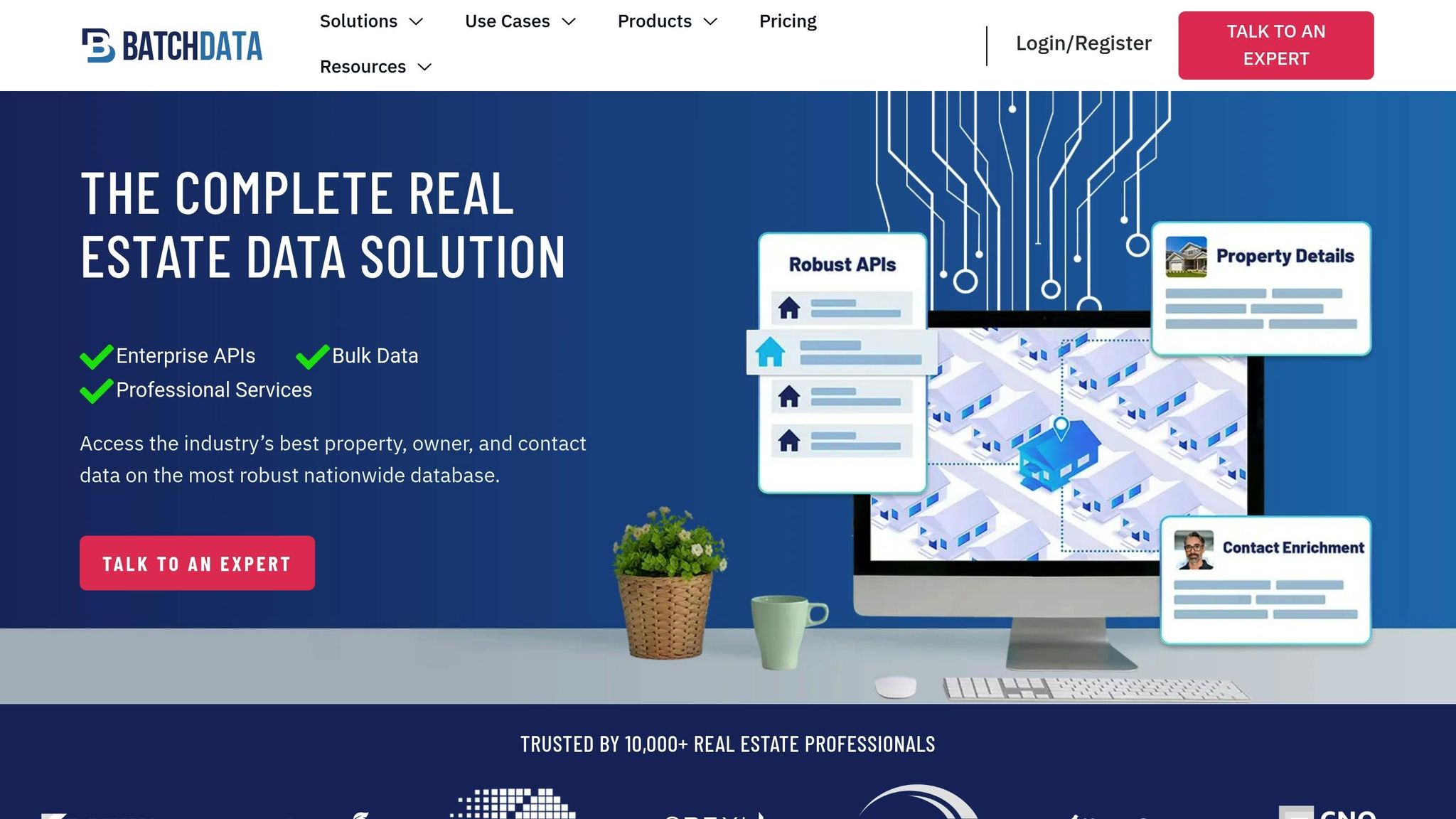
BatchData transforms raw data into actionable insights by enhancing property and contact records with additional layers of information.
- Property Search API: BatchData’s API pulls detailed property data directly into your CRM or marketing tools. This eliminates the need for manual data entry and ensures your information is always up-to-date.
- Skip Tracing: Need to track down hard-to-reach property owners? BatchData’s skip tracing gathers verified contact details, making it easier to connect with them.
- Bulk Data Delivery: Populate your databases with enriched property and contact records in bulk, saving time and effort.
- Real-Time Verification: BatchData also offers real-time phone and address verification, improving the accuracy of your outreach and marketing campaigns.
By integrating seamlessly with your existing systems, BatchData enhances any storage solution, turning your data into a powerful tool for decision-making and strategy.
Tailored Solutions for U.S. Real Estate
Beyond its enrichment features, BatchData offers customized solutions designed specifically for the U.S. real estate market. Their professional services team can create data workflows tailored to your needs, all on a flexible, pay-as-you-go model.
BatchData can also develop custom datasets to match your unique business goals or target specific market segments. Whether you’re refining an investment strategy or exploring a new niche, they provide the precise data you need. Additionally, they offer consultations to help optimize your data pipelines and refine your go-to-market strategies, ensuring you get the most value out of your storage system.
For developers, BatchData’s APIs are designed to integrate effortlessly into your tech stack, giving you real-time access to enriched data whenever you need it.
Conclusion: Choosing the Right Storage for Your Real Estate Data
When selecting a storage solution for your real estate data, it’s essential to align your choice with your business’s specific needs, budget, and growth plans. For small to medium-sized firms, the cloud offers an appealing option with its low upfront costs and ability to scale as needed. Larger enterprises, on the other hand, may find on-premise or hybrid solutions better suited to meet stringent compliance requirements. This decision lays the groundwork for a seamless and efficient data environment – critical for running successful real estate operations.
A hybrid approach can be particularly effective. Sensitive data, such as client information and proprietary market insights, can be stored securely on-premise, while cloud resources handle tasks like marketing campaigns and managing seasonal demand spikes. This setup allows real estate businesses to balance security with flexibility.
But storage is just one part of the equation. Integration is the true key to gaining a competitive edge. Tools like BatchData enhance any storage strategy by streamlining enriched data workflows. With access to over 700 data points per property and delivery options like APIs, bulk downloads, S3 buckets, and SFTP, BatchData ensures your data flows seamlessly across your tech stack.
To build a resilient and scalable data infrastructure, focus on solutions that not only meet your storage and compliance needs but also enable smooth integration. Smart tools like BatchData can help turn raw data into actionable insights, making your tech stack a powerful foundation for growth.
FAQs
What should real estate firms consider when deciding between cloud and on-premise storage for data?
When choosing between cloud and on-premise storage for real estate data, firms need to consider factors like scalability, cost, security, and control.
Cloud storage stands out for its scalability and accessibility, making it a good fit for companies with expanding data needs or teams working remotely. That said, it comes with ongoing subscription fees and less hands-on control over the infrastructure. On the flip side, on-premise storage offers more control and customization, which can be appealing for firms with strict security or compliance demands. However, it does require a hefty upfront investment and consistent maintenance.
To decide which option works best, assess your firm’s data volume, security priorities, compliance requirements, and current IT setup. The right choice will align with your operational needs while ensuring secure and efficient data management.
What are the advantages of using a hybrid storage solution for managing real estate data?
A hybrid storage solution strengthens data security by storing sensitive real estate information on-premises, minimizing risks from external threats. Meanwhile, less critical data can be stored in the cloud, making it easily accessible from virtually anywhere while maintaining reliability.
This setup also offers flexibility, enabling businesses to adjust storage capacity as their needs shift. By blending the benefits of on-premise and cloud storage, real estate companies can streamline data management, control costs more effectively, and handle fluctuating workloads with ease.
What challenges might arise when integrating cloud or on-premise storage with real estate tools?
Integrating storage solutions – whether cloud-based or on-premise – with your current real estate tools isn’t always straightforward. Each option comes with its own set of challenges.
Cloud storage often struggles with compatibility when paired with older, legacy systems. This can make synchronization tricky and disrupt smooth operations. On top of that, moving to cloud-based platforms can bring hurdles like resistance to change within your team and the upfront costs tied to implementation.
On the other hand, on-premise storage has its own obstacles. Limited remote access, higher maintenance expenses, and potential security risks can make it harder to integrate with today’s real estate platforms. To navigate these challenges, it’s crucial to carefully assess your existing systems and plan thoroughly. This way, you can ensure a smoother integration process and set yourself up for long-term success.