Data latency – the delay between real-world property updates and when they appear on PropTech platforms – can derail real estate deals. Imagine spending hours on a perfect property, only to find out it was sold days ago. This issue frustrates users, wastes time, and erodes trust in platforms.
Key findings:
- 96% of new MLS listings are updated within 24 hours on high-performing platforms; others capture just 4%.
- Pending updates are reflected within 24 hours by 95% of top systems, while slower ones miss these changes entirely.
- Outdated data leads to missed opportunities, incorrect pricing, and inefficient workflows.
Solution: Platforms like BatchData reduce these delays with real-time updates, 99% accurate ownership data, and APIs designed for fast integration. This ensures agents, investors, and property managers can act quickly, avoid errors, and close deals confidently.
Low-latency data isn’t just faster – it’s the difference between success and failure in the fast-moving real estate market.
What Is Data Latency and Why It Matters
Defining Data Latency in PropTech
Data latency refers to the time it takes for real-world events to be reflected on your platform. In the PropTech world, this could look like a property being marked as "pending" in the MLS on Monday morning but not showing that status change on your app until Wednesday afternoon – or even later.
This delay isn’t just a minor inconvenience. It can lead to legal disputes, miscommunication, and poor decision-making. Even small delays mean professionals might act on outdated information, which can have serious consequences.
Let’s dive into how these delays impact the workflows of real estate professionals.
How Data Latency Affects Workflows and Decisions
High data latency throws a wrench into the daily operations of real estate professionals. Their work depends on having accurate, real-time information to prioritize leads, schedule showings, and plan marketing strategies. When data is delayed, agents might waste time contacting homeowners about properties that are no longer available. Investors could miss out on distressed properties heading to foreclosure auctions. Appraisers might base their valuations on market trends that are no longer relevant.
The ripple effects don’t stop there. Take expired or canceled listings as an example. These often indicate motivated sellers who are open to new offers. If your platform takes days to reflect these changes, you might miss the narrow window to connect with these sellers. In real estate, even a 24-hour delay can mean the difference between sealing a deal and losing out entirely.
Outdated data can also skew pricing strategies. Properties might linger on the market because they’re priced incorrectly, or sell for less than their value because the information wasn’t updated in time. Buyers may waste time and money chasing properties that are no longer available, while sellers could miss out on interested buyers simply because their property’s status wasn’t updated quickly enough.
How Data Latency Hurts PropTech Users
Lost Opportunities and User Frustration
Imagine an investor dedicating hours to analyzing a property – comparing comps, calculating potential ROI, and preparing an offer – only to find out the property went pending three days ago. Frustrating, right? This scenario isn’t uncommon. A 2024 industry test revealed that major real estate platforms captured just 4% of new MLS active listings within 24 hours, compared to low-latency platforms that managed to capture 96%. The gap is just as stark for pre-foreclosure properties (73% vs. 48%) and expired or canceled listings (85% vs. 25%). These missed opportunities not only waste time but also erode user confidence in the platform.
Loss of User Trust
When users repeatedly encounter outdated information – like unavailable properties or incorrect contact details – it chips away at their trust. For real estate professionals who depend on accurate data to make decisions, this creates a major problem. Some platforms fail to register pending status changes within 24 hours, while low-latency providers capture 95% of these updates.
"A system with low data latency builds trust, ensuring that professionals can rely on accurate information when making deals, scheduling showings, or managing portfolios."
– BatchLeads
This erosion of trust often forces users to juggle multiple platforms or abandon one entirely in search of a more reliable alternative.
Impact on Business Operations
The damage doesn’t stop at individual frustrations. Outdated information disrupts business operations on a larger scale. For example, legacy systems used to take 30 minutes to verify ownership data, whereas low-latency solutions can do it in just 30 seconds.
"What used to take 30 minutes now takes 30 seconds. BatchData makes our platform superhuman."
– Chris Finck, Director of Product Management, Crexi
Accuracy in ownership data is critical. Leading providers reflect assessor and recorder data with 99% accuracy within 24 hours, while others lag behind at 48%. Inaccurate ownership information can lead to costly legal errors during transactions. Similarly, stale contact data – like wrong phone numbers or undeliverable addresses – wastes time and marketing resources. Modern APIs, however, achieve 76% right-party contact accuracy, three times the industry average. This means fewer disconnected calls, more meaningful conversations, and a better return on outreach efforts – all of which highlight the value of real-time data in creating a seamless user experience.
Why Are Large GIS Datasets So Slow To Download? – CountyOffice.org
How BatchData Reduces Data Latency

BatchData tackles the challenges of data latency head-on, helping PropTech professionals access fresher data faster. By addressing these delays, the platform empowers users to make timely decisions with confidence.
Real-Time Data Updates
BatchData ensures data stays current by capturing property information within just 24 hours. According to internal tests conducted in September 2024, the platform successfully captured 96% of new MLS listings, 95% of pending status changes, and 85% of canceled or expired listings within this timeframe.
But it doesn’t stop at listings. BatchData also updates ownership records, including assessor and recorder data, with a 99% accuracy rate within 24 hours. For distressed properties, the platform identified 73% of pre-foreclosure properties as of September 2, 2024. These frequent updates give users the ability to act quickly, seizing opportunities before they slip away. The platform’s precision in delivering timely data creates a reliable foundation for efficient decision-making.
Flexible and Scalable Solutions
BatchData offers a pricing model that adapts to your needs. With pay-as-you-go options and customizable plans, businesses can access fresh data without overspending. Whether managing a small property portfolio or operating at an enterprise level, BatchData tailors datasets and delivery methods to fit seamlessly into your workflow. The platform also rigorously tests its data against industry standards to maintain a competitive edge. This commitment to optimization ensures that as your business grows, your access to reliable, low-latency data grows with it.
Easy API Integration
BatchData’s APIs are designed to integrate effortlessly into your existing systems. Through a developer-friendly portal, PropTech applications can directly pull real-time insights into their workflows. This approach speeds up integration by 53% compared to traditional methods. Additionally, modern data pipelines reduce preparation time by 40%–60%, freeing your team to focus on core tasks. By shifting from batch processing to continuous, real-time data flows, BatchData ensures your applications can deliver fresh insights right where they’re needed, supporting fast and informed decision-making.
The Benefits of Low-Latency Data for PropTech
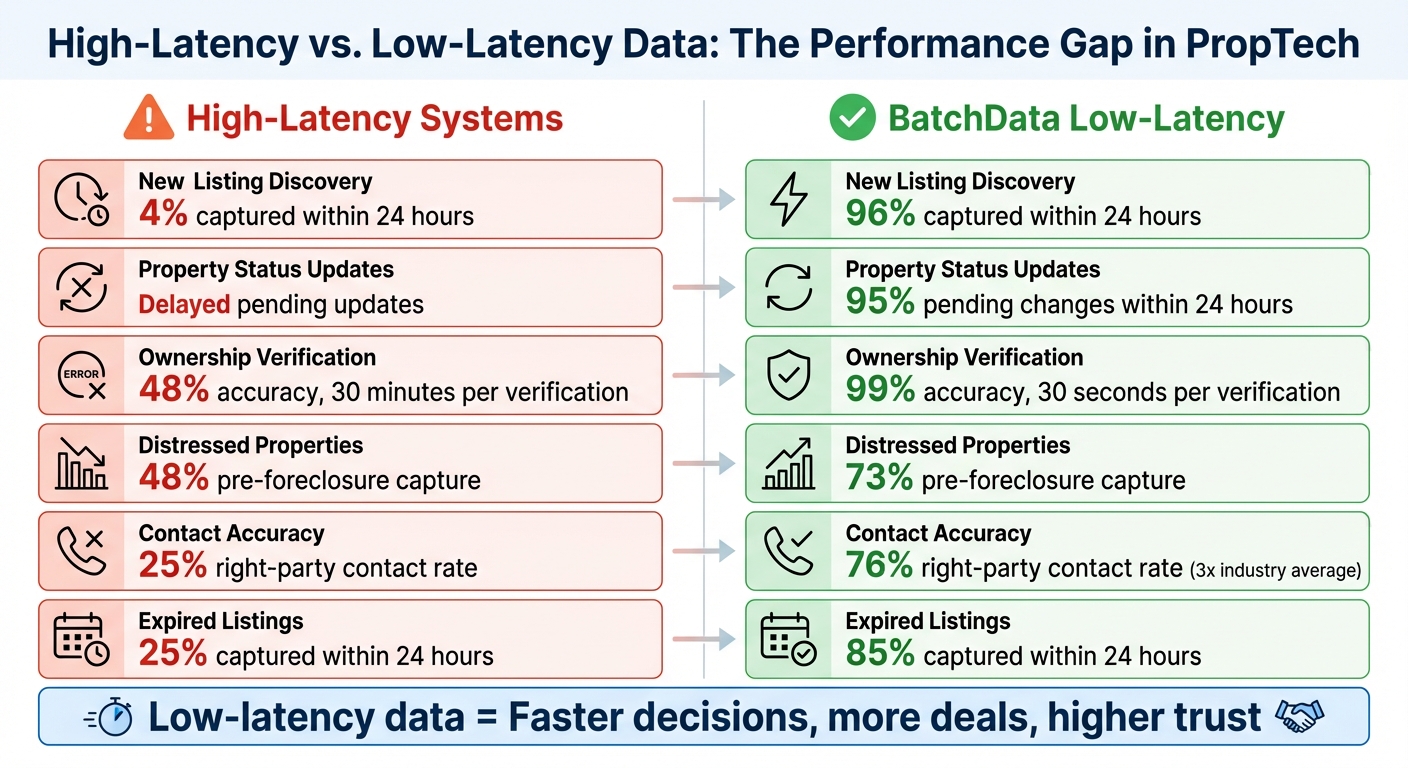
High-Latency vs Low-Latency PropTech Data Performance Comparison
Low-latency data is reshaping how PropTech platforms operate, improving both the user experience and the decision-making process. By addressing the delays caused by outdated information, it ensures faster, more accurate, and more efficient workflows for real estate professionals.
When property data updates in near real-time – within 24 hours rather than days or weeks – it creates a smoother, more dependable experience. Agents and investors can act quickly, trust the information they’re working with, and avoid costly mistakes caused by outdated data.
Better User Experience
Timely data builds confidence. Agents, property managers, and investors rely on PropTech platforms for critical decisions, and they need to know the data is up-to-date. Low-latency updates eliminate frustrating scenarios like contacting sellers about already-sold properties or scheduling showings for listings that are no longer available. By reducing the need for manual verification, users can focus on what truly matters – closing deals.
Real-time updates also lead to higher engagement. When users know they can count on a platform for the latest property insights, they’re more likely to stay active and take advantage of new listings as soon as they appear. This speed and reliability make a noticeable difference in how efficiently professionals can operate.
Better Decision-Making
Access to accurate, current data is essential for making sound investment decisions. When valuations reflect the latest market trends and recent sales, investors can make competitive offers without overpaying. On the flip side, outdated data can lead to pricing errors, costing thousands of dollars per transaction.
Low-latency updates also help agents and investors spot opportunities faster. For example, when canceled or expired listings are updated within 24 hours, agents can quickly reach out with alternative strategies. Similarly, early access to pre-foreclosure data gives professionals a head start in negotiating deals before properties reach auction. Acting quickly can mean the difference between closing a deal and losing out.
Comparison Table: High-Latency vs. Low-Latency Scenarios
| Scenario | High-Latency Impact | BatchData Low-Latency Advantage |
|---|---|---|
| New Listing Discovery | Delays in new listings can lead to missed opportunities. | 96% of MLS active listings captured within 24 hours |
| Property Status Updates | Risk of scheduling showings for properties already marked as pending or sold. | 95% of pending status changes updated within 24 hours |
| Ownership Verification | Slower updates can result in inaccurate ownership records. | 99% accuracy in ownership changes within 24 hours |
| Distressed Property Leads | Missed opportunities before foreclosure auctions due to outdated data. | 73% of pre-foreclosure properties captured early |
| Contact Accuracy | Outdated contact details waste marketing resources. | 76% accuracy in verified contact data – 3x the industry average |
| Expired Listings | Delayed updates prevent timely follow-ups with motivated sellers. | 85% of canceled/expired listings updated within 24 hours |
Low-latency data isn’t just about speed – it’s about creating a competitive edge. Whether it’s securing a deal, building trust with clients, or optimizing workflows, having the most current information makes all the difference.
Conclusion
Tackling the challenges of delayed property data, low-latency data stands out as a critical advantage for PropTech platforms. In this fast-paced market, where timing can mean the difference between sealing a deal or losing it, outdated data erodes trust, wastes time, and causes missed opportunities. Simply put, when property data is even a few days behind, it can derail user confidence and effectiveness.
BatchData addresses this head-on with its low-latency performance, delivering up-to-date property data that empowers agents, investors, and property managers to act quickly and make smarter decisions. With real-time APIs, daily updates covering over 155 million property records, and flexible delivery options, BatchData ensures your platform provides the most accurate, current data available.
Whether you’re developing a new PropTech solution or enhancing an existing one, BatchData equips your platform with the tools to eliminate data delays, build user trust, and secure more deals. Upgrade your PropTech platform with BatchData and gain the edge that comes with real-time, reliable property data.
FAQs
Why is data latency a critical issue in real estate transactions?
Data latency often results in outdated property details – like listings for homes that have already been sold weeks ago. This not only frustrates buyers and agents but also wastes time and can lead to missed opportunities or even financial setbacks.
When you have accurate, current data, transactions flow more smoothly, decisions are more informed, and everyone involved enjoys a more dependable experience.
How can PropTech platforms minimize data latency to improve user experience?
PropTech platforms can significantly cut down on data latency by upgrading how they process and deliver information. Moving from periodic updates to near real-time data pipelines means that updates – like a property being sold or a listing being modified – are reflected almost instantly. This ensures users always have access to current and dependable information.
On the backend, improving performance is key. Techniques like fine-tuning database queries, indexing crucial fields, and using caching mechanisms can help maintain speed, even as the volume of data grows. Event-driven systems, such as webhooks or message queues, can further streamline updates, eliminating the need for scheduled checks and enabling immediate changes.
To top it off, implementing continuous latency monitoring and automated alerts allows teams to quickly spot and address any bottlenecks. This ensures the platform consistently delivers accurate, up-to-date information to users.
Why does having up-to-date data matter for building trust in PropTech apps?
Keeping property information up-to-date is key to maintaining user confidence. Imagine the frustration a user feels when they inquire about a property, only to find out it was sold weeks ago. Experiences like that can quickly shake trust in the app.
By delivering real-time data, PropTech apps guarantee users access to the latest property details. This ensures a smooth, dependable experience and reinforces the app’s reputation as a trustworthy resource for making real estate decisions.