Rental prediction APIs save time and deliver precise data for real estate professionals. Instead of manually scraping listings, a real estate API provides real-time rental insights, including property valuations, vacancy rates, and neighborhood trends. They pull data from public records, MLS feeds, and HUD Fair Market Rent databases, offering actionable insights for tasks like underwriting, tenant screening, and portfolio management.
Key factors to evaluate rental APIs:
- Coverage: ZIP code and property-level data for broader market insights.
- Granularity: Detailed metrics like bedroom count, square footage, and effective rent.
- Prediction Accuracy: Weekly updates and confidence scores for reliable forecasting.
- Integration: REST APIs, batch processing, and developer-friendly tools.
Top providers include:
- RentCast: Covers 140M+ properties with daily updates and no-code support.
- ATTOM: Focuses on socioeconomic data for valuations.
- HouseCanary: Offers 1-year rental forecasts refreshed every 2–3 days.
- BatchData: Tracks 155M+ properties with advanced tools like sale propensity scoring.
Choose APIs based on your needs, whether it’s bulk data delivery, predictive analytics, or real-time updates.
Time Series Forecasting Rental Prices with FB Prophet

sbb-itb-8058745
How to Evaluate Rental Prediction APIs
A good rental prediction API relies on solid data, precise forecasting, and smooth integration, similar to other real estate APIs.
Data Coverage and Granularity
When it comes to coverage, the numbers matter. An API covering 28,000 ZIP codes captures about 55% of U.S. rental units. But those reaching 33,000 ZIP codes can cover up to 95% of the market. That difference becomes a real hurdle when evaluating properties in smaller markets like Boise or Knoxville.
Granularity is just as important. The best APIs offer data across multiple levels – street address, radius-based searches (usually 2–5 miles), ZIP code, county, and Metropolitan Statistical Area (MSA). For multifamily properties, critical details like unit mix, bedroom count, square footage, year built, and property type are essential for precise evaluations. It’s also crucial that the API differentiates between asking rent and effective rent, as effective rent provides a more accurate picture of actual income.
Once you have granular data, the next step is determining how well the API predicts rental trends.
Prediction Capabilities
A solid API should provide low, mid, and high rent estimates to help model different scenarios. Confidence scores are equally important – they allow you to identify estimates with limited comparable data instead of treating every result as equally reliable.
Data freshness is another critical factor. APIs that update weekly outperform those with monthly or quarterly updates. As ApartmentIQ puts it:
"You can’t forecast the future if you’re behind the market."
Their 2025 performance data highlights this point. For Salt Lake City, public benchmarks predicted +2.12% rent growth, but actual growth was -1.76%, a 3.88-percentage-point miss. ApartmentIQ’s model, however, predicted -0.30%, demonstrating much tighter accuracy. For lenders or acquisition teams, this level of precision can directly influence deal pricing.
While strong data and predictions are essential, integration plays a big role in practical use.
Integration and Developer Experience
An API should deliver clean JSON responses over REST with response times under 200ms. Simple API key authentication makes onboarding quick and painless. For large-scale analysis, batch endpoints that handle 50+ addresses per request are a must.
Good documentation is another key factor. Look for APIs that provide complete endpoint references, pre-built code examples, and a free tier or sandbox mode for testing without using production credits. Features like a data_as_of timestamp in responses and a data_source field (indicating whether the data comes from MLS records, public sources, or models) can make debugging and auditing much easier.
BatchData Rental Market Prediction Capabilities
BatchData takes rental market analysis to a new level by tapping into a massive data infrastructure. With a database that tracks over 155 million properties across the U.S. and processes more than 1 billion data points, it equips analysts with a solid foundation for building rental forecasting workflows. This approach ties into earlier discussions on API integration and prediction accuracy, creating a strong base for insights into the rental market.
Core Real Estate Data Foundation
Accurate rental predictions depend on detailed, property-specific data. BatchData delivers this with records that include over 700 attributes per property. These attributes cover critical details like bedroom and bathroom counts, square footage, year built, construction type, tax records, sales history, estimated equity, and Loan-to-Value (LTV) ratios. Additionally, the platform provides rent estimates alongside property valuations, speeding up assessments of rental potential.
Ownership data adds another layer of depth to the analysis. BatchData identifies ownership behind LLCs and trusts, tracks absentee owners, and monitors length of residence. This information is crucial for building rental comparables or pinpointing off-market acquisition opportunities. The database includes 221 million homeowners and 260 million email addresses, making it a valuable tool for outreach and detailed analytics.
APIs and Bulk Data Delivery for Analytics
For teams building rental analytics platforms, BatchData offers various tools to integrate and use its data effectively. These include a real-time REST API, direct cloud sharing with platforms like Snowflake, BigQuery, and Databricks, and bulk delivery via Parquet files. These options enable both quick property lookups and integration of national datasets. Real-time data access ensures that rental models stay accurate and up-to-date.
BatchRank™, a standout feature, analyzes over 800 data points to assign a sale propensity score (ranging from 0 to 100) to each property. In Q3 2025 testing, it achieved 82% accuracy in predicting which properties would sell. For rental investors, this predictive tool helps prioritize markets and properties for underwriting.
"Data freshness means daily updates and real-time checks for content accuracy. It is what separates productive deal-making from wasted effort." – Ivo Draginov, President, BatchData
Professional Services for Custom Solutions
Understanding that not all teams have the resources to build their own data pipelines, BatchData offers professional services to assist with custom data integration, enrichment workflows, and technical setup for non-developers. The onboarding process is hands-on, with dedicated real-time support channels.
For those managing rental portfolios, BatchData can set up Smart Monitoring – an automated alert system that flags critical events like new liens, ownership changes, or listing activity across a portfolio. A free API key is available for initial testing, with usage-based pricing for BatchRank starting at $0.10 per API call. These tailored services simplify rental market analysis and align with the article’s emphasis on advanced prediction tools.
"We envision transitioning from simply being a data provider to becoming an intelligence partner that can tell you both a property’s history and predict its future." – Ivo Draginov, President, BatchData
Top Rental Market Prediction API Providers
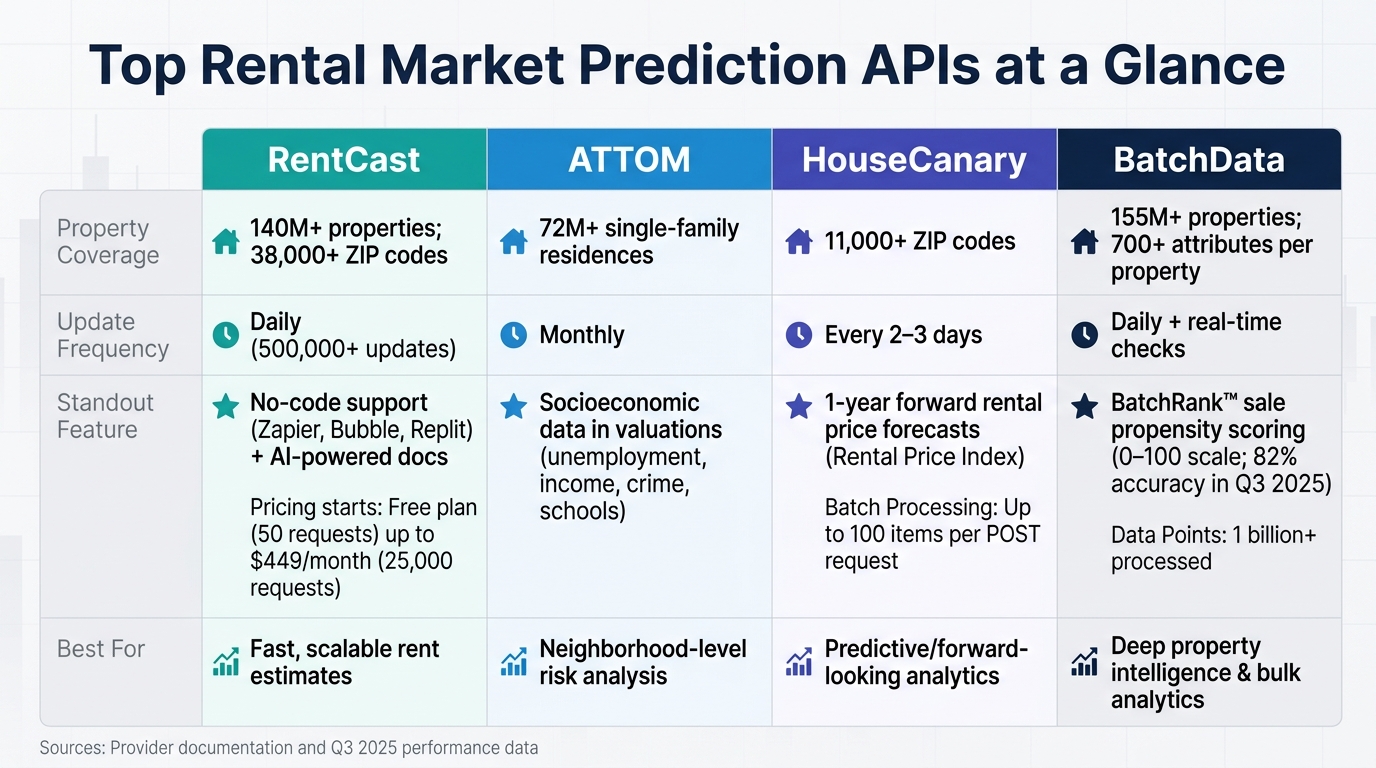
Top Rental Market Prediction APIs Compared: Coverage, Updates & Features
These APIs focus on rent estimation, forecasting, and delivering rental data. The best choice will depend on your specific needs, coverage area, and technical setup.
RentCast API
RentCast is built for fast and scalable rent estimates. Using an Automated Valuation Model (AVM), it generates long-term rent estimates based on property details and nearby comparables. The platform boasts coverage of over 140 million property records across 38,000+ U.S. zip codes, with historical rental data going back to April 2020.
For teams looking to automate workflows without coding, RentCast offers no-code integration support with tools like Zapier, Bubble, and Replit. Developers can take advantage of an MCP Server and OpenAPI documentation for seamless integration. Pricing starts with a free plan (50 requests) and scales up to $449/month for 25,000 requests.
"Our API comes with comprehensive documentation, live chat support and no contracts to help you start using our data in minutes." – RentCast
However, there’s a limitation: for multi-family or apartment properties, the rent estimate endpoint provides data for a single unit rather than the entire building.
Next, let’s explore how ATTOM integrates socioeconomic data into its rental valuations.
ATTOM Rental and Market Intelligence APIs
ATTOM’s Rental AVM covers 72 million+ single-family residences across the U.S. and provides monthly rental estimates using three methods: Gross Rent Multiplier, hedonic modeling, and area-based rates for regions with limited data. Its valuation model incorporates socioeconomic factors like local unemployment rates, median income, crime statistics, and school rankings. This gives analysts a broader understanding of neighborhood-level rental demand and potential risks.
While the monthly updates offer valuable insights, they might lag behind the pace of rapidly changing rental markets.
For teams focused on predictive analytics, HouseCanary offers a forward-focused approach.
HouseCanary Rental Forecasting Endpoints
HouseCanary specializes in forward-looking rental analytics. Its Rental Price Index (RPI) provides 1-year rental price forecasts, along with historical data down to the zip code level. The service covers 11,000+ zip codes, with models refreshed every 2–3 days.
Developers will find integration straightforward, thanks to a Python API Client and sample code available in seven programming languages, including Java, C#, Ruby, and JavaScript. Additionally, batch processing allows up to 100 items per POST request, making it efficient for bulk data needs.
| Provider | Coverage | Update Frequency | Standout Feature |
|---|---|---|---|
| RentCast | 140M+ properties; 38,000+ zip codes | Daily (500,000+ updates) | No-code support; AI-powered docs |
| ATTOM | 72M+ single-family residences | Monthly | Socioeconomic data in valuations |
| HouseCanary | 11,000+ zip codes | Every 2–3 days | 1-year forward rental forecasts |
Use Cases and Integration Patterns
The way you incorporate these APIs into your processes ultimately determines how effective they are.
Portfolio Dashboards and Asset Monitoring
APIs make it easier to track and manage large property portfolios, whether it’s dozens or even hundreds of properties, all from a single interface. For example, batch endpoints like /v1/comps/batch can handle up to 50 addresses in one request. This allows asset managers to update rent benchmarks across their entire portfolio in one go. Additionally, the API’s confidence_score field can be displayed directly in the dashboard, helping analysts gauge the reliability of data, especially when local listing density is sparse.
With real-time data feeds, dashboards stay up-to-date with market trends, ensuring rental predictions remain relevant and actionable. These dashboards can showcase key metrics such as median days on market, year-over-year rent growth, and gross yield, making it easier to identify which properties are lagging behind in performance compared to the local market.
Underwriting and Acquisition Modeling
These APIs are invaluable for streamlining underwriting and acquisition workflows. When evaluating deals, precision is key, and rental prediction APIs provide detailed data like bedroom-level rent ranges (from studios to 4-bedroom units), HUD Fair Market Rents, and broader indicators like vacancy rates and Home Price Index trends – all in a single response. This eliminates the need for manually combining data from various sources like government databases, MLS feeds, or AVM outputs.
Consider this: for a 75-unit portfolio with a 6.5% cap rate, increasing rent by just $100 per month per unit could raise the asset’s value by roughly $1.38 million. Accurate rent forecasting directly influences acquisition pricing. For larger portfolios of 200+ units, leveraging asynchronous API calls (e.g., with Python’s asyncio) can reduce data collection time by up to 90% compared to sequential methods.
These APIs also support operational decisions, such as tenant screening and risk management, beyond just valuation.
Tenant Screening and Risk Analytics
APIs that provide rent burden data – the percentage of median household income spent on rent in a specific ZIP code – help property managers set more tailored income-to-rent thresholds. This approach accounts for local economic realities instead of applying a one-size-fits-all 3x-income rule across the board.
For landlords working with Section 8 applicants, HUD Fair Market Rent endpoints instantly verify voucher amounts against federal standards for any U.S. ZIP code. This data is usually updated annually in October. By implementing programmatic confidence score thresholds (e.g., flagging estimates below 0.80), landlords can ensure that borderline applications are flagged for manual review, reducing the risk of errors in automated approval systems.
Conclusion
Modern APIs have transformed rental market analytics, offering bedroom-specific rent ranges, vacancy trends, HUD Fair Market Rent data, and professional-grade insights – all delivered in milliseconds.
"Manual rent research does not scale. Your platform needs data you can trust – programmatically." – RentComp API
Each provider highlighted here caters to different needs: RentComp API excels in delivering accurate rent estimates across major metros, ATTOM and HouseCanary offer rich historical data and forecasting capabilities for institutional-level underwriting, and BatchData’s property intelligence layer – spanning over 155 million properties with 500+ data points per record – provides robust enrichment that enhances the accuracy and usefulness of rental analytics.
To achieve reliable rental predictions, it’s essential to use APIs that refresh data weekly, cover your target areas, and include clear data source indicators. These factors are key to making well-informed decisions across your portfolio.
BatchData raises the bar with its BatchRank propensity scoring, a tool that adds predictive insights to rental analytics. Unlike reactive APIs, this feature helps investors identify properties likely to change hands before they hit the market – a crucial edge in competitive environments. With bulk delivery options and professional services for custom data pipelines, BatchData serves as a comprehensive property data API rather than just a standalone API.
When choosing an API, prioritize those offering up-to-date, granular, and trustworthy data. Start by verifying coverage, testing data freshness, and ensuring your analytics foundation can grow alongside your portfolio.
FAQs
What data should a rental prediction API return besides a rent estimate?
A reliable rental prediction API should go beyond simple rent estimates. It should offer a wealth of data, including comparable rental listings (such as rent amounts, square footage, and days on the market), market statistics (like vacancy rates, historical trends, and year-over-year changes), and neighborhood details (median income, population density, and Walk Scores). Clarity and openness are crucial – look for features like confidence scores, information on data freshness, and source details to ensure the data is dependable.
How can I validate a rental API’s accuracy for my market?
To check a rental API’s reliability, confirm it provides adequate sample sizes: at least 15 listings for address-level, 30 for ZIP code-level, and 80 for city-level data. Choose APIs that include confidence scores and clearly disclose their data sources, such as MLS or government records. Additionally, favor APIs that use median-based benchmarks to prevent results from being distorted by outliers. BatchData stands out by meeting these criteria with its dependable property search APIs and data enrichment services.
What’s the best way to integrate rental APIs for bulk portfolio updates?
To update rental portfolios in bulk using APIs, it’s important to pick the right approach based on your needs and infrastructure. RESTful APIs work best for real-time, transactional updates, while direct cloud delivery – like pushing data to a warehouse – is more suitable for handling large-scale analytics.
Some key tips to keep in mind include using asynchronous processing for smoother operations, setting up webhooks to handle updates efficiently, and closely monitoring your usage to manage credits effectively during bulk processes.