


































SEO Title: Lis Pendens and Foreclosure: A 2025 Investor's Guide
Meta Description: Understand the direct link between a lis pendens and foreclosure. Learn the timeline, how it clouds a title, and how investors find pre-foreclosure deals.
Meta Keywords: lis pendens and foreclosure, lis pendens, what is a lis pendens, pre-foreclosure, judicial foreclosure, non-judicial foreclosure, real estate investing
A lis pendens is the official starting gun for a foreclosure lawsuit, putting the world on notice that a property's ownership is now in dispute. For investors, this legal filing is the earliest signal of a distressed asset, creating a high-stakes opportunity long before a property hits the auction block. Understanding this link is critical to capitalizing on pre-foreclosure deals.
| Core Takeaway | Description |
|---|---|
| Legal Trigger | A lis pendens is a public notice of a pending lawsuit; foreclosure is the legal process to seize the property. The lis pendens initiates the foreclosure. |
| Title Impact | The filing creates a "cloud" on the property title, making it impossible to sell or refinance through traditional channels. |
| Investor Signal | For investors, a lis pendens filing identifies a motivated seller under immense pressure to resolve their debt. |
| Timeline is Key | The path from lis pendens to auction varies from 60 days (non-judicial) to over 2 years (judicial), depending on state law. |
This guide breaks down exactly how these two legal concepts connect and how smart investors leverage this information to secure off-market deals.
What is the direct connection between a lis pendens and foreclosure?
The connection is causal and immediate: a lis pendens is the first public, legal step that initiates a judicial foreclosure. It is the formal announcement of the foreclosure lawsuit, not the foreclosure itself. By filing this notice, the lender places a legal "cloud" over the property's title, effectively freezing the asset and preventing the owner from selling or refinancing it until the lawsuit is resolved.
Comparison: Lis Pendens vs. Foreclosure
| Attribute | Lis Pendens | Foreclosure |
|---|---|---|
| Definition | A public notice of a pending lawsuit affecting a property's title. | The legal process of seizing and selling a property to repay a debt. |
| Purpose | To warn potential buyers and lenders of the legal dispute over the property. | To reclaim the property (collateral) after a borrower defaults on a loan. |
| Legal Status | A notice creating a "cloud" on the title. Ownership has not changed. | A full lawsuit that results in the transfer of ownership via auction or repossession. |
| Timing | The first step in a judicial foreclosure process. | The entire process that follows the lis pendens filing. |
| Outcome | Warns third parties and makes the property unmarketable. | Ends in a public sale, loan reinstatement, or the bank taking ownership (REO). |
Legal Framework
A lis pendens carries significant legal weight, designed to protect the lender's interest during the lengthy foreclosure process. Without it, a homeowner could sell the property to an unsuspecting buyer, leaving the lender with a defaulted loan and no asset to recover.
- Creates a Public Record: The filing ensures anyone performing a title search is immediately aware the property is entangled in litigation.
- Binds Future Buyers: Anyone who purchases the property after the lis pendens is filed is legally bound by the lawsuit's outcome. If the lender wins, the new buyer loses the property.
- Governed by State Law: The specific rules, terminology, and timelines vary significantly by state. Some jurisdictions use specialized roles like foreclosure commissionerships to oversee the process, making local knowledge essential.
Pre-Foreclosure Activity Trends
This is not a niche legal concept; it is a widespread and growing market signal. In the first half of 2025, 187,659 U.S. properties had foreclosure filings. A significant portion of this activity, 140,006 properties, were new foreclosure starts—a 7% increase from the prior year. This data confirms that more properties are entering the pre-foreclosure stage, which begins with the filing of a lis pendens.
A lis pendens is a red flag on a property's title. It does not guarantee a foreclosure auction will occur, but it confirms the legal process has started, putting all parties on high alert.
This filing initiates a critical timeline, giving the homeowner a limited window to resolve the debt before the property is lost at auction.
How does a lis pendens cloud a property's title?
A lis pendens creates a "cloud" on the title, which is a formal claim or encumbrance that makes the property's ownership uncertain. This cloud renders the property a toxic asset on the open market, halting nearly all standard real estate transactions because no title insurance company will issue a policy for it.
Once this cloud is present, the property's liquidity vanishes. The owner cannot sell it conventionally, access equity via a HELOC, or refinance the mortgage.
The Role of Title Insurance
The paralyzing effect of a lis pendens stems from its impact on title insurance. This insurance is a non-negotiable requirement for nearly every U.S. property sale or mortgage, protecting buyers and lenders from financial loss due to title defects.
When a title search reveals an active lis pendens, title insurance companies refuse to issue a policy. The pending lawsuit represents an unquantifiable risk they will not underwrite.
- For Buyers: Without title insurance, a buyer would have zero protection. If the lender wins the foreclosure suit, the new owner's claim is extinguished, and they lose their entire investment when the bank seizes the property.
- For Lenders: No lender will finance a mortgage on a property without a clear title backed by an insurance policy. It is equivalent to lending money on an asset that may be legally repossessed at any moment.
The Investor's Gamble: Buying "Subject To"
An investor with cash can bypass traditional lenders and purchase the property directly from the distressed owner. However, this is an extremely high-risk strategy. Buying a property with a lis pendens means acquiring it "subject to" the outcome of the pending lawsuit.
The lis pendens serves as constructive notice to the entire world, ensuring the court's final judgment binds any subsequent owner.
By purchasing a property with a lis pendens, an investor legally acknowledges the lawsuit and agrees to be bound by its resolution. Claiming ignorance is not a defense.
The potential outcomes are brutally straightforward.
| Scenario | Legal Consequence for New Buyer | Financial Impact |
|---|---|---|
| Lender Wins Foreclosure | The lender's claim is superior. The property is sold at auction, and the new buyer's title is completely extinguished. | Buyer loses 100% of their investment and has no recourse. |
| Homeowner Wins Lawsuit | The lis pendens is removed (expunged), clearing the title. The new buyer now owns the property free and clear. | A rare but highly profitable outcome, as the property was likely acquired at a significant discount. |
| Case is Settled/Dismissed | The lis pendens is withdrawn, clearing the title. The new buyer secures ownership. | A favorable outcome, but not one that can be reliably predicted or controlled. |
This extreme risk is precisely what makes a lis pendens and foreclosure filing such a powerful tool for lenders. It traps the homeowner by cutting off their ability to sell the asset to pay the debt.
What is the timeline from lis pendens to auction?
The timeline from a lis pendens filing to a foreclosure auction is determined entirely by state law, which follows one of two paths: judicial or non-judicial foreclosure. Understanding which process applies is the first step for an investor to gauge holding costs, homeowner motivation, and the potential auction date.
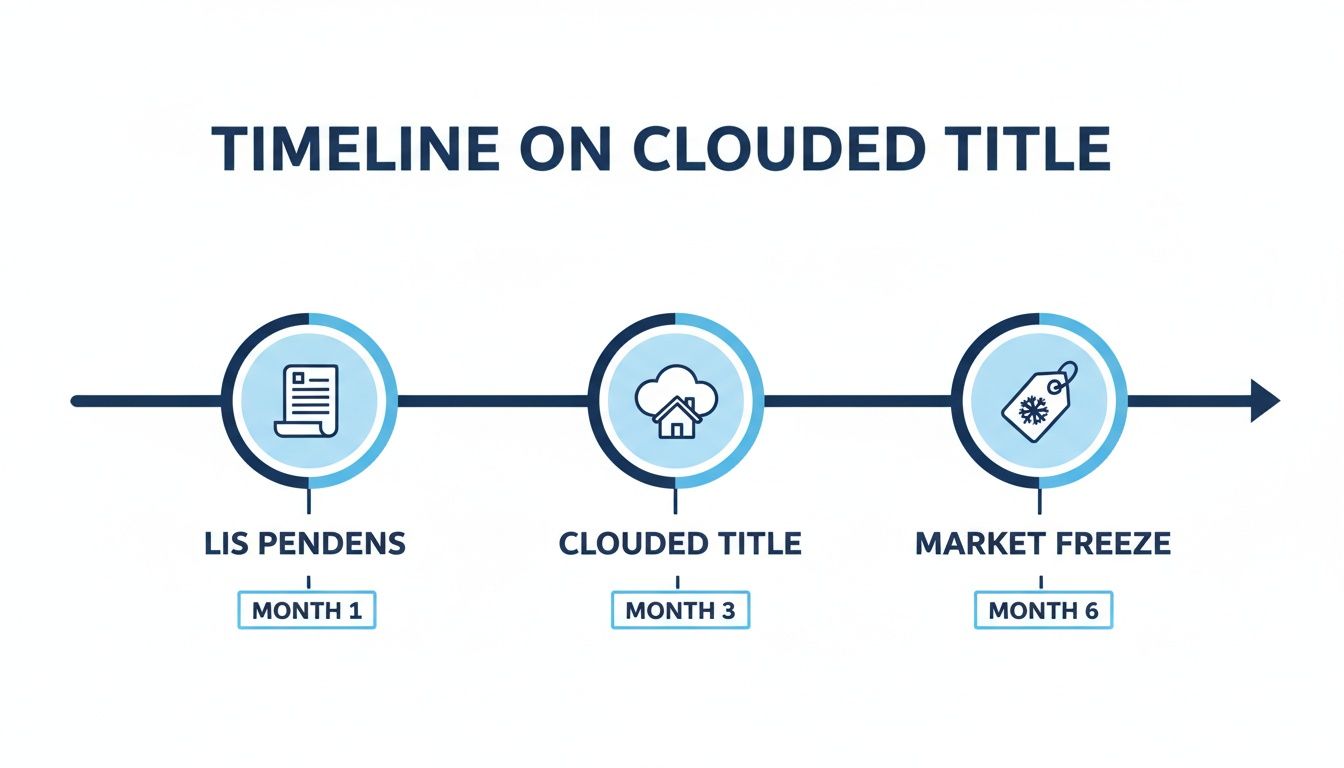
A lis pendens is the trigger that immediately clouds the title, effectively freezing the property on the open market.
Judicial Foreclosure: The Marathon
In states like New York and Florida, a foreclosure is a formal lawsuit that proceeds through the court system. This judicial foreclosure process is methodical and slow. After the lis pendens is filed, the lender sues the homeowner, who has the opportunity to contest the action in court.
- Filing and Service: The lender files the lawsuit and serves the homeowner with the complaint.
- Answer Period: The homeowner has a set time (typically 20-30 days) to file a formal response.
- Discovery: Both parties can request information, which can add months to the timeline.
- Court Hearings: The case proceeds through motions and potentially a trial, subject to the court's schedule.
- Final Judgment: If the lender wins, the court issues a judgment of foreclosure authorizing an auction.
Due to crowded court dockets, this entire process can take from six months to over two years.
Non-Judicial Foreclosure: The Sprint
In states like Texas and California, foreclosures are primarily non-judicial. This is enabled by a "power of sale" clause in the mortgage agreement, which allows the lender to sell the property after a default without court approval. It is a much faster and more direct path to auction.
Non-judicial foreclosure steps are defined by state statute, not a judge's calendar, and the process is often completed in a few months. A neutral third party typically manages the sale; it is crucial to understand the role of a trustee in a trustee's sale in these states.
The core difference is authority. In judicial foreclosure, the court grants permission to sell. In non-judicial foreclosure, the mortgage contract itself grants that permission.
Comparison: Judicial vs. Non-Judicial Timelines
The table below outlines the typical stages and timelines for both processes following the initial notice.
| Stage | Judicial Foreclosure (e.g., Florida) | Non-Judicial Foreclosure (e.g., Texas) |
|---|---|---|
| Initiation | Lawsuit and lis pendens are filed with the court. | Notice of Default is recorded and sent to the homeowner. |
| Homeowner Response | Formal legal response is required within a set timeframe (e.g., 20 days). | No court response is necessary; the process moves forward automatically. |
| Resolution Period | Can take months or years due to court hearings, motions, and discovery. | A statutory waiting period (e.g., 20 days) before the next notice. |
| Notice of Sale | Published after the court issues a final judgment of foreclosure. | Notice of Trustee's Sale is filed, posted, and mailed (e.g., 21 days before sale). |
| Total Estimated Time | 180 days to 2+ years | 60 to 120 days |
This stark difference in timelines is a fundamental factor for any investment strategy in the pre-foreclosure market.
How do you find and resolve a lis pendens?
A lis pendens must be addressed immediately by both homeowners and investors. The first step is to confirm the filing's existence and details, and the second is to execute a plan to resolve it. Ignoring the notice is not an option, as it signals an active legal battle moving the property closer to auction.
Successfully navigating this requires knowing where to find these notices and what actions are necessary to clear the title.
Methods for Uncovering a Lis Pendens
A lis pendens is a public record by design. There are three primary methods for locating one.
- County Recorder or Clerk of Court Records: This is the most direct source. Most counties provide online portals to search property records by address, owner name, or parcel number. The lis pendens will appear as a recorded document associated with the property.
- Title Company Services: A professional title search is the gold standard for identifying title defects. A title company will conduct a comprehensive review of public records and produce a preliminary report that flags any active lis pendens filings.
- Specialized Data Providers: For investors tracking pre-foreclosure activity at scale, data platforms are essential. These services aggregate public records, providing real-time alerts, detailed property profiles, lis pendens filings, mortgage data, and owner contact information. Learn how to find property owners to begin targeted outreach.
Monitoring these records is increasingly important. In Q1 2025, new foreclosure starts increased to 68,794 U.S. properties, a 14 percent jump from the previous quarter. States like Kansas (117%) and Delaware (58%) saw dramatic year-over-year increases in foreclosure activity. You can explore more on this trend and see the full report on U.S. foreclosure activity.
Pathways to Resolution and Removal
Once a lis pendens is confirmed, the objective is its removal. This requires resolving the underlying lawsuit.
A lis pendens is a symptom, not the disease. To cure the title, you must resolve the underlying legal conflict. The notice is lifted automatically once the lawsuit is dismissed, settled, or concluded.
These are the primary strategies for removing a lis pendens:
- Resolve the Underlying Debt: The most direct path is settling with the lender.
- Loan Reinstatement: Pay all missed payments, fees, and penalties to bring the loan current.
- Full Payoff: The homeowner or an investor pays the entire remaining loan balance.
- Loan Modification: The lender agrees to new loan terms, such as a lower interest rate or extended term, to make payments more affordable.
- Litigate the Lawsuit: The homeowner can fight the foreclosure in court. If a judge rules in their favor, the case is dismissed, and the lis pendens is removed.
- Negotiate a Withdrawal: The lender may agree to withdraw the lawsuit and lis pendens as part of an alternative resolution, such as a short sale or a deed in lieu of foreclosure.
- Motion to Expunge: In cases where a lis pendens was filed improperly (e.g., the lawsuit does not involve a valid claim to real property), a homeowner can file a motion to expunge (cancel) the notice. This requires convincing a court the filing is invalid.
How do investors use lis pendens data as an opportunity?
A lis pendens filing is the earliest and most reliable indicator of a motivated seller. Savvy investors use this public data to gain a competitive advantage by identifying off-market, pre-foreclosure deals long before they reach the MLS.
The strategy is built on the homeowner's urgent need to sell quickly to protect their credit, salvage remaining equity, and avoid foreclosure. This urgency creates an opportunity for an investor to provide a fast, all-cash solution.

Modern data platforms transform raw legal filings into an actionable pipeline of pre-foreclosure leads.
Investor Playbook: Pre-Foreclosure Deals
Successful investors operate a systematic, data-driven process. The moment a lis pendens is recorded, a clock starts. The first investor to establish contact with the homeowner often secures the deal.
- Identify the Opportunity: The process begins with fresh lis pendens and foreclosure data. Investors use platforms that deliver real-time alerts as soon as a notice is filed.
- Enrich the Data: The lis pendens is just the starting point. The next step is to append property details (estimated value, equity, mortgage data) and accurate owner contact information via skip tracing.
- Execute Targeted Outreach: Using the enriched data, investors launch multi-channel outreach campaigns including direct mail, cold calls, and SMS. The communication must be empathetic and solution-focused.
- Negotiate and Close: Due to the homeowner's motivation, negotiations can proceed quickly. The investor aims to acquire the property at a discount to its market value, factoring in repair and holding costs.
Using Data Platforms for a Competitive Edge
Manually searching county websites for filings is slow, inefficient, and impossible to scale. Professional investors use real estate data platforms to automate their lead generation engine.
A lis pendens is public information, but timely access to it is a private advantage. The investor who gets the data first, with the most accurate contact details, has the highest probability of closing the deal.
These platforms provide the tools necessary to build a scalable pre-foreclosure investment strategy.
| Feature | Manual Process | Platform-Based Process |
|---|---|---|
| Lead Sourcing | Check county websites daily, one by one. Slow and prone to delays. | Real-time, automated alerts pushed directly to your dashboard or CRM. |
| Data Enrichment | Search multiple public and private databases for owner info and property specs. | Instant access to comprehensive property profiles and skip-traced contact data. |
| Outreach | Manually prepare mailers or look up phone numbers. Highly time-consuming. | Integrated communication tools to launch campaigns directly from the platform. |
| Portfolio Monitoring | No easy way to track multiple properties or get updates. | Automated monitoring APIs that flag new liens, listings, or status changes. |
A unified platform allows investors to stop wasting time on manual data collection and focus on revenue-generating activities: contacting sellers and closing deals. Any serious investor should start by learning how to find distressed properties effectively.
Furthermore, applying the Top Real Estate Investment Tax Strategies is crucial for maximizing returns. Smart tax planning can significantly impact the profitability of a distressed asset purchase.
What are the most common questions about lis pendens?
Navigating a potential foreclosure is stressful. This section provides direct answers to the most common questions from homeowners and investors.
Does a lis pendens mean foreclosure is guaranteed?
No. A lis pendens is the start of a foreclosure lawsuit, not its conclusion. The homeowner can still resolve the situation through several means, such as reinstating the loan, negotiating a loan modification, or selling the property in a short sale. It is a serious warning, but not a final outcome.
How does a lis pendens affect a credit score?
The lis pendens filing itself is not reported to credit bureaus and does not directly impact a credit score. The cause of the lis pendens—missed mortgage payments—is what inflicts severe damage. These delinquencies are reported and can lower a credit score by 100 points or more, with the subsequent foreclosure causing further harm.
Can I buy a house with a lis pendens on it?
Yes, but it is extremely risky. Purchasing a property with an active lis pendens means buying it "subject to" the lawsuit's outcome.
If the lender wins the foreclosure case, your ownership rights are completely extinguished. You will lose the property and 100% of your investment.
This is why traditional mortgages are unavailable for such properties; it is a cash-only gamble. Most investors either acquire the property before the lis pendens is filed or wait for the foreclosure auction.
How is a lis pendens removed?
The notice cannot be removed directly; the underlying lawsuit must be resolved. A lis pendens is a symptom, and the lawsuit is the disease. The primary methods for removal are:
- Paying the Debt: The homeowner reinstates the loan or pays it off in full.
- Winning the Lawsuit: A court dismisses the foreclosure case in favor of the homeowner.
- Lender Withdraws Lawsuit: The lender voluntarily dismisses the case, often as part of a short sale or deed in lieu of foreclosure agreement.
- Motion to Expunge: In rare cases where the lis pendens was filed improperly, a court can order it to be canceled.
Once the legal action concludes, the lis pendens is officially released, and the property's title is cleared.
Gain a competitive edge in real estate investing with BatchData. We provide real-time pre-foreclosure data, comprehensive property details, and verified owner contact information so you can find motivated sellers first. Discover your next deal at https://batchdata.io.