





































Most real estate teams do not need a fancy scoring system first. They need one that fits their data and gets agents to act fast.
If I had to boil this article down, here’s the answer:
- Point-based scoring is best when I want a simple setup with fixed scores for actions.
- Recency-based scoring is best when I care most about what happened lately.
- Frequency-based scoring is best when I want to spot repeat behavior around the same listings or areas.
- Blended scoring is best when I can combine behavior, lead fit, and contact quality in one model.
A few numbers matter right away:
- Leads are 21x more likely to convert with a response in under 5 minutes
- Buyers often search for about 10 weeks
- They view a median of 7 homes during that time
So if I’m choosing a model, I’d look at three things first:
- How clean my CRM data is
- How fast my team follows up
- Whether agents can see why a lead scored high
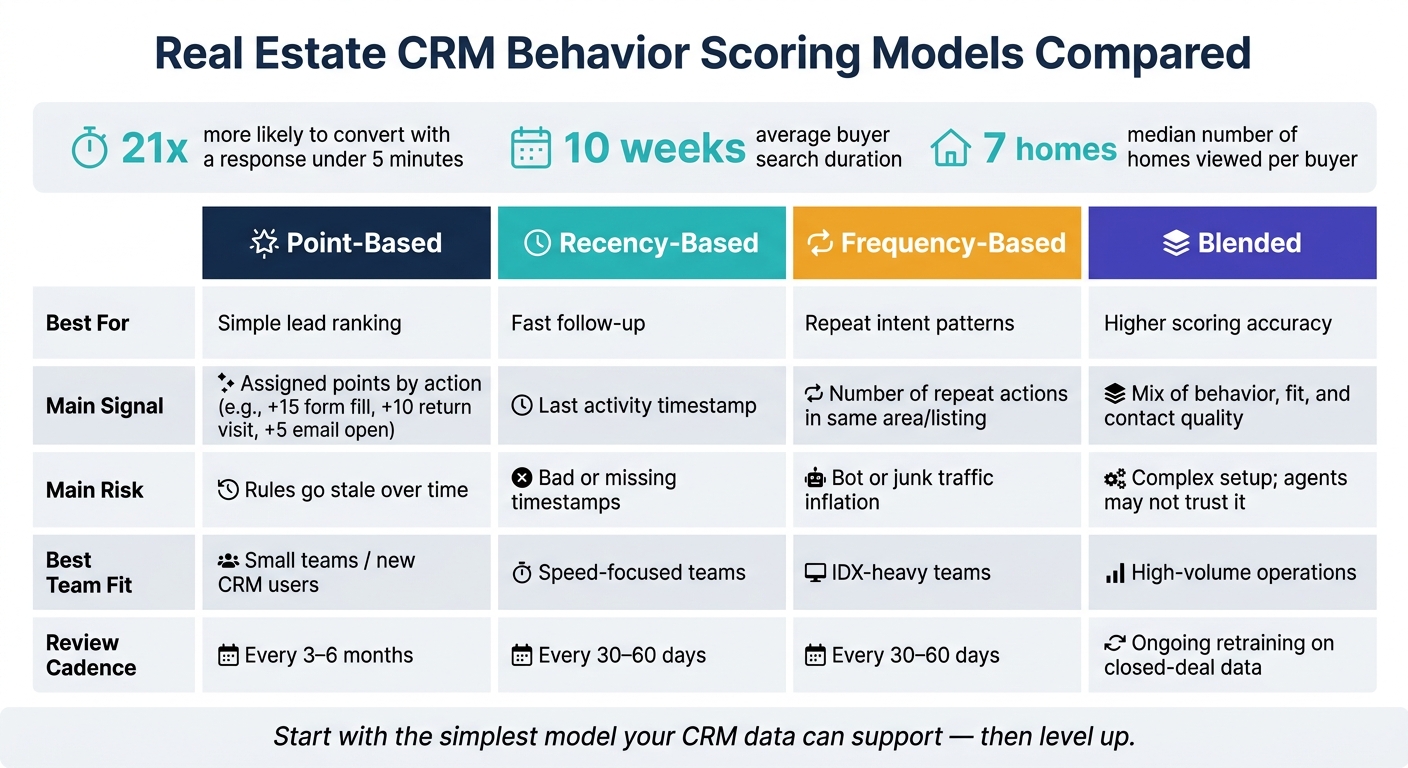
Real Estate CRM Behavior Scoring Models: Side-by-Side Comparison
Close more real estate deals with AI Lead Scoring & AI Opportunity Summaries
Quick Comparison
| Model | Best For | Main Signal | Main Risk | Best Team Fit |
|---|---|---|---|---|
| Point-based | Simple lead ranking | Assigned points by action | Rules get stale | Small teams |
| Recency-based | Fast follow-up | Last activity time | Bad timestamps | Speed-focused teams |
| Frequency-based | Repeat intent patterns | Number of repeat actions | Bot or junk traffic | IDX-heavy teams |
| Blended | Higher scoring accuracy | Mix of behavior, fit, and contact quality | More setup and data needs | High-volume teams |
The short version: use the simplest model your CRM can support well, then review scores every 3 to 6 months so the system stays useful.
1. Point-Based Behavior Scoring
Point-based scoring gives each CRM action a set value. High-intent actions add points. Low-fit signals take points away. Over time, those actions build a running score that helps you sort lead priority.
Signal Logic
A contact form fill might be worth +15, a return visit +10, and an email open +5. Leads outside your target area can lose 5 to 10 points.
It also helps to keep behavior scoring and fit scoring separate. Behavior scoring tracks what a lead does. Fit scoring looks at things like location, income, and other demographic details.
Data Requirements
To make this work, track three inputs:
- Property engagement
- Communication activity
- Website behavior
Pipeline Fit
As scores build, leads usually fall into three bands:
| Score Band | Pipeline Status | Recommended Action |
|---|---|---|
| Hot | Bottom of funnel | Immediate call |
| Warm | Middle of funnel | Bi-weekly drip |
| Long-term nurture | Top of funnel | Quarterly check-in |
Hot leads show repeated high-intent activity. That could mean viewing 10 listings in 2 days or submitting a home valuation request.
Warm leads tend to browse broader content instead of zeroing in on specific listings. Cold leads have gone quiet or no longer match your criteria, so their scores should drop over time to reflect inactivity.
Agent Actionability
Point-based scoring works best when it leads to immediate action. If a lead crosses a set threshold, your CRM should flag that person right away. For example, a showing request or repeated views of the same listing should put that lead in front of an agent fast, while interest is still high.
You should also review point values every 3–6 months against conversion data.
Point totals show who’s engaged. Recency scoring shows who’s active right now.
2. Recency-Based Behavior Scoring
If point-based scoring adds everything up, recency scoring looks at one thing first: when did the lead last do something? Scores go up when a lead engages. They drop when that activity slows down or stops.
Signal Logic
Recency logic needs to tell the difference between casual browsing and clear intent. There’s a big gap between someone who clicks one email and vanishes, and someone who comes back to the same listings in one ZIP code for three straight days.
The same goes for valuation and Comparative Market Analysis (CMA) pages. If a lead keeps returning to those pages, that’s a much stronger sign of intent. Repeat visits there should carry heavy weight and should trigger immediate follow-up.
Data Requirements
Recency scoring depends on timestamps for every interaction: page visits, email opens, form submissions, and calls. Without that timing data, decay logic falls apart.
You also need to track smaller signals across website, portal, and email activity in real time. Those little actions often show the first signs that a lead is warming up again.
Pipeline Fit
Recency scoring works especially well for spotting re-engagement. This is the lead who went quiet for 90+ days and then suddenly comes back. Agents can miss that kind of shift pretty easily. A CRM, on the other hand, can catch it right away.
Here’s how engagement windows can map to CRM actions:
| Engagement Window | Intent Level | Recommended CRM Action |
|---|---|---|
| Last 24–48 hours | Critical | Immediate agent alert; SMS or call |
| Last 7 days | Active | Personalized nurture; new listing alerts |
| Last 30 days | Warm | Monthly market report; email check-in |
| 90+ days (re-engagement) | Re-engaged | Immediate notification to the assigned agent |
Agent Actionability
When recency scores spike, automated workflows should fire right away. But agents need more than a number. They need context they can use.
A plain-language alert like "viewed 5 listings in one ZIP last night" does a lot more than a raw score by itself. It tells the agent what happened and why it matters.
Decay windows should also be reviewed every 30–60 days against appointments and closed deals.
Recency tells you when interest last spiked. Frequency tells you how often it keeps happening.
sbb-itb-8058745
3. Frequency-Based Behavior Scoring
Recency shows when a lead last came back. Frequency shows how often they return – and whether that repeat pattern means anything. That makes frequency useful for spotting behavior that starts broad and then tightens around a clear area of interest.
Signal Logic
When someone keeps viewing the same neighborhood or the same set of properties, that usually points to stronger intent than casual browsing. Repeated property views, recurring IDX clicks, and sessions that include several related listings should push the score up. Broad browsing, on the other hand, should stay mostly flat.
As repeat activity starts to center on specific listings or one neighborhood, the score should rise. If visits stay scattered, it shouldn’t. And if the site sees repeat sessions with little engagement, that can be scored negatively to help screen out junk traffic or bot-like behavior.
Data Requirements
Frequency models depend on small behavior signals that add up over time. That includes:
- Repeat property page views
- Recurring IDX feed clicks
- Saved search returns
- Mortgage calculator use
- Time spent on high-intent pages like "recently sold" sections or home valuation tools
If that tracking isn’t consistent, the model can’t tell the difference between intent and noise.
One design choice matters a lot here: recency weighting inside the frequency model. A lead who visited yesterday and looked at five listings should score higher than someone whose five views happened six months ago. These signals work best together, not on their own.
Pipeline Fit
Frequency scoring works best when repeated actions start clustering around a property type, neighborhood, or listing group. That makes it easier to send the lead to the right agent.
Buyers usually spend a median of 10 weeks searching and view a median of 7 homes during that period. That’s a long stretch of behavior data. Frequency scoring helps turn that stream of clicks and visits into a clearer read on where the lead sits in the buying process.
Agent Actionability
High-frequency behavior should trigger automated routing, ideally to the agent who knows that neighborhood or property type best. That level of detail makes the handoff much more useful.
The CRM should also show agents plain-English context next to the score. "Viewed 5 listings in ZIP 90210" or "Requested valuation twice in 48 hours" tells an agent what to say when they follow up. A score by itself doesn’t give them much to work with.
It also helps to recalibrate the model every 30–60 days by comparing high-frequency scores with actual conversion results. That way, the thresholds reflect buying behavior, not just a lot of activity.
Use these patterns to separate broad curiosity from concentrated intent.
| Behavioral Signal | Score Impact | Intent Level |
|---|---|---|
| Multiple views of the same listing | High Positive | High – more focused intent |
| 20+ random property views | Low/Neutral | Low – broad curiosity |
| Repeated low-engagement visits | Negative | Junk/Bot Filter |
| Repeated visits to the same listing cluster | High Positive | High – more focused intent |
| Recurring saved search clicks | Medium Positive | Moderate – nurture |
4. Blended Behavior Scoring
When behavior by itself doesn’t tell the whole story, it helps to combine it with fit and contact quality.
Point-based, recency, and frequency models each show one part of lead intent. Blended scoring pulls those parts into one score by combining behavior, property fit, contact quality, and financing readiness. It uses the timing from recency, the repeat actions from frequency, and the weighting from point-based scoring, then adds fit data on top.
Signal Logic
The idea is simple: stack implicit signals like website visits, email opens, and listing views with explicit fit signals such as location, budget, and financing status. That cuts down on false positives. A lead who views five listings in one ZIP code, uses the mortgage calculator, and has a verified phone number should score much higher than someone just clicking around.
Points should also come off for bad-fit or low-quality signals, including out-of-area geography, fake phone numbers, and repeated low-engagement visits.
Data Requirements
That kind of scoring only works if the CRM data is clean.
Blended models need more inputs than a single-signal setup, so data quality matters a lot. Contact verification – confirmed phone numbers and valid email addresses – works as the first filter. If a lead has a fake number, the system should flag or disqualify that record.
BatchData can support this layer with property and contact enrichment, skip tracing, phone verification, APIs, and bulk delivery.
Pipeline Fit
Buyer and seller intent shouldn’t be scored the same way.
Use separate logic for each side of the transaction. Buyer scoring should lean on budget fit, location narrowing, and repeat listing views. Seller scoring should lean on valuation requests, CMA engagement, and equity inquiries. If both sides use the same weights, the model can get noisy, so it’s better to keep the logic separate.
Agent Actionability
The CRM should show a plain-English reason next to the score – something like "Viewed 5 listings in ZIP 90210, requested a tour, pre-approved". That gives the agent a clear starting point before making the call.
If the model can’t explain why a lead moved to the top of the queue, agents won’t trust it.
| Data Category | Input Examples | Scoring Impact |
|---|---|---|
| Behavioral (Implicit) | Repeat listing views, saved homes, email clicks | High – indicates active intent |
| Profile (Explicit) | Budget, timeline, financing status, location | Medium – indicates fit |
| Contact Quality | Verified phone, valid email, skip-traced data | Critical – filters junk leads |
| Negative Signals | Out-of-area geography, fake phone, low engagement | Subtractive – reduces noise |
Strengths, Tradeoffs, and Limitations by Model
Each model balances simplicity, speed, and accuracy in its own way. The main difference comes down to what each one is built to favor: simplicity, speed, repeat behavior, or full-context accuracy.
Point-based scoring is easy to set up. The downside is that static rules and manual updates can drift as market conditions shift.
"Traditional lead scoring… is too static and prone to human bias. It can’t adapt to changing market conditions or learn from past successes and failures."
It works well for small teams or anyone just getting started with lead scoring. But the rules need a checkup every 3–6 months to stay useful.
Recency scoring is good at picking up immediate intent. The catch is timestamp accuracy. Your CRM needs to log the last activity date across every connected channel, including website, email, and SMS. If that data is off, stale leads can look hot. This model also needs score decay logic so quiet leads move back down instead of hanging onto their rank.
Frequency scoring works best when you want to spot repeated, clustered behavior. But it depends on cross-session tracking and bot filtering. Otherwise, non-human activity can push scores up and muddy the picture.
Blended models tend to give the best accuracy, but they ask more from your data. You need clean cross-channel records and historical closed-deal data. In most cases, they need at least 3 months of training data to hit peak accuracy. The tradeoff is trust. If agents can’t see why a lead scored high, they may shrug and ignore it.
The table below boils each model down to its main strength, main tradeoff, and maintenance load.
| Model | Biggest Strength | Main Tradeoff | Key Maintenance Need |
|---|---|---|---|
| Point-Based | Simple to deploy in most CRMs | Static rules; prone to human bias | Manual rule updates |
| Recency-Based | Captures immediate intent | Depends on accurate real-time timestamps across channels | Automated score decay logic |
| Frequency-Based | Identifies high-intent leads through repeat behavior | Cross-session tracking; vulnerable to bot inflation | Filters for non-human activity |
| Blended/AI | Highest accuracy | More complex setup and less transparent to agents | Regular retraining on closed-deal data |
Grading and scoring are not the same thing. Grade for fit first. Score behavior second. Keeping them in separate CRM fields helps keep the logic clean and the sales queue usable.
That sets up the next issue: which model your CRM data can actually support without losing agent trust.
Conclusion
The best model comes down to CRM data quality and how your team actually works day to day. The main decision isn’t which model sounds smartest. It’s which one your CRM can support in a steady, reliable way.
Point-based scoring works well for small teams and newer CRM users because it’s clear and easy to use. Recency-based scoring makes sense for speed-first teams that need to respond fast. Frequency scoring is a good fit for teams that watch repeat visits and bursts of listing activity. Blended models work best for teams that can mix behavior, fit, and contact quality into one setup.
Start with the simplest model your data can handle. Then level up only when your tracking and conversion history are strong enough to support it. Put simply, point-based fits smaller teams, recency suits speed-driven teams, frequency fits IDX-heavy teams, and blended models fit high-volume operations. No matter which model you pick, plan to review the scoring weights every 3–6 months as market conditions and buyer behavior change.
FAQs
Which scoring model should I start with?
Start with a simple point-based system. Use lead grading first to split promising prospects from the ones that don’t need attention right away. Then score your hot leads based on behavior and fit.
Assign points to actions like email opens and property views, along with details like budget and timeline. As you see what leads to deals, tighten the rules and layer in deeper property and ownership data from BatchData.
How much CRM data do I need before scoring leads?
Before you score leads, grade them first. That step helps you spot which prospects are even worth nurturing, so you don’t waste time scoring every single record in your database.
At a minimum, your CRM should store a property address and ZIP code. Those two fields give you the starting point for enriched data like property value, equity, and ownership status.
And that data is what your scoring rules should rest on.
How do I keep agents from ignoring lead scores?
Make lead scoring something your team can act on right away. When a lead hits a high score, the system should instantly send a notification, assign the lead, create a task, and add a priority tag. Lower-scoring leads shouldn’t just sit there – they should move straight into a nurture flow.
Keep scores up to date with real-time CRM data. That way, agents can trust the rankings and move fast when a lead turns hot.