
BatchRank uses AI to predict which properties are likely to sell, while traditional lead lists rely on static data that often misses seller intent. If you’re tired of wasting time on outdated lists, BatchRank offers a smarter alternative by analyzing over 800 data points to score properties based on their likelihood to sell, utilizing data-driven property services to refine lead quality.
Key Takeaways:
- BatchRank: AI-powered, predicts seller behavior with a 63–64% success rate, updates in real-time, and reduces manual work by up to 70%.
- Traditional Lead Lists: Based on public records, lacks predictive insights, requires manual sorting, and delivers lower accuracy (20–25% contact rate).
BatchRank delivers better results by prioritizing high-intent leads, cutting costs, and improving ROI. If efficiency and accuracy matter to you, BatchRank is the clear winner.
Quick Comparison:
| Feature | BatchRank (AI-Powered) | Traditional Lead Lists |
|---|---|---|
| Prediction Accuracy | 63–64% | 20–25% |
| Data Points Analyzed | 800+ | Limited |
| Update Frequency | Real-time | Periodic |
| Workflow | Automated | Manual |
| Lead Quality | High-intent sellers | Generic data |
BatchRank simplifies lead generation by replacing guesswork with data-driven insights, saving time and boosting conversions. For developers looking to integrate these insights directly into their own platforms, a real estate API provides the necessary infrastructure.
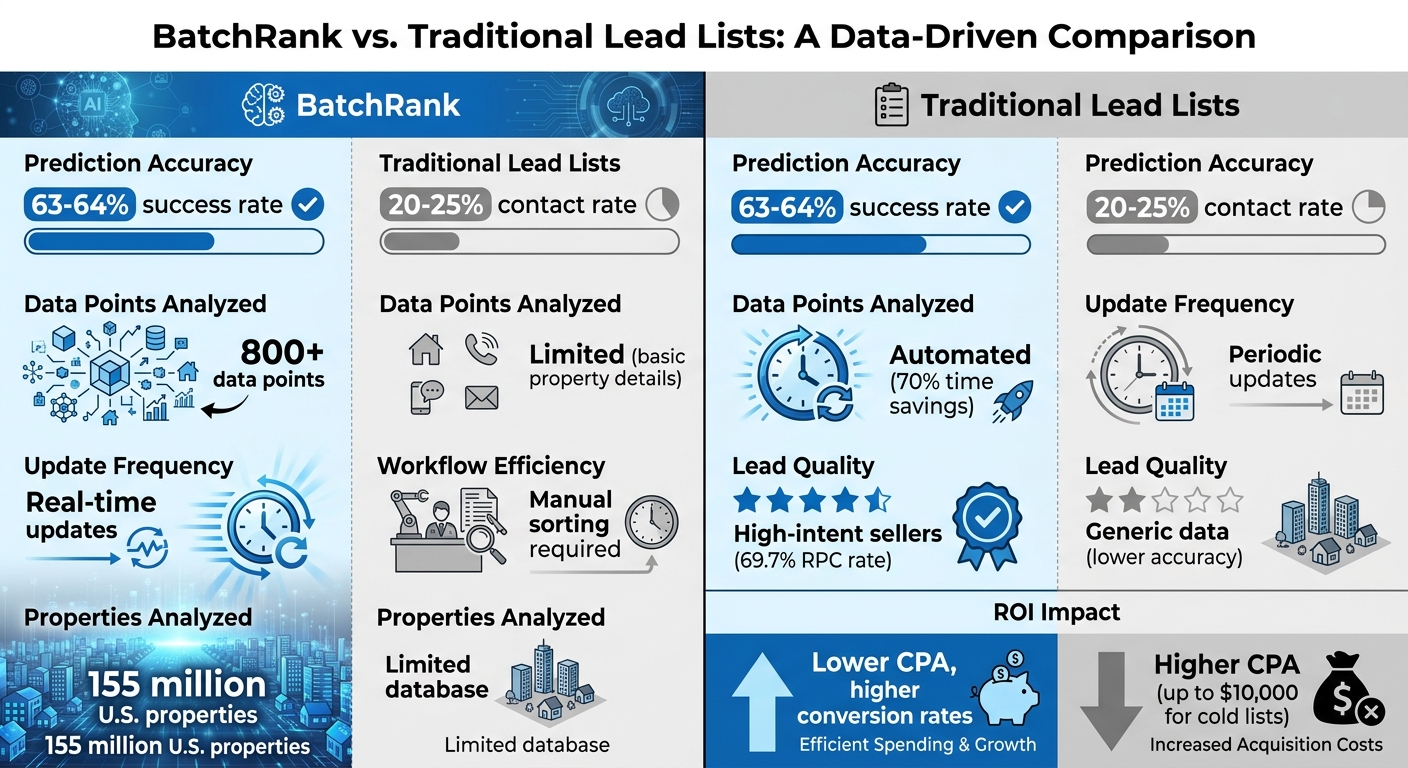
BatchRank vs Traditional Lead Lists: Performance Metrics Comparison
How BatchRank and Traditional Lead Lists Differ
When comparing BatchRank to traditional lead lists, the key distinction lies in prediction versus description. Traditional lead lists focus on describing property ownership – identifying out-of-state landlords, estate holders, or long-term owners. In contrast, BatchRank predicts when these owners are likely to sell, offering actionable insights tied to a specific timeline.
BatchRank: AI-Powered Lead Scoring
BatchRank leverages advanced machine learning to process over 800 unique data points for more than 155 million U.S. residential properties. These data points include details like ownership history, lien records, and economic trends, which are analyzed to assign a sale propensity score ranging from 0 to 100. This score estimates the likelihood of a property being sold within the next 6 months days to 12 months.
By replacing speculation with data-backed predictions, BatchRank delivers a ranked list of properties statistically likely to sell soon. This eliminates the guesswork of identifying motivated sellers. As BatchData explains:
BatchRank provides dynamic intelligence. It tells you which properties are most likely to become active leads, allowing you to focus your resources with surgical precision before the property even hits the market.
Another advantage? BatchRank continuously updates its insights as new data becomes available, ensuring that your lead list stays relevant. This dynamic and predictive approach sets it apart from traditional methods.
Traditional Lead Lists: Static Data Sources
Traditional lead lists rely on public records and basic filters, such as absentee ownership or equity percentages, to deliver static information like property size, owner names, and last sale dates. While this data can be helpful, it lacks context about seller intent or timing.
The result is often overwhelming: large, unprioritized lists that require significant manual effort to sort through. Without predictive scoring, marketers risk wasting resources on unmotivated sellers, leading to longer sales cycles and inefficient spending. By contrast, BatchRank’s predictive system has demonstrated 64% accuracy in identifying properties that eventually sell, a stark improvement over the trial-and-error nature of static filtering.
Accuracy and Predictive Performance Comparison
When it comes to predicting property sales, BatchRank stands out from traditional lead lists by achieving far better accuracy. The numbers speak for themselves: BatchRank boasts a 63–64% success rate in predicting which properties are likely to sell within 6–12 months. In contrast, traditional lead lists often result in contact rates of just 20–25%, largely due to outdated or incomplete information.
BatchRank’s Prediction Success Rate
The secret behind BatchRank’s accuracy lies in its AI-driven approach. By analyzing millions of property data points – such as property features, ownership history, market trends, economic factors, and lien data – it calculates a sale propensity score. This score ranks properties based on their likelihood to sell, offering a clear roadmap for targeting the right leads. Historical sales data has validated this method, confirming its effectiveness.
BatchRank further enhances efficiency by organizing leads into High, Medium, and Low tiers. This tiered system helps marketers allocate their budgets wisely, cutting out the guesswork that often leads to wasted resources. In short, BatchRank transforms raw data into practical insights, making lead targeting both cost-effective and results-driven.
Traditional Lead Lists: Lower Accuracy Rates
Traditional lead lists, on the other hand, rely heavily on public records for basic property details. Unfortunately, these lists lack a predictive element to gauge seller intent or timing. The result? Large, unfiltered datasets filled with irrelevant leads. Teams end up spending time and money contacting property owners who have little to no intention of selling.
“Buying more data leads to more noise. BatchRank provides a clear signal through that noise.” – BatchData
This inefficiency highlights the limitations of traditional methods, which often require manual sorting and still fail to deliver reliable results.
Accuracy Metrics Comparison Table
| Metric | BatchRank (AI-Powered) | Traditional Lead Lists |
|---|---|---|
| Accuracy/Success Rate | 63–64% predictive success | 20–25% contact rate |
| Data Points Analyzed | Millions of variables | Limited (size, owner, last sale) |
| Update Frequency | Continuous, real-time updates | Periodic |
| Lead Quality | High-intent, motivated sellers | Prevalent noise; manual sorting needed |
Efficiency and Scalability: Automated vs. Manual Workflows
When dealing with thousands of properties, the difference between automated and manual workflows becomes clear. Tools like BatchRank can cut prospecting time by up to 70%, while traditional methods often involve hours of manually sorting and cross-referencing spreadsheets. This comparison highlights how BatchRank’s automation stacks up against the labor-heavy processes of traditional lead lists.
BatchRank’s Automated Workflow
BatchRank takes the hassle out of list management by using AI to prioritize leads and update data in real time. Instead of combing through generic lists (like “all absentee owners”), the system assigns propensity scores based on hundreds of factors – such as equity levels, tax delinquency, lien filings, and ownership trends. High-value leads are sent directly to decision-makers, while lower-priority ones are funneled into automated follow-up campaigns.
With real estate API integrations and real-time updates, any change – like a new pre-foreclosure filing or a shift in LTV ratio – triggers immediate system updates. This seamless integration allows BatchRank to process over 155 million properties in milliseconds via cloud-based access. For example, in April 2026, Norway-based SuperOffice reduced research time by 70% across its teams using similar automation, enabling their staff to focus on closing deals instead of sifting through data.
Traditional Lead Lists: Manual Sorting Required
Traditional lead lists demand constant manual oversight. Users often need to clean, sort, and cross-reference data, which slows down outreach significantly.
“It saved over 80 hours.” – Ken Roden, B2B Sales Expert
This manual process is hard to scale. By the time a traditional list is sorted and validated, the data is often outdated, making it nearly impossible to meet the critical five-minute speed-to-lead window. Every step requires human involvement, creating bottlenecks that hinder efficiency and impact conversion rates.
Efficiency Metrics Comparison Table
| Feature | BatchRank (Automated Workflow) | Traditional Lead Lists |
|---|---|---|
| Data Processing | AI-driven scoring and prioritization | Manual sorting, cleaning, and cross-referencing |
| Scalability | High; real-time data feeds and bulk APIs | Limited; relies on CSV uploads and spreadsheet management |
| Speed to Lead | Instant; outreach within 5 minutes | Slow; manual uploads to dialers/CRMs |
| Research Time Savings | Cuts manual research by up to 70% | Hours spent compiling data |
| Operational Impact | Proactive; automates lead routing | Reactive; constant list updates required |
This table underscores the efficiency gap between automated systems like BatchRank and traditional manual workflows, particularly in handling large-scale operations.
Use Cases and ROI Analysis
BatchRank delivers a sharp reduction in CPA by focusing on high-intent sellers, unlike traditional lead lists that often promise low CPL but fail to ensure meaningful conversions. By harnessing AI to analyze over 800 data points across 150 million properties, BatchRank pinpoints motivated sellers with precision. This approach not only improves cost efficiency but also enhances campaign ROI by delivering more accurate targeting and a smoother workflow.
BatchRank for Targeted Campaigns
BatchRank shines in campaigns that require advanced data filtering to identify highly motivated sellers. For wholesalers, it combines criteria like out-of-state ownership, high equity, and tax delinquency to pinpoint leads that are ready to act. Fix-and-flip investors see a competitive edge thanks to 96% MLS updates within 24 hours, with canceled and expired listings becoming available days before competitors can access them. Enterprise teams benefit from automated triggers – for instance, when a property enters pre-foreclosure, BatchRank immediately activates CRM campaigns. With a 69.7% Right Party Contact (RPC) rate, outreach efforts are directed at actual decision-makers, avoiding outdated contacts or tenant roadblocks. This level of precision means teams can focus their energy on negotiating deals rather than chasing unproductive leads, directly boosting conversion rates.
Traditional Lead Lists: Limited Targeting Capabilities
Traditional lead lists often fall short by providing generic data that lacks critical motivation signals, such as equity analysis or distress indicators. Manual processes for lead validation further slow down outreach, giving competitors a head start on the most promising leads.
Without automated scoring, these lists result in lower lead-to-close ratios. For example, referral channels achieve a 30.0% lead-to-close rate at an average CPA of $167, while direct mail campaigns using cold lists convert at just 0.8% with a staggering $10,000 CPA. These figures highlight how poor targeting drives up acquisition costs and diminishes overall campaign efficiency.
ROI Comparison Table
The table below highlights the stark differences in ROI between BatchRank and traditional lead lists:
| Metric | BatchRank (Data-Driven Approach) | Traditional Lead Lists |
|---|---|---|
| Targeting Method | AI-powered propensity scoring (800+ variables) | Manual filtering of static attributes |
| Data Freshness | 96% MLS updates within 24 hours | Delayed updates (often days or weeks behind) |
| Contact Accuracy | 69.7% Right Party Contact (RPC) rate | Lower accuracy due to unverified skip tracing |
| Lead Quality | High-intent (distress signals + equity) | Generic (e.g., all absentee owners) |
| Workflow | Automated triggers and CRM integration | Manual list pulling and sorting |
This comparison underscores how BatchRank’s automation and data-driven approach reduce wasted outreach, lower CPA, and significantly improve lead-to-close ratios. By focusing on high-quality leads and eliminating inefficiencies, BatchRank offers a clear advantage over traditional methods.
Conclusion: Which Approach Fits Your Real Estate Goals
After examining the performance and efficiency metrics, the decision becomes straightforward. BatchRank removes the uncertainty from prospecting by analyzing thousands of data points across 155 million U.S. properties. It provides instant lead scoring to pinpoint high-intent sellers before they hit the market. This approach not only simplifies the workflow but also supports operational and compliance advantages.
“Success now belongs to operators who build proactive, data-driven acquisition engines to identify and engage motivated sellers before they hit the open market.” – BatchData
BatchRank shines by connecting you directly with verified decision-makers and delivering current property data. It avoids common pitfalls like anonymous LLCs or trusts. With bulk skip tracing costs starting at just $0.08 per record and integrated DNC scrubbing to protect against penalties (up to $1,500 per violation), it addresses many of the legal and financial risks tied to manual processes.
For real estate professionals aiming to boost ROI, BatchRank offers a clear solution. Its automated workflows, predictive modeling, and real-time updates provide the tools needed to thrive in today’s competitive market. Why keep chasing cold leads when you could focus on closing deals with motivated sellers? Dive into BatchData’s tools, like real estate APIs and 1-click list generation, to shift your acquisition strategy from reactive to proactive.
FAQs
What does BatchRank’s score predict?
BatchRank’s score estimates the likelihood of a property selling within the next 6 months. Leveraging AI, it processes millions of data points to pinpoint listings with a strong chance of selling.
How often is property and contact data updated in BatchRank?
BatchRank keeps property and contact data continuously updated as fresh information becomes available. This means users always have access to the latest insights, helping them target leads more accurately and effectively.
How do I use BatchRank scores in my CRM or campaigns?
BatchRank scores can be a game-changer for your CRM or marketing campaigns. These scores, ranging from 0 to 100, are calculated by analyzing over 800 signals to determine a property’s likelihood of selling within the next 6–12 months.
By integrating BatchRank into your system, you can prioritize high-probability leads and focus your efforts where they matter most. The API allows for real-time data enrichment and lead scoring, making it easier to target the right prospects. High scores can also help with better segmentation and outreach, leading to smarter decisions and boosting conversion rates.