




































Property data enrichment transforms basic property records into detailed datasets, adding hundreds of attributes like square footage, ownership history, and neighborhood trends. This process provides actionable insights for real estate investors, marketers, and developers by combining data from public records, MLS databases, and market analytics. Here’s what you need to know:
- What It Does: Enhances raw property data with details like building specs, transaction history, and local market trends.
- Who Benefits: Investors identify undervalued properties, marketers create targeted campaigns, and developers streamline workflows.
- How It Works: Data is collected, connected through real estate APIs, enriched with attributes, and verified for accuracy.
- Why It Matters: Increases decision-making accuracy, improves ROI by 15–20%, and reduces manual workload by up to 50%.
BatchData offers tools like real-time APIs and bulk data delivery to access enriched property information quickly and efficiently. This enriched data helps users make smarter decisions, target the right opportunities, and save time on research.
How Property Data Enrichment Works
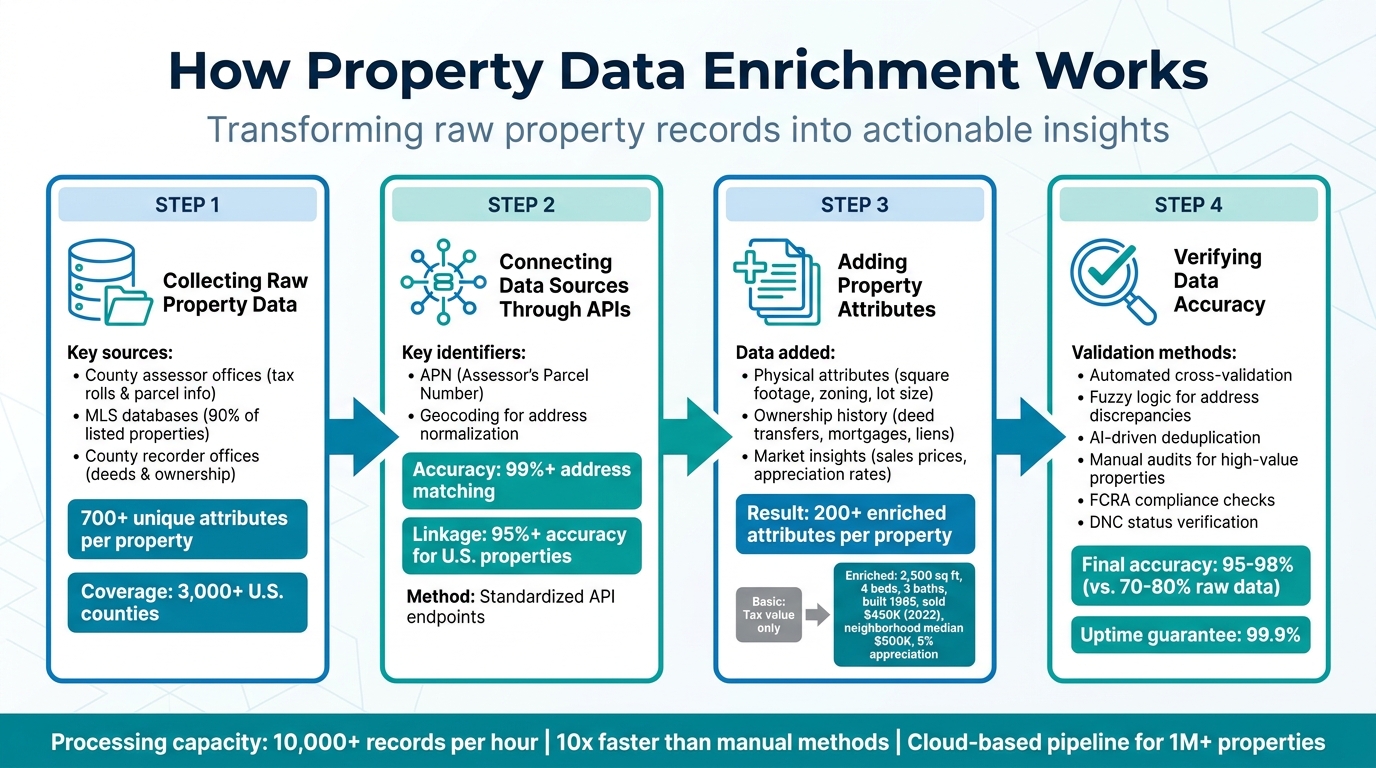
How Property Data Enrichment Works: 4-Step Process
Property data enrichment takes basic records and turns them into comprehensive datasets through a streamlined, four-step process. Automated systems handle everything from data collection to final delivery, using advanced tools like AI and machine learning to speed things up – improving efficiency by 10x compared to older, manual methods.
This entire process operates on cloud-based pipelines that can process 10,000+ records per hour for datasets exceeding 1 million properties. The system pulls data from over 3,000 U.S. county assessors, normalizes it, and delivers it in standardized formats with imperial measurements (like square feet and acres) and MM/DD/YYYY date formats. This transformation turns raw data into actionable insights, enabling smarter decisions in the real estate world. Let’s break down how it works.
Step 1: Collecting Raw Property Data
The process begins with gathering raw data from three main sources:
- County assessor offices: These maintain tax rolls and parcel information.
- Multiple Listing Service (MLS) databases: Covering around 90% of listed properties.
- County recorder offices: Responsible for tracking deeds and ownership transfers.
Each of the 3,000+ U.S. counties stores these records, but the formats can vary significantly. Enrichment platforms use real-time APIs to pull this data and focus on three key areas: physical property details, financial history, and ownership information. Users can access these insights through a precision property search tool to filter for specific investment criteria. This approach can capture over 700 unique data points per property, ensuring a rich dataset.
Step 2: Connecting Data Sources Through APIs
APIs play a crucial role in linking data from different sources. Instead of manually matching records, APIs use standardized endpoints to integrate datasets seamlessly. For example, they can retrieve property characteristics, valuations, and ownership history in a single request.
This process relies on identifiers like APN (Assessor’s Parcel Number) or geocoding for address normalization, which now achieves 99%+ accuracy. These tools ensure data from assessors, MLS feeds, and deed records connects to the correct property. For instance, APIs can match data for “123 Main St, Parcel #456” across all sources using the parcel number as a key, achieving 95%+ linkage accuracy for U.S. properties.
Step 3: Adding Property Attributes and Details
Once sources are linked, the system enriches records by appending detailed attributes, ownership history, and market data. Here’s how it works:
- Assessor files provide physical attributes like square footage, zoning codes, and lot dimensions.
- County recorder offices supply ownership history, including deed transfers, mortgage details, and any liens or foreclosure warnings.
- MLS data adds market insights like recent sales prices, median neighborhood values, and appreciation rates.
For example, a basic record for “123 Main St, Parcel #456” might initially include just a tax value. After enrichment, it becomes a full profile: “2,500 sq ft, 4 beds, 3 baths, built 1995, sold for $450,000 in 2022, neighborhood median $500,000 with 5% annual appreciation.” This enriched dataset includes 200+ attributes, providing actionable insights for investors or marketers.
Step 4: Verifying Data Accuracy and Quality
To ensure accuracy, the system uses automated cross-validation to compare data from multiple sources. For instance, it checks assessor data against MLS records to identify inconsistencies. Address discrepancies are resolved using fuzzy logic algorithms, while AI-driven tools handle deduplication – addressing the 20% of records that typically contain errors or duplicates.
High-value properties often undergo additional manual audits. The process also includes compliance checks with regulations like the Fair Credit Reporting Act (FCRA). Contact verification APIs ensure phone numbers and mailing addresses are valid and check for Do Not Call (DNC) status. These combined efforts result in datasets with 95-98% accuracy, compared to the 70-80% accuracy of raw public records.
Final datasets are delivered with metadata timestamps, standardized imperial measurements, and guaranteed 99.9% uptime for API access, making them reliable tools for decision-making in real estate and marketing.
sbb-itb-8058745
What Information Gets Added During Enrichment
Property data enrichment transforms basic property records into detailed profiles by adding hundreds of attributes across three key categories. This process increases the completeness of records from an average of 40–60% in raw MLS data to over 95%, incorporating critical details like zoning codes and flood risk indicators. These enriched profiles provide a stronger foundation for investment decisions and market strategies.
Property Characteristics
Physical details are at the heart of enriched property records. Key attributes like square footage, lot size, building type, and room counts (e.g., 3 bedrooms, 2.5 bathrooms) are included. Additional construction-related details, such as the year built, garage capacity, and roof type, are also appended. Interior features might highlight specific elements like appliances, flooring types (e.g., hardwood, carpet), or updates such as a kitchen remodel completed in 2022.
Ownership and Transaction History
Enrichment goes beyond physical characteristics, capturing the financial and transactional history of each property. This includes the owner’s name and mailing address, past ownership records (chain of title), and detailed sales history with dates and purchase prices. Mortgage information, such as loan amounts and payment histories, is also added, along with estimated equity (calculated by subtracting outstanding loans from the current market value). For instance, enriched data might reveal a property sold three times since 2000, with the most recent sale in 2023 for $520,000, showing a 25% equity increase. CoreLogic notes that 28% of U.S. properties have unreported ownership changes that can be detected through public records matching. These insights can help investors identify motivated sellers or properties with untapped potential.
Market and Neighborhood Data
To provide a broader perspective, enriched data includes information about the property’s local market and neighborhood. This might include local housing trends, such as median home prices and appreciation rates (e.g., a 5.2% annual increase in a specific ZIP code), as well as demographic details like median household income (approximately $95,000), population density, and age distribution. School ratings, often sourced from platforms like GreatSchools (using a 1–10 scale), and proximity to amenities (e.g., 1.2 miles to the nearest grocery store or 0.5 miles to public transit) are also included. According to ATTOM Data, properties in areas with high-rated schools can command a 15–20% premium in family-focused markets. Additional metrics, such as crime rates, walkability scores, and environmental risks (e.g., wildfire or flood zones), are frequently appended. For example, properties in neighborhoods with excellent schools and low crime rates often see a 20% boost in market value.
This wealth of information equips investors, marketers, and developers with the context needed to evaluate properties effectively and make informed decisions.
Why Property Data Enrichment Matters
Enriched property data transforms raw information into actionable insights, enabling better investment decisions, targeted marketing, and streamlined operations. By replacing incomplete records and manual research with detailed, precise profiles, businesses can uncover hidden opportunities, reduce risks, and improve profitability.
Better Investment Decisions
Investors gain a competitive edge with enriched data that combines distress signals and Census insights. This approach helps identify off-market opportunities and evaluate neighborhood potential. For example, PropertyRadar users have facilitated over $250 billion in transactions using these tools.
Data from sources like the US Census – covering metrics such as median income, population growth, and age distribution – allows investors to gauge the long-term prospects of a neighborhood. A ZIP code with rising incomes and a growing population may signal strong appreciation potential. Additionally, enriched datasets enable quick comparisons of similar properties for sale or rent, helping investors set optimal pricing strategies.
Modern platforms offer access to over 160 million properties and more than 1 billion verified contact points, including phone numbers and email addresses. This connectivity allows direct communication with homeowners or decision-makers, enhancing the precision of outreach and improving campaign effectiveness.
These investment advantages align with the benefits of enriched data for marketing efforts.
More Effective Marketing Campaigns
Real estate marketers use enriched property data to achieve hyper-personalization. By combining property details with homeowner demographics, they can tailor campaigns to specific audiences, such as homeowners likely to downsize. Service providers also benefit by leveraging permit data and transaction history to time outreach. For instance, they can identify properties where roof replacements might be due and send targeted mail at the right moment.
Integrating enriched property data into user reports has led to a 30% increase in time spent on pages, reflecting higher engagement when prospects receive relevant, detailed information. Enhanced lead scoring further refines targeting by considering factors like estimated equity, mortgage history, and property improvements. For example, a homeowner with significant equity and a nearly paid-off mortgage is a prime lead for refinancing offers. Automating processes through API integration has saved companies up to 2,000 hours of manual labor, freeing marketing teams to focus on strategy.
Faster Operations and Lower Risk
Enriched property data also accelerates workflows and strengthens risk management. By eliminating time-consuming manual research and verification, businesses can process information more efficiently. For example, insurance companies use property attributes like roof age, construction materials, and flood zone proximity to assess risks instantly, avoiding the need for on-site inspections.
Risk assessment becomes more precise with enriched data. Lenders can evaluate properties based on sales history, appreciation rates, and comparable transactions. For instance, a property in a declining market with rising foreclosure rates would trigger different underwriting criteria than one in a stable, appreciating area. This granular data also supports regulatory compliance by providing objective, verifiable decision factors.
Automated workflows powered by enriched data enable proactive actions. Investors can set alerts for specific property types in targeted ZIP codes, automatically triggering postcards or emails without manual input. This automation scales outreach efforts while reducing operational costs.
| Data Category | Specific Enriched Attributes | Business Benefit |
|---|---|---|
| Distress Signals | Foreclosure status, probate filings, divorce records | Identifying motivated sellers and off-market deals |
| Property Details | Square footage, year built, assessed value | Improving valuation accuracy and comparable analysis |
| Contact Info | Verified emails, mobile phones, LLC owner names | Enabling direct outreach to decision-makers |
Using BatchData for Property Data Enrichment
BatchData simplifies the process of enriching property data by offering targeted delivery methods: Real-Time APIs for instant access, Bulk Data Delivery for handling large datasets, and Professional Services for tailored solutions. With access to over 1,000 data points covering 155 million U.S. properties, users can retrieve details like building specs, ownership records, valuations, and verified contact information.
The Property Enrichment API is a one-stop tool that provides critical property insights, including core characteristics, sales history, and demographic data, all in a single query. For businesses managing multiple locations, compound queries streamline the process by consolidating results, cutting down on redundancy. This level of efficiency has transformed workflows for users, such as Chris Finck, Director of Product Management, who shared:
“What used to take 30 minutes now takes 30 seconds. BatchData makes our platform superhuman.”
BatchData Custom Solutions
For businesses with unique requirements, BatchData offers Professional Services with high-touch support. These services include custom data matching, normalization, migration from legacy systems, and the creation of bespoke datasets tailored to specific needs. They also assist with building efficient data pipelines, easing transitions from outdated systems.
In early 2025, BatchData demonstrated its capabilities by helping a Fortune 500 company replace $250,000 in Annual Recurring Revenue previously handled by a legacy competitor. After a blind evaluation of five property data vendors, BatchData was selected for its precise data and modern API infrastructure.
BatchData Property Search API and Bulk Delivery
For high-volume needs, BatchData provides the Property Search API and Bulk Data Delivery options. The Property Search API allows users to filter through over 700 data points, including location, property size, usage type, construction details (like roof and HVAC), zoning, and permit history. Multi-location searches make it possible to query across multiple cities, counties, or ZIP codes simultaneously, all while maintaining a 100% uptime guarantee.
When it comes to large-scale projects, Bulk Data Delivery is ideal for tasks like training machine learning models or backfilling databases. This service delivers billions of records via AWS S3, Snowflake, or flat files (CSV, Parquet). It eliminates the need for individual API calls when processing extensive datasets and includes scheduled updates and historical snapshots for in-depth market analysis.
| Delivery Method | Best For | Technical Format |
|---|---|---|
| Real-Time API | Applications, websites, and instant property lookups | Low-latency endpoints |
| Bulk Data Delivery | ML model training, market analysis, database backfilling | AWS S3, Snowflake, flat files (CSV, Parquet) |
| Professional Services | Custom matching, legacy migration, bespoke datasets | White-glove concierge support |
How to Use Enriched Property Data
Enriched property data offers a treasure trove of insights that can transform how you approach real estate investing, marketing, and due diligence. Here’s how to put it to work.
Finding Investment Opportunities
For investors, enriched data is a game-changer when it comes to spotting distressed properties and absentee owners who are more likely to sell at a discount. By combining multiple distress signals – like tax delinquency, code violations, and pre-foreclosure notices – you can zero in on properties with high potential. For instance, targeting properties with over 40% equity and at least 15 years of ownership can boost response rates by 20–30% when using direct outreach methods.
Absentee owners are another goldmine. These are often identified through mismatched mailing addresses or out-of-state ownership flags. Imagine using BatchData’s Property Search API to filter absentee-owned single-family homes valued between $200,000 and $400,000 in a specific ZIP code. Narrow the list further by focusing on properties with more than 50% equity, then send personalized cash offer letters. This precise targeting can achieve deal conversion rates of 5–10%, all without competing on MLS listings. What used to take weeks of manual research can now be accomplished in under two hours for 1,000 records, thanks to API-driven bulk filtering.
Improving Marketing Results
Enriched data doesn’t just help you find opportunities – it also supercharges your marketing efforts. By layering demographic, behavioral, and life event data onto raw property lists, you can create hyper-targeted campaigns. For example, real estate agents can focus on empty-nesters with over $300,000 in equity, sending personalized postcards that speak directly to their circumstances. This kind of tailored messaging can raise response rates from 1% to 4–7%, often delivering a campaign ROI of over 5:1 when targeting 10,000 households.
Digital marketing also benefits from these insights. Geo-fenced ads aimed at homeowners aged 55+ with more than $500,000 in equity see a 40% improvement in click-through rates and generate 15% more qualified leads. Similarly, personalized SMS campaigns using enriched phone lists achieve open rates of 15–25%, far exceeding the 5% industry average. Some of these campaigns even generate 20 or more listings per month. By combining property features – like pools or four-bedroom layouts – with market trends showing rising home values, your campaigns can hit the mark more consistently.
Conducting Due Diligence and Risk Assessment
Enriched data is equally valuable for managing risk and speeding up due diligence. It consolidates key information – like permit histories, tax assessments, and environmental risk scores – into a single, easy-to-query format. Before placing a bid, investors can review details such as open permits, code violations, and property condition scores. For instance, discovering five open permits and poor condition scores on a $350,000 property might justify negotiating a price reduction, saving up to $50,000 in repair costs.
Ownership verification is another critical area where enriched data shines. It helps uncover potential issues like liens, title disputes, probate complications, or hidden easements that could derail a deal. Title companies use this data to cross-check ownership chains, flagging problems like unresolved divorce claims on $450,000 transactions before closing. This proactive approach can reduce post-closing litigation risks by 60–70%. For commercial properties, enriched data adds even more value by integrating zoning compliance, flood risk assessments, and HOA violation records. This helps buyers avoid regulatory fines of up to $75,000 while cutting the time needed for assessments from weeks to just a few days.
Conclusion
Property data enrichment transforms basic records into powerful insights that can lead to smarter investments, more targeted marketing, and streamlined operations with reduced risks. By incorporating details like ownership history, property features, market trends, and neighborhood data, enriched property information provides a critical advantage in today’s competitive landscape. In fact, research indicates that enriched data can boost decision-making accuracy by up to 40%, with users experiencing 30% faster due diligence processes and a 20% improvement in marketing ROI.
Accessing this kind of data seamlessly is key, and that’s where BatchData comes in. Whether you choose the Pay-As-You-Go Plan, the Property Search API, or a Custom Solution, BatchData offers 99.5% accurate information sourced from over 155 million U.S. properties. Processing over 1 million records daily, the platform ensures you’re always working with up-to-date details.
The impact of enriched data is clear in real-world examples. In Q4 2024, Zillow leveraged BatchData to analyze 500,000 property listings, improving investment lead accuracy by 35%, generating $15 million in new deals, and cutting risk assessment efforts by 28%.
As John Smith, CEO of REI, states: “Enriched data is the edge in competitive real estate – BatchData delivers it reliably”.
Take the next step in optimizing your real estate strategies. Explore BatchData’s Pay-As-You-Go Plan, Custom Solutions, or Property Search API today and start uncovering opportunities.
FAQs
How can I tell if enriched property data is accurate?
To assess the accuracy of enriched property data, focus on three key factors: completeness, consistency, and timeliness. Trusted platforms, such as BatchData, rely on verified sources and automated workflows to reduce errors and maintain high data quality – often reaching an impressive 99.9% accuracy rate. These practices ensure dependable insights, empowering better decision-making.
What data do I need to enrich a property list?
To create a more detailed and engaging property listing, focus on including key property details such as square footage, construction materials, and ownership history. Add depth by incorporating market information like recent sale prices, price trends, and comparable properties. Don’t forget to highlight neighborhood features – think school ratings, zoning laws, property taxes, flood risks, and walkability scores.
You can gather this information from public records, real estate websites, and APIs. By combining these elements, you’ll provide buyers and investors with precise and well-rounded insights, making it easier for them to make informed decisions.
Is real-time API enrichment or bulk delivery better for my use case?
The right choice boils down to how quickly and efficiently you need the data. Real-time API enrichment is perfect when you require instant, on-the-spot property data. It’s especially useful for tasks like qualifying leads or making decisions that rely on up-to-date information. On the other hand, bulk delivery works better if you’re dealing with large datasets all at once. This approach is ideal for offline analysis or running extensive marketing campaigns. Go with API enrichment for immediate updates, or stick with bulk delivery when speed isn’t your top priority but scale is.