


































Finding the right property can be overwhelming, but APIs with advanced filtering capabilities make the process faster and more precise. Whether you’re a developer, real estate agent, or investor, these APIs streamline property searches by offering detailed filters like location, price, property type, and unique features. Here’s a breakdown of the top real estate APIs and what they offer:
- BatchData Property Search API: Offers over 700 filters for 155M+ properties, including financial details like liens and equity. Supports large-scale data delivery and has 100% uptime.
- Repliers API: Connects to MLS systems across the U.S. and Canada with real-time data. Features AI tools like natural language search and image-based filtering.
- Apify Realtor Properties Search Scraper API: Pulls data directly from Realtor.com with customizable filters via URL parameters. Ideal for detailed scraping tasks.
- ATTOM Data API: Covers 158M+ properties with 9,000+ attributes, including ownership, tax, and neighborhood insights. Supports bulk queries up to 10,000 properties.
- CoreLogic API: Utilizes the OData protocol for advanced filtering and sorting. Includes 50 years of property records and integrates with industry standards.
- Homesage.ai API: Focused on investment insights with AI-powered tools for ROI, renovation costs, and property condition.
Each API excels in specific areas, from contact enrichment to AI-driven insights. Choose the one that aligns with your needs, whether it’s real-time MLS data, investment analysis, or large-scale property datasets.
1. BatchData Property Search API

Filtering Capabilities
The BatchData Property Search API gives users access to an impressive dataset of over 700 data points across more than 155 million properties nationwide. This isn’t just about price and location – filters can dive deep into property specifics like square footage, roof type, and even financial details such as equity, loan amounts, liens, or pre-foreclosure status.
Compound queries are supported, allowing searches across multiple cities, counties, or zip codes. The API also includes specialized filters for unique needs. For example, you can find properties with certain roof materials for insurance purposes, assess HVAC system ages for maintenance planning, or locate homes with south-facing sun exposure for solar panel projects. Plus, with 100% uptime and daily data updates, you can rely on consistent and accurate information.
This level of filtering is powered by one of the most extensive property databases in the country.
Data Coverage
BatchData’s database covers the entire United States, with information on over 155 million properties and more than 1 billion data points. It includes both active and historical listings, with real-time tracking for statuses like active, sold, or expired. The platform also offers contact enrichment, boasting a 76% accuracy rate for owner phone numbers and emails.
Aside from its robust data and filtering features, the API is designed to make integration as smooth as possible.
API Usability
The API is built for developers, offering seamless integration through a REST API optimized for low latency. Official SDKs for Python and Node.js are available to simplify development. There’s also interactive documentation that allows users to test live responses.
For more demanding tasks like large-scale analytics or machine learning, BatchData supports cloud delivery directly to platforms like Snowflake, BigQuery, Databricks, S3, or Google Drive. This bypasses REST API rate limits, making it ideal for high-volume workflows. While standard plans already provide generous rate limits, enterprise options include dedicated infrastructure tailored for handling nationwide datasets.
sbb-itb-8058745
2. Repliers API
Filtering Capabilities
Repliers connects to hundreds of MLS systems across the U.S. and Canada through a single endpoint, making it a powerful tool for property search. It supports a wide range of filters, including price range, location (like address, city, neighborhood, zip code, or state), bedrooms, bathrooms, property type, lot size, square footage, year built, and even amenities. For more advanced searches, it allows geospatial queries using radius parameters or GeoJSON polygons. It can also filter by listing status (Active, Unavailable, Sold, Leased) and date ranges.
What makes Repliers stand out is its use of AI-powered search features. It uses natural language processing (NLP) to turn conversational prompts into precise API requests, making the search process more intuitive. Its AI image search enables sorting based on visual relevance, while Smart Rules ensure consistent results by normalizing terms across different MLS systems – for example, treating "detached" and "single family residence" as equivalent terms. These advanced tools are paired with extensive data coverage, which is discussed below.
Data Coverage
Repliers provides comprehensive nationwide coverage across the United States and Canada, offering real-time access to active listings, sold data, and property media such as high-resolution images, videos, and floor plans. To avoid redundancy, the platform automatically deduplicates properties listed on multiple MLS boards, ensuring a clean data set. Beyond basic listing details, it enriches data with property transaction history, market analytics, and neighborhood insights that include information about schools, parks, and demographics.
API Usability
Repliers is designed for speed and reliability, delivering responses with under 300 ms latency and maintaining 99.9% uptime. Its "headless" architecture gives developers full control over the user interface and experience, supported by tools like SDKs, Postman collections, and interactive Playgrounds. These tools allow developers to test features such as map clustering, statistics, and conversational search.
The Aggregates feature is particularly useful for building front-end filters, as it identifies valid options for dropdown menus based on distinct filter values. Additionally, Webhooks provide real-time notifications for price or status changes, eliminating the need for constant polling. This combination of speed, flexibility, and functionality makes the API a versatile solution for developers.
3. Apify Realtor Properties Search Scraper API
Filtering Capabilities
The Apify Realtor Properties Search Scraper API pulls data straight from Realtor.com, one of the biggest real estate platforms in the U.S. It allows you to filter by city, property type (like house, condo, townhome, multi-family, mobile home, farmland, or "ANY"), and listing status (for_sale, sold, or ALL). For more detailed filters, you can set your criteria directly on Realtor.com and then copy the URL into the scraper’s startUrls parameter.
Sorting Options
Want to organize your search results? The API’s sort_option parameter lets you sort listings based on various criteria. You can choose relevance (default), highest or lowest price, newest listings, year built, open houses, price reductions, largest square footage, largest lot size, or even the number of photos.
These sorting tools make it easier to find exactly what you’re looking for.
Data Coverage
This scraper provides nationwide coverage, tapping into millions of listings on Realtor.com. It handles diverse market segments, including properties for sale, recently sold properties, and rentals. For each listing, it gathers detailed information, such as images, pricing, neighborhood insights, nearby schools, and specific property features.
API Usability
The API combines advanced filtering and sorting with features designed for developers. Many businesses integrate a real estate API to automate these workflows at scale. It includes proxy configuration to avoid blocking during extensive data extractions. Output formats include JSON, CSV, HTML, and Excel, and it integrates seamlessly with Python, JavaScript, CLI, or OpenAPI. The pricing model is pay-per-use, starting with a 3-day free trial and then $25 per month. Users can also tweak parameters like page_count to control the scraping scope and manage resources efficiently.
4. ATTOM Data API
Filtering Capabilities
The ATTOM Data API gives developers a powerful real estate API toolkit for digging into property data with precision. It enables advanced filtering across location, property details, and financial metrics. You can search properties by address, APN, or ATTOM ID. For geographic filters, options include ZIP codes, radius searches (using latitude and longitude), or Geoidv4 identifiers for areas like census blocks, neighborhoods, and school districts.
When it comes to property attributes, you can filter by ranges for bathrooms (bathstotal), bedrooms (beds), lot size (in acres or square feet via lotsize1/lotsize2), building size, and year built. Financial filters add another layer, allowing searches by Automated Valuation Model (AVM) values, market total values, last sale amounts, and sale dates. You can also filter properties by when records were added or last updated using addeddate and calendardate. Range filters use min and max prefixes (e.g., minbeds=3), while date-based filters rely on start and end prefixes (e.g., startcalendardate=01/01/2024). This extensive filtering system ensures access to one of the most detailed property datasets out there.
Sorting Options
The API also allows you to sort search results by various metrics like assessed value, AVM value, bedroom/bathroom count, building size, sale amount, sale date, and even distance for radius-based searches. Sorting is controlled through the orderby parameter, with calendardate set as the default for most queries. For location-specific searches, sorting by distance is particularly helpful. This flexibility ensures that you can organize data in a way that best fits your needs.
Data Coverage
ATTOM’s database is massive, covering over 158 million properties across the U.S. It pulls data from more than 3,000 counties, encompassing 99% of the population. The database includes over 70 billion rows of transactional-level data and more than 9,000 individual data points for each property, amounting to around 30TB of information. It spans both residential and commercial properties, with details like ownership history, property characteristics, sales records, mortgage data, foreclosure information, and valuation metrics. Beyond individual properties, the API offers insights at the neighborhood level, such as crime statistics, school ratings for 127,000 schools, climate risks, and transit data for 3,400 cities.
API Usability
The REST-based API supports JSON and XML responses, making it versatile for developers. A 30-day free trial is available to test its features and filtering options. The API can return up to 10,000 properties in a single query, but for larger datasets, developers need to use pagination with page and pagesize to manage results and control costs. For the most reliable property matching, the ATTOM ID is your go-to – it’s a unique identifier that stays consistent even if an address or APN changes. The API also includes address standardization, helping to fix formatting issues and fill in missing details like ZIP+4 codes.
5. CoreLogic API

CoreLogic’s API offers advanced property filtering and search capabilities, designed to integrate smoothly with industry standards and meet the needs of real estate professionals.
Filtering Capabilities
The CoreLogic Trestle API leverages the OData protocol to enable detailed property searches. It supports standard operators like eq (equal), ne (not equal), gt (greater than), lt (less than), as well as logical operators such as and, or, and not. With these tools, you can filter by fields like BedroomsTotal, BathroomsTotalInteger, LotSizeAcres, Appliances, and PropertyType. Price filters are managed using ListPrice, while StandardStatus allows you to search properties by statuses like ‘Active’ or ‘Pending.’
The API also makes location-based searches simple. You can filter by City, PostalCity, StreetName, or State, and for more precise targeting, it includes geo.distance for radius-based queries and geo.intersects for polygon-based boundaries. Text searches are supported with string functions like contains, startswith, and endswith. For time-sensitive data, fields like ModificationTimestamp or ListingContractDate can be filtered using UTC timestamps. Additionally, the has operator is perfect for multi-select attributes, such as finding properties with specific WaterfrontFeatures or Appliances.
Sorting Options
Sorting is managed using the $orderby parameter, which allows you to arrange results by any queryable field in either ascending (asc) or descending (desc) order. For instance, $orderby=ListPrice desc sorts properties from highest to lowest price. You can apply this to fields like bedrooms, square footage, or listing dates, giving you full control over result organization.
Data Coverage
CoreLogic boasts an enormous database of 5.5 billion U.S. property records spanning over 50 years. With 99.9% market coverage, it provides one of the most extensive property data collections in the U.S., making it a go-to resource for real estate applications.
API Usability
Built on RESO (Real Estate Standards Organization) standards, the API is intuitive for developers familiar with industry norms. CoreLogic offers code samples in seven programming languages: HTTP, C#, Java, Go, Node.js, Python, and Rust. Developers can also access a Postman Collection for testing queries and join a dedicated Slack channel for real-time assistance.
6. Homesage.ai API
Homesage.ai blends standard property search features with AI-driven investment insights. Covering over 140 million properties across all 50 U.S. states, the API is updated daily to ensure users access the latest data.
Filtering Capabilities
The Bulk Property Info API allows filtering based on location (city, state, zip), property status (active or sold), and listing_age (days on market). To retrieve recently updated listings, you can use the updated_since parameter with ISO 8601 timestamps.
For more advanced filtering, Homesage.ai provides AI-enhanced endpoints. The TLC API identifies properties needing repairs, while the Investment Potential API categorizes properties as Good, High, or Excellent for ROI. The Price Flexibility Score API evaluates negotiation potential on a 0–10 scale. Additionally, the Property Condition API uses computer vision to rate properties as Excellent, Good, Outdated, Poor, or Very Poor, assisting with visual property assessments.
Sorting Options
Homesage.ai ensures data can be effectively organized, even though explicit sorting parameters are not included. JSON responses include numerical fields like listing_price, sold_price, listing_age, and distance_miles, enabling client-side sorting. The Property Comps endpoint further aids organization by using a radius parameter (defaulting to 0.5 miles) and returning results with distance measurements for proximity-based sorting.
Data Coverage
The platform boasts 99.9% uptime with response times generally under 100ms. Homesage.ai processes over 2 million new listings daily, integrating both MLS and off-market data for extensive coverage. Historical pricing trends are accessible through the Home Value Graph endpoint, which presents data in chronological order.
API Usability
Designed with developers in mind, Homesage.ai employs JWT authentication and a RESTful framework, providing JSON responses. It includes code samples in Python, JavaScript, and Bash, along with an interactive playground for testing. Developers can also utilize "API Recipes", which combine endpoints like Property Info, Renovation Cost, and Investment Potential to create robust search tools. Pricing starts at $200/month under a credit-based system, with requests ranging from 1 credit for Bulk Property Info to 30 credits for a Full Property Report.
Feature Comparison Table
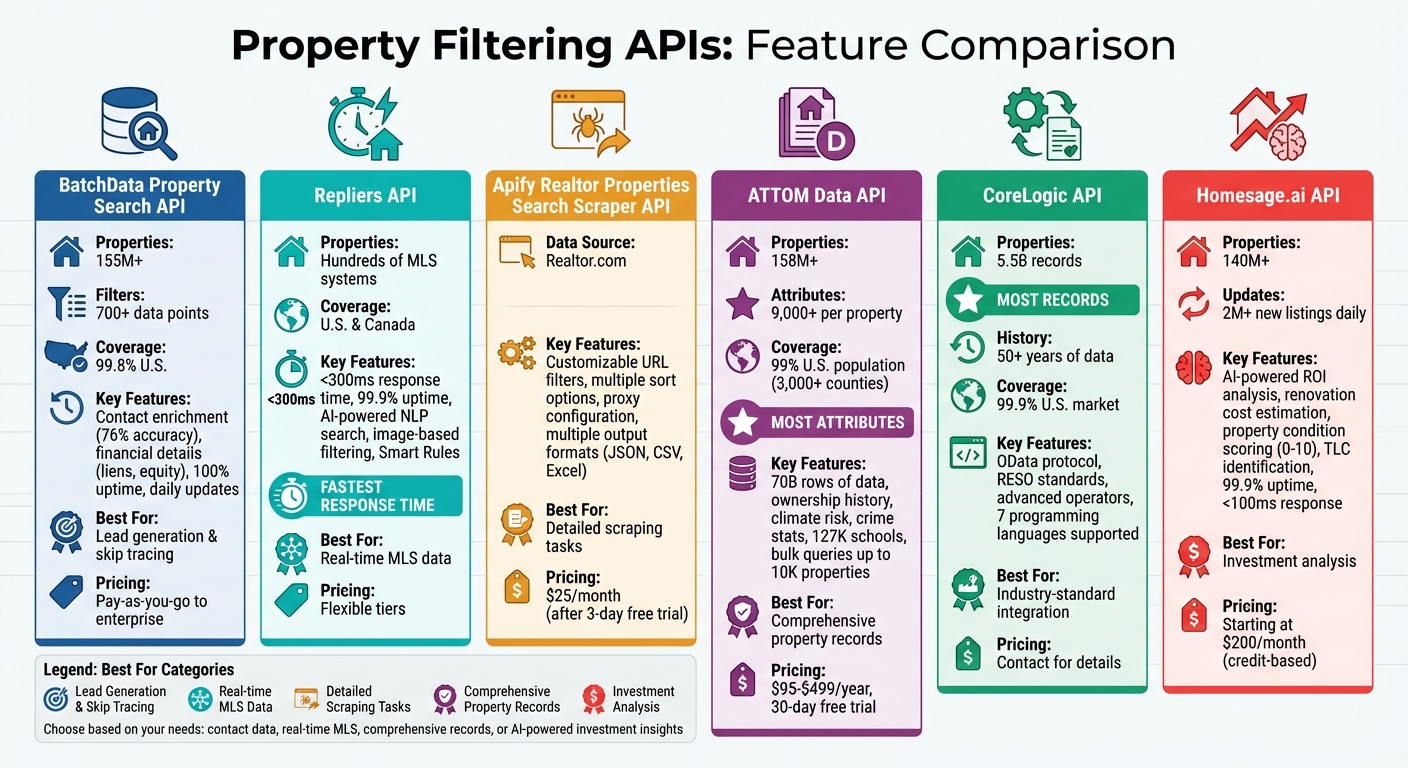
Property Filtering API Comparison: Features, Coverage and Pricing
When selecting an API, consider whether you need extensive property attributes, real-time MLS data, or tools tailored for investment analysis. Each API in the table below offers advanced filtering options to simplify property searches, aligning with the goal of efficient data retrieval. Here’s a comparison of four APIs based on their focus, filtering capabilities, data coverage, and pricing structure.
| API Provider | Primary Focus | Key Filtering Options | Data Coverage | Performance & Pricing |
|---|---|---|---|---|
| BatchData | Property & Contact Data | 700+ attributes including location, property type, ownership details, and contact enrichment | 155M+ parcels (99.8% U.S. coverage) | Daily updates, 76% contact accuracy, pay-as-you-go pricing |
| Repliers | Real-Time MLS | Live listings, sold data, property features, photos, and neighborhood insights | Hundreds of MLS systems (U.S. & Canada) | <300ms response times, 99.9% uptime, flexible tiers |
| ATTOM Data | Comprehensive Records | 9,000+ attributes covering ownership, tax, mortgage, climate risk, crime, and schools | 158M+ U.S. properties | Plans ranging from $95/month to $499/year |
| Homesage.ai | AI Investment Tools | Investment-focused filters including investment ROI, renovation costs, property condition, price flexibility, and investment potential | Approximately 140M+ U.S. residential properties | Pricing starts at $200/month |
Each API stands out for its specific strengths. BatchData is a top choice for property intelligence and skip tracing, thanks to its extensive contact enrichment and attribute range. Repliers excels in delivering real-time MLS data with lightning-fast response times of under 300ms. For investment-driven insights, Homesage.ai offers AI-powered tools to evaluate high-ROI opportunities. Meanwhile, ATTOM Data provides an expansive range of 9,000+ attributes, including details on climate risk, crime, and schools, making it a solid option for detailed property evaluations.
"Mashvisor delivers the only fully comprehensive real estate dataset covering property attributes, tax and assessment history, transaction records, STR and LTR analytics, comps, valuations, neighborhood scores, and 36-month performance trends under one unified API"
Ultimately, your choice should hinge on whether you value attribute variety, real-time MLS capabilities, or investment-specific analytics.
Conclusion
Advanced filtering options and strategic API features have the potential to reshape property search workflows in significant ways. The key is to select an API that aligns with both your business goals and technical requirements.
BatchData is a strong contender for professionals focused on lead generation. It excels in providing verified contact data and skip tracing, boasting an impressive 76% right-party contact accuracy across a database of over 155 million properties with 700+ attributes. If your aim is to build a platform for real estate marketers and quickly identify motivated sellers, BatchData’s skip tracing and entity resolution tools could streamline your operations.
To ensure compatibility with your technical setup, explore BatchData’s developer portal and live endpoints. Whether you need real-time REST API access for transactional needs or prefer cloud delivery through services like Snowflake for large-scale data analysis, BatchData offers options to fit various use cases. Their pricing is flexible, ranging from pay-as-you-go plans to custom enterprise solutions, allowing you to scale as your business evolves.
When evaluating BatchData, focus on its features, data accuracy, geographic reach, and the specific attributes critical to your application. A well-chosen API can enhance your platform’s functionality and user experience, delivering the contact enrichment and detailed property insights needed to achieve outstanding results.
FAQs
How do I choose the right property filtering API for my use case?
When selecting a property filtering API, focus on a few critical aspects to ensure it meets your requirements. Start with data coverage – the API should offer comprehensive, up-to-date information across the regions you’re targeting. Next, check the filtering options. It’s important that the API allows detailed searches based on criteria like location, price range, property size, and other relevant factors.
Another key consideration is ease of integration. An API with straightforward implementation will save time and reduce development headaches. Additionally, evaluate the pricing model and scalability to ensure it aligns with your budget and can grow with your needs.
Lastly, clear documentation and reliable support are non-negotiable. These will make the setup process smoother and help resolve any issues quickly, ensuring a hassle-free experience.
What’s the difference between real-time API access and bulk cloud delivery?
Real-time API access provides instant, on-demand data retrieval via a REST API. This is perfect for applications like dynamic property searches or tools that require up-to-the-minute data updates. On the other hand, bulk cloud delivery offers access to large datasets stored in cloud warehouses such as Snowflake or BigQuery. This approach is ideal for tasks like extensive analytics, machine learning projects, or generating reports, as it eliminates the need for repeated individual requests.
In essence, real-time APIs are tailored for immediate, time-sensitive needs, while bulk delivery is designed for large-scale data analysis and processing.
How can I filter properties by equity, liens, or pre-foreclosure status?
You can narrow down property searches by filtering for details like equity, liens, or pre-foreclosure status. APIs offering advanced property data solutions, such as BatchData, provide tools to spot signs of distressed properties. These include indicators like pre-foreclosure or liens, helping you fine-tune your search based on precise criteria.