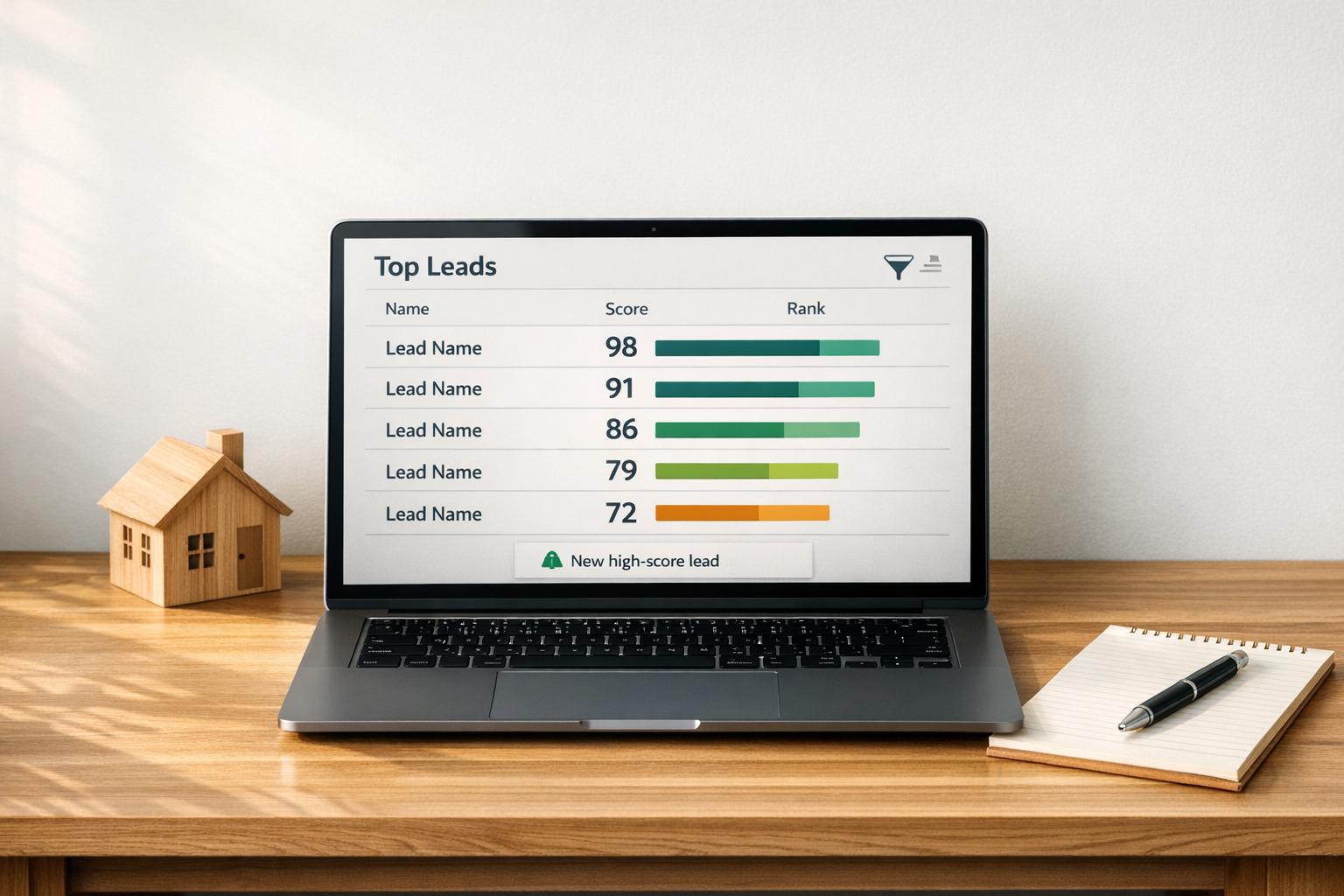


































APIs are transforming real estate by delivering instant, accurate data that helps businesses make smarter decisions. Here’s how they make a difference:
- Real-time Data Access: APIs provide up-to-date property details, ownership records, and market trends instantly, replacing slow, error-prone manual processes.
- Automation: They integrate with CRMs, apps, and websites to automate tasks like lead generation, data enrichment, and property analysis.
- Cost Efficiency: Pay-as-you-go models let businesses of all sizes access powerful tools without heavy infrastructure costs.
- Better Insights: APIs fuel predictive analytics, helping professionals identify trends, forecast market changes, and target specific opportunities.
- Personalized Marketing: Enriched data enables tailored outreach, improving customer engagement and lead conversion rates.
Whether you’re an agent, investor, or proptech startup, APIs streamline workflows, reduce errors, and give you a competitive edge in a constantly shifting market.
What Real Estate APIs Do and How They Work
What Are Real Estate APIs?
A real estate API acts like a bridge, connecting your software directly to property databases. This connection gives you instant access to key details like ownership records, transaction histories, equity data, and trends in the market. Essentially, APIs are your ticket to real-time property data.
Here’s how it works: when your system sends a request – say, for properties in a specific ZIP code that meet certain criteria – the API responds almost instantly with the relevant data. This eliminates the need for manual data collection, reducing errors and saving time. With this setup, you can build tools, transform business operations, and make decisions based on up-to-date information.
Let’s dive into the main types of real estate APIs and how they’re used.
Main Types of Real Estate APIs
- Property Search APIs: These tools allow users to quickly sift through property data based on location, features, or market conditions. They’re the backbone of platforms used by investors, agents, and even homebuyers who need instant results from massive property databases.
- Data Enrichment APIs: Starting with basic input like a street address, these APIs return a wealth of information – owner names, phone numbers, mortgage details, estimated property values, and transaction histories. This automation eliminates the need for manual research by filling in lead profiles instantly.
- Bulk Data Delivery APIs: Designed for large-scale data needs, these APIs handle massive requests efficiently. They’re perfect for tasks like portfolio analysis or predictive modeling, providing on-demand access without the hassle of downloading static files.
How APIs Improve Data Accuracy and Speed
APIs ensure you’re always working with the freshest data. By pulling directly from continuously updated sources, they eliminate the risk of relying on outdated reports – critical in a fast-changing market where property statuses and trends can shift overnight.
They also manage high volumes of requests with ease, seamlessly integrating into your existing tools like CRMs, websites, or custom apps. And with many APIs operating on a pay-as-you-go basis, you only pay for the data you actually use, making them both efficient and cost-effective.
sbb-itb-8058745
Real Estate Data Masterclass 2025: AI + Automation
How API Integration Improves Real Estate Market Strategy
APIs are reshaping the real estate landscape by automating data collection and analysis, helping professionals spot trends, target the right prospects, and make faster decisions. Let’s dive into how quick data access, predictive insights, and precise marketing can elevate your market strategy.
Faster Data Access and Analysis
APIs cut out the time-consuming manual research process by delivering structured, actionable data in seconds. Imagine needing to analyze properties across a ZIP code or find owners with specific equity levels – APIs make this possible almost instantly. For example, in November 2024, Crexi, a commercial real estate platform, integrated the BatchData API to streamline an entity resolution process. What used to take 30 minutes manually now happens in seconds. This incredible speed lets teams evaluate hundreds of properties in the time it once took to research a single one, freeing up resources for more strategic tasks.
Real-time data access is another game-changer. APIs ensure you’re working with up-to-date information, not outdated spreadsheets. Whether you’re assessing investment opportunities or identifying motivated sellers, having current data at your fingertips is critical. For lenders and insurers, this means faster risk assessments and quicker eligibility decisions – sometimes within seconds. In a competitive market, this kind of efficiency can make all the difference.
Better Market Predictions and Insights
APIs don’t just provide raw data – they fuel predictive analytics by delivering clean, structured information. With access to property histories, transaction records, and market trends, you can spot ZIP codes where prices are likely to rise, flag properties at risk of foreclosure, or identify emerging markets for rentals. Leading firms like Blackstone and CBRE are already using APIs coupled with machine learning to stay ahead of the curve.
Take Automated Valuation Models (AVMs) as an example. These models, powered by real estate data APIs, have reduced error rates for on-market properties to below 2.5% – a significant improvement over traditional appraisals. For iBuyers and single-family rental investors, APIs also provide detailed property condition data, such as roof type, solar panels, and structural details. This allows investors to focus on high-potential properties while steering clear of risky ones. By turning technical data into actionable insights, APIs give you the edge to act before opportunities vanish.
More Targeted Marketing and Personalization
APIs take marketing from broad and generic to precise and personalized. With enriched property and contact data, you can create custom audiences based on owner profiles, transaction history, and demographic details. Instead of sending the same message to an entire neighborhood, you can zero in on homeowners with high equity, long-term ownership, or signs of financial distress like tax defaults.
These tools also streamline processes like pre-filling legal forms and mortgage applications with verified data, reducing errors and improving user experience. For home service companies – like those offering solar installations or roofing – APIs provide insights into property specifics, such as roof age, material type, and square footage. This allows you to tailor your outreach to address each client’s unique needs. By focusing your marketing efforts on the right audience, APIs help turn data into measurable business results.
How to Use APIs to Improve Your Market Strategy
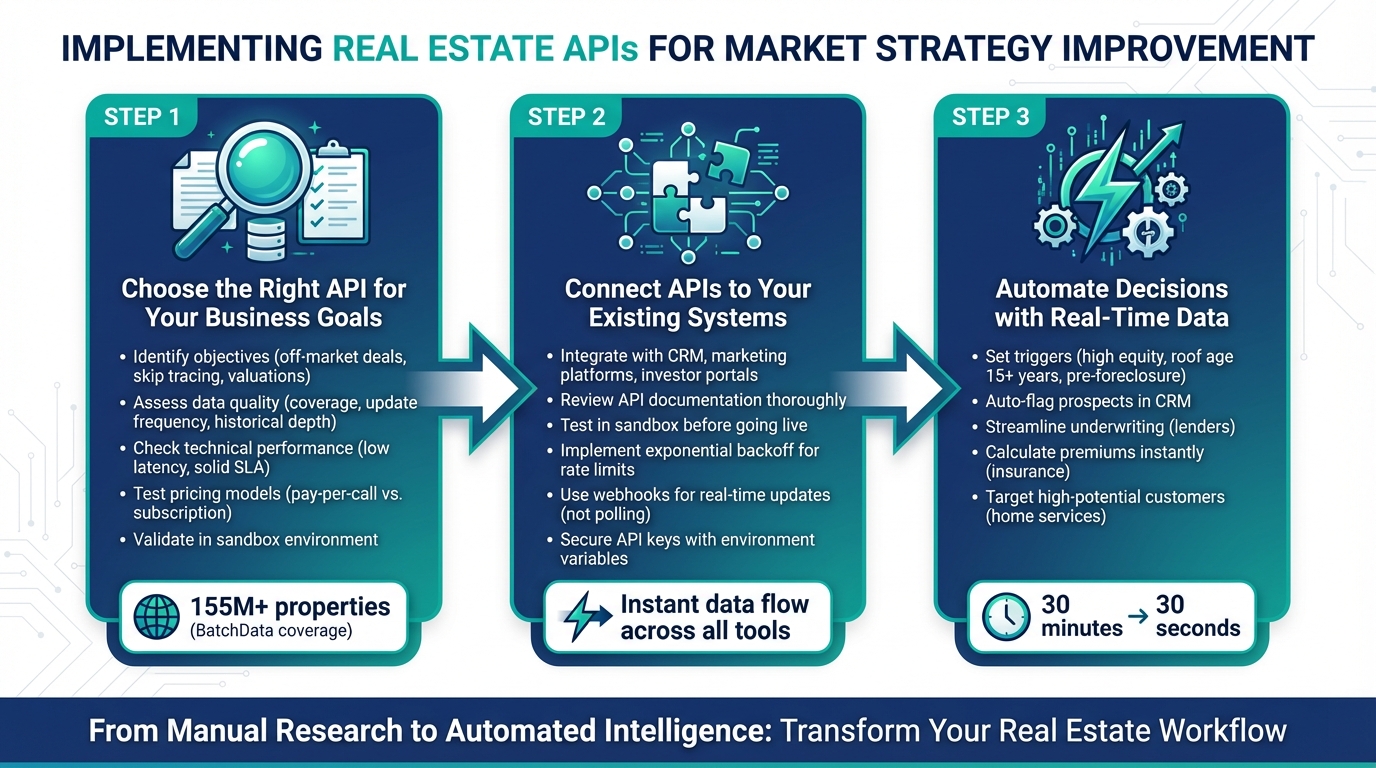
3-Step Process for Implementing Real Estate APIs to Improve Market Strategy
Integrating APIs into your real estate workflow isn’t just about pulling in data – it’s about selecting the right tools, connecting them efficiently, and automating decisions that lead to actionable outcomes. Leveraging real-time insights and predictive analytics, here’s how you can make APIs work for your business.
Step 1: Choose the Right API for Your Business Goals
Start by identifying your objectives. Are you looking to find off-market deals? Improve skip tracing property owners with enriched contact data? Automate property valuations? Your goals should guide your API selection. For instance, wholesalers focused on distressed properties will benefit from APIs offering details like pre-foreclosure status, tax delinquency, and high-equity properties. On the other hand, if your business involves home services like roofing or solar, you’ll want APIs that provide property-specific details such as roof age, material type, square footage, and HVAC system information.
Assess the quality of the data by checking factors like geographic coverage, update frequency, and historical depth. Always request sample data and run validation tests to ensure accuracy and completeness. Technical performance is equally important – opt for APIs with low latency (quick response times) and a solid Service Level Agreement (SLA) for reliability. For example, BatchData’s property search API offers extensive property coverage with real-time updates, making it a strong choice for marketers and investors who need up-to-date insights.
Choose a pricing model that aligns with your business size and needs. If you’re a startup, pay-per-call pricing might be more flexible, while subscription models work better for high-volume, predictable usage. Before fully committing, test the API in a sandbox environment to identify potential edge cases and prevent costly errors during development. This groundwork ensures you’re set up for fast, accurate data access.
Step 2: Connect APIs to Your Existing Systems
Once you’ve chosen the right API, the next step is to integrate it with your current tools, such as your CRM, marketing platform, or investor portal. Proper integration ensures smooth data flow and minimizes disruptions. Carefully review the API provider’s documentation and test all features in a sandbox environment before going live. This approach saves time and helps you catch issues early.
You might encounter challenges like rate limits or securing API keys. To handle rate limits, implement exponential backoff in your code – this means retrying requests at increasing intervals when limits are reached. For security, avoid hardcoding API keys; instead, use environment variables or a secrets manager to keep them safe. For real-time updates, webhooks are a better option than constant polling. Webhooks notify your system immediately when property statuses change, cutting down on unnecessary API calls and improving efficiency. This way, your team always has the most current data at their fingertips, whether they’re evaluating investment opportunities or updating client records.
Step 3: Automate Decisions with Real-Time Data
One of the biggest advantages of APIs is their ability to automate decisions using real-time data. Set up triggers based on key data points – like high equity, roof age over 15 years, or pre-foreclosure status – to flag prospects automatically. These triggers can help adjust marketing strategies or prioritize leads in your CRM without manual intervention.
For example, lenders use APIs to streamline underwriting by quickly pulling sales comparables, lien data, and tax history, allowing them to make eligibility decisions in seconds. Insurance companies calculate premiums instantly by accessing property details like construction year, building materials, and proximity to risks. Similarly, home services businesses can identify high-potential customers by filtering for specific criteria, such as roof type or HVAC system age, and tailor their outreach accordingly. By automating actions based on real-time data, you can respond to market changes faster and stay ahead of the competition.
Case Study: How BatchData‘s APIs Improve Market Strategy

This case study highlights how BatchData’s real-time data integration can transform market strategies for businesses.
How BatchData APIs Work in Practice
Wholesalers and investors often face intense competition to secure off-market leads before others. Traditional methods, which depend on outdated and manual data processes, just can’t keep up. Enter BatchData’s Smart Search API – a tool designed to proactively notify users the moment their criteria are met, using webhooks for instant alerts.
Here’s how it works: Imagine a wholesaler sets specific acquisition criteria – like properties with high equity, absentee owners, and pre-foreclosure status in a specific ZIP code. BatchData’s system continuously scans its database of over 155 million properties, refreshed daily, to find matches. When new leads surface, they’re automatically pushed into the user’s CRM via webhooks. This automated process kickstarts outreach efforts immediately, giving teams a crucial edge in contacting motivated sellers.
BatchData also offers skip tracing and data enrichment to improve lead quality. With access to over 600 million records and an impressive 76% right-party contact accuracy rate – nearly three times the industry standard – users can reliably connect with property owners. For home service businesses, like roofing or HVAC companies, the API takes it a step further by filtering properties based on specific traits, such as roof age or HVAC system type. This enables highly targeted and cost-efficient marketing campaigns.
By automating these processes and improving data accuracy, businesses save time and enhance the quality of their leads, leading to better outcomes.
Results and Outcomes
BatchData’s APIs deliver clear benefits in speed, efficiency, and return on investment. Chris Finck, Director of Product Management, explains the impact:
"We want to supplement your work and make you superhuman so you can do things in seconds not hours. That’s where BatchData comes in. What used to take 30 minutes now takes 30 seconds. BatchData makes our platform superhuman."
Conclusion
Real estate APIs have shifted from being a luxury to becoming a core necessity for businesses, turning hours-long tasks into processes completed in mere seconds. This efficiency boosts market positioning, sharpens predictions, and enables quicker responses to opportunities. Institutional investors now rely on API-driven predictive analytics to fine-tune portfolio strategies, while iBuyers and single-family rental investors enjoy the ability to assess properties at scale, instantly. These APIs integrate property valuation, AI, and market analytics, replacing the need for scattered data sources.
BatchData highlights this shift perfectly. Their advanced API solutions help businesses automate lead generation, refine targeting, and scale operations seamlessly. Take their Smart Search API, for example: its webhook functionality sends instant alerts when properties match specific criteria, ensuring teams act without delay – critical in a fast-moving industry. This approach bridges the gap between outdated practices and real-time decision-making.
For companies still relying on traditional data methods, the gap is only growing wider. APIs provide the real-time insights needed to stay competitive in today’s dynamic market. Whether you’re a wholesaler chasing off-market deals, a lender optimizing underwriting, or a home services provider targeting specific property traits, integrating APIs is no longer optional – it’s essential.
Those who adopt these tools today will set the pace for their industries, while others risk falling behind. Now is the time to embrace API integration and secure your place at the forefront of the market.
FAQs
Which real estate API type do I need for my goals?
To pick the best real estate API, start by identifying your specific goals. If you’re looking to access property details, a property search API or data enrichment API might be what you need. For automating processes like lead generation or skip tracing, a workflow automation API is a better fit. On the other hand, if you’re aiming to gain insights into market trends or property valuations, go for APIs that provide analytics or AVMs (Automated Valuation Models). Choose an API that aligns closely with your business requirements.
How can I integrate an API with my CRM safely?
To connect an API with your CRM securely, prioritize safe authentication methods such as OAuth 2.0 or API keys. Ensure credentials are stored in a secure environment, and enforce strict access controls to limit who can access the API. Always rely on HTTPS to protect data during transmission and keep an eye on API activity to detect any unusual behavior.
Additionally, adhere to compliance standards like DNC (Do Not Call) and TCPA (Telephone Consumer Protection Act) to avoid legal risks. Regularly updating and refreshing your data is also key to maintaining accuracy and safeguarding sensitive information.
How do I measure ROI from real estate API data?
To gauge the return on investment (ROI) from real estate API data, focus on tracking key performance indicators (KPIs) such as quicker property acquisitions, increased conversion rates, and more precise market analysis. Look at cost savings achieved by minimizing manual work and revenue growth driven by automation. For instance, APIs can simplify workflows, save countless hours, and speed up lead response times – directly boosting profitability. Keeping a close eye on these metrics helps ensure the investment delivers clear, measurable results.