



Pre-foreclosure in the U.S. can run from a few months to several years. Federal servicing rules generally create a 120-day floor before formal foreclosure can begin, while homes foreclosed in Q2 2026 averaged 563 days from the first public notice to completion.
That gap is the central answer to how long is the pre foreclosure process. The calendar depends on the state, the foreclosure method, court involvement, notices, mediation, and whether the borrower cures the default or negotiates another resolution. The legal window and the usable negotiating window aren't always the same.
- Federal starting point: A servicer generally can't begin formal foreclosure until the loan is at least 120 days delinquent. Consumer Financial Protection Bureau guidance explains the federal timeline.
- Fast markets: Some non-judicial states can move from notice to auction in roughly 90 to 120 days. Rocket Mortgage's pre-foreclosure overview gives Texas as a major example.
- Slow markets: Judicial states can take 8 to 14 months, while extended judicial systems can run 12 to 24 months or longer. Bankrate's state procedure comparison explains why court involvement stretches the process.
- National context: The Q2 2026 average was 563 days, but state results varied dramatically. ATTOM's 2026 midyear foreclosure report shows why a national average can't predict an individual property.
The practical question isn't only when the auction occurs. It's when the owner loses the ability to sell, reinstate, obtain a modification, or negotiate a short sale.
What Pre Foreclosure Means and How Long It Lasts
Pre-foreclosure is the period after mortgage delinquency and before a foreclosure sale or another event ends the process. During that period, the homeowner may still cure the default, sell the property, request loss mitigation, negotiate a short sale, or challenge the lender's action.
A missed payment starts the borrower's financial clock, but not necessarily the formal legal process. Federal servicing rules generally prevent a servicer from initiating formal foreclosure until the mortgage is at least 120 days delinquent. Notices, collection calls, fees, and assistance discussions can begin earlier, while state law controls what happens after the federal waiting period. Rocket Mortgage describes the 120-day federal floor and state-level variation.
The timeline is easier to follow when separated into three clocks:
- The payment clock starts when a scheduled payment is missed.
- The legal clock generally starts only when the loan reaches the required delinquency threshold and the lender completes the required filing or notice.
- The sale clock starts when state law permits the lender or trustee to schedule and publish an auction.
These clocks can overlap, pause, or reset. A complete loss-mitigation application, mediation, bankruptcy case, or court defense may delay a sale, but the effect depends on the loan, state law, and the file's procedural status.
Reinstatement changes the picture. If the borrower pays the amount the servicer requires to bring the loan current, the foreclosure action may be dismissed, withdrawn, or stopped. The original default does not necessarily vanish from the servicing history, and a later missed payment can create a new delinquency. A borrower should obtain written confirmation that the account is current and ask whether any recorded notice, lawsuit, or sale has been cancelled. In practical terms, reinstatement can stop the legal and sale clocks, while the payment clock begins again if another payment is missed.
Practical rule: Treat every letter, recorded filing, mediation notice, and sale notice as its own deadline. The date printed on the document controls the immediate response, not a general estimate.
The length also depends on what is being measured. A Harvard Joint Center for Housing Studies paper reported an average expected timeline from referral to finalized sale and possession of 206 days in judicial-foreclosure states and 93 days in statutory-foreclosure states. Its actual timelines were 272 days and 149 days, respectively. The Harvard paper provides the judicial and statutory comparisons.
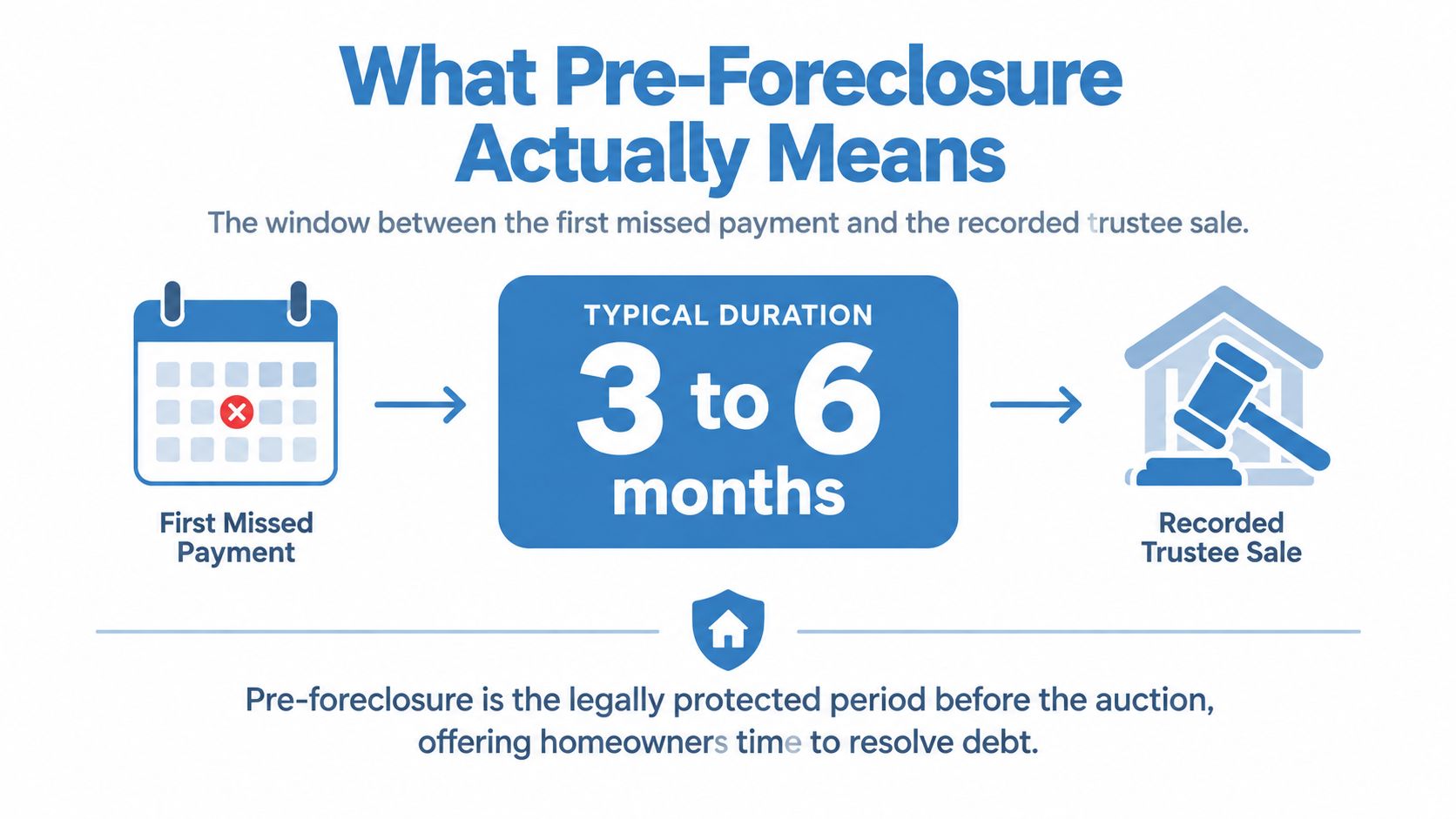
The usable negotiating window is often shorter than the legal window. Owners and investors can use pre-foreclosure records to identify properties early, assess whether equity exists, and approach the owner before a sale deadline narrows the available choices. For plain-language terminology, SAFE course foreclosure materials explain concepts such as a Notice of Default, lis pendens, Notice of Sale, and completed auction.
The Stages of the Pre Foreclosure Process From Missed Payment to Auction
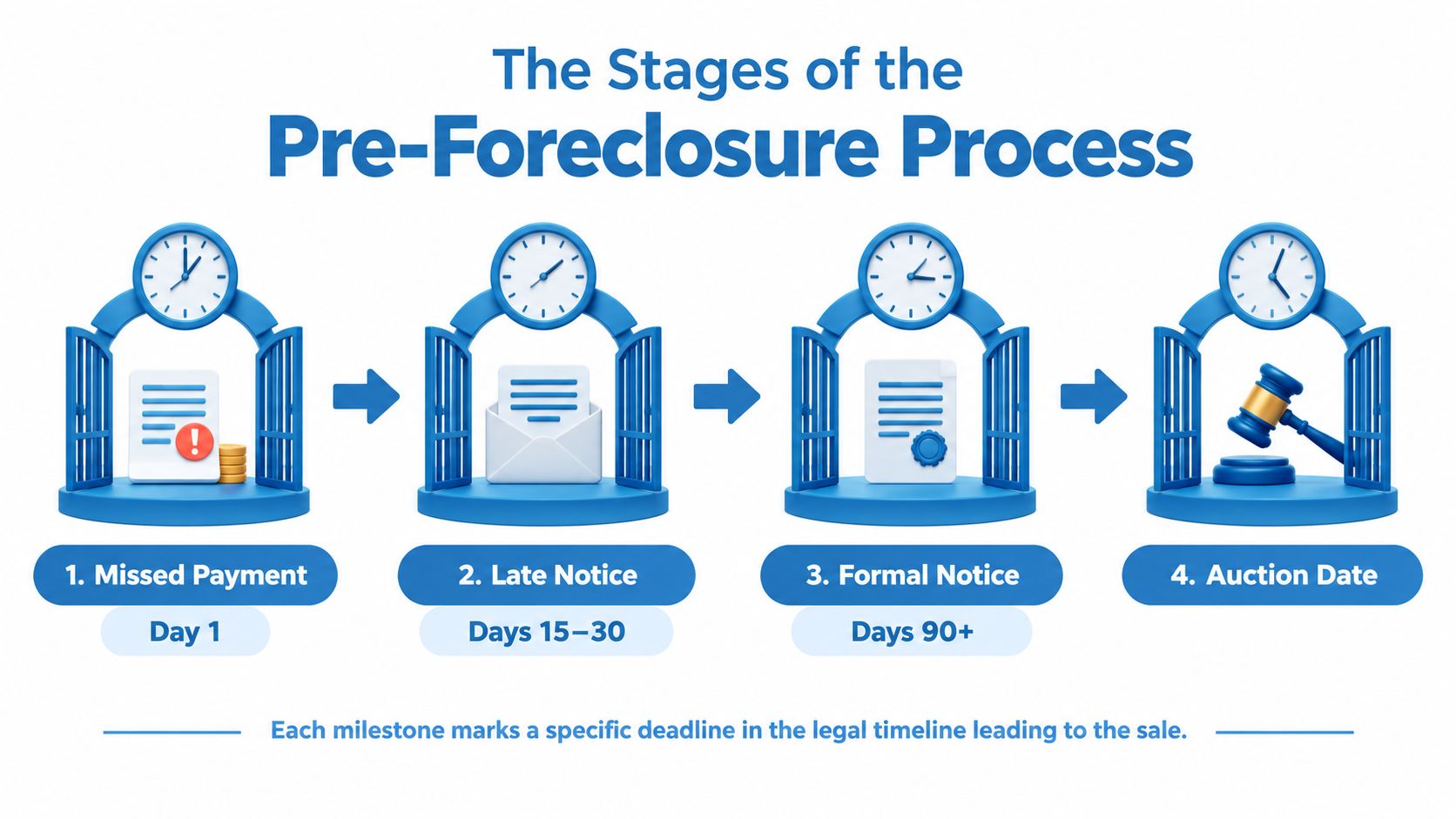
A foreclosure file usually passes through several legal gates before an auction can occur. Each gate has its own actor, document, and deadline. A missed payment starts the financial problem, but a valid notice, the required waiting period, and compliance with state law determine whether the matter can advance.
The first payment gates
Day 1, missed payment: The borrower does not make the scheduled mortgage payment. The servicer records the delinquency internally, may send reminders, and may provide information about assistance programs. At this point, no public foreclosure record may exist.
Days 15 to 30, late notice: The servicer typically sends a late-payment notice and may apply charges allowed by the loan agreement. The borrower should contact the servicer, request the current reinstatement amount, and ask which loss-mitigation options are available. Early contact can preserve choices that become harder to use later.
Days 30 to 90, grace and escalation period: The delinquency becomes more serious. The servicer may send breach or intent-to-foreclose correspondence. For covered mortgages, federal rules generally prevent formal foreclosure initiation before 120 days of delinquency, although state requirements and loan-specific facts still matter.
The formal filing gate
Around Day 90 or later, default filing: In a non-judicial state, the trustee or lender may record a Notice of Default once state law permits. In a judicial state, the lender may file a foreclosure complaint. The public record may also contain a lis pendens, which alerts buyers, lenders, and other third parties that litigation affects the property.
A Notice of Default explained by BatchData is a formal escalation document, not an auction notice. The borrower may still have time to cure the default, negotiate with the servicer, sell the property, or defend the case. For an investor, the filing can mark the point at which public records reveal a possible negotiating window, subject to state rules and the homeowner's circumstances.
Days 90 to 120 and beyond, cure period: State law controls the time available after the formal notice. The borrower should confirm the exact reinstatement or payoff figure with the servicer. That amount can change because of fees, escrow advances, legal costs, and continuing payments.
The sale gate
Notice of Sale: After the required conditions are met, the trustee or court sets a sale date. Depending on state law, the notice may need to be served, posted, published, or recorded. Some procedures require only 14 to 30 days of notice, leaving little time for a homeowner to arrange a cure, refinance, sale, or negotiated solution.
Auction: The trustee or sheriff conducts the sale under the published terms. Pre-foreclosure generally ends at the sale, unless state law provides a post-sale redemption right or another legal remedy.
Reinstatement changes the clock: If the borrower pays the required cure amount and the servicer confirms that the default is resolved, the foreclosure action may be dismissed or halted. A later missed payment can begin a new delinquency cycle. The borrower should obtain written confirmation that the original sale date has been canceled.
The document controls the immediate deadline. A phone promise, incomplete application, or pending buyer conversation does not necessarily stop a scheduled auction. Investors using pre-foreclosure data should therefore verify the latest filing and sale information before contacting an owner or evaluating a deal.
Why Judicial Versus Non Judicial States Change Everything
The foreclosure route determines who must act before a sale can occur. Judicial foreclosure requires a court case, while non-judicial foreclosure generally lets a trustee proceed under a statutory power of sale without obtaining a foreclosure judgment first. A judicial case works like a lawsuit with scheduled steps. A non-judicial case follows a statutory checklist, where missed notice or posting requirements can delay or invalidate the sale.
Texas and New York show the difference clearly. In Texas, the lender or servicer generally must satisfy statutory notice and posting requirements before the auction, and the path from notice of default to sale can be roughly 90 to 120 days, as described in Rocket Mortgage's state timeline discussion. New York requires a court process, so service, pleadings, conferences, defenses, and the court's schedule can extend a case to 12 to 24 months or longer.
| Procedural Gate | Non-Judicial States, CA, AZ, NV, TX, WA | Judicial States, NY, FL, IL, OH, NJ |
|---|---|---|
| Starting legal action | Trustee or lender records the required default notice and follows statutory sale rules | Lender files a complaint and starts a court case |
| Decision-maker | Trustee administers the statutory sale process | Judge or court enters the order or judgment needed to proceed |
| Main source of delay | Notice defects, postponements, loss mitigation, or statutory cure rights | Service, pleadings, hearings, defenses, mediation, judgment, and docket congestion |
| Practical effect | Statutory deadlines can compress the period before auction | Court milestones can spread the process across many months |
| Negotiating effect | The owner may need to act soon after formal notice | The owner may have more time, but court orders and sale notices still control |
The legal system changes the shape of the available window, not just its length. In a non-judicial case, a defective notice may create a procedural issue, but a valid notice can keep the file moving without a hearing. In a judicial case, a homeowner may have opportunities to respond in court, yet each conference, order, or judgment can create a separate deadline.
Research summarized in The Harvard foreclosure timeline study separates statutory and judicial foreclosure systems and illustrates why legal procedure affects actual completion times. The figures are historical averages, not a promise for any property. A specific file can move faster or slower because of service problems, loss-mitigation review, litigation, local court capacity, or a scheduled sale date.
For homeowners, the practical lesson is to read the latest notice and court document rather than rely on a general state average. For anyone reviewing pre-foreclosure records, the same distinction determines which deadlines, filings, and sale notices require verification before evaluating the property.
Pre Foreclosure Timeline by State With the Biggest Outliers
A Q1 2025 state comparison ranged from 110 days in New Hampshire to approximately 3,038 days in Louisiana, measured from the first public foreclosure notice to completion. That spread shows why a national average can mislead a homeowner or investor. The usable negotiating window depends on the state's procedure, the event already recorded, and the deadline that follows.
| State | Procedure | Typical Days to Sale or Completion | Redemption Window | Strategy Note |
|---|---|---|---|---|
| Texas | Non-judicial | See the Texas timeline in Section 3 | No general post-sale redemption for a non-judicial sale | Fast statutory process can compress negotiations |
| Florida | Judicial | Commonly about 8 to 14 months in major-market examples | Depends on applicable law and case | Court scheduling and judgment requirements add time |
| New York | Judicial | See the New York timeline in Section 3 | Depends on the case and applicable law | Court backlogs and litigation can extend the pipeline |
| New Hampshire | Non-judicial | About 110 days average | Depends on applicable law | A short calendar leaves little time for repeated outreach |
| Louisiana | Judicial or executory process | About 3,038 days average | Depends on the procedure | The cited comparison's longest timeline |
| Michigan | Non-judicial in many cases | State-specific | Six months in most cases, 12 months in some cases | Post-sale redemption can extend the possession timeline |
| Wyoming | State-specific | About 136 days average | Depends on applicable law | A relatively short window requires early document review |
| Minnesota | State-specific | About 139 days average | Depends on applicable law | Sale timing and notice status need prompt verification |
| Rhode Island | State-specific | About 149 days average | Depends on applicable law | A longer period than the fastest states can still narrow near-sale options |
The Q1 2025 comparison reported 110 days in New Hampshire, 116 days in Texas, 136 days in Wyoming, 139 days in Minnesota, 149 days in Rhode Island, and approximately 3,038 days in Louisiana. These figures describe the wider foreclosure pipeline, not one universal definition of pre-foreclosure. Use them as state-level context, then verify the property's notices, filings, sale date, and procedure.
Three outliers that change the strategy
Louisiana requires a different planning model. Its cited average is far beyond the faster state examples. Before estimating a sale date, determine whether the lender is using executory process, an ordinary proceeding, or another route. The legal path affects both timing and the point at which a buyer can negotiate with the owner or lender.
New Hampshire compresses the outreach window. A file can move quickly from public notice to completion, so waiting for several contact attempts may leave too little time for valuation, title review, financing, and a recorded transaction. Investors should check the latest public filing before treating the record as an open opportunity.
Michigan separates pre-sale negotiation from post-sale possession. The Michigan State Housing Development Authority states that redemption begins on the sheriff's-sale date and lasts six months in most cases, with 12 months possible when the debt is less than two-thirds of the original indebtedness. Farming property can also receive up to 12 months. Michigan's foreclosure stages explains why a redemption period is not the same as extra time to stop the sale.
For investors, the timeline is a filter rather than a prediction. A state with a longer average may offer more time for contact and underwriting, while a short-calendar state rewards fast verification and a clear offer process. Platforms such as foreclosure data by state can help organize records by jurisdiction and status. The working question remains: which legal event happened, and what deadline follows it?
Homeowner Options and Their Deadlines Inside the Window
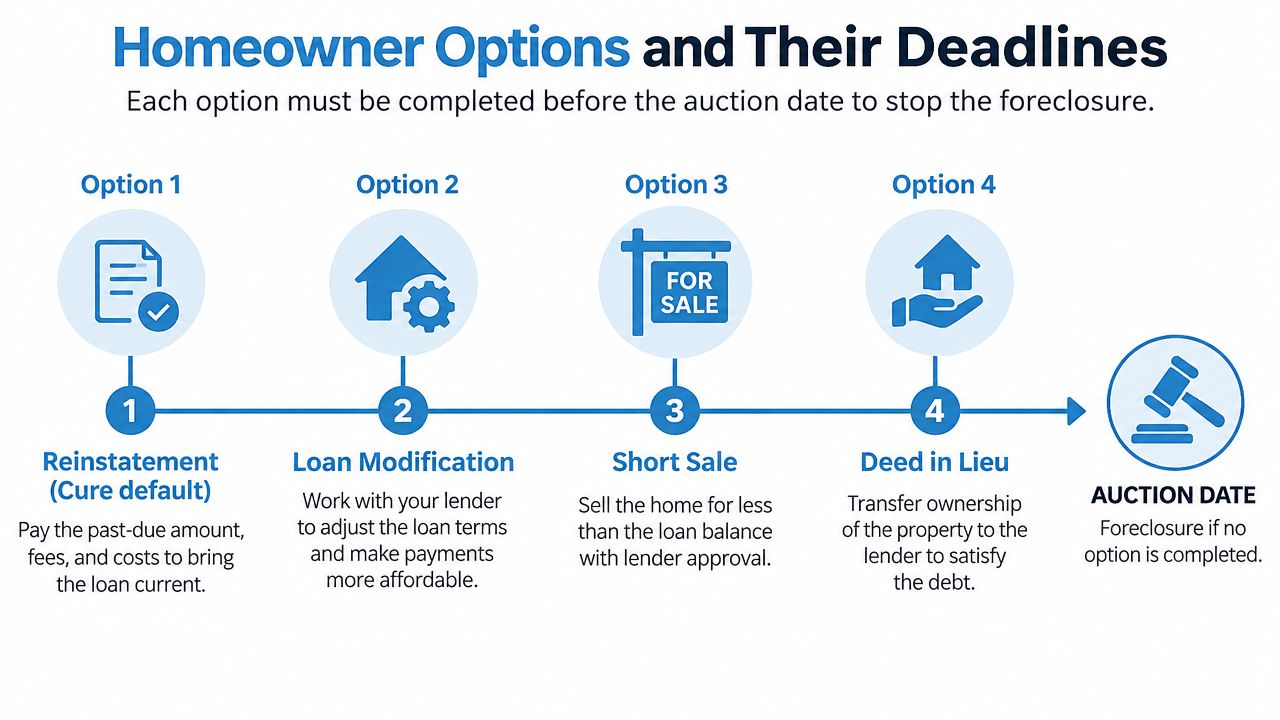
A homeowner can pursue several exits, but each has a different finish line. The practical question is not only which option sounds workable. It is whether the borrower can complete the required step before the sale date, including review, approval, signing, payment, and recording.
Reinstatement and loss mitigation
Reinstatement means curing the default before the scheduled sale. The borrower should request a written reinstatement quote, confirm the amount's expiration date, and ask how the servicer will verify that the sale has been canceled or postponed. A verbal promise is not a reliable substitute for written confirmation.
Federal servicing rules give a complete loss-mitigation application its protections only when submitted at least 37 days before the scheduled foreclosure sale. The servicer generally must evaluate a complete application within 30 days. The loss-mitigation application procedures in 12 CFR 1024.41 set out these requirements.
Completeness can determine whether the clock helps the borrower. Missing income records, bank statements, hardship explanations, or authorization forms may delay review or prevent the servicer from treating the package as complete. A housing counselor can help organize the submission, while the borrower should communicate with the servicer and retain copies of every document and delivery record.
Selling or transferring the property
A short sale needs lender approval when the expected proceeds will not cover the mortgage balance and approved costs. The owner must allow time for valuation, buyer qualification, title review, lender negotiation, and closing. A buyer may identify a solution before the auction, yet still lack enough time to complete it.
A deed in lieu of foreclosure transfers the property voluntarily to the lender. It can avoid the auction process, but the lender must accept the arrangement, title problems must be resolved, and the written agreement should address liens, possession, deficiency treatment, and release obligations.
Bankruptcy is a legal remedy that calls for advice from a qualified bankruptcy attorney. Filing can trigger an automatic stay that pauses collection and foreclosure activity, although exceptions, motions for relief, earlier filings, and court orders can change the result.
The operative deadline is the completed legal step, not the date someone first discusses an option. Depending on the path, that may be approval, signed documents, receipt of funds, or a required court order.
This video provides another practical visual explanation of the available paths:
What the Timeline Means for Real Estate Investors
For investors, pre-foreclosure is a moving response window, not a permanent property status. A recorded lis pendens or Notice of Default can identify a file, but it doesn't prove that the owner wants to sell, that equity exists, or that an auction will occur.
The most useful signals usually include:
- Lis pendens filing: Indicates a foreclosure lawsuit has entered the public record in a judicial process.
- Notice of Default recording: Signals formal escalation in a non-judicial process.
- Auction-date update: Creates the most urgent deadline for any purchase, reinstatement, or negotiated resolution.
- Tax delinquency or code violations: Add context about financial pressure, property condition, and the likelihood that a transaction will require title or repair work.
Those signals should change the outreach calendar by weeks, not merely by days. A file with a newly recorded default notice may justify title research, equity review, ownership verification, and a careful first contact. A file with a published auction date requires immediate confirmation of whether a direct sale is still legally and practically possible.
Investors should price the procedure into the offer strategy. A slow judicial file may allow more time for comparable-sales analysis, financing, inspection, and seller education, but the recorded debt and litigation can be more complex. A fast non-judicial file can require cash or highly reliable financing, accelerated diligence, and a willingness to accept thinner margins because the owner has less time to evaluate alternatives.
The goal isn't to pressure a distressed owner. It's to know the deadline accurately enough to make a legitimate offer before the owner loses control of the transaction.
BatchData can fit into this workflow as a property-data source for pre-foreclosure records, owner contacts, mortgage and lien details, valuations, and related property attributes. Investors still need to verify the current legal record, respect communication laws, and avoid treating a data flag as proof that a sale is available.
How Investors Monitor Pre Foreclosure With BatchData
A reliable monitoring system connects the public filing to the correct owner, property, stage, and next deadline. The process should be repeatable enough for a small acquisition team and structured enough for a larger CRM.
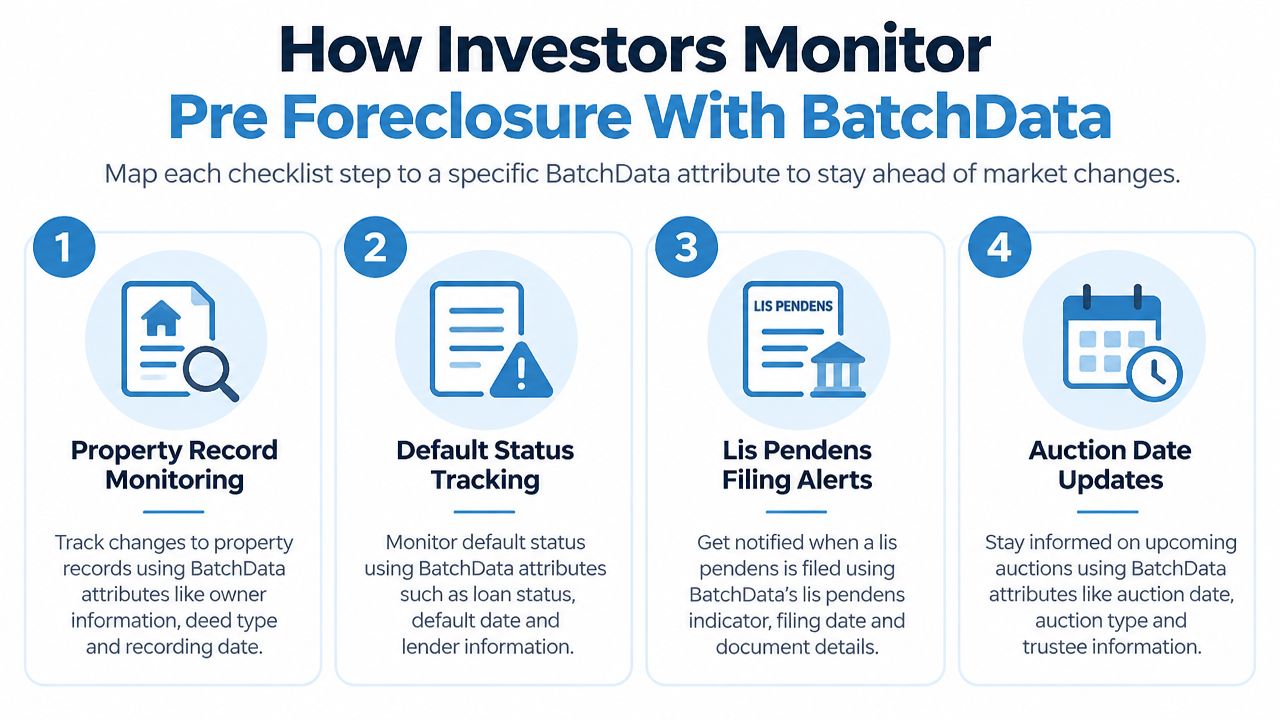
A practical monitoring checklist
- Property record monitoring: Match the parcel, address, owner, assessor record, and ownership history before outreach.
- Default status tracking: Record whether the file shows a Notice of Default, lis pendens, Notice of Trustee Sale, foreclosure sale, or another stage.
- Date validation: Capture filing dates, sale dates, postponements, and cancellations rather than relying on a general “pre-foreclosure” label.
- Contact enrichment: Verify current owner details, especially when the owner is absentee, has changed addresses, or holds the property through an entity.
- Workflow triggers: Route a new filing to title review, equity analysis, compliant mail, or a human follow-up task.
- Refresh discipline: Recheck records often enough to catch a sale-date change, reinstatement, dismissal, transfer, or new lien.
BatchData's pre-foreclosure data covers foreclosure-related lifecycle events such as Notice of Default or lis pendens, Notice of Trustee Sale or foreclosure sale, and auction details. Its broader platform also provides property records, valuations, owner contacts, mortgage and lien information, and contact-enrichment services.
For implementation, a team can use batch queries for geographic prospecting, webhook alerts for newly detected filings or date changes, and CRM integrations to assign follow-up. The API or bulk-delivery approach should match the operating model. A daily feed may suit active acquisition markets, while a less frequent review may suit portfolio monitoring with fewer time-sensitive files.
Compliance remains part of the system design. Investors should follow applicable federal and state rules for calls, texts, email, and direct mail, use consent where required, honor opt-out requests, and avoid communicating misleading urgency. Data freshness doesn't replace legal review, title verification, or a respectful conversation with the owner.
BatchData offers property records, pre-foreclosure event tracking, valuations, lien and mortgage details, and verified owner-contact enrichment for teams managing time-sensitive real-estate workflows. Use BatchData to connect foreclosure signals with the property and contact data needed for responsible, deadline-aware outreach.