



Psychographic data is the qualitative and quantitative data that explains why a person makes a decision, focusing on their activities, interests, opinions, and values. When combined with demographics, it raises predictive power from approximately 15% to over 45%, and in real estate 72% of homebuyers prioritize lifestyle alignment over price.
Relying on demographics alone is a category error. Age, income, and ZIP code can describe a prospect, but they can't explain motivation, hesitation, or timing. In property, lending, and insurance, that gap matters because expensive decisions are rarely driven by surface traits alone.
This is why psychographic data keeps showing up in serious data stacks. It helps operators distinguish a price-sensitive lead from a values-led buyer, a stability-focused borrower from an impulsive one, and a casual browser from someone whose intent is hardening fast.
Core takeaways:
- Definition: Psychographic data captures the motives behind decisions through Activities, Interests, and Opinions, plus values and lifestyle factors.
- Business impact: It improves prediction, targeting, and segmentation far beyond demographic-only models, especially in high-stakes sectors like housing and finance.
- Collection method: The strongest programs use multi-source triangulation instead of a single survey or cookie trail.
- Modeling reality: Static labels age badly. In volatile markets, teams need systems that refresh psychographic assumptions with current behavior.
- Compliance risk: In lending, sloppy use of psychographic variables can create disparate impact and real regulatory exposure.
- Operational value: The best use cases sit inside audience segmentation, lead scoring, underwriting review, portfolio monitoring, and message personalization.
Psychographic signals also matter outside consumer marketing. Teams evaluating talent and organizational fit often look at adjacent tools like psychometric assessments for hiring because they tackle the same underlying question from a different angle: what drives human decisions?
Introduction
Psychographic data matters because it explains intent, not just identity. That makes it more useful than many realize and more dangerous than most compliance programs assume.
The standard foundation is the AIO framework, short for Activities, Interests, and Opinions. It has been the baseline for measuring psychological attributes since the 1970s. In practice, psychographic data tells you whether a household is drawn to stability, status, sustainability, family orientation, convenience, community, or opportunity. That's the missing layer between “who this person is” and “what this person does.”
In real estate and finance, that layer changes decisions. A buyer who values walkability and community won't respond to the same listing language as a buyer focused on yield and efficiency. A borrower who prioritizes long-term stability should not be modeled the same way as someone whose patterns suggest reactive decision-making.
Psychographic data is not a branding exercise. It's a decision variable.
A key advantage is strategic clarity. You stop treating everyone in the same demographic bucket as interchangeable, and you stop mistaking observed behavior for underlying motive.
How Does Psychographic Data Differ From Demographics and Behavior?
Demographics tell you who someone is, behavioral data tells you what they did, and psychographic data tells you why they're likely to do it.
That distinction sounds simple. It isn't. Many data teams blur these categories and then wonder why their segmentation looks precise but performs poorly.
The comparison that actually matters
| Data Type | What It Answers | Example | Primary Use Case |
|---|---|---|---|
| Demographic | Who is this person? | Age, income, household status, education | Market sizing, eligibility screens, broad segmentation |
| Behavioral | What has this person done? | Visited listing pages, clicked rate content, opened an email | Retargeting, funnel optimization, recency-based triggers |
| Psychographic | Why does this person decide? | Community-oriented, risk-averse, sustainability-driven, family-first | Messaging, propensity modeling, underwriting context, audience design |
The cleanest way to think about it is this:
- Demographics are descriptive.
- Behavior is observable.
- Psychographics are interpretive.
That interpretive layer is what gives psychographic data its power. Two borrowers can share the same age, income, and neighborhood. They can even click the same mortgage content. One may be motivated by security and predictability. The other may be chasing financial advantage and upside. If your model treats them as equivalent, your next action will be wrong.
Why the difference changes execution
If you're still lumping psychographics into broad customer profiling, you're underusing it. The better use is operational.
- For marketers: It sharpens message fit.
- For analysts: It improves segmentation logic.
- For lenders and servicers: It adds context around decision style and response patterns.
- For property operators: It helps identify what a listing should emphasize, not just whom to show it to.
A good companion reference on the “who” side is this overview of demographic data in real estate workflows. It's useful precisely because it shows where demographics stop being enough.
The mistake isn't using demographics. The mistake is stopping there.
How Is Psychographic Data Sourced and Modeled?
High-quality psychographic data is built through multi-source triangulation, then modeled into usable segments with AIO and VALS frameworks.
Psychographics go wrong when teams infer too much from a single input. A survey alone is noisy. Social listening alone is biased toward the loudest users. Website behavior alone can confuse curiosity with intent. The stronger approach combines sources, validates them, and turns them into structured variables.
How collection works in practice
According to Adobe's explanation of psychographic segmentation, 74% of credible psychographic data comes from structured surveys and focus groups, 62% from social media listening, and 58% from website analytics, and that triangulated approach delivers 92% precision in distinguishing motivation from demographics in the stated framework of collection quality and inference Adobe psychographic segmentation methods.
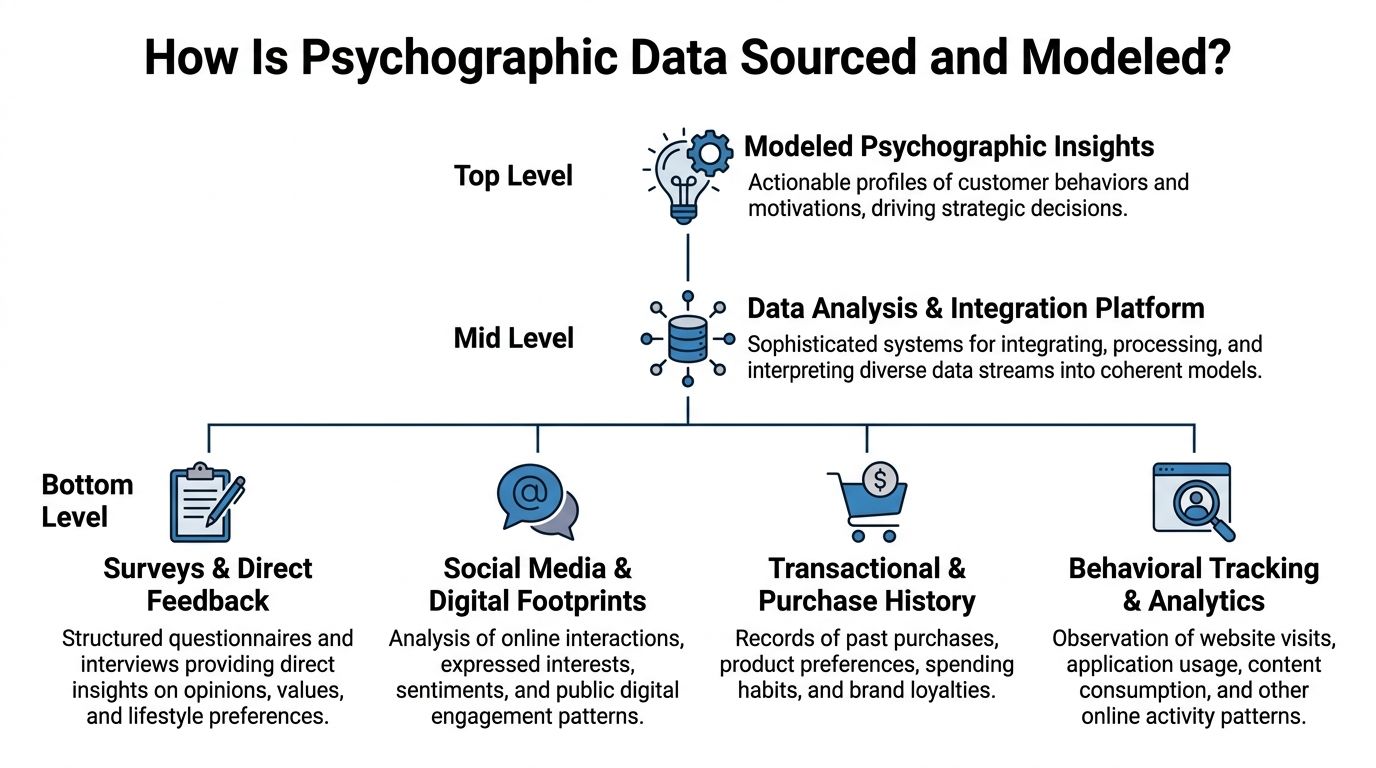
That usually produces four source classes:
Surveys and direct feedback
These capture declared attitudes, preferences, and self-reported values. They're the cleanest way to measure overt opinions.Social media and digital footprints
These surface expressed interests, language patterns, affinities, and public sentiment.Transactional history
Past purchases, category preferences, and product mix often reveal lifestyle alignment more clearly than a stated preference does.Behavioral analytics
Site visits, content sequences, and consumption depth help infer urgency, curiosity, or sustained intent.
How raw inputs become models
The dominant frameworks are AIO and VALS.
- AIO organizes psychographic data around activities, interests, and opinions.
- VALS classifies audiences by motivation and resources into nine psychographic types, including groups such as Innovators, Thinkers, and Survivors, as described in the psychographics overview on Wikipedia.
Once collected, these signals are usually transformed into structured features. Survey responses, behavioral proxies, and sentiment indicators are aggregated into a score vector. That vector is then used in clustering methods such as K-means or DBSCAN to group people by psychological proximity rather than demographic similarity.
In real estate and finance, those models often feed propensity modeling workflows, where the question isn't “who fits the market?” but “who is most likely to act, respond, convert, refinance, default, or disengage?”
The hidden modeling problem most teams miss
Static psychographic labels degrade. Fast.
A 2024 McKinsey study on behavioral science in volatile economies reported that static psychographic profiles can lose 65% of their predictive accuracy within 30 days during market shifts McKinsey behavioral science in volatile economies. That matters in housing because rates, inventory, and local conditions can flip motivation quickly.
Practical rule: Treat psychographics as a living layer, not a permanent label.
A “risk-averse” prospect can become opportunistic after a pricing reset. A “family-first” buyer can become cost-constrained after a financing shock. If your model isn't refreshing those assumptions with current behavior, it's producing false confidence.
What Are the Core Psychographic Attributes to Track?
The core attributes are activities, interests, opinions, values, attitudes, and lifestyle signals. Together, they form the explanation layer behind intent.
AIO is still the operational core
The AIO framework remains the easiest way to structure psychographic data for practical use.
Activities
These are the repeated actions that reflect lifestyle. In property contexts, that can include home renovation behavior, gardening, investment research habits, or frequent engagement with neighborhood content.Interests
These show what consistently attracts attention. Common real-estate-relevant interests include sustainable living, DIY improvements, school access, design aesthetics, rental income, or long-term wealth preservation.Opinions
These capture stated or inferred views. A person may hold strong opinions about inflation, urban density, remote work, homeownership, regulation, or environmental impact.
Values and attitudes matter more than teams admit
AIO alone is useful, but values turn profiles into business decisions.
Consider these kinds of values-led categories:
Community-oriented
More responsive to neighborhood identity, social cohesion, local amenities, and belonging.Financial security focused
More sensitive to downside protection, predictable costs, and long-term stability.Status or design led
More likely to respond to prestige, aesthetics, exclusivity, and curated lifestyle framing.Sustainability driven
More likely to engage with efficiency, environmental benefits, and durable asset quality.
Attitudes shape timing. Values shape fit. Lifestyle shapes message.
Why attribute selection matters
The wrong attribute set produces elegant nonsense. If a team tracks only broad lifestyle tags like “outdoorsy” or “affluent,” it won't have enough precision to guide pricing, targeting, or underwriting review.
Useful psychographic attributes tend to have three properties:
| Attribute quality | Why it matters | Example in property contexts |
|---|---|---|
| Observable or inferable | You need a repeatable way to measure it | Repeated engagement with renovation content |
| Decision-relevant | It should change messaging or model logic | Stability preference in borrower outreach |
| Refreshable | It should be updated as conditions change | Shift from aspirational browsing to urgency |
Good psychographic data doesn't just describe personality. It changes what your team does next.
How Is It Applied in Real Estate and Marketing?
Psychographic data is most valuable when it changes segmentation, lead scoring, and messaging.

In property workflows, broad audience definitions stop being useful quickly. “Homebuyers in suburban ZIP codes” is a media audience. It is not a strategy. Psychographics let teams build segments around motivation, which is what drives response.
Purpose-driven buyer personas beat generic lead buckets
Numerator's psychographic insights describe real estate segmentation at a much more granular level. In that framing, teams can analyze 500+ variables, and 68% of high-net-worth property buyers are motivated by values and lifestyle alignment, which supports purpose-driven buyer personas that reduce cold outreach failure rates by 45% Numerator psychographic insights.
That changes how operators define target audiences.
Instead of:
- High-income buyers in a metro area
- Investors with prior ownership
- Households with children
You get more useful segments such as:
- Family-first stability seekers
- Design-led urban professionals
- Yield-focused opportunistic investors
- Sustainability-motivated long-term owners
Those segments support stronger audience segmentation for real estate marketing because they tell creative teams what to emphasize and analytics teams what to rank.
Message alignment changes conversion quality
Psychographic data is what lets the same property be marketed differently without becoming misleading.
A listing framed as a “family-oriented sanctuary” targets safety, routine, community, and emotional permanence. The same property framed as a “live-work space for creative professionals” targets flexibility, identity, and self-expression.
Those are not cosmetic edits. They are hypothesis-driven message choices based on likely motive.
Another data point reinforces the pattern. The 2023 Statista Global Consumer Survey found that 73% of consumers are more likely to engage with advertisements that reflect their specific personality traits and values than with generic demographic targeting, based on a survey of 15,000 participants across 20 countries.
Here's a short explainer worth watching before teams operationalize this into campaigns:
Lead scoring and underwriting get sharper
Psychographics also improve model inputs.
In mortgage underwriting, profiles associated with risk-averse lifestyle and long-term stability values have been cited as correlating with a 30% lower default probability than demographically similar but psychographically impulsive segments. In enterprise pipelines, value-aligned segments have also been shown to move through real estate transactions faster, which matters for sales ops, acquisition teams, and lender workflows.
Practitioners need discipline when handling psychographic variables. These variables should influence prioritization, personalization, and review logic, but they should not be dropped blindly into regulated decisioning without validation.
The highest-value use of psychographics in real estate is not better ad copy. It's better prioritization.
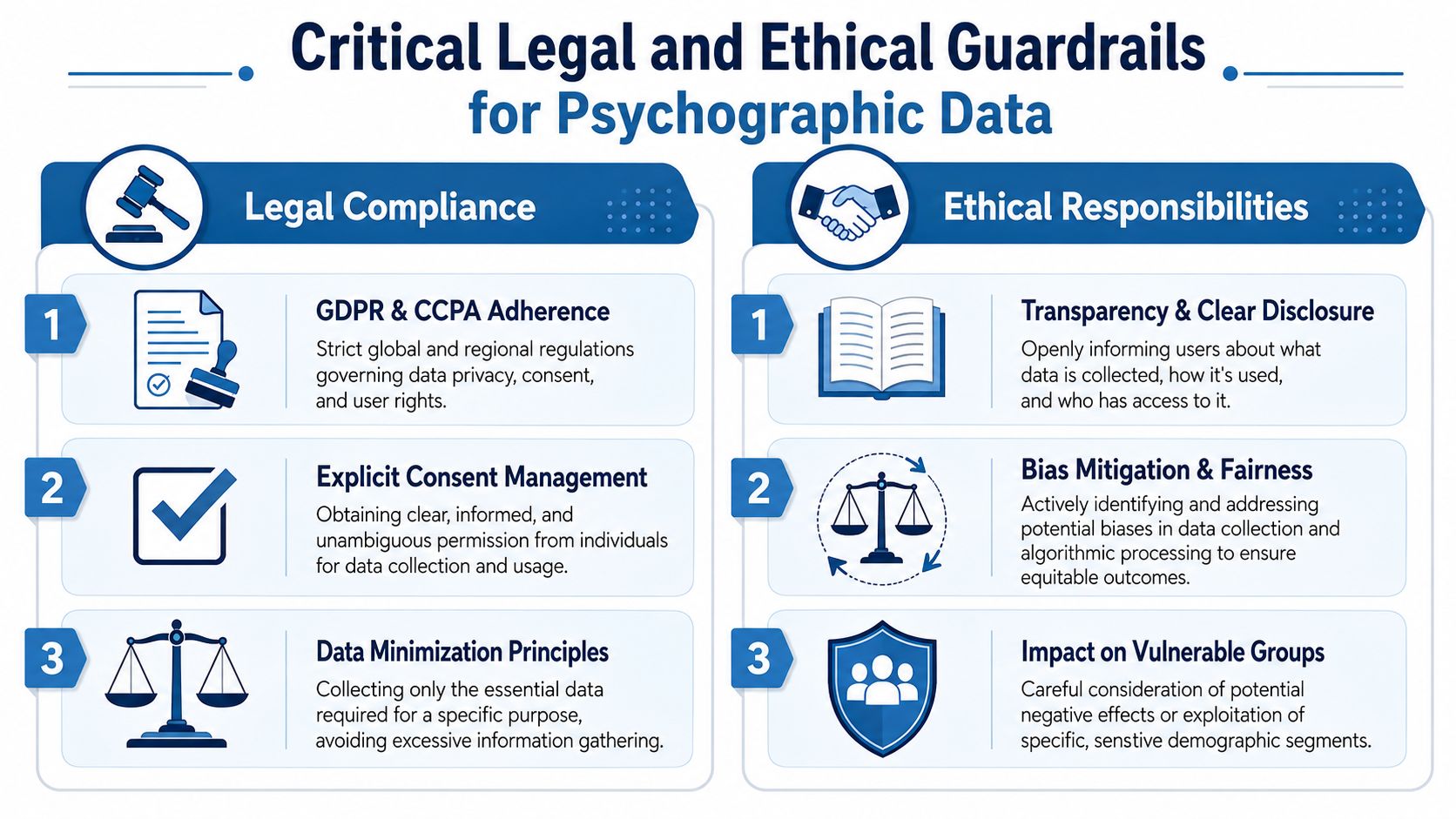
What Are the Critical Legal and Ethical Guardrails?
Psychographic data can improve targeting and risk models, but in lending and housing it can also create illegal disparate impact if you don't validate every variable.
Most guidance on this subject is too vague to be useful. “Use data responsibly” is not a framework. In regulated sectors, you need controls that are specific enough to survive audit, model review, and legal scrutiny.
The risk is correlation with protected-class proxies
A 2025 Federal Reserve report on AI and Bias in Lending found that 78% of lenders using psychographic variables for risk scoring unknowingly introduced disparate impact because lifestyle data correlated with protected class proxies, leading to $2.3B in regulatory penalties Federal Reserve AI and Bias in Lending.
That is the central legal problem. A variable can look harmless on its face and still function as a proxy for a protected characteristic. “Lifestyle,” “community preference,” “media affinity,” and even certain opinion clusters can map unevenly across populations. If those features affect approvals, pricing, or servicing intensity, you can create discriminatory outcomes without ever using a protected field directly.
A practical compliance framework
Use psychographic data under a rule set, not a hunch.
Separate use cases by regulatory sensitivity
Marketing personalization and creative testing are not the same as credit decisioning. Don't let one feature set drift into both environments without review.Document variable intent
For every psychographic field, record what it is supposed to measure and why it belongs in the model.Test for proxy behavior
If a lifestyle or values field tracks too closely with protected-class patterns, remove it or restrict its use.Run fairness audits before deployment
Review outcomes for disparate impact, not just aggregate accuracy.Refresh governance as markets shift
A variable that seemed benign in one period can become riskier when economic conditions change user behavior.
Ethics starts where legality ends
Even if a use case clears legal review, it may still be a bad idea.
The ethical baseline is straightforward:
- Be transparent about collection and use.
- Minimize data to what the use case needs.
- Avoid exploitation of vulnerable groups.
- Build secure operating practices around sensitive profiles.
For teams tightening those practices, references like Donely's secure AI operations are useful because they focus on operational discipline, privacy posture, and accountable AI use rather than abstract promises.
If your team can't explain why a psychographic variable belongs in a workflow, it doesn't belong there.
How to Integrate Psychographic Data into Your Platform
Integrate psychographic data by appending it to existing customer or property records, validating it at ingest, and routing it into systems that can act on it.
The technical path is usually straightforward. The governance path is not. Start with both.
A workable implementation sequence
Ingest with schema control
Use API or bulk delivery pipelines that enforce a consistent lifestyle-value-opinion schema. Psychographic fields only become useful when they're normalized enough for analytics and activation.Attach to a hybrid profile
Blend psychographic attributes with demographic, property, and transactional records. Psychographics alone are incomplete. Their value comes from context.Define approved use cases
Map fields to workflows such as CRM routing, campaign personalization, lead prioritization, portfolio monitoring, or analyst review. Keep regulated decisioning on a separate approval path.Set refresh logic
Static profiles drift. Use current behavior to update or downgrade stale assumptions.Measure operational lift
In enterprise real estate pipelines, value-aligned psychographic segments have shown 40% faster conversion cycles than non-aligned segments in the cited implementation context BatchData enterprise psychographic pipelines.
A clean integration doesn't just make psychographic data available. It makes it governable, testable, and useful at the exact point where a team needs to decide what to do next.
If you need property, owner, valuation, and contact data that can support richer audience design, underwriting analysis, and portfolio workflows, BatchData gives teams access to a modern real estate data platform with low-latency APIs, bulk delivery, and the operational infrastructure to put high-intent data to work.