



Building a real estate portfolio is not about acquiring a few random rentals; it's about engineering a repeatable system that generates long-term wealth through income-producing assets. The entire process hinges on a data-driven framework for deal sourcing, financing, and asset management, which starts with a brutally honest assessment of your financial goals and risk tolerance.
This is not a get-rich-quick scheme—it's an active, strategic pursuit. Success means moving beyond gut feelings and adopting the mindset of a financial analyst to build a durable, high-performing portfolio.
- Core Strategy: Define a precise investment thesis for asset type and location.
- Deal Sourcing: Create a systematic, off-market lead generation engine.
- Financial Modeling: Underwrite deals conservatively, accounting for all expenses.
- Asset Management: Actively monitor KPIs to maximize returns and mitigate risk.
This guide provides the blueprint for turning a chaotic process into a predictable system for scalable growth.
What Is the Blueprint for a Profitable Real Estate Portfolio?
The path to a multi-property portfolio is built on strategic, data-driven decisions, not luck or online hype about "infinite returns." Building a durable portfolio is an active process that demands a clear, executable game plan. Real estate investing offers a spectrum of involvement, from being a hands-on landlord for a single-family rental to a passive investor in a private real estate fund. The cornerstone of any solid portfolio is a razor-sharp objective.
The Core Stages of Portfolio Construction
Building a portfolio is a repeatable cycle, not a one-time event. Mastering each phase is how you scale without catastrophic failure.
| Stage | Core Objective | Key Action |
|---|---|---|
| Strategy & Thesis | Define what you buy, where you buy it, and why. | Analyze market data to identify target regions and asset types. |
| Sourcing & Screening | Build a consistent pipeline of potential acquisitions. | Use data platforms to find off-market deals and apply quick financial filters. |
| Underwriting & Finance | Validate a deal's financial viability and secure capital. | Create a detailed pro forma and structure debt and equity. |
| Operations & Monitoring | Optimize asset performance to maximize returns. | Track KPIs like NOI and cash-on-cash return; manage proactively. |
| Risk & Exit | Protect your assets and plan for profitable disposition. | Implement legal protections and define your exit strategy upfront. |
Internalizing these stages transforms a chaotic process into a predictable system for growth.
The single biggest mistake I see new investors make is getting lazy with due diligence. They underestimate repair costs, get starry-eyed about potential rent, and completely ignore critical expenses like vacancy and capital expenditures. A thorough, data-backed underwriting process is your best shield against a bad deal.

Adopting A Data-First Mindset
Today’s most successful investors run on data, not gut feelings. The game has moved beyond the MLS. Platforms like BatchData provide a significant competitive advantage by enabling you to bypass the public market and target specific properties and owners directly. Imagine pulling a list of every out-of-state owner with high equity in a specific zip code; this is how you find motivated sellers. While crafting the blueprint is one thing, execution is another. Expert corporate real estate services can be invaluable for strategic planning and asset optimization, turning this complex framework into an actionable plan.
How Do You Define an Investment Thesis?
An investment thesis is the data-backed rationale for what you buy, where you buy it, and why. It acts as a precise filter that eliminates 99% of market noise. A weak thesis is a vague wish ("I want to buy some rentals"), whereas a strong thesis is an actionable plan: "I will acquire Class B multifamily properties in Sun Belt secondary markets showing 3%+ annual job growth and a structural housing deficit." A sharp thesis separates a cohesive, high-performing portfolio from a random collection of properties. A solid grasp of Financial Planning and Analysis is critical for building a strategy that holds up long-term.

Aligning Strategy with Capital
Your strategy must align with your available capital and risk tolerance. Whether you have a $50,000 down payment or $500,000 directly dictates your path. For instance, limited capital but ample time suits the BRRRR method (Buy, Rehab, Rent, Refinance, Repeat). Conversely, an investor with deep pockets but no free time might focus on turnkey rentals or syndicated deals.
| Strategy Comparison | BRRRR (Active) | Value-Add (Semi-Active) | Turnkey (Passive) |
|---|---|---|---|
| Best For | Investors with hands-on skills or time. | Investors with project management skills. | High-income professionals with limited time. |
| Typical Activities | Sourcing distressed assets, managing renovations, tenant placement. | Buying stable assets and forcing appreciation via light upgrades. | Buying rent-ready properties from a specialized company. |
| Capital Required | Low to Moderate | Moderate to High | High |
| Time Commitment | High | Moderate | Low |
Using Macro Data
Once you have a personal framework, start hunting for markets that fit your thesis using macro-level data. This allows you to spot regions with powerful economic tailwinds before the competition.
- Job Growth: Target markets consistently beating the national average, with 2-3% annual growth being a strong indicator.
- Population Growth: Follow migration patterns to identify areas with growing populations of young professionals, families, or retirees.
- Housing Supply vs. Demand: Use platforms like BatchData to cross-reference population growth with new housing starts to find markets with a structural housing deficit, which drives future rent growth.
Your thesis should be a living document. The core principles might remain, but the specific markets and asset classes you target will evolve. Stay agile and let the data guide your adjustments.
The U.S. commercial real estate investment market is projected to hit $562 billion in 2026, and this growth will not be evenly distributed. A data-driven thesis is your most important tool for finding opportunities in a market with varying oversupplies and shortages.
How Do You Systematically Source and Screen Deals?
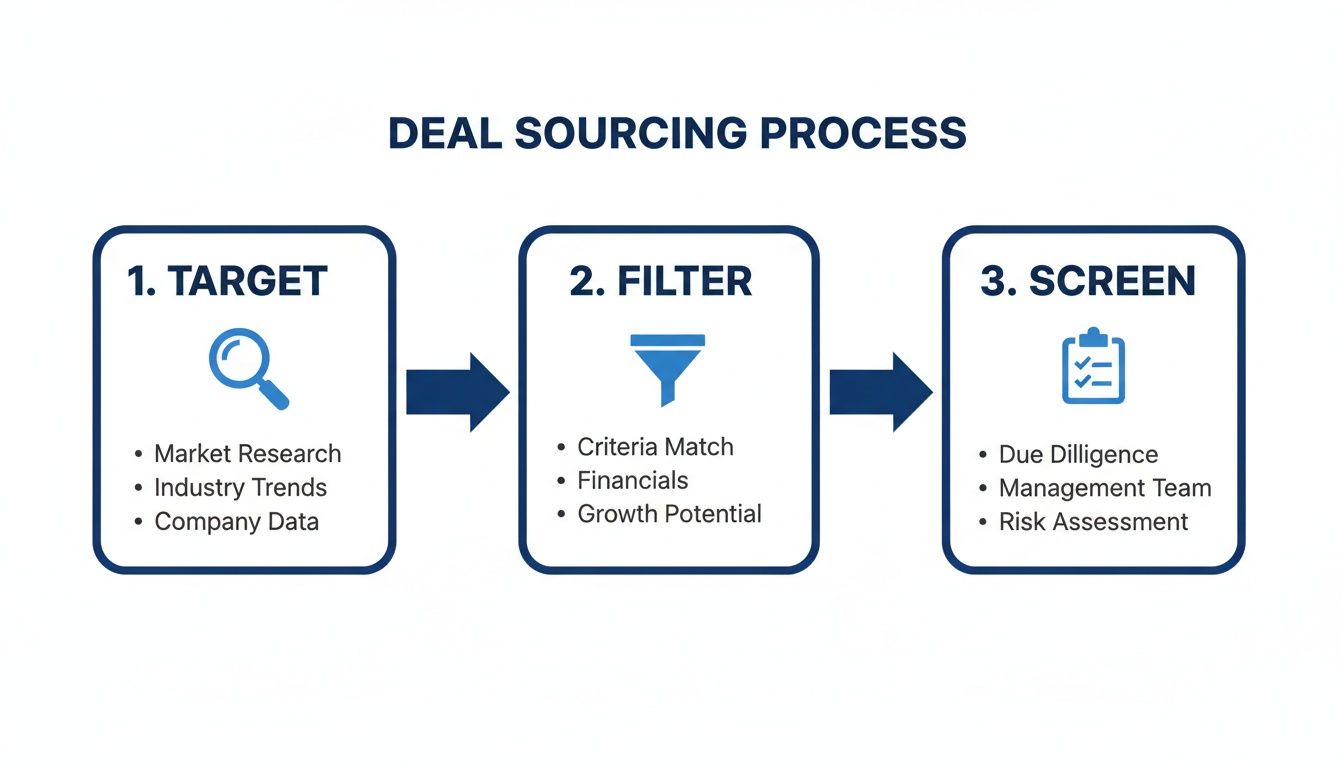
Finding great deals is the lifeblood of a growing portfolio, and relying on the MLS means you are actively choosing to overpay. Professional investors build a data-driven funnel to find off-market opportunities from motivated sellers before they become public knowledge. This shifts you from being a reactive buyer to a proactive deal hunter.
Building Your Off-Market Lead Engine
Think like a data scientist, not a real estate agent. Property data platforms allow you to pinpoint the exact types of owners most likely to sell. Our guide on how to find real estate leads breaks down advanced strategies. Using BatchData's Smart Search, you can stack criteria to create a hyper-targeted prospect list.
- Ownership Status: Target out-of-state or absentee owners who are often more open to a cash offer.
- Equity Position: Zero in on properties with 50% or more equity, as these owners have the financial flexibility to negotiate.
- Length of Ownership: Focus on owners of 10+ years who may be looking to cash out their appreciation.
- Distress Signals: Layer in data points like pre-foreclosure filings, tax delinquencies, or code violations as clear signs of motivation.
The Rapid Screening Gauntlet
Once your lead engine runs, you need a ruthless screening process to eliminate the 95% of deals that are a waste of your time. This initial review should take no more than five minutes per lead.
The goal of screening isn't to find the perfect deal. It's to eliminate the 95% of deals that are a waste of your time as quickly as humanly possible. Your time is your most valuable asset in the acquisition phase.
Must-Pass Financial Filters
Your screening criteria should be simple enough for a back-of-the-napkin calculation. These two rules are non-negotiable for your initial pass.
| Screening Rule | Definition & Purpose | Quick Calculation Example |
|---|---|---|
| The 1% Rule | Gross monthly rent must be at least 1% of the total purchase price. This is a classic, quick-and-dirty test for cash flow potential. | A $200,000 property must generate at least $2,000/month in rent. If market rent is only $1,500, the deal is dead. |
| Quick Expense Ratio | Assume operating expenses (OpEx) will be 50% of your gross rental income. This covers vacancy, repairs, management, taxes, and insurance. | If monthly rent is $2,000, immediately earmark $1,000 for OpEx. This leaves $1,000 to cover your mortgage payment. |
If a property cannot clear these hurdles, move on. This discipline protects your capital and ensures only viable deals advance to deep underwriting.
How Do You Underwrite and Finance Acquisitions?
Underwriting is the cold, hard process of killing bad deals with ruthless financial analysis so the great ones can shine. After a quick screen with the 1% Rule, you must build a full-blown financial model that stress-tests a property against the brutal realities of ownership. The best investors underwrite conservatively, wanting the numbers to prove them wrong.
Building a Pro Forma That Tells the Truth
A pro forma is your financial forecast for a property, and its accuracy is the difference between hitting cash flow goals and owning a cash-draining disaster. Your goal is to build a model so conservative that if the deal still works, you’ve found a winner.
Your expense model must account for the "Big 5" expenses that rookies always underestimate:
- Vacancy Reserves: A standard 5-8% vacancy reserve is a non-negotiable line item.
- Capital Expenditures (CapEx): Budget 5-10% of gross rents for big-ticket items like a new roof or HVAC system.
- Repairs & Maintenance: This covers day-to-day fixes and can easily run another 5-10% of gross rents.
- Property Management: Budget the standard 8-10% fee, even if you self-manage, to keep numbers honest for future scaling.
- Utilities, Taxes, and Insurance: Never rely on the seller's stated figures. Pull actual tax bills and get real insurance quotes.
Structuring Financing to Scale
Once underwriting confirms a solid deal, financing is the next puzzle. How you fund your first properties sets the pace for your portfolio's growth. Relying solely on conventional mortgages with a 20-25% down payment will result in very slow growth.
The most sophisticated investors think in terms of capital structure. They don't just ask, "Can I get a loan?" They ask, "What's the optimal mix of debt and equity to maximize my return while managing risk?"
This means exploring a spectrum of financing tools and matching the strategy to the deal and your long-term vision.
| Financing Comparison | Best For | Key Consideration |
|---|---|---|
| Conventional Mortgage | Your first 1-4 properties, especially with W-2 income. | Strict debt-to-income ratios and a limit of 10 financed properties. |
| Portfolio Lenders | Investors with more than 4 properties. | They look at the portfolio's cash flow, not just personal income. Much more flexible. |
| Seller Financing | Motivated sellers and creating win-win deals. | Can mean lower down payments and flexible terms, but rates are often higher. |
| Private/Hard Money | Short-term financing for fix-and-flips or BRRRR deals. | Funding is fast, but rates are high (8-15%). You need a crystal-clear exit plan. |
Your ability to "stack" different forms of capital separates amateurs from professional operators. For a complete checklist on underwriting and financing, review our comprehensive guide on real estate due diligence.
How Do You Manage Assets for Maximum Portfolio Health?
Asset management is the process of systematically boosting a property's performance to exceed original underwriting projections and drive long-term value. This is where you graduate from being a reactive "landlord" who fixes problems to a forward-thinking "asset manager" who anticipates them while hunting for opportunities to increase revenue and slash costs. This operational discipline separates a random collection of rentals from a resilient, high-performing portfolio.

The Operational Trinity
Day-to-day mastery boils down to three core functions. Getting these right builds a rock-solid foundation for every asset.
- Proactive Maintenance Programs: Implement a scheduled maintenance calendar (HVAC servicing, gutter clean-outs, roof inspections) to slash expensive emergency repairs, which can cost up to five times more than planned work.
- Effective Tenant Retention: Tenant turnover costs one to two months of rent in vacancy, cleaning, and marketing. A solid retention strategy, like responding to maintenance requests within 24 hours, is pure profit.
- Smart Vendor Management: Build relationships with a handful of reliable, insured vendors. As your portfolio grows, negotiate better pricing based on volume and always have a vetted backup for critical services.
The idea of being "on call" for a rental property is what scares off a lot of new investors. But the reality is far less dramatic for anyone used to professional life. If your systems are tight and your management is on point, a true "rental emergency" call is an incredibly rare event, not a constant headache.
Monitoring The KPIs That Actually Matter
You cannot improve what you do not measure. To run your portfolio like a business, you must track the Key Performance Indicators (KPIs) that reveal its true financial health.
| KPI Comparison | What It Is | Why It Matters |
|---|---|---|
| NOI (Net Operating Income) | The property's pure profitability before you pay the mortgage. | It's the cleanest way to measure how well an asset is performing and what it's truly worth. |
| CoC Return (Cash-on-Cash Return) | Your annual pre-tax cash flow divided by the total cash you put in. | This shows the direct return on your deployed capital—how hard your money is actually working. |
| DSCR (Debt Service Coverage Ratio) | The ratio of your NOI to your total annual mortgage payments. | Lenders live and die by this. A DSCR dipping below 1.2x is a massive red flag signaling you may struggle to pay your debt. |
Building Your Portfolio Monitoring Dashboard
Tracking KPIs manually in a spreadsheet becomes a nightmare past a few properties. Technology gives you a serious advantage. Smart investors build real-time dashboards for a consolidated view of their entire portfolio's health.
Platforms with portfolio monitoring APIs, like BatchData, can automate this process. A dashboard can automatically:
- Pull in all your property data.
- Track changes in each property's Automated Valuation Model (AVM).
- Calculate your real-time equity across the portfolio.
- Send you an instant alert if a new lien or pre-foreclosure notice is filed against one of your assets.
This is active risk management. Seeing equity shoot up might signal a cash-out refinance to fund your next deal. Data-driven asset management with the right real estate portfolio management software is the new standard.
How Do You Manage Risk and Plan an Exit Strategy?
An exit strategy is a core piece of your investment plan that you bake in from day one, not an afterthought. This, combined with rock-solid risk management, is the unglamorous but vital work that prevents a single problem from becoming a portfolio-wide catastrophe. It's about building firewalls to survive downturns so you can thrive in the upturns.
Fortifying Your Portfolio
You need three core defensive layers in place to protect your assets.
- Legal Structure: Holding properties in your personal name is a rookie mistake. Each asset should be held in its own separate Limited Liability Company (LLC) to compartmentalize liability.
- Proper Insurance: You need a robust landlord policy with significant liability coverage—$1-2 million is standard—and an umbrella policy on top of your entire portfolio.
- Cash Reserves: Keep a dedicated reserve fund for each property with at least 3-6 months of total expenses (PITI, maintenance, management). This is the cash that weathers a long vacancy or a surprise $10,000 HVAC replacement.
Stress-test your entire portfolio at least once a year. Run the numbers on worst-case scenarios, like a 20% drop in rents or a 2% spike in interest rates. If your portfolio can't stay cash-flow positive under that pressure, you’re over-leveraged and need to de-risk immediately.
Engineering Your Profitable Exit
Your exit strategy, decided at the time of purchase, influences property selection, financing, and your entire investment thesis. Sophisticated investors rely on three primary exit pathways.
| Exit Strategy Comparison | Core Objective | Best Use Case |
|---|---|---|
| 1031 Exchange | Defer capital gains tax by rolling proceeds into a "like-kind" property. | You want to trade up into a larger, higher-quality asset without taking a massive tax hit. |
| Cash-Out Refinance | Pull tax-free equity out of a property to fund new acquisitions. | Your property has appreciated significantly, and you want to scale your portfolio by recycling capital. |
| Strategic Sale | Sell an asset to capture gains and rebalance your portfolio. | The market is at a cyclical peak, or the asset no longer fits your investment thesis. |
For instance, a 1031 exchange is perfect for consolidating high-maintenance single-family homes into a single apartment building. A cash-out refinance is a powerful growth engine, letting you use equity from a BRRRR project to fund your next down payment. Your exit strategy is the final, critical step in your wealth-building machine.
What Are the Top Questions About Building a Portfolio?
Whether you're a first-timer or a seasoned pro, the same questions about capital, strategy, and risk always emerge. Here are the direct answers to the most common queries.
How Much Money Do You Really Need to Start?
There is no single magic number; you can often start with less cash than you think by using creative financing. Strategies like house hacking—living in one unit of a multi-family property—dramatically lower your barrier to entry. An FHA loan allows an owner-occupant to get in with as little as a 3.5% down payment. For a traditional, non-owner-occupied investment, plan for a 20-25% down payment, plus 2-5% for closing costs and a cash reserve for several months of expenses.
Should I Pay Off One Property or Buy More?
The correct answer depends entirely on your risk tolerance and goals.
| Path | Pros | Cons |
|---|---|---|
| Pay Off Property | Creates a secure, debt-free asset with maximum cash flow. Prioritizes stability. | Slower portfolio growth and net worth accumulation. |
| Buy More Properties | Accelerates portfolio growth and net worth through leverage. | Higher risk and requires careful debt management. |
Many experienced investors use a hybrid approach: stabilize the first few properties by paying down debt, then strategically use leverage to expand.
What Is the Single Biggest Mistake New Investors Make?
The most common and costly mistake is shoddy due diligence. New investors get swept up in the excitement of a deal and fail to properly vet the numbers.
The classic error is underestimating repair costs while overestimating what you can charge for rent. A conservative, thorough underwriting process where you account for every possible expense—vacancy, cap-ex, property management, you name it—is the single best defense you have against a bad investment.
Ready to build your portfolio with a data-driven edge? BatchData provides the property data, owner contact information, and portfolio monitoring tools you need to find off-market deals and manage your assets with precision. Stop guessing and start executing.