Real-time skip tracing APIs simplify how real estate professionals find and contact property owners. These tools provide instant, verified contact details – like phone numbers, emails, and mailing addresses – using just a property address or owner name. They’re especially useful for off-market deals, uncovering LLC owners, and speeding up lead generation. Key benefits include:
- Speed: Results delivered in milliseconds for immediate follow-up.
- Accuracy: 76% right-party contact rate, far above industry averages.
- Integration: Seamlessly connects with CRMs and marketing platforms.
- Compliance: Built-in safeguards for DNC and TCPA regulations.
These APIs are essential for locating motivated sellers, identifying distressed properties, and gaining an edge in competitive markets. By automating manual tasks, they save time and improve efficiency for real estate professionals.
How to Make the Most of Skip Tracing
Core Features of Real-Time Skip Tracing APIs
Real-time skip tracing APIs bring a powerful toolkit to streamline real estate workflows. These tools go far beyond simple contact lookups, combining property insights with instant data enrichment. At their core, they focus on three key areas: broad data access, real-time precision, and smooth integration with existing systems.
Types of Data Available Through APIs
Skip tracing APIs today grant access to over 700 attributes across 155 million properties, offering a wealth of information for lead research. On the contact side, you’ll find verified phone numbers (labeled as mobile or landline), deliverable email addresses, and the owner’s current mailing address, which often differs from the property address. On the property side, the data includes valuations, tax assessments, sales history, mortgage details, and over 300 additional points like property age and lot size.
A standout feature is entity resolution, which connects LLCs and trusts to their actual owners. Financial distress indicators, such as lien records and pre-foreclosure statuses, help pinpoint motivated sellers. Other useful capabilities include USPS/CASS-certified address standardization, residential delivery indicators (RDI), and geospatial data with precise coordinates. These tools enable real-time mapping, routing, and location-based analysis for enhanced lead management.
With these data points, you get an unmatched level of precision in real-time decision-making.
Real-Time Data Retrieval and Accuracy
The combination of speed and accuracy is what makes real-time APIs invaluable. They deliver skip tracing results in milliseconds, allowing immediate data enrichment as soon as a lead enters your system. Unlike static databases that can become outdated, these APIs refresh data daily from multiple sources, ensuring you’re working with the most current information.
Features like phone confidence scores help you focus outreach efforts on the most reliable contacts, while real-time validation removes disconnected numbers and undeliverable addresses. This reduces wasted marketing spend and boosts your conversion rates.
“What used to take 30 minutes now takes 30 seconds. BatchData makes our platform superhuman.” – Chris Finck, Director of Product Management
Integration With Real Estate Tools
Real-time skip tracing APIs are designed to fit seamlessly into your existing real estate systems. They connect directly to CRMs and marketing platforms via developer-friendly endpoints, turning manual research into an automated process. As leads flow into your workflow, the API instantly enriches property records. Webhooks and API calls automate this enrichment the moment new leads are identified.
For bulk processing, you can upload a file and receive enriched data in just minutes. These integrations also include built-in compliance tools, such as scrubbing data against the National Do Not Call (DNC) registry and TCPA litigator lists. Additionally, address autocomplete features for websites and apps suggest valid USPS addresses as users type, improving data accuracy at the point of capture and speeding up the process from lead identification to first contact.
Key Metrics and Performance Considerations
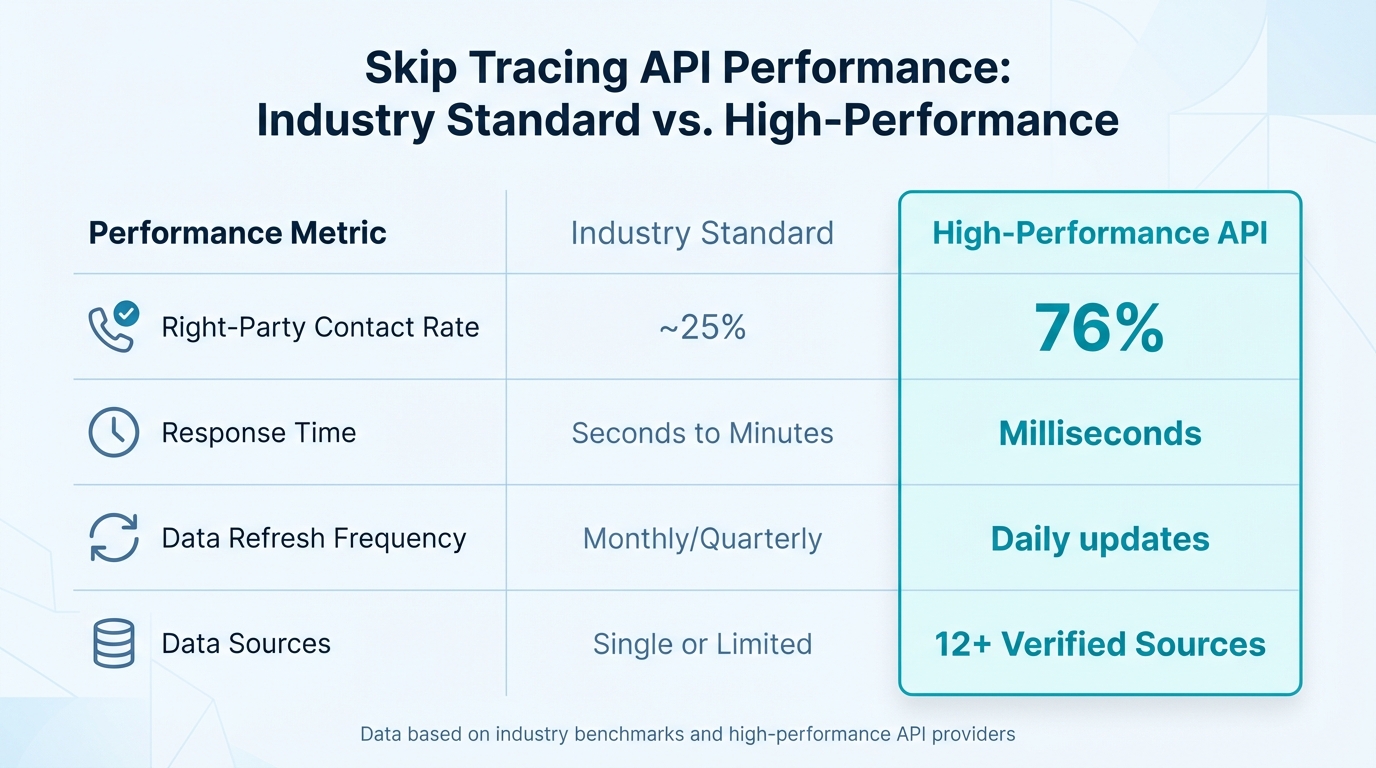
Real-Time Skip Tracing API Performance Metrics Comparison
When you’re evaluating a real-time skip tracing API, it’s essential to go beyond just checking its features. Instead, focus on the performance metrics that directly influence your results. The right API can save you time by reducing unverified leads and helping you connect with actual property owners. Two key aspects to consider are the accuracy of the contact data it provides and how reliably it delivers that data when you need it.
Match Rates and Data Coverage
Match rate is a critical metric – it shows the percentage of records the API successfully enriches with accurate contact details. The best APIs boast match rates as high as 75%–90%, along with a 76% right-party contact (RPC) rate. That RPC rate is especially important because it measures how often the phone number actually belongs to the property owner, rather than a relative or an outdated contact.
Data coverage is another area you can’t overlook. A strong API should return multiple phone numbers (clearly labeled as mobile or landline), valid email addresses, and up-to-date mailing addresses for each match. Some providers even deliver up to 8 phone numbers and 5 email addresses per record. Additionally, advanced features like LLC and trust unmasking – which identify the real decision-makers behind corporate entities – are invaluable, particularly in commercial and off-market real estate.
Top-performing APIs pull data from over 12 verified sources and refresh it daily to ensure the information stays current. They also benefit from real-time feedback from more than 20,000 users, which constantly updates and validates contact records. When testing an API, make sure it can handle LLC-owned properties effectively, providing individual owner names and mobile numbers instead of just the registered agent’s address.
These metrics are the foundation for assessing an API’s reliability and efficiency.
API Uptime and Latency
Beyond match rates, speed and uptime are crucial. A high-performance API should deliver data in milliseconds – not seconds or minutes. This speed is vital when you’re enriching leads as they enter your CRM or processing thousands of records for automated campaigns. Millisecond response times ensure smooth bulk processing and seamless integration with customer-facing applications.
Equally important is uptime. Look for providers that offer Enterprise Service Level Agreements (SLAs) to guarantee consistent availability. Unreliable APIs can lead to downtime in your lead generation system, costing you opportunities while competitors act faster. A reliable infrastructure that supports both single lookups and bulk operations is essential for scaling your business.
| Performance Metric | Industry Standard | High-Performance API |
|---|---|---|
| Right-Party Contact Rate | ~25% | 76% |
| Response Time | Seconds to Minutes | Milliseconds |
| Data Refresh Frequency | Monthly/Quarterly | Daily updates |
| Data Sources | Single or Limited | 12+ Verified Sources |
Compliance and Legal Considerations
Legal compliance is a cornerstone of dependable API performance, especially in the realm of skip tracing for real estate. The Telephone Consumer Protection Act (TCPA) governs the use of automated calls, text messages, and AI voice agents, setting strict rules for outreach. Real estate professionals must also adhere to the National Do Not Call Registry and maintain their own internal “Do Not Call” (DNC) lists to honor opt-out requests. Even outreach for property acquisitions is considered “marketing or solicitation” under these regulations. These rules form the foundation for the operational practices discussed below.
“Most TCPA problems don’t come from investors trying to do something shady. They come from investors trying to do something fast.” – Pathwaize
Consent plays a critical role here. You must obtain clear, specific, timestamped, and revocable consent before contacting anyone. When purchasing leads, insist on proof of consent – this includes what the consumer agreed to, when they opted in, and whether they consented to automated communication. Be aware that some states enforce stricter “mini-TCPA” laws, which may include additional restrictions on calling hours and mandatory disclosures. Advanced APIs can help mitigate risks by offering Litigator Scrubs, which identify known TCPA litigators and professional plaintiffs, reducing your exposure to legal complications.
DNC and TCPA Compliance
Operational precision is key to staying compliant. If a contact opts out by saying “stop”, their number must be suppressed across all workflows, teams, and future lists. Ensure your system accounts for local time zones so calls and texts are sent only during permitted hours. Your CRM should maintain a detailed timeline, including consent records, contact history, and opt-out events, to defend against potential allegations.
“If you can’t prove how you got permission to contact a number, you’re relying on hope.” – Pathwaize
Real-time phone validation is another critical step, as TCPA rules for mobile numbers are generally stricter than for landlines. APIs that identify disconnected numbers and distinguish between line types can help you avoid compliance issues. Regular weekly audits of your outreach operations can catch any system failures or compliance oversights before they escalate into costly legal problems.
Data Privacy and Security Standards
Beyond TCPA and DNC compliance, data privacy is equally important. Leading skip tracing APIs comply with the California Consumer Privacy Act (CCPA) and other state-level privacy laws in states like Colorado, Connecticut, Oregon, Utah, Texas, and Virginia. These systems are designed to handle requests for data access, correction, and deletion, empowering individuals to manage their personal information.
“We follow generally accepted industry standards to protect the information submitted to us, both during transmission and once we receive it. We employ reasonable administrative, technical, and physical safeguards to protect the PII we collect.” – BatchData
Providers utilize robust encryption methods and notify users of any data breaches. The best APIs also employ automated enrichment to keep contact data accurate and up-to-date, reducing the chances of contacting the wrong individuals. This approach helps top platforms maintain a 76% right-party contact rate – nearly three times the industry average.
Pricing and Cost Structures
When it comes to skip tracing APIs, real estate professionals typically choose between pay-as-you-go and subscription plans. Pay-as-you-go pricing can be useful for businesses with occasional or variable workloads, while subscription plans are generally better suited to teams processing consistent, higher volumes of records.
The right pricing model depends on factors such as lead volume, billing method, included usage, data quality, and any additional features or services required. Before choosing a plan, compare the provider’s pricing structure with your expected usage to understand the potential cost per usable contact.
Because pricing, plan limits, and available options can change over time, check the provider’s official pricing page for the latest rates and plan details. This helps ensure your budget is based on current information rather than outdated pricing.
Pay-As-You-Go vs. Custom Solutions
The flexibility of skip tracing APIs extends to their pricing structures. Pay-as-you-go plans can be a practical option for businesses with variable or occasional workloads, allowing them to align costs with their usage. For businesses requiring higher volumes, additional features, or more advanced support, subscription and custom enterprise solutions may provide a better fit.
Enterprise-level solutions can include features such as tailored integrations, service-level agreements (SLAs), dedicated account management, and support for high-volume workflows, depending on the provider and plan. These options allow businesses to scale their skip tracing operations while choosing a pricing structure that matches their data volume and technical requirements.
Because pricing models, plan limits, and included features can change, check the provider’s official pricing page for the latest rates and available options before making a purchasing decision.
Factors Impacting Total Cost of Ownership
The overall cost of using a skip tracing API goes beyond the base subscription fee. Data accuracy and match quality play an important role in reducing wasted outreach caused by disconnected numbers, outdated information, or incorrect contacts.
Additional datasets and features, such as contact enrichment, demographic information, property valuations, and other data add-ons, can also increase the total cost. When comparing providers, consider which features are included in the base plan and which require additional fees.
Compliance-related capabilities, such as Do Not Call (DNC) screening and litigator scrubbing, may also be valuable when evaluating a provider. Other advanced features, such as phone validation and entity-resolution tools, can help businesses identify and prioritize more relevant contacts.
For teams with consistent monthly lead volumes, developer-friendly documentation, testing environments, and straightforward integrations can help reduce implementation and maintenance costs. It is also important to consider the cost of pursuing low-quality or uncontactable leads. Providers that deliver reliable, timely results and strong validation capabilities can help reduce these inefficiencies and improve the overall return on your investment.
Pricing, add-on costs, and included features can change over time, so check the provider’s official pricing page for the latest information before estimating total costs.
Conclusion: How Real-Time Skip Tracing APIs Benefit Real Estate Professionals
Real-time skip tracing APIs have reshaped the way real estate professionals approach their work by offering unmatched speed, precision, and legal safeguards. Instead of spending hours combing through public records, investors and agents can simply upload property lists and receive verified contact details in just milliseconds. This rapid access allows for immediate engagement with motivated sellers, absentee owners, and probate heirs, helping to close deals faster and uncover off-market opportunities. With hit rates ranging from 70–90% and confidence scores to rank leads, these tools minimize wasted outreach and connect professionals with the right decision-makers.
Beyond accuracy, these APIs also prioritize compliance. Features like automatic scrubbing against the DNC registry and TCPA litigator lists mitigate legal risks before a single call is made. Advanced functions, including unmasking LLCs and trusts, further enhance efficiency by bypassing intermediaries and linking directly to the individuals behind corporate entities.
For professionals handling large volumes of leads – whether it’s wholesalers tracking pre-foreclosures or agents targeting distressed properties – integrating APIs into CRMs and property platforms streamlines workflows. By eliminating manual data entry, this automation not only saves time but also scales operations without increasing staffing needs, ultimately driving higher ROI.
BatchData offers a tailored solution for real estate professionals, combining property search, contact enrichment, and phone verification into a single platform. With a 76% right-party contact rate – roughly three times the industry average – achieved through daily data updates and multi-source verification, BatchData ensures both reliability and compliance. Flexible pay-as-you-go options and enterprise solutions make it easy to start small or scale up to millions of monthly skip traces, all while maintaining the standards your business demands.
FAQs
How do I test skip tracing accuracy on my own leads?
To check how accurate your skip tracing is, begin by making sure your lead data is clean and up-to-date. This includes verifying property details and owner information. Leverage advanced tools, like skip tracing APIs, to confirm contact details and eliminate invalid entries. Keep an eye on important metrics like right-party contact (RPC) rates, and measure your performance against industry standards. Updating your data sources regularly and automating validation processes can help you maintain strong accuracy over time.
What’s the safest way to stay TCPA/DNC compliant when calling or texting owners?
To stay on the safe side, always prioritize explicit consent, respect do-not-call lists, and rely on verified, up-to-date contact information. This approach minimizes the chances of contacting the wrong party and reduces legal risks. Incorporating real-time skip tracing APIs can also improve the accuracy of your data and ensure compliance, making your outreach efforts more effective and reducing potential liabilities.
How hard is it to connect a skip tracing API to my CRM?
Connecting a skip tracing API to your CRM can be a simple process, especially when using platforms like BatchData that provide thorough support. The setup usually includes configuring API triggers, aligning data fields, and streamlining workflows through automation. While you might need to handle some technical steps, BatchData offers helpful resources and guidance to make the integration process easier, even for those without extensive technical knowledge.