





































SEO Title: What Is Point of Interest for Real Estate Data
Meta Description: Learn what POI means in proptech, how POI data is validated, and how teams use it in valuation, underwriting, and market analysis.
Meta Keywords: what is point of interest, POI data, proptech data, real estate analytics, geospatial analysis, underwriting data, location intelligence, property valuation
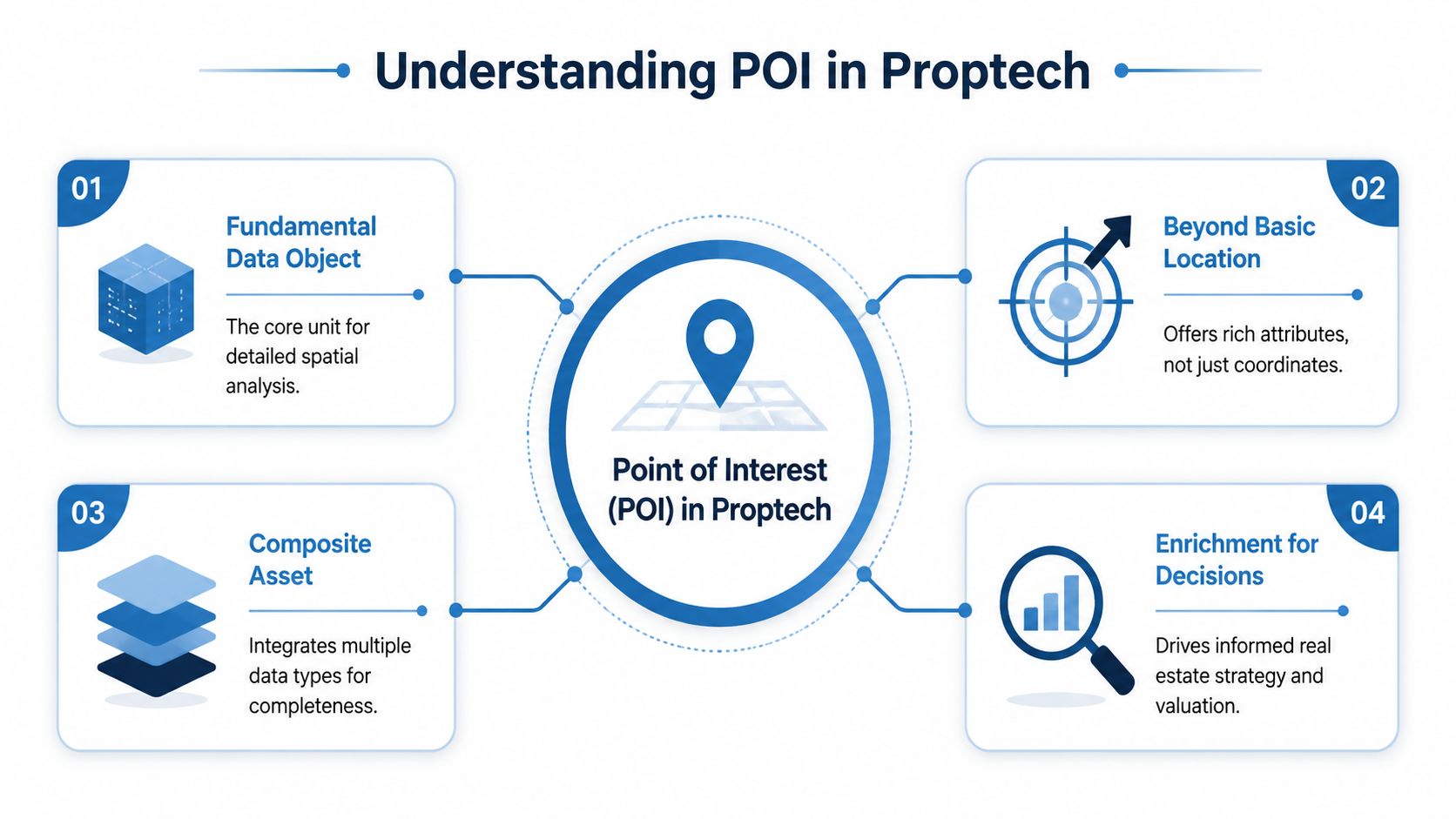
A point of interest is a geocoded data record for a specific, useful location, built from coordinates plus attributes such as name and category. In real estate analytics, that matters because a POI isn't just a map pin. It becomes an input for routing, proximity search, filtering, spatial analytics, valuation context, and risk modeling.
Most real estate teams underrate POI data because they treat it like an amenity checklist. That's a mistake. A hospital, grocery store, station, school, or shopping center only becomes operationally useful when the place is stored as structured, machine-readable data and kept current enough to trust in production.
If you're a product manager or engineering lead, the real question isn't just what is point of interest. It's whether your team is using consumer-grade location hints or investment-grade location data.
Key takeaways
- POIs are data objects: They combine coordinates, names, categories, and optional attributes into something software can query and score.
- Quality matters more than coverage: Broad POI coverage without validation introduces stale records and category noise.
- Real estate use is different from consumer maps: Finance workflows need evidence of freshness, validation logic, and closure handling.
- Spatial value comes from analysis: Radius counts, drive-time, and category weighting turn raw places into decision signals.
- Implementation is a data-engineering problem: Matching properties, normalizing categories, and managing update cadence matter as much as the source itself.
- Data access architecture matters: Teams building multi-source location products often also need unified data access for founders so POI, parcel, ownership, and model outputs don't live in isolated systems.
Introduction
A POI becomes valuable in proptech when it stops being a label and starts behaving like a decision-grade record.
That distinction sounds small. It isn't. A map app can tolerate a wrong category or a slow update on a nearby business. A lender, insurer, or investor often can't. The same location signal that feels cosmetic in a consumer interface can change how a team interprets neighborhood utility, access, or risk.
In practice, POI data sits between raw geography and business judgment. It helps teams ask operational questions such as:
- Access questions: How close is the property to transit, healthcare, food, or retail?
- Context questions: What kind of commercial and civic environment surrounds the parcel?
- Comparability questions: Do two similar homes sit in meaningfully different location ecosystems?
- Monitoring questions: Has the surrounding place mix changed enough to affect demand or underwriting assumptions?
Practical rule: If your model uses nearby places, you need to know not only what the place is, but how the record was sourced, categorized, and refreshed.
That's where most “what is point of interest” guides stop too early. They define the term, show examples like restaurants or landmarks, and move on. For proptech, that's only the first layer.
The useful distinction is this:
| POI view | What it means | Why it matters in real estate |
|---|---|---|
| Map view | A visible place on a map | Good for user discovery |
| Data view | A structured record with coordinates and attributes | Needed for analytics and automation |
| Model view | A scored spatial signal tied to a property | Used in valuation, underwriting, and monitoring |
Consumer products optimize for convenience. Real estate financial systems optimize for consistency, traceability, and fit for purpose. Those are not the same thing.
What Exactly Is a Point of Interest for Proptech?
A point of interest in proptech is a geocoded feature record representing a real-world location that software can query, compare, and analyze.
According to the Wikipedia definition of a point of interest, a POI is not just a name on a map. It typically includes latitude and longitude, a human-readable name or description, category metadata, and sometimes optional attributes such as phone number or altitude. Those coordinates anchor routing, proximity search, and map rendering. The category system makes the POI machine-queryable for filtering and spatial analytics.
A POI is a record, not a place
A grocery store exists in the physical world. A POI exists in your data stack as the digital representation of that store.
That representation is what your systems work with. Your database doesn't reason over “the coffee shop on the corner.” It reasons over a record with geometry, taxonomy, identifiers, and attributes.
A useful mental model is a digital business card for a location.
Typical fields include:
- Coordinates: Latitude and longitude are the spatial anchor.
- Name: The human-readable label.
- Category: Restaurant, hospital, school, gas station, transit stop, public library, and so on.
- Attributes: Address, phone, hours, brand, or related metadata when available.
Why the category matters more than most teams think
Coordinates alone tell you where. Categories tell you what kind of utility the location represents.
That's the difference between a map layer and an analytics layer. If your product can't distinguish a supermarket from a convenience store, or a hospital from a clinic, you'll inject noise into every downstream feature that relies on “proximity to essentials.”
This is where taxonomy design starts to matter. Many teams pull in POI records and assume source categories are ready to use. They usually aren't. You'll need a normalization layer so your product can answer business questions consistently.
Examples of category use in proptech include:
- Filtering properties near healthcare
- Scoring access to daily-needs retail
- Identifying transit-oriented inventory
- Comparing submarkets by amenity mix
If you want to see how geospatial context feeds broader property analysis, this write-up on how geospatial mapping tracks property trends is a useful companion.
A POI only becomes valuable when its category system matches the decision you're trying to make.
What works and what doesn't
What works
- A controlled category schema
- Stable identifiers where possible
- Property-to-POI joins based on validated geocodes
- Attribute storage that preserves source lineage
What doesn't
- Treating every nearby place as equally relevant
- Mixing source taxonomies without normalization
- Using POIs as presentation-only data when the product depends on them analytically
For proptech, a POI is the smallest useful unit of location intelligence. Once you frame it that way, implementation decisions get sharper.
How Is POI Data Sourced and Validated?
High-quality POI data is usually assembled from multiple acquisition and validation channels, not a single feed. The Intetics guide to POI data for business notes that providers commonly combine government directories, web sources such as Google Maps, user-generated location data, manual research, and even field-agent checks. It also makes the trade-off explicit: broader source diversity improves coverage, but without active verification it increases stale or inconsistent attributes that can degrade downstream models.
Why single-source POI data usually fails in production
A single source rarely gives you all three of the things that matter at once:
- Coverage
- Freshness
- Consistency
Government directories may be authoritative for certain civic locations but incomplete for commercial businesses. Web-sourced directories may have broad coverage but uneven closure detection. User-generated edits can surface changes quickly, but they can also introduce noise. Manual verification improves trust but increases operational cost and latency.
That's why serious POI datasets are composite assets.
Consumer-grade versus investment-grade POI data
This distinction is where real estate teams should get more demanding.
| Data type | Strength | Weakness | Suitable use |
|---|---|---|---|
| Consumer-grade POI data | Broad discovery and UI convenience | Inconsistent freshness, weaker validation trail | Search interfaces, nearby discovery |
| Investment-grade POI data | Validation workflow, category control, update discipline | More implementation work, narrower acceptance criteria | Underwriting, AVMs, insurance, monitoring |
| Hybrid POI stack | Better balance of coverage and control | Requires governance and reconciliation logic | Product platforms serving multiple workflows |
A product team can ship a “nearby places” widget with consumer-grade data. That same dataset may be unsafe for a feature that influences pricing, portfolio surveillance, or underwriting.
Operational test: Ask whether your team can explain how a closed, relocated, duplicated, or recategorized POI gets detected and resolved.
If the answer is vague, your model inputs are weaker than they look.
Validation is a pipeline, not a one-time cleanup
POI quality decays because the world changes. Businesses open, close, move, rename, or change category. Hours change. Brands reflag locations. Facilities merge.
A practical validation pipeline usually includes:
- Source reconciliation: Compare records across feeds and resolve conflicts.
- Deduplication: Collapse records that refer to the same physical place.
- Category normalization: Map source-specific labels into a controlled taxonomy.
- Freshness checks: Flag records that haven't been revalidated recently.
- Exception review: Route uncertain records for manual research.
What doesn't work is loading a POI file into a warehouse and treating it like parcel geometry or ZIP boundaries. POIs are living records.
Why this matters for financial modeling
A bad POI record doesn't stay isolated. It propagates into feature engineering, property scoring, and business decisions.
In real estate finance, the important question isn't whether a POI exists. It's whether the record is reliable enough for the model feature it powers. A weak retail category may be harmless in a browse experience. A weak healthcare proximity feature can distort a risk signal.
That's the practical line between consumer-grade and investment-grade POI data. One is built to inform a user. The other has to survive audit questions from product, analytics, and operations.
How Do POIs Help Measure Location Value?
POIs help measure location value by turning the surrounding built environment into quantifiable spatial signals.
The big shift came when POIs moved from simple map labels to structured records used in consumer apps, enterprise analytics, and location search. The Placer.ai guide to POI data describes that change as the digitization of place into coordinates plus attributes, which made POI data scalable for drive-time analysis and nearby-search ranking across industries. That same shift is what makes POIs useful in property analytics.

Radius counts are the blunt instrument
The simplest method is counting POIs within a defined distance from a property.
Examples:
- Schools within a set radius
- Grocery options near a residential parcel
- Healthcare facilities in the surrounding trade area
This method is easy to implement and useful for broad screening. It also breaks down fast when distance is measured as a straight line and the road network doesn't support direct access.
A river, highway barrier, rail line, or limited street grid can make “close” functionally far away.
Drive-time and walk-time are closer to lived reality
Network analysis improves on raw distance by measuring how long it takes to reach a POI through actual streets, paths, or transit networks.
That's often the more meaningful feature. A property with fewer total POIs may still outperform another if essential services are easier to reach in practical travel time.
Teams building valuation or neighborhood quality features often combine:
- Drive-time to daily-needs retail
- Walk-time to transit
- Access time to hospitals or schools
If you're working with AVM features, this overview of how geospatial analysis enhances automated valuation models connects the spatial methods to model design.
Category weighting is where strategy enters
Not every POI contributes the same value signal.
A multifamily operator may care more about transit and grocery access. A senior housing analyst may prioritize healthcare-related categories. An insurer may care about emergency services, infrastructure access, or specific nearby land uses. An investor evaluating neighborhood resilience may treat civic institutions differently from discretionary retail.
Don't score POIs as if they're interchangeable. The category framework should reflect the asset type and the business decision.
A practical weighted approach asks:
- Which categories matter for this use case
- How should access be measured
- Which nearby places are positive, neutral, or potentially adverse
- How should the final score behave across different submarkets
What works in practice
The best location value models usually don't rely on one metric. They combine several layers:
| Metric | Best use | Main limitation |
|---|---|---|
| Radius count | Fast screening across large inventories | Overstates real accessibility |
| Drive-time | Operational access analysis | Requires network computation |
| Walk-time | Urban residential context | Sensitive to path and network quality |
| Category-weighted score | Decision-specific ranking | Depends on disciplined taxonomy |
POIs don't assign value by themselves. They provide structured evidence about the environment around a parcel. The model, scoring logic, and use case determine whether that evidence becomes signal or noise.
What Are the Key Use Cases in Real Estate and Proptech?
POI data matters in real estate because nearby place relevance can directly affect valuation and risk assessment. The Smappen discussion of points of interest highlights a hard truth that many teams gloss over: for mortgage lenders, insurers, and investors, a nearby POI that's outdated by 6 months can create underwriting errors. It also notes that public industry standards for POI accuracy in financial services remain undocumented, which leaves a real blind spot for teams trying to use location features responsibly.
Underwriting and valuation
A lender building neighborhood context into underwriting doesn't need a pretty nearby map. It needs a defensible signal.
Suppose a model uses hospital access as a proxy for service availability or neighborhood utility. If the hospital record is stale, mislocated, or refers to a smaller facility under the same umbrella, the property feature is wrong before the model even runs.
That's why underwriting teams should separate:
- Display POIs used for borrower or analyst interfaces
- Model POIs approved for production features
The second group needs tighter controls.
Site selection and market analysis
A developer or retail operator looks at POIs as a competitive and demand map.
The question isn't “what's nearby?” It's “what ecosystem already exists here, and what's missing?” A cluster of fitness, grocery, and transit POIs can support one thesis. A thin amenity mix with strong civic anchors can support another. The work is interpretive, but the input still has to be structured.
POI data gains utility when paired with parcel, transaction, and neighborhood context. For broader market workflows, real estate data analytics gives the surrounding stack that POI data usually plugs into.
Targeted marketing
Marketing teams often misuse POIs by targeting too loosely.
A better pattern is to define an actual audience condition. For example, properties near a newly relevant retail corridor, transit station, medical cluster, or school ecosystem. The POI isn't the audience. It's the spatial filter that helps define one.
This works well when campaigns depend on place-based relevance. It fails when the team assumes every nearby POI creates the same consumer intent.
Teams get better results when they use POIs to narrow context, not to replace actual audience logic.
Portfolio monitoring
This is one of the most underused applications.
Asset managers can watch the POI environment around owned properties for signs that the submarket is changing. New openings may indicate commercial activation. Closures or category drift may suggest deterioration, repositioning, or a shift in neighborhood demand patterns.
The value here isn't prediction by itself. It's earlier detection of environmental change around a portfolio.
What most teams miss
The highest-value use cases aren't powered by “all nearby places.” They're powered by a specific subset of trusted categories matched to a real business question.
That's the line between an attractive feature and a useful one.
How Should Teams Implement POI Data Integration?
Teams should implement POI data integration as a repeatable spatial data product, not a one-off enrichment job.
The fastest way to create bad location features is to pull POIs into a warehouse, join them loosely to properties, and never revisit the taxonomy or update process. That approach looks efficient early on. It creates cleanup work later in the product, model, and analytics layers.
Start with the data model
Store POIs as first-class entities.
At minimum, your schema should preserve:
- Stable record identifiers
- Geometry fields or coordinates
- Normalized category
- Source category
- Core descriptive attributes
- Freshness or update metadata
- Source lineage
Then model the property-to-POI relationship explicitly. Don't hardcode proximity assumptions into application logic if you expect to support multiple use cases. A valuation model, a search experience, and a portfolio dashboard may all need different spatial relationships to the same POI set.
Normalize before you score
Most implementation problems show up in taxonomy and matching, not in storage.
A practical sequence looks like this:
- Geocode the property accurately
- Ingest POI records with raw source categories intact
- Map source categories into a controlled internal taxonomy
- Calculate spatial relationships such as distance, drive-time, or nearest-neighbor
- Generate use-case-specific features
This is also where teams should decide whether to compute features on demand or precompute them.
Choose the right integration pattern
| Integration Pattern | Best For | Latency | Example Use Case |
|---|---|---|---|
| Real-time API queries | Product experiences that need current nearby context | Low at request time, dependent on API performance | Property detail pages showing nearby amenities |
| Scheduled batch enrichment | Analytics workflows and recurring feature generation | Higher, based on batch cadence | Weekly portfolio scoring by POI access |
| Bulk delivery to warehouse or lakehouse | Model training and enterprise analytics | Depends on internal pipelines | Joining POI data to large property universes |
| Hybrid approach | Teams serving both product and modeling needs | Mixed | Precomputed core features plus live UI lookups |
Match the implementation to the decision
Use real-time queries when the product needs current context in an interface. Use bulk delivery when data science or underwriting teams need consistent training and scoring inputs at scale.
For example, a platform may keep normalized POI data in Snowflake or flat files for feature engineering while also supporting on-demand UI calls for nearby search. BatchData, for example, provides property data through APIs and bulk delivery options such as S3, Snowflake, and flat files, which is the kind of delivery pattern teams often want when combining property context with geospatial features.
Sample query logic
The actual syntax depends on your stack, but the pattern is straightforward.
Example request shape
- Target record: Property centroid or parcel geometry
- POI filter: Category = supermarket
- Access rule: Within a defined drive-time threshold
- Output: Matching POIs plus nearest-access feature for the property
Pseudo workflow
- Reverse geocode or confirm the property coordinates.
- Filter POIs to the normalized category set.
- Run network analysis from the property to candidate POIs.
- Return nearest match, count within threshold, and any confidence metadata.
That's enough to support a product feature or generate a model input without exposing raw category chaos to the application layer.
Operational safeguards
A POI integration should also define rules for:
- Update cadence: How often records are refreshed or revalidated
- Backfills: How historical features are recalculated when categories or records change
- Versioning: How model features map to specific POI snapshots
- Privacy boundaries: What happens when POI data is combined with mobility, owner, or contact data
Implementation advice: If a POI feature affects pricing, risk, or automated decisions, version the source snapshot and the category mapping used to create it.
Without that, debugging becomes guesswork.
The teams that do this well treat POI data like any other important production dataset. It gets lineage, QA, taxonomy governance, and an owner.
If your team needs property data infrastructure to support geospatial features, BatchData is one option to evaluate. It provides large-scale U.S. property records, APIs, and bulk delivery formats that can sit alongside POI enrichment workflows for underwriting, monitoring, and analytics.