



You've launched a property lookup job, the workers are running in parallel, and then the API starts returning HTTP 429 Too Many Requests instead of records. API rate limiting is the server-side control that caps how many requests a client can send during a defined period.
It protects shared databases, prevents one customer from consuming the entire platform's capacity, and gives the provider a predictable way to manage infrastructure and downstream costs. For developers, the practical challenge is balancing interactive traffic, bulk enrichment, retries, and worker concurrency without turning a temporary quota response into a failed batch.
- Definition: A limit on requests from a client within a time window.
- Signal: Usually HTTP 429, potentially with
Retry-After. - Mechanics: A client identity, counting rule, threshold, and enforcement response.
- Client responsibility: Read headers, queue work, back off, and avoid retry storms.
- Design choice: Fixed window, sliding window, token bucket, and leaky bucket each handle bursts differently.
What API Rate Limiting Means
You start a BatchData property lookup with several workers running in parallel. The first records return normally, then new requests receive HTTP 429 Too Many Requests. Your code may be valid and your credentials correct. The provider is telling you that your client has exceeded an allowed request rate.
API rate limiting is a server-side cap on requests a client can send during a period. The server identifies the caller, applies its counting policy, and accepts or rejects traffic near the configured threshold. 429 Too Many Requests is the standardized response for this condition, defined by RFC 6585.
Providers set these limits for practical reasons:
- Backend protection: Property searches, enrichment, and contact verification may query internal databases or third-party data sources. A limiter prevents a sudden flood from overwhelming those dependencies.
- Fair sharing: Multiple customers use the same platform. One customer's large job should not consume capacity needed by others.
- Predictable operations: A defined quota helps the provider plan infrastructure, resource use, and downstream service exposure.
The request pattern matters as much as the total count. A user opening one property record may create a short burst and then stop. A batch job processing an entire list can send requests continuously. Parallel workers increase the burst size, while scheduled imports create sustained traffic. Retries add load when they repeat calls that the provider has already declined.
Practical rule: Treat a rate limit as part of the API contract, not as an unexpected exception.
Rate limiting and throttling describe related controls, but they do not behave identically. A rate limiter commonly rejects excess requests with 429. A throttling system may slow them down or place them in a queue. A short delay may suit an interactive property screen, while a queue usually protects a bulk workflow better than repeatedly submitting rejected calls.
The server may count requests by IP address, user, API key, token, endpoint, organization, or another identity. The counting method can also differ between property lookups and batch operations. Do not assume that one credential maps to one universal quota. Check the provider's documentation and design workers around the stated limits.
How Rate Limiting Works Behind the Scenes
A developer integrating a data-heavy real estate API such as BatchData may send a quick burst of property lookups, then run a batch job that keeps workers active for much longer. The limiter evaluates both patterns through four questions: who sent the request, which time window applies, how much quota remains, and what happens after the threshold is crossed.
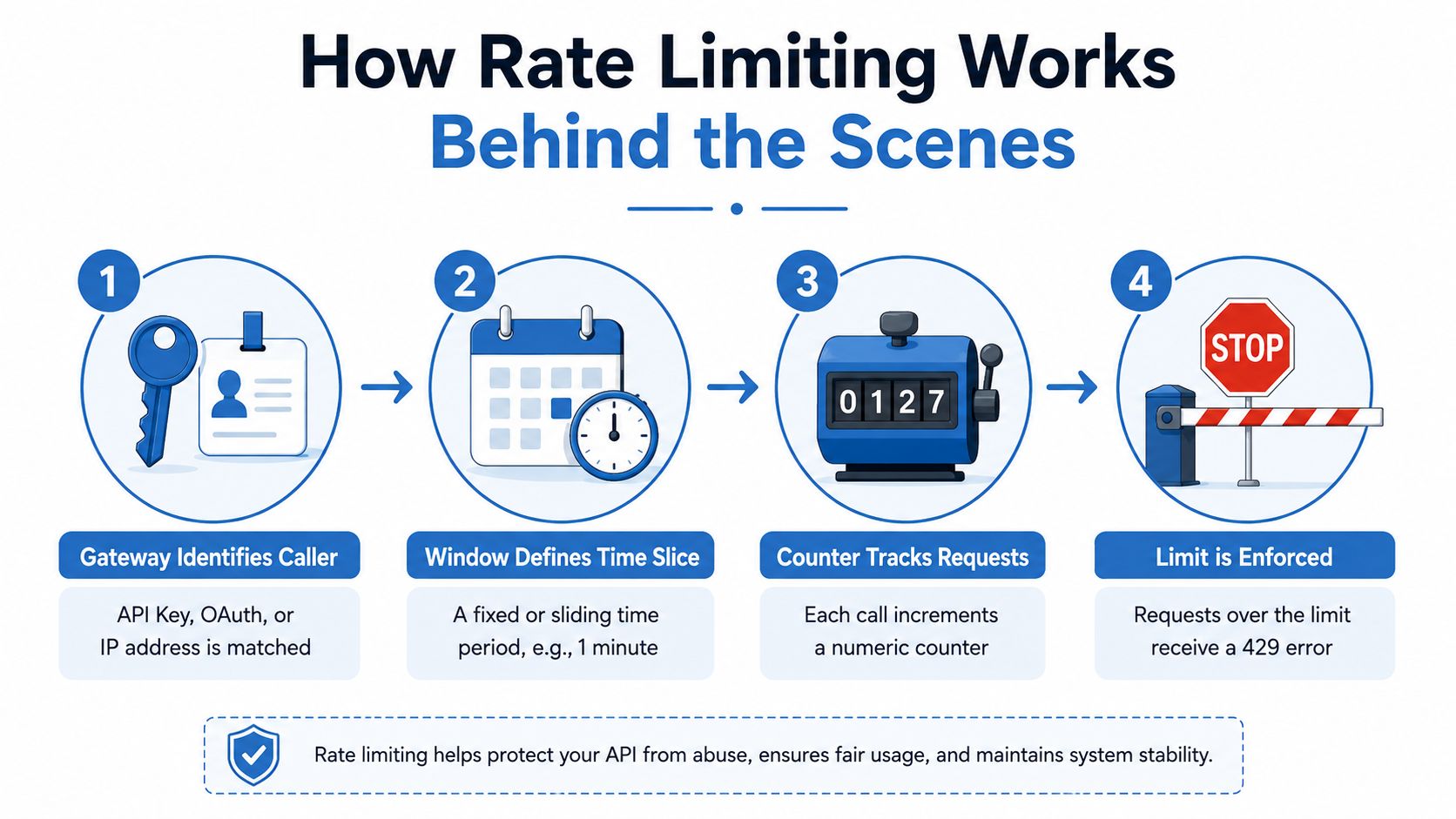
The four enforcement steps
Identify the caller. The gateway extracts an API key, OAuth client, user identity, or IP address. Authenticated property APIs usually provide a clearer identity than unauthenticated traffic, though a provider may apply several identities at once.
Select the window. The policy may use a fixed interval or rolling period. A fixed window resets at a defined boundary. A sliding window evaluates recent activity continuously.
Compare usage with the threshold. Suppose a policy permits 60 requests per minute per API key. The limiter increments a counter for each accepted request and compares the total with that allowance. This example explains the mechanism, not a universal quota.
Enforce the result. Requests within the allowance proceed. Excess requests commonly receive 429 Too Many Requests, with retry or reset guidance when the provider supplies it. The MDN reference for 429 explains that
Retry-Aftermay communicate a delay in seconds or an HTTP date.
A burst can therefore affect an interactive property screen differently from a sustained batch job. Parallel workers spend available capacity quickly, while a slower worker may remain under the limit for longer. The algorithm and quota shape determine which workflow gets delayed first.
Why distributed counters matter
Several API servers may handle the same customer. A counter stored inside one application process sees only traffic reaching that process. If a deployment scales from two pods to four and each pod keeps an independent counter, the effective admission capacity can rise unexpectedly.
A shared counter store, often an in-memory or cache-backed system, lets nodes decide against common state. It must respond quickly because the limiter runs on the request path. It also needs enough consistency that concurrent workers do not all observe the same remaining slot and admit too much traffic.
Clock differences create another boundary problem. If servers disagree about when a window begins or ends, requests may pass unevenly. Sliding-window and token-bucket implementations reduce some boundary effects, but distributed state still requires careful coordination.
The provider may count requests per IP, user, token, or another key. That flexibility, described by RFC 6585, explains why endpoints under one API can behave differently. A search route may consume a separate bucket from a record lookup, while a project or organization aggregates several credentials. Check the provider's rules before assigning workers to a batch job.
Comparing the Main Rate Limiting Algorithms
The right algorithm depends on the traffic shape you need to permit and the system you're protecting. Consider a real estate integration with steady property lookups during business hours, a large morning batch burst, and much lighter activity later in the day.
| Algorithm | Behavior | Burst Tolerance | Memory Cost | Best For |
|---|---|---|---|---|
| Fixed window | Counts requests until a fixed window resets | Weak at boundaries, because traffic can cluster around a reset | Low | Simple policies where boundary spikes are acceptable |
| Sliding window | Counts recent requests across a moving period | Better than fixed windows | Higher than a basic counter | Fairer public API enforcement |
| Token bucket | Refills tokens steadily and spends them per request | Configurable burst capacity | Low | Bursty workflows that need short spikes |
| Leaky bucket | Queues requests and releases them at a fixed rate | Smooths bursts rather than admitting them immediately | Medium | Protecting downstream systems that need steady output |
Fixed window
Fixed windows are easy to implement and explain. A counter increments during the active interval, then resets. The weakness appears at the boundary. A client can use its allowance near the end of one window and receive another allowance immediately after the reset, producing a short burst larger than the intended steady rate.
That behavior may be acceptable for a low-risk internal service. It's a poor fit when a data provider needs a strict traffic envelope or when a batch worker can deliberately synchronize calls around the reset.
Sliding window
A sliding window evaluates a moving slice of recent activity, so the counter doesn't suddenly become empty at a boundary. That improves fairness and reduces artificial bursts. The trade-off is implementation complexity and more state, especially when the system tracks individual request timestamps rather than compact counters.
For a public API with customers using different traffic patterns, the accuracy can justify that cost. It limits clients based on what they sent recently rather than on an arbitrary clock transition.
Token bucket
A token bucket separates average throughput from burst capacity. Tokens refill at a steady rate, and each request consumes one. An idle client can accumulate tokens and spend them during a short burst, then must settle into the refill pace.
That model fits property workflows where a morning import needs temporary capacity but the provider still wants to control sustained load. The bucket size determines how much burst the client can absorb, while the refill rate determines its long-term pace. More burst capacity isn't free. It can push pressure into the database unless the backend was designed for it.
Leaky bucket
A leaky bucket accepts requests into a queue and drains them at a fixed output rate. It protects a fragile downstream provider particularly well because the downstream sees smooth traffic. The cost is latency. Legitimate requests wait in line even when the upstream client is capable of sending them immediately.
Choose it when downstream stability matters more than immediate response time. Choose token bucket when your product can safely accept short bursts.
Reading 429 Responses and Rate Limit Headers
A 429 response means the server believes the client has exceeded a request limit, but the response headers tell you how to recover. RFC 6585 defines 429 for excessive requests in a period and recommends Retry-After; it also states that 429 responses must not be cached. Read the actual headers before deciding how long to wait.
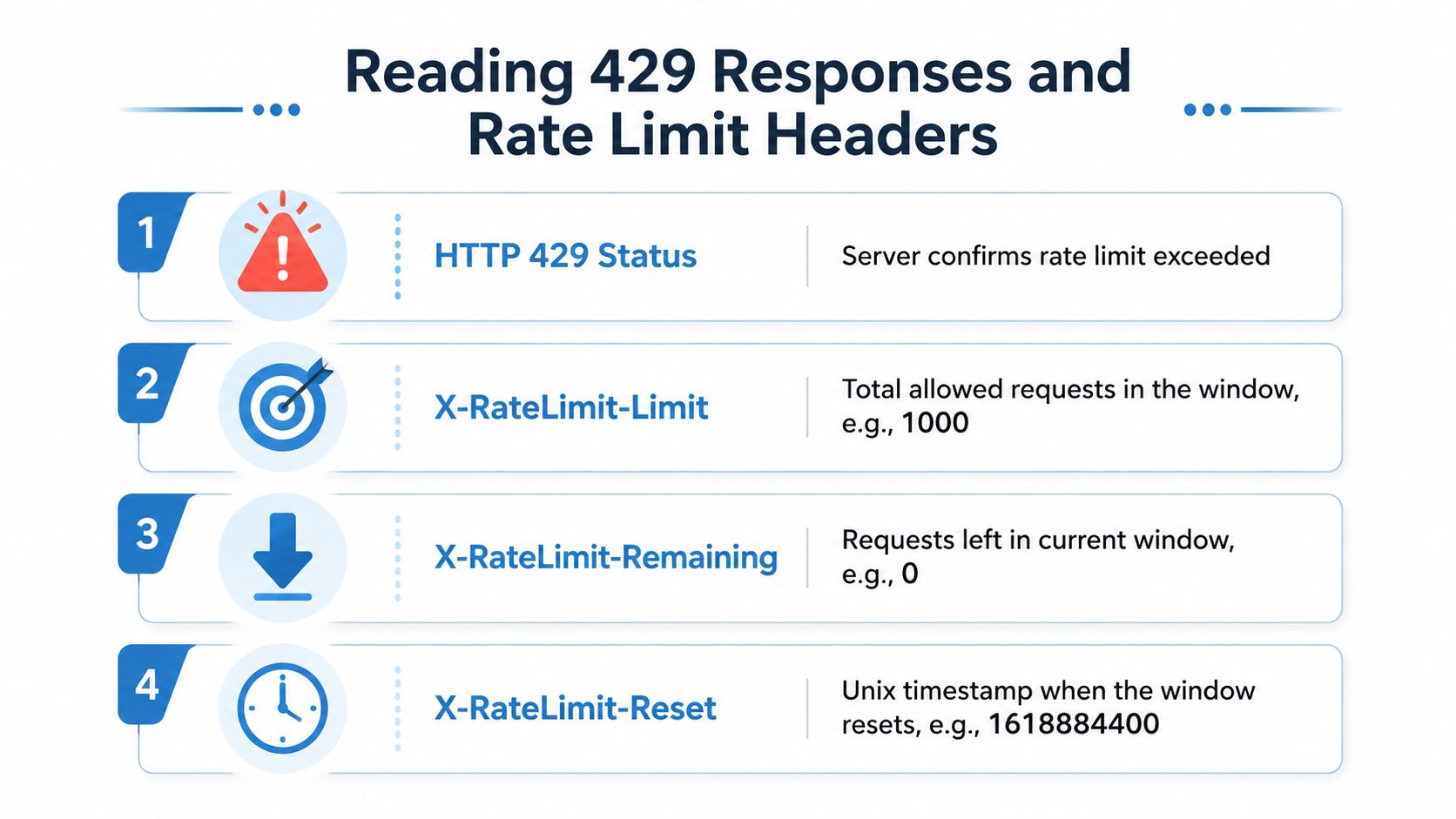
Many APIs expose the older X-RateLimit-* family:
X-RateLimit-Limit: The total allowance for the relevant window.X-RateLimit-Remaining: The requests still available.X-RateLimit-Reset: Often the time at which the window resets, commonly represented as a Unix timestamp.
The IETF RateLimit header draft defines machine-readable fields with similar roles. RateLimit-Limit communicates the quota, RateLimit-Remaining shows the balance, and RateLimit-Reset indicates the number of seconds until reset. A policy can also expose a quota and window through a named policy format, as described in this API rate-limit documentation.
Decode the response before retrying
Check these items in order:
- Status: Confirm that the server returned 429 rather than treating every client error as retryable.
- Retry instruction: Read
Retry-After. It may be a non-negative number of seconds or an absolute HTTP date, according to HTTP header guidance. - Remaining quota: Inspect
X-RateLimit-RemainingorRateLimit-Remainingwhen available. - Reset meaning: Determine whether the reset value is a timestamp or a delay.
- Scope: Check documentation and error details to learn whether the bucket applies to an endpoint, token, user, or organization.
- Body: Parse structured fields such as an error code, message, and retry value.
A BatchData-style response might look like this:
HTTP/1.1 429 Too Many Requests
Retry-After: 30
X-RateLimit-Remaining: 0
{"error":"rate_limit_exceeded","message":"Request quota exceeded","retry_after_seconds":30}
That payload is an illustrative shape, not a claimed BatchData response. Don't assume the number in Retry-After is a wall-clock timestamp. A value such as 30 is a delay, while an HTTP date requires date parsing.
Building Retry Logic That Works
A property lookup may succeed during testing, then hit throttling when a batch job releases thousands of records together. Retry logic must distinguish a temporary quota boundary from a request that will fail every time. Retry only when the server indicates that retrying can help. Repeating invalid input or an unauthorized call will not fix the cause.
A resilient client combines server guidance with controlled pacing:
- Honor server timing: Prefer
Retry-Afterover a locally guessed delay. - Use exponential backoff: Increase the delay after each successive 429.
- Add full jitter: Randomize the wait so multiple workers do not retry together.
- Cap the work: Limit attempts and record the failed item for later recovery.
- Protect unsafe operations: Use idempotency keys when repeating a request could create a duplicate effect.
- Open a circuit: Pause a worker group after consecutive 429 responses instead of letting every worker continue.
A simple control loop is:
- Send the request.
- If it succeeds, inspect remaining quota and reduce concurrency as the bucket approaches empty.
- If it returns 429, parse
Retry-After. If that header is absent, calculate an exponential delay with jitter. - Retry only while the attempt budget remains.
- If the budget is exhausted, place the record on a durable retry queue and alert on the batch result.
Retrying isn't recovery if every worker retries at the same time.
Preemptive pacing keeps a property lookup workflow below the provider's operating boundary. A local token bucket releases work gradually, while a queue stops a large input file from becoming a synchronized wave of requests. This matters most for sustained enrichment jobs, where repeated bursts can delay the entire batch.
Deduplication also preserves quota. If several application components request the same property during one processing cycle, coalesce those requests and share the result. Cache idempotent lookups according to the provider's freshness and caching rules, but do not cache 429 responses. RFC 6585 says that 429 responses must not be cached.
Aggressive retries can look faster in a small test. During a large BatchData-style enrichment batch, they produce rejection, delay, and repeated rejection. A slower worker pool that respects the quota usually completes more predictably and leaves fewer records in an ambiguous state.
Best Practices for BatchData API Integrations
For a real estate data integration, design the client around the provider's documented endpoint limits rather than around available CPU cores. Batch property lookups, skip tracing, contact verification, and enrichment have different cost and latency profiles, so one unrestricted worker pool is a weak design.
BatchData publishes API documentation and rate-limit guidance for its endpoints, including handling for HTTP 429 responses. Use the provider's current documentation as the source of truth for the limits attached to your plan and endpoint. The platform provides property records, valuations, owner contacts, and related real estate data through APIs and bulk delivery options, so an integration may need both request pacing and an offline delivery path.
A safer batch architecture
- Queue records first: Put property identifiers into durable work items before workers call the API. The queue gives you pause, resume, retry, and dead-letter behavior.
- Use a client-side token bucket: Set its refill rate from the documented quota, not from the number of application threads. Let the bucket absorb only the burst your workflow can safely tolerate.
- Separate workloads: Keep interactive property lookups from competing directly with bulk enrichment or skip-tracing jobs. Give each class its own queue or priority.
- Persist quota state: Store the last known reset guidance and worker state so a process restart doesn't immediately replay the same burst.
- Cache repeatable lookups: Reuse valid results for idempotent requests where the provider's freshness requirements allow it.
- Degrade deliberately: If limits tighten, reduce concurrency and continue at a slower rate rather than failing the entire batch.
A pre-flight request can validate authentication and endpoint availability, but it shouldn't be treated as a guaranteed capacity reservation. A HEAD check may not be supported or may not represent the cost of the eventual request. Control must remain in the queue and limiter that govern every call.
For a worker pool, calculate concurrency from observed response time and the permitted request rate, then enforce the lower of the two constraints. CPU availability doesn't grant more API quota. If the vendor offers bulk delivery through options such as S3, Snowflake, or flat files, evaluate that route for large recurring datasets instead of forcing every record through synchronous request traffic.
Batch integration checklist
- Confirm the quota scope for each endpoint and credential.
- Record every 429 with the request type and batch identifier.
- Parse
Retry-Afterand reset headers defensively. - Apply exponential backoff with jitter.
- Make retries idempotent and deduplicated.
- Pause workers through a circuit breaker after repeated 429 responses.
- Keep partial results and resume from the last successful item.
- Monitor remaining quota, queue depth, latency, and failed records.
Where Rate Limiting Is Heading Next
Static per-minute caps are becoming only one part of rate-limit design. Providers are moving toward adaptive thresholds, multi-dimensional controls, and anomaly detection that adjust enforcement to the request context. Tencent Cloud's overview of modern rate limiting describes limits based on dimensions such as user identity, IP, endpoint, and transaction type.
A hardcoded constant may suit a simple contract, yet it becomes brittle when property lookups, expensive searches, and bulk enrichment consume capacity differently. Organization and project-level quotas, including model-specific and long-context controls, show how policies can become more granular than one account-wide number.
What adaptive controls mean for data APIs
A future-ready integration should account for several layers:
- Multi-dimensional limits: One request may consume both an organization budget and an endpoint-specific allowance.
- Quota budgets: Usage may be allocated across related routes rather than tracked as one isolated counter per URL.
- Real-time adjustment: Available capacity may change with tenant tier, system health, traffic conditions, or observed behavior.
- Anomaly signals: Sudden parallel access can trigger extra controls even when a simple per-minute count appears acceptable.
- Richer client feedback: Gateways may expose policy metadata, allowing SDKs to reduce concurrency before rejection.
The benefit is fairer capacity sharing and stronger abuse prevention. The trade-off is less certainty for clients. A single permanent number cannot describe every property lookup or batch job, so integrations need dynamic configuration, queue-based work management, header parsing, and clear observability.
For a BatchData integration, confirm whether property lookup, skip tracing, bulk enrichment, and verification follow separate policies. Check whether the API reports remaining quota and reset guidance, and determine how enterprise capacity, dedicated infrastructure, and plan-level limits affect the contract. A burst that works for one property lookup may still overload a sustained enrichment job, so workers should adjust concurrency instead of assuming all requests cost the same.
BatchData provides real estate APIs and bulk delivery for property records, valuations, owner contacts, enrichment, and related workflows. Review its API capabilities and rate-limit guidance at BatchData, then base the integration on quota-aware workers, queues, and deliberate retry behavior.